
On this page
Start here
Quick answer
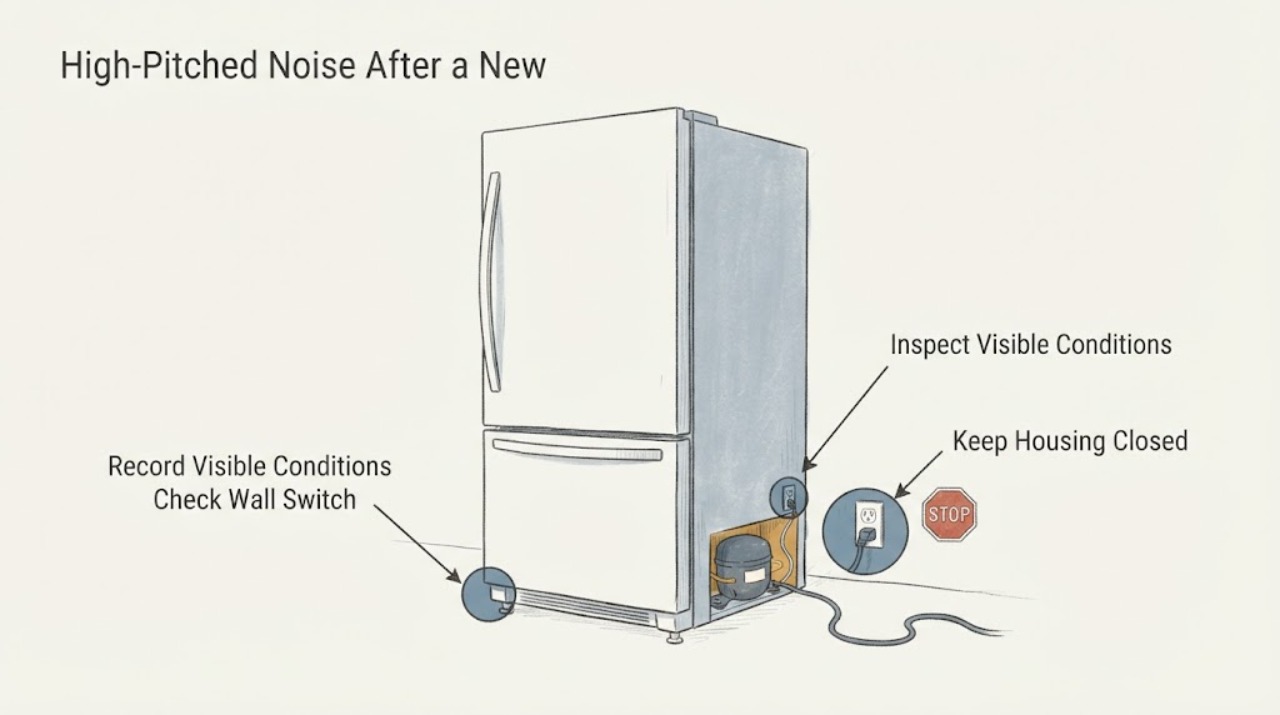
For a Thermador T30IR905SP that developed a high-pitched sound after installation, first document when the sound occurs and compare it with the model manual's listed operating sounds. The manual describes droning from a motor or fan, bubbling/buzzing/gurgling from refrigerant flow, clicking from switching, and cracking during automatic defrost; it does not identify every high-pitched sound as normal. Because this is a built-in column that may weigh up to 500 kg, do not pull it out or try to re-level it yourself. Have the installer verify the stable base, anti-tip installation, level, cabinet or panel contact, and any removable shelf/bin vibration. If the sound is persistent, harsh, newly worsening, accompanied by poor cooling or an alarm, or the installation cannot be safely checked, stop troubleshooting and arrange qualified Thermador service.
Work through in order
Diagnostic checks
Use only checks that match the exact appliance or system and its official guide.
-
Check 1
Confirm the rating-plate model is T30IR905SP and record the complete sound description: high or low pitch, steady or intermittent, where it seems loudest, when installation was completed, and whether the sound changes during cooling, fan operation, water/ice activity, or defrost. Also note any display warning, warm food compartment, leak, smoke, or burning odor.
Expected result: The model matches, the tone is repeatable, the sound is brief and function-linked, the sound is continuous or harsh, the model differs, or a cooling/electrical safety symptom is present.
Next step: Continue only for a confirmed T30IR905SP with no hazard. Photograph the rating plate and display; if the model is different, use its exact manual. If cooling is failing or an electrical/fire symptom is present, stop and arrange service.
Stop if: Stop immediately for smoke, burning odor, sparks, a hot or damaged cord, liquid near electrical parts, repeated breaker trips, or a cabinet/panel that is loose or unsafe.
Why this matters
Why: Thermador's support page provides model-specific documents for T30IR905SP variants, while the manual identifies the T30IR905SP family and separates normal operating sounds from faults. A different model or a safety symptom cannot be covered by this page.
-
Check 2
Compare the timing and character of the sound with the manual's listed normal events without touching internal parts: droning when a motor or fan runs, bubbling/buzzing/gurgling as refrigerant flows, clicking when motors or valves switch, and cracking during automatic defrost.
Expected result: The sound matches one of those brief function-linked patterns, is a sustained high-pitched tone not represented in the list, or cannot be tied to an appliance function.
Next step: Monitor only a brief, repeatable, function-linked sound while cooling remains normal. For a persistent or unexplained high-pitched tone, proceed to the installation-context check and plan service if it remains.
Stop if: Do not remove the rear cover, probe a fan, touch the compressor or tubing, or place hands near moving parts to identify the pitch.
Why this matters
Why: A function-linked sound may be normal operation, but the manual's list is not proof that a persistent high-pitched tone is normal. A tone that is new, continuous, worsening, or unrelated to a listed event remains unresolved.
-
Check 3
From outside the cabinet, look for a safe installation-related contact: a visibly vibrating custom panel, trim, adjacent cabinet, loose accessible object, or removable bin/shelf that wobbles or sticks. Do not pull, tilt, or slide the built-in refrigerator.
Expected result: A panel, trim, object, bin, or shelf visibly vibrates or contacts another surface, or all accessible external items are stable.
Next step: Remove only a loose accessible object or have the installer correct a removable bin/shelf. If a panel or cabinet contact is suspected, document it and ask the installer to inspect it; if nothing external explains the tone, arrange qualified service.
Stop if: Do not loosen the decorative panel, anti-tip bracket, hinges, trim, or fasteners, and do not move a heavy built-in column to test the sound.
Why this matters
Why: Thermador says an unlevel appliance and wobbling or sticking removable equipment can create noise. That makes a new-installation vibration plausible, but an external observation does not prove the refrigeration system is healthy.
-
Check 4
Ask the installer or qualified service technician to verify the installation-specific items in the manual: the base is stable, the built-in cut-out and side panels are secure, the anti-tip bracket is fitted, and the column is level. Provide the model, sound recording, and exact installation date rather than attempting these adjustments yourself.
Expected result: The installer confirms the base, anti-tip hardware, cabinet fit, and level are correct, an installation issue is found, or the installation cannot be verified without moving the appliance.
Next step: Have the installer correct only an identified installation issue. If the installation is confirmed sound and the tone continues, leave the refrigerator in place and arrange Thermador service for model-specific diagnosis.
Stop if: Do not attempt to re-level the column, remove the anti-tip hardware, pull it from the cut-out, or access energized or sealed components.
Why this matters
Why: The T30IR905SP is a heavy built-in appliance; an installation defect or vibration path can change the sound, but a high-pitched tone can also require refrigeration or fan diagnosis. These checks do not identify a replaceable part.
-
Check 5
Observe whether cooling, interior lighting, door operation, and the display remain normal while the sound is present. Record whether the tone changes with a cooling cycle or appears together with an alarm, temperature rise, or unusual compressor behavior; do not repeatedly power-cycle the refrigerator.
Expected result: Cooling and controls remain normal, the tone persists after installation checks, a warning or temperature problem appears, or the sound is accompanied by heat, odor, water, or electrical symptoms.
Next step: For a persistent high-pitched tone, failed cooling, warning, or abnormal operation, keep the unit in place and contact qualified Thermador service with the model, production details, sound recording, installation date, and observations. Stop immediately for a safety hazard.
Stop if: Do not continue operation with smoke, burning odor, exposed damage, water near electrics, repeated breaker trips, or severe overheating; do not make live tests or open covers.
Why this matters
Why: Normal cooling does not prove the noise source is harmless, while a noise plus a failed function raises the need for service. Thermador's manual directs owners to customer service when they cannot rectify a fault and asks for product and production information.
Use your observations
Decision map
Find the observation that best matches what you see, then follow the next safe action.
-
PATH 01Next step
What you see
The sound is brief, repeats only when the motor/fan or defrost operates, matches one of the manual's listed sound patterns, and cooling remains normal.
Do this next
Monitor without moving the built-in column. Arrange service if the pitch becomes continuous, harsher, louder, or is joined by a temperature or display problem.
Why this path and its safety boundary
Why it matters: The pattern is more consistent with a documented operating sound than with an immediately identified installation defect, although the manual does not classify every high-pitched tone as normal.
-
PATH 02Next step
What you see
The high-pitched sound began directly after installation and a cabinet, trim, custom panel, bin, or shelf visibly vibrates or contacts another surface.
Do this next
Document the contact and have the original installer or qualified service correct the accessible installation issue. Stop if the correction would require loosening structural or anti-tip hardware.
Why this path and its safety boundary
Why it matters: An installation or vibration path is more likely than a code-selected internal part, but the heavy built-in appliance should not be repositioned by the owner.
-
PATH 03Next step
What you see
The installation is confirmed stable and level, but the high-pitched tone persists or is unrelated to the normal function-linked sounds.
Do this next
Leave the column in place and arrange qualified Thermador service with the sound recording, model/production information, timing, and cooling observations. Do not order a component from the symptom alone.
Why this path and its safety boundary
Why it matters: The sound source remains unresolved and could involve a fan, compressor, control, or sealed-system condition; the sound alone cannot select a part.
-
PATH 04Next step
What you see
The noise occurs with poor cooling, an alarm, an abnormal display, smoke, burning odor, water near electrical parts, heat, or repeated breaker trips.
Do this next
Stop using the refrigerator and isolate power only if it is dry and safe to do so without touching damaged parts. Contact qualified appliance/electrical service; use emergency services for an active fire.
Why this path and its safety boundary
Why it matters: This is a service or immediate safety branch rather than a normal-noise observation.
Helpful context
Understand the symptom
A high-pitched noise immediately after installation deserves a different first check from an unexplained noise on an established refrigerator. Thermador's guide lists several normal operating sounds, but it does not say that every high-pitched tone is normal. The new-installation context makes cabinet contact, leveling, a stable base, and installation hardware important observations before anyone guesses at a fan or compressor part.
Keep the refrigerator in place and make only observations that do not expose wiring, the sealed refrigeration system, or a heavy built-in appliance to movement. Do not remove panels, reach into a fan area, loosen the anti-tip hardware, or use a live electrical test to locate the tone.
When checks do not resolve it
Need a professional?
Arrange qualified Thermador service if the high-pitched noise remains after the installer verifies level, stable support, anti-tip installation, and cabinet/panel contact; if the sound is persistent, harsh, or worsening; or if cooling, controls, or the display change. Stop immediately for smoke, burning odor, sparks, water near electrical parts, a hot/damaged cord, severe overheating, or repeated breaker trips. Do not move the built-in column, remove covers, loosen anti-tip hardware, access fans, open the sealed system, or make live electrical tests.
Common questions
FAQ
Is a high-pitched sound normal on a Thermador T30IR905SP after installation?
The opened T30IR905SP guide lists droning, bubbling/buzzing/gurgling, clicking, and cracking as normal operating sounds, but it does not classify every high-pitched tone as normal. Compare the timing with those events and have the installer or qualified service check installation vibration if the tone persists.
Can I pull out or re-level the T30IR905SP to stop the noise?
Do not do that yourself. Thermador's guide says the appliance may weigh up to 500 kg and requires a stable base and anti-tip installation. Ask the installer or qualified service to verify level and cabinet fit without the owner moving the column.
Should I replace a fan or compressor because the T30IR905SP is high-pitched?
No. A sound does not identify a part. First record the timing, check only safe external installation conditions, and use Thermador service if the tone persists or cooling changes. Do not open covers or the sealed refrigeration system.
Read the exact guide
Official sources
- Service Assistance - T30IR905SP/17 | THERMADOR USThermador · Opened Thermador US product-service page for the T30IR905SP family; it identifies the built-in refrigerator column and provides model-specific manuals and support.
- USE & CARE GUIDE - T23IR905SP, T24IR905SP, T30IR905SP, T36IR905SP RefrigeratorThermador / BSH Home Appliances · Opened official Thermador/BSH use-and-care PDF; the cover lists T30IR905SP and the English section provides the noise, installation, safety, and customer-service guidance used here.
Community feedback
Share a repair observation
Share a plain-text repair observation. Accepted observations are published automatically; this page may take a moment to update.