
On this page
Start here
Quick answer
If a Thermador refrigerator or freezer is leaking water, stop the water supply at the appliance shut-off valve when it is safely accessible, keep water away from electrical parts, and do not pull a built-in unit forward to reach a wet hose. Thermador manuals for specific product families identify a non-tight water connection or damaged hose as a cause of water leaking out and direct the owner to check the connections and hose; a damaged hose should be replaced through customer service or similarly qualified service. Because no model was supplied, use these checks only where your exact manual confirms the same water-system layout, and escalate an internal, repeated, or unidentified leak.
Work through in order
Diagnostic checks
Use only checks that match the exact appliance or system and its official guide.
-
Check 1
Keep people away from the wet area, place an absorbent container or towels where they can be used without reaching behind the refrigerator, and close the refrigerator water shut-off valve only if it is dry and safely accessible. Do not move a built-in unit or touch a wet plug, outlet or wiring.
Expected result: The valve closes and the leak stops, or water continues, the valve cannot be reached, or water is near electrical parts.
Next step: Leave the supply off. If water is near electricity, keep clear and use qualified assistance; do not pull the appliance forward.
Why this matters
Why: A stopped leak points to the connected water system; continuing water or an inaccessible valve requires service and may involve a hidden connection or another source.
-
Check 2
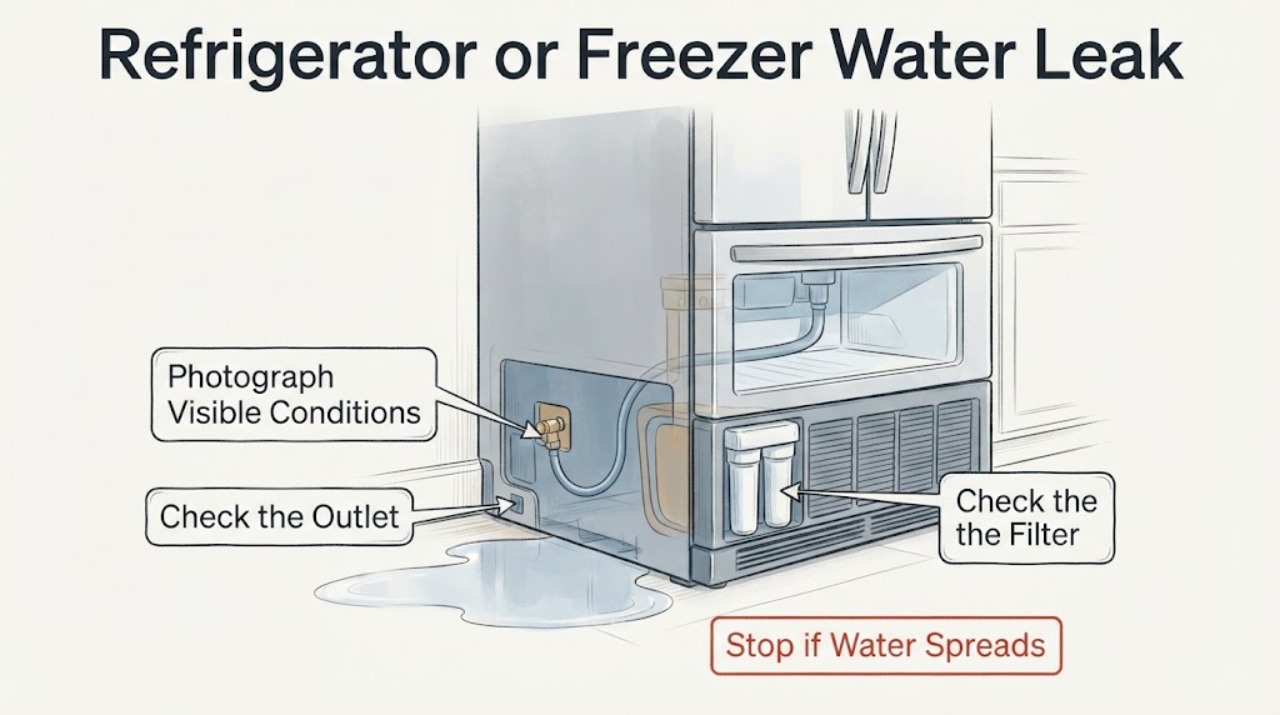
Without moving the appliance, photograph and inspect only visible water connections and hose sections for a loose connection, kink, crushing, cut, split, modification or evidence of a hose being pulled.
Expected result: A visible connection is loose, the hose is damaged, or no visible defect is found.
Next step: Keep the water off and arrange model-matched hose/connection service for damage or persistent leakage. Do not patch, splice or force fittings.
Why this matters
Why: Thermador’s opened T30IB1-family manual identifies a non-tight water connection or damaged hose as the cause of water leaking out; an unseen defect cannot be ruled out by a dry exterior.
-
Check 3
If the leak began after a filter change or dispenser use, note the event and model/filter identity. Do not remove a filter again while the line is pressurized or use repeated dispensing as a test.
Expected result: Only a brief drip occurred during filter removal, or water continues to drip from the filter/dispenser area.
Next step: Follow the exact owner manual for filter seating. If the leak continues, close the supply and have the water system inspected.
Why this matters
Why: The T48-family manual says the filter is under pressure and a small amount of water may drip when removed; that limited observation does not explain a continuing leak.
-
Check 4
Check the water location with the supply off: inside the freezer/refrigerator, at the front dispenser area, under the cabinet, or behind the built-in unit. Do not remove interior covers, back panels, doors or water-system parts.
Expected result: Water is confined to an accessible external connection, returns inside the cabinet, or its path cannot be identified.
Next step: Keep the supply off and arrange Thermador or qualified service, providing photos, model/E-Nr., filter history and where water first appeared.
Why this matters
Why: An external connection can be documented for service; water inside the cabinet or an unidentified path may involve an internal water-bearing component outside the safe user-check scope.
-
Check 5
Find the full Thermador model/E-Nr. and use its owner-support page or manual before any further filter, dispenser or water-connection work.
Expected result: The exact model is available, or the refrigerator/freezer model remains unknown.
Next step: Use the model-matched manual for any owner step; otherwise keep the water supply off and request qualified service.
Why this matters
Why: Thermador states that instructions and water/filter features vary by model, and the opened manuals cover specific product families rather than every Thermador refrigerator.
Use your observations
Decision map
Find the observation that best matches what you see, then follow the next safe action.
-
PATH 01Next step
What you see
The leak stops when the accessible appliance water shut-off valve is closed, and a visible connection or hose is loose or damaged.
Do this next
Keep the valve closed, photograph the defect and arrange model-matched hose/connection service; do not patch or splice the hose.
Why this path and its safety boundary
Why it matters: The opened Thermador manuals support a water-connection or hose leak as the likely scope, but they do not authorize a generic repair or replacement part.
-
PATH 02Next step
What you see
The leak continues with the shut-off valve closed, or the valve cannot be reached without moving a built-in appliance.
Do this next
Keep clear of wet electrical areas, do not move the appliance, and arrange qualified Thermador service or plumbing assistance.
Why this path and its safety boundary
Why it matters: The visible supply connection is not enough to explain the leak, or safe isolation cannot be confirmed.
-
PATH 03Next step
What you see
A small drip occurred only while a pressurized water filter was removed, then stopped after the filter was handled according to the exact model manual.
Do this next
Dry and monitor only with the exact model instructions; close the water supply and call service if any drip returns or the filter will not seat securely.
Why this path and its safety boundary
Why it matters: The T48-family manual describes a small removal drip as possible, but this does not establish that a continuing leak is normal.
-
PATH 04Next step
What you see
Water appears inside the refrigerator/freezer, under the cabinet, near electrical components, or the leak source cannot be identified.
Do this next
Leave the water supply off, protect food and flooring as practical, and request qualified service with the model and photos.
Why this path and its safety boundary
Why it matters: The source is outside the verified external hose/connection checks, and a generic model-free repair path would be unsafe.
Helpful context
Understand the symptom
Stop the leak without moving a built-in refrigerator
Protect the floor and nearby cabinets, keep hands and cords out of standing water, and close the appliance water shut-off valve only if it is dry, clearly accessible and can be reached without moving the appliance. The opened Thermador manuals require a shut-off valve for connected appliances and warn that water hoses can be damaged by kinking, crushing, modification or pulling. Do not slide a built-in refrigerator forward or reach behind wet equipment to find a valve; use qualified help if the valve is inaccessible or water is near electrical connections.
Determine whether the leak is at the water connection
With the water supply stopped and the outside of the appliance dry enough to inspect safely, look only at visible connection points, the accessible hose and the floor under the appliance. A loose connection or visibly damaged hose matches the cause and check described in the Thermador T30IB1-family manual. Do not tighten fittings by force, disconnect a pressurized filter, or pull the appliance out to inspect hidden tubing.
Treat the hose as a service item when damaged
A hose that is kinked, crushed, cut, modified, previously used or visibly split is not a candidate for patching or rerouting behind the appliance. Thermador documentation says damaged water hoses can damage the appliance and directs replacement when necessary; the T30IB1-family troubleshooting section assigns damaged-hose replacement to customer service or similarly qualified service. Keep the water supply off until the hose is model-matched and replaced.
Use filter and dispenser clues carefully
If the first drip appeared immediately after filter replacement or dispenser use, record that timing and the exact filter/model rather than repeatedly removing the filter. The opened T48-family manual states that the filter is under pressure and that a small amount of water may drip during removal; it does not authorize using that observation to dismiss a continuing leak. A continuing drip, water inside the cabinet, or water returning with the supply on needs the exact manual or qualified service.
When the source is not visible, stop investigating
A leak can travel under a cabinet or originate inside a water-bearing component that cannot be reached safely from the outside. No model was supplied and Thermador provides model-specific manuals and support paths. If the valve is closed but water continues, the source is behind the appliance, the appliance is built in, or the leak is near electrical components, leave the water off and arrange qualified Thermador service rather than removing panels or testing valves.
When checks do not resolve it
Need a professional?
Keep the water supply off and arrange qualified Thermador or plumbing service when the hose is damaged, the leak continues after the supply is closed, the appliance is built in, water is near electrical components, water appears inside the cabinet, or the source cannot be identified. Do not move the refrigerator, patch or splice hoses, remove pressurized filters, open panels or test hidden valves.
Common questions
FAQ
Should I keep using the refrigerator if the water leak is small?
Do not ignore a continuing leak. Close the accessible water shut-off valve, keep water away from electricity, and identify the model before following filter or hose instructions. A damaged hose or leak that continues needs qualified service.
Can I pull a built-in Thermador refrigerator forward to inspect the hose?
Do not move a built-in unit as a user leak test. Thermador manuals warn against pulling on the rear hose and require safe installation/connection; use qualified service when the connection is hidden or inaccessible.
Is a few drops from the filter normal?
The opened T48-family manual says a small amount of water may drip when a pressurized filter is removed. That limited event does not make a continuing leak normal; follow the exact model instructions and stop the supply if dripping returns.
What should I give the technician?
Provide the full Thermador model/E-Nr., photos of where water first appeared, whether the leak stops with the supply valve closed, filter replacement timing, and whether the hose or connection is visibly damaged.
Read the exact guide
Official sources
- Use and Care Manual T36FT.. | ThermadorThermador / BSH Home Appliances · Opened the official Thermador/BSH PDF for the T36FT family. Used for water-hose damage, pressure and handling warnings; the article does not apply its exact pressure range to an unknown model.
- Appliance Information - Built-in French Door Bottom Freezer | T36BT110NS/02Thermador / BSH Home Appliances · Opened Thermador product-support page for T36BT110NS/02. Used only to establish that Thermador provides model-specific manuals, installation instructions and owner support; no claim is generalized from this model to all Thermador units.
- Use and Care Manual T30IB1... | ThermadorThermador / BSH Home Appliances · Opened the official Thermador/BSH PDF for the T30IB1 family. Used for the exact family’s leaking-water troubleshooting, shut-off valve, water hose and qualified replacement boundaries; not treated as a manual for an unidentified model.
- Refrigerator Troubleshooting | Problems & Solutions | ThermadorThermador / BSH Home Appliances · Opened Thermador owner-support troubleshooting page. Used for model-specific support/manual routing, water-system cautions and the instruction to check connection lines, shut-off valve and filter according to the model.
- Use and Care Manual T48BT110NS, T48BT120NS, T48IT100NP | ThermadorThermador / BSH Home Appliances · Opened the official Thermador/BSH PDF for the listed T48 models. Used only for the filter-under-pressure and small-removal-drip warning, not as a generic filter installation or leak diagnosis for unknown models.
Community feedback
Share a repair observation
Share a plain-text repair observation. Accepted observations are published automatically; this page may take a moment to update.