
On this page
Start here
Quick answer
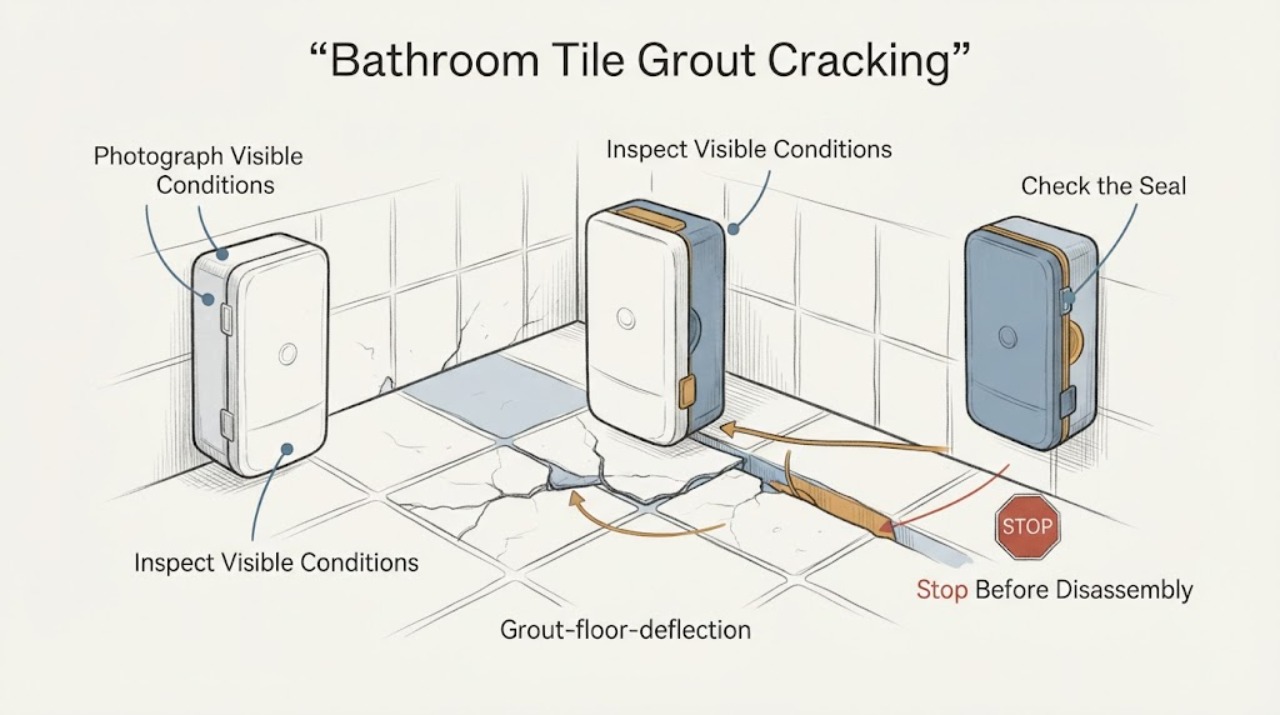
Repeatedly cracking grout in a bathroom floor, especially when the floor flexes under normal walking or the cracks follow several joints, is a movement problem until proven otherwise. A bouncing or unstable wood floor can crack grout and loosen tile, while a crack at a change of plane may need flexible sealant rather than rigid grout. Do not simply regrout over active movement: document the crack pattern, check for moisture and loose tile without opening the assembly, and have a qualified tile professional assess the tile system; any noticeable floor deflection, vertical crack movement, soft framing, or suspected structural issue needs a building or structural professional before tile repair.
Work through in order
Diagnostic checks
Use only checks that match the exact appliance or system and its official guide.
-
Check 1
Photograph every visible grout crack and mark its location on a simple bathroom sketch, noting whether it is isolated, follows a straight line, repeats across several joints, or returns after an earlier repair.
Expected result: The crack is limited to one joint or corner, or it continues through multiple joints and tile edges in a line or pattern.
Next step: Keep the photos and sketch, then inspect for floor movement and moisture without removing tile or grout.
Why this matters
Why: An isolated corner or change-of-plane crack may be a movement-joint detail; a repeated line or returning crack is more consistent with movement in the tile assembly, substrate, or framing and should not be treated as a cosmetic defect alone.
-
Check 2
During ordinary walking only, observe the cracked area from the side or have another person watch the grout and tile; do not jump, add weight, or deliberately flex the floor.
Expected result: The floor visibly dips or vibrates, the crack opens or closes with normal loading, a tile rocks, or no movement is visible.
Next step: Stop cosmetic repair and arrange a qualified tile professional plus a building or structural professional when deflection is visible, repeated, or accompanied by a rocking tile or vertical crack movement.
Why this matters
Why: Visible or load-linked movement indicates active deflection or loss of support, which can crack grout and loosen tile; no visible movement does not rule out small or concealed substrate movement.
-
Check 3
Identify whether each crack is at a wall-to-floor corner, tub or shower edge, curb, doorway, cabinet, pipe, or other change of plane, and compare it with ordinary grout joints in the field.
Expected result: The crack is at a perimeter or change of plane, or it is in the middle of a field joint with no nearby transition.
Next step: Have a tile professional identify the intended movement detail and the correct sealant or grout system before removing material; do not seal over a structural crack or a wet substrate.
Why this matters
Why: Tile industry guidance uses flexible sealant at restraining surfaces and changes of plane because these locations accommodate movement; a field-joint crack calls for checking the tile bond and substrate rather than substituting caulk indiscriminately.
-
Check 4
Inspect accessible surfaces around the bathroom floor and nearby walls or ceiling for staining, dampness, musty odor, soft trim, swollen wood, or a plumbing leak; do not cut into the waterproofed floor to investigate.
Expected result: Moisture or soft material is present, or the area appears dry with no visible water damage.
Next step: Stop wet use around the affected area and address the leak with a qualified professional before tile repair when moisture or softness is found; keep the photos for the assessment.
Why this matters
Why: Moisture can damage plywood, framing, grout, and the bond below tile; a dry visible surface does not exclude moisture trapped under the tile or in the framing.
-
Check 5
Gather the tile and grout product names, installation date, subfloor type if known, underlayment or membrane information, and any earlier regrouting or tile repairs for the installer.
Expected result: The floor is wood-framed or plywood-based, the underlayment is unknown, or the tile installation system and movement details are documented.
Next step: Ask a qualified tile professional to inspect the assembly and refer a building or structural professional when floor members, subfloor fastening, joist movement, settlement, or load capacity may be involved.
Why this matters
Why: Wood and plywood assemblies need a stable, properly constructed support system; product-specific mortar, backer, membrane, grout, and movement details can change the safe repair path. Unknown construction is not evidence that the floor meets tile requirements.
Use your observations
Decision map
Find the observation that best matches what you see, then follow the next safe action.
-
PATH 01Next step
What you see
The crack is isolated at a wall, tub, shower, curb, doorway, or other change of plane, with no visible floor deflection or loose tile.
Do this next
Have a tile professional verify whether that joint was intended to be a flexible movement joint and use the compatible sealant detail rather than rigidly refilling it with grout.
-
PATH 02Next step
What you see
Cracks repeat across several joints, return after regrouting, or open with normal floor loading.
Do this next
Stop cosmetic regrouting. Treat active movement or deflection as the leading issue and arrange tile-system assessment plus building or structural evaluation before disturbing the floor.
-
PATH 03Next step
What you see
The tile rocks, the crack has vertical displacement, the floor feels soft, or framing or subfloor movement is suspected.
Do this next
Do not bridge the problem with grout, caulk, or a crack-isolation membrane. Stop DIY repair and obtain a professional structural or building assessment; the substrate must be made suitable before tile work.
-
PATH 04Next step
What you see
There is staining, dampness, a leak, swollen wood, or a musty odor near the cracked tile.
Do this next
Control the water source and keep the area dry. Arrange moisture and substrate assessment before replacing grout or tile, because the visible crack may be a symptom of wet or deteriorated support.
-
PATH 05Next step
What you see
The crack is limited to grout with no movement, no moisture, no loose tile, and no repeat pattern.
Do this next
A tile professional may evaluate grout depth, joint filling, curing, and the specified grout type. Regrout only after the joint and substrate are confirmed sound and the wet-area details are preserved.
Helpful context
Understand the symptom
Grout is brittle compared with the framing and underlayment below it. A small isolated defect may be a grout installation or curing issue, but cracks that return after regrouting, cross several joints, align with a joist or subfloor seam, or open when the floor is loaded are evidence that the assembly is moving. The crack pattern is more informative than the grout color or age.
Bathrooms add a second concern: moisture can weaken wood-based components and damage the tile assembly. Keep the inspection visual and low-force. Do not pry up tile, drill through waterproofing, add extra weight to make the floor move, or grind out a joint until the movement and wet-area details are understood.
A flexible sealant at a properly identified change of plane is a different detail from filling a normal field joint with caulk. If the floor itself deflects or a crack has vertical displacement, a sealant or crack-isolation product alone is not a structural repair; the substrate and framing must be assessed first.
Only after diagnosis
Potential parts
- flexible movement-joint sealant
Only relevant when a tile professional confirms that the crack is at a designed change of plane, perimeter, or other movement joint rather than a structural or deflection crack.
Match the sealant chemistry, wet-area rating, color, joint size, and tile or waterproofing system; sealant is not a substitute for structural repair. - tile crack-isolation or uncoupling membrane
Only consider after a qualified professional confirms that the substrate movement is within the membrane system's intended scope and that there is no unresolved vertical or structural movement.
Verify the exact membrane, mortar, tile, waterproofing, and substrate requirements from the system manufacturer; do not assume a membrane corrects a bouncing floor. - matching grout for the existing tile system
Only relevant after movement, moisture, joint type, and substrate suitability are confirmed and the existing grout is the damaged finish rather than the symptom of ongoing deflection.
Match the existing joint width, tile material, wet-area requirements, and manufacturer instructions; a color match alone is not sufficient.
When checks do not resolve it
Need a professional?
Arrange tile-system inspection for recurring or patterned grout cracks, and add a building or structural assessment for visible deflection, soft framing, vertical crack movement, settlement, or water damage.
Have this ready
- Provide crack-pattern photos and a sketch, normal-load movement observations, moisture or leak history, tile and grout details, installation date, subfloor or framing information, and records of earlier repairs.
Common questions
FAQ
Will regrouting stop bathroom floor grout from cracking?
Only if the substrate, tile bond, joint type, moisture condition, and movement are sound. If the floor deflects or the crack returns, regrouting alone treats the finish and not the cause.
How can I tell whether the floor is deflecting?
Observe the area during ordinary walking without jumping or adding weight. A visible dip, vibration, rocking tile, or crack that opens with normal loading is enough to stop cosmetic repair and arrange professional assessment; do not try to calculate structural capacity from a homeowner test.
Should I fill a cracked corner with grout or caulk?
A corner or change of plane may require a compatible flexible sealant, but first confirm that it is a movement joint and not a structural crack or wet-area failure. Do not caulk over vertical movement or an unstable substrate.
Can a crack-isolation membrane fix a bouncing bathroom floor?
Not by itself. A membrane may be appropriate only for movement within the system's intended scope after a professional confirms the substrate is suitable. Significant deflection, vertical movement, or damaged framing requires substrate or structural correction first.
Read the exact guide
Official sources
- Cement GroutsLATICRETE · LATICRETE cement grout troubleshooting and movement-joint guidance
- Frequently Asked QuestionsCUSTOM Building Products · CUSTOM tile installation, substrate movement, backerboard, and grout guidance
- ThinsetsLATICRETE · LATICRETE tile installation planning over wood floors and deflection guidance
Community feedback
Share a repair observation
Share a plain-text repair observation. Accepted observations are published automatically; this page may take a moment to update.