
On this page
Start here
Quick answer
A deteriorated concrete expansion-joint seal is a maintenance decision, not automatically a caulking job. First document whether the sealant is missing, hardened, split, debonded, extruded, or filled with debris, and whether the concrete edges are sound and the joint is moving or admitting water. Resealing may be appropriate when the joint and surrounding concrete remain sound, but polyurethane is not universally suitable: the product must be rated for the joint's movement, substrate, orientation, moisture, exposure, and traffic, and the manufacturer's instructions control. A backer rod or bond breaker is used to control sealant depth and avoid three-sided adhesion; it does not repair spalled or moving concrete. Arrange qualified concrete service for cutting or grinding out old material, solvent or chemical use, structural movement, widespread spalling, unsafe access, or any uncertainty about joint design. [src-fhwa-joint-distress, src-sika-hy100, src-caltrans-existing-concrete]
Before you begin
Safety first
- The homeowner portion is limited to safe visual documentation and route control. A qualified professional determines whether resealing, joint-reservoir work, concrete repair, drainage correction, structural assessment, or another treatment is appropriate, and follows the selected material's current instructions and safety data.
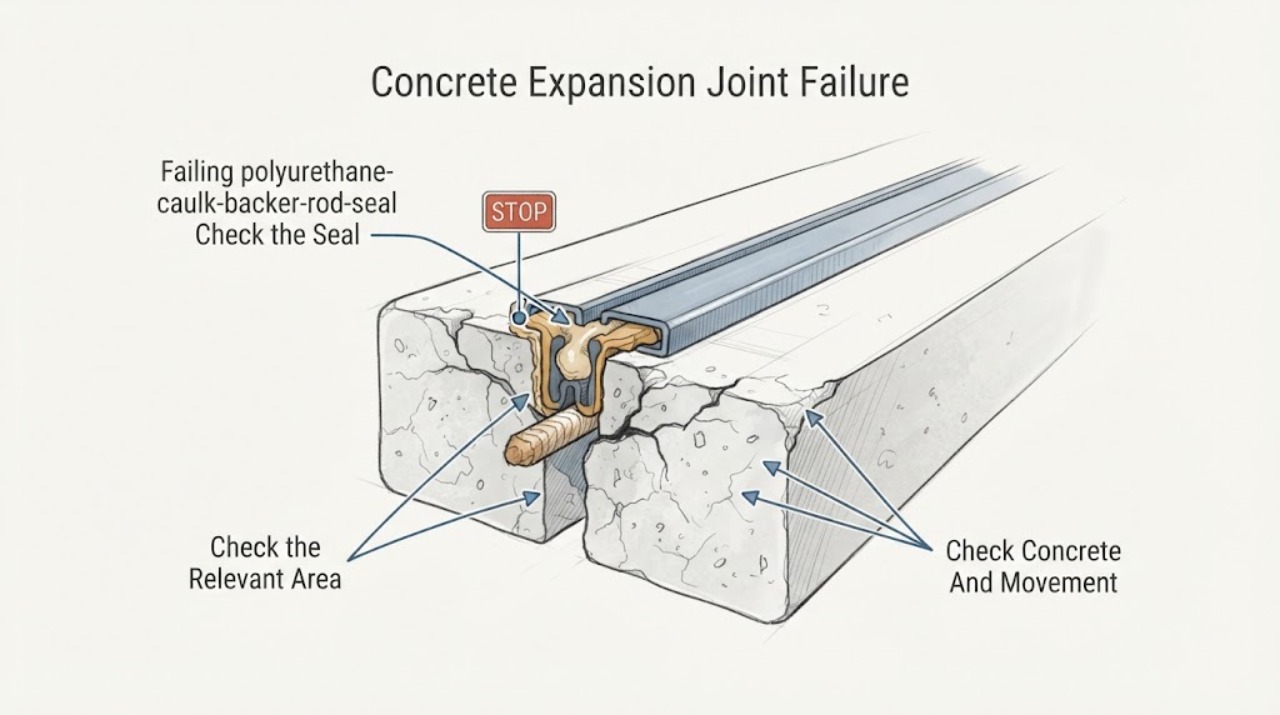
Work through in order
Diagnostic checks
Use only checks that match the exact appliance or system and its official guide.
-
Check 1
From a stable surface and without stepping into the joint, map its location, length, orientation, adjacent slabs or walls, pedestrian or vehicle route, drainage path, and any nearby edge or drop-off.
Expected result: Record whether the joint is on a sidewalk, driveway, patio, slab edge, parking area, wall-to-slab transition, or another concrete assembly; note whether access is level, wet, slippery, elevated, or exposed to traffic.
Next step: Photograph the joint from both sides and tell the concrete professional how people, vehicles, water, and weather reach it. Keep people and vehicles away if the opening or edge creates a trip or load hazard.
Stop if: Do not enter traffic, climb onto an elevated edge, walk on unstable or rocking concrete, move heavy covers, or reach into a deep or contaminated opening.
Why this matters
Why: A horizontal traffic-bearing joint, a pedestrian trip point, and a vertical building joint have different sealant, access, and safety requirements. Location alone does not establish the correct polyurethane product or repair method.
-
Check 2
Inspect the sealant visually from a safe position and compare several sections of the joint without pulling, probing, or cutting the bead.
Expected result: Note missing sealant, hardening, splitting, adhesive separation from one or both joint faces, cohesive tearing, extrusion, shrinkage, blisters, open gaps, vegetation, sand, stones, or other incompressible debris.
Next step: Mark or photograph representative sections and estimate the affected length without disturbing the material. Ask service to inspect whether the old sealant and backer material can be removed without damaging the joint reservoir.
Stop if: Do not tug out sealant, use a knife, chisel, screwdriver, wire brush, grinder, saw, or compressed air, and do not scrape debris toward a drain or traffic route.
Why this matters
Why: These are recognizable seal-damage patterns, but their percentage and distribution matter: isolated deterioration in an otherwise sound joint can lead to maintenance, while widespread loss or debris intrusion can require a coordinated resealing plan. The visible bead does not show the backer-rod condition below it.
-
Check 3
Observe the concrete immediately beside the joint without tapping, lifting, loading, or widening it; compare the edge height and condition along the joint and on both sides.
Expected result: Record sound-looking edges versus cracking, spalling, scaling, loose fragments, a raised or depressed lip, rocking, offset, widening, recurring movement, or damage extending away from the seal.
Next step: Keep the affected route unloaded or isolated when it is unstable or creates a trip hazard, and request a concrete professional to determine whether partial-depth, full-depth, joint, drainage, or structural work is needed before sealing.
Stop if: Stop for rocking or collapsing concrete, a void, exposed reinforcement or dowel, a deep opening, falling fragments, an unsupported edge, or any need to stand on or pry the slab.
Why this matters
Why: A failed seal in sound concrete may be a resealing candidate, but spalling, displacement, rocking, or progressive movement can mean the concrete, base, load transfer, or structure needs assessment first. A bead of polyurethane cannot be assumed to stabilize a moving or deteriorated slab.
-
Check 4
Document the joint's exposure from a safe position over normal weather and use patterns; do not create a hose, load, or ponding test.
Expected result: Note standing water, runoff entering the opening, dampness after rain, freeze-thaw exposure, deicing material, oil or chemical contamination, continuous immersion, sun and temperature changes, traffic, or no unusual exposure.
Next step: Add the weather and use timeline to the service request and ask the professional to address drainage and exposure along with sealant selection. Keep the joint free of added water or chemical experiments.
Stop if: Do not enter contaminated water, handle unknown chemicals, use solvent or cleaner, pressure-wash the opening, or approach during flooding, ice, lightning, or unsafe traffic.
Why this matters
Why: Water, incompressible material, movement, chemicals, immersion, and traffic change the service and material requirements. A dry day does not prove that the joint stays dry, and a sealant rated for one exposure may not be suitable for another.
-
Check 5
Gather the joint dimensions and history for the professional without altering the joint: approximate visible width and depth, concrete age or repair history, old sealant type if known, orientation, and the proposed product data sheet if a product has already been selected.
Expected result: The joint geometry and substrate are clear, partly known, or unknown; the proposed polyurethane is explicitly rated for the actual joint movement and exposure, conditionally rated, or not documented.
Next step: Use the manufacturer's current instructions and request a field adhesion or technical review when the substrate, old sealant, moisture, movement, or joint configuration is unusual. Do not buy a product or backer rod solely from the title of this article.
Stop if: Do not assume polyurethane is suitable for a submerged, structural, chemically exposed, traffic-bearing, unusually wide, or moving joint; do not mix products, prime, puncture, or install backer rod as a trial.
Why this matters
Why: A product name alone does not prove compatibility. The selected system must account for substrate soundness, joint movement, sealant depth, backer-rod or bond-breaker behavior, primer needs, moisture, curing, and use conditions. For example, Sika identifies some polyurethane products as non-structural and limits their use by depth or exposure.
-
Check 6
Use the seal, concrete, movement, exposure, access, and material records to choose between scheduled maintenance assessment and prompt professional evaluation.
Expected result: The joint is accessible only from a safe route, concrete appears sound, deterioration is limited, exposure is understood, and the selected system has documented suitability; or the joint is widespread, moving, spalled, wet, contaminated, structurally important, traffic-bearing, or uncertain.
Next step: Arrange concrete service for condition assessment and resealing scope. Provide the map, photos, failure classification, movement and water history, dimensions, access limits, and product information; keep any hazardous route controlled until assessed.
Stop if: Do not cut, grind, chisel, solvent-clean, pressure-wash, fill, paint over, or traffic-open a repaired joint without qualified planning, material instructions, and required cure or protection time.
Why this matters
Why: A sound, isolated seal failure may support a resealing estimate. Structural movement, extensive concrete deterioration, unknown geometry, persistent water, hazardous access, or uncertain product fit makes a simple bead replacement unreliable and raises the need for a broader concrete or engineering assessment.
Use your observations
Decision map
Find the observation that best matches what you see, then follow the next safe action.
-
PATH 01Safety boundary
What you see
Sealant is missing, split, or debonded in a limited area, while the concrete edges appear sound, stable, and free of a broader movement or water problem.
Do this next
Request a scheduled joint-resealing assessment and provide representative photos and the affected-length estimate. The professional confirms removal, preparation, backer or bond-breaker, sealant, and cure requirements.
Why this path and its safety boundary
Safety stop: Do not patch over failed sealant or choose polyurethane from appearance alone.
-
PATH 02Safety boundary
What you see
Sealant loss, hardening, debonding, splitting, or incompressible debris extends through much of the joint.
Do this next
Arrange a coordinated resealing plan rather than spot-filling. Ask for the joint reservoir, backer material, surrounding concrete, drainage, and affected length to be assessed together.
Why this path and its safety boundary
Safety stop: Do not sweep debris into the opening, pressure-wash it, or remove cured material with cutting or grinding tools.
-
PATH 03Safety boundary
What you see
Edges are spalled, loose, rocking, displaced, widening, or deteriorating beyond the sealant line.
Do this next
Keep the route clear as needed and request concrete assessment for the cause and repair extent before specifying a backer rod or polyurethane seal.
Why this path and its safety boundary
Safety stop: Do not use sealant to bridge an unstable edge or conceal structural, base, or load-transfer damage.
-
PATH 04Safety boundary
What you see
The joint is submerged, chemically exposed, unusually wide or deep, traffic-bearing, structurally important, connected to dissimilar materials, or the product and geometry are not documented.
Do this next
Pause material selection and obtain manufacturer or qualified professional review, including any required adhesion test or project specification. Treat polyurethane as conditional, not assumed.
Why this path and its safety boundary
Safety stop: Do not mix sealants, improvise primer or bond breaker, or rely on a generic cartridge label for compatibility.
-
PATH 05Safety boundary
What you see
Water repeatedly enters the joint, the route is flooded or icy, access requires traffic or height exposure, or debris/chemicals create an immediate hazard.
Do this next
Isolate the area from a safe position and arrange qualified concrete, drainage, or site-safety help. Share the timing and source of water or contamination.
Why this path and its safety boundary
Safety stop: Do not enter contaminated or moving water, work in traffic, climb, pressure-wash, or handle unknown chemicals.
Helpful context
Understand the symptom
Separate seal failure from concrete or movement failure
A seal can fail by hardening, splitting, losing adhesion, being pushed out, disappearing, or allowing debris and water into the joint. Those signs do not by themselves prove that removing and replacing the bead will solve the problem. If the concrete edges are spalled, rocking, widening, displaced, or repeatedly wet from a drainage problem, the joint may need a concrete, structural, or water-management assessment before resealing. FHWA uses the condition of both the seal and the surrounding pavement to distinguish maintenance from more extensive repair. [src-fhwa-joint-distress, src-fhwa-partial-depth]
Backer rod controls geometry; it is not a universal filler
Backer rod or bond-breaker material keeps sealant from bonding to the bottom of a moving joint and helps control the sealant bead's depth. Product instructions differ on joint geometry, rod size, primer, substrate preparation, movement capability, curing, and wet or submerged exposure. Sika's product guidance, for example, requires sound, clean, dry joint faces and says to confirm unusual applications with technical service. Use the data sheet for the selected product and the actual joint; do not treat one polyurethane cartridge or one rod diameter as a universal specification. [src-sika-hy100, src-sika-construction, src-sika-application]
The safest homeowner contribution is a condition record
You can photograph and describe the joint from a stable, safe position, note water and traffic exposure, and give the service professional the product history. Removing cured sealant, sawing or grinding concrete, cleaning with solvents, installing a backer rod at an unknown depth, and applying a sealant are execution steps that can damage the joint or create chemical, dust, access, or traffic hazards. Caltrans requires damaged sealant removal, reservoir cleaning, backer-rod installation, and sealant installation to protect the joint and follow the material instructions. [src-caltrans-existing-concrete, src-sika-hy100]
Safety boundary
Stop conditions
- Do not step onto unstable, rocking, elevated, flooded, icy, or traffic-exposed concrete to inspect or repair a joint.
- Do not cut, grind, chisel, wire-brush, pressure-wash, or mechanically remove cured sealant as an ordinary-user step; these operations create dust, flying-debris, substrate-damage, and access hazards.
- Do not use solvents, primers, cleaners, or mixed chemicals without qualified handling and the applicable safety and manufacturer instructions.
- Do not assume polyurethane or a particular backer rod is suitable for every joint, and do not use sealant to conceal structural movement, spalling, drainage failure, or an unstable edge.
Only after diagnosis
Potential parts
- closed-cell backer rod
Consider this only after the professional confirms the joint is a suitable moving sealant joint and specifies the rod type, size, depth, and compatibility with the selected sealant. Backer rod controls sealant geometry; it does not replace deteriorated concrete or solve structural movement.
Follow the selected sealant manufacturer's instructions. Do not stretch, puncture, prime, or force rod into a joint with unknown geometry, contamination, immersion, or unstable edges. - polyurethane joint sealant
Consider this only when the manufacturer and qualified professional confirm suitability for the actual concrete substrate, movement, orientation, sealant depth, moisture, chemical exposure, traffic, and cure conditions. Polyurethane is not a universal structural or submerged-joint repair.
Use the current product data and safety data sheets; confirm primer, bond-breaker, surface preparation, temperature, cure, and protection requirements before purchase or installation.
When checks do not resolve it
Need a professional?
Arrange qualified concrete service for deteriorated, missing, split, debonded, or extruded joint sealant, especially when damage is widespread or water and debris are entering. Request prompt assessment for spalling, rocking, displacement, progressive widening, structural or load-bearing joints, traffic exposure, contaminated or submerged conditions, unsafe access, or uncertain material compatibility. A drainage or structural professional may also be needed when the joint failure is a symptom of water or movement rather than a sealant-only defect.
Safety scope: The homeowner portion is limited to safe visual documentation and route control. A qualified professional determines whether resealing, joint-reservoir work, concrete repair, drainage correction, structural assessment, or another treatment is appropriate, and follows the selected material's current instructions and safety data.
Common questions
FAQ
Does a failed concrete expansion-joint seal always need polyurethane?
No. Polyurethane is only one possible sealant class, and suitability depends on the actual joint movement, concrete substrate, orientation, moisture, chemicals, traffic, geometry, and the manufacturer's instructions. A professional may find that the joint needs concrete, drainage, structural, or another seal system assessment first. [src-sika-hy100, src-fhwa-joint-distress]
What does the backer rod do in an expansion joint?
Backer rod helps control the sealant bead depth and prevents a moving sealant from bonding to the bottom of the joint, which avoids three-sided adhesion. It does not stabilize spalled concrete, correct joint movement, or replace a structural repair. [src-sika-hy100, src-sika-application]
Can I caulk over the old expansion-joint sealant?
Do not assume an overlay will bond or perform. Failed sealant, contamination, the reservoir, backer material, and concrete faces need assessment; Caltrans guidance emphasizes removing damaged sealant without damaging the reservoir and preparing the joint before new sealant. [src-caltrans-existing-concrete, src-sika-application]
When is an expansion-joint failure more than a sealant problem?
Treat it as broader than a bead replacement when the concrete is spalled, rocking, displaced, progressively widening, or repeatedly wet, or when the joint carries traffic or serves a structural or water-exposed function. Request assessment of the concrete, movement, drainage, and joint system before resealing. [src-fhwa-joint-distress, src-fhwa-partial-depth, src-fhwa-full-depth]
Is a backer rod the same as expansion-joint filler?
Not necessarily. A backer rod is used to control sealant geometry and break the bond at the base of a moving sealant joint; an existing joint may contain a different filler or system. Identify the actual assembly and follow the selected sealant and project instructions rather than substituting materials by appearance. [src-sika-hy100, src-caltrans-existing-concrete]
Read the exact guide
Official sources
- Chapter 2: Distresses for Pavements With Jointed Portland Cement Concrete SurfacesFederal Highway Administration · Concrete pavement joint-seal inspection concepts used here for sealant deterioration patterns, water/debris intrusion, and affected-length assessment; not a project-specific repair specification.
- 3.0 Design Considerations - Full-Depth Repairs - ConcreteFederal Highway Administration · General concrete pavement repair planning used only to support escalation when deterioration extends beyond a seal; not a repair prescription for a private project.
- Sikaflex + Construction SealantSika Corporation · Product-specific example used only to show that sealant depth, clean dry joint walls, bond-breaking, and primer decisions are product-dependent.
- How-To Apply Sikaflex+ SealantsSika Corporation · Manufacturer educational guidance used to explain why moving joints need bond-breaking and why self-leveling products have slope and depth limits; not a substitute for the selected product data sheet.
- Chapter 4: Construction Details, Section 41: Existing Concrete PavementCalifornia Department of Transportation · Public-construction inspection guidance used for the importance of protecting the reservoir, cleaning before backer rod, and following material specifications; not a private-project specification.
- Sikaflex HY 100Sika Corporation · One manufacturer's product data used to demonstrate conditional selection and the need to follow product-specific substrate, depth, backer, exposure, and preparation requirements; not a universal recommendation.
- 4.0 Construction - Partial-Depth Repairs - ConcreteFederal Highway Administration · Concrete pavement repair context used to distinguish surrounding concrete deterioration from sealant-only maintenance; not a homeowner procedure.
Community feedback
Share a repair observation
Share a plain-text repair observation. Accepted observations are published automatically; this page may take a moment to update.