
On this page
Start here
Quick answer
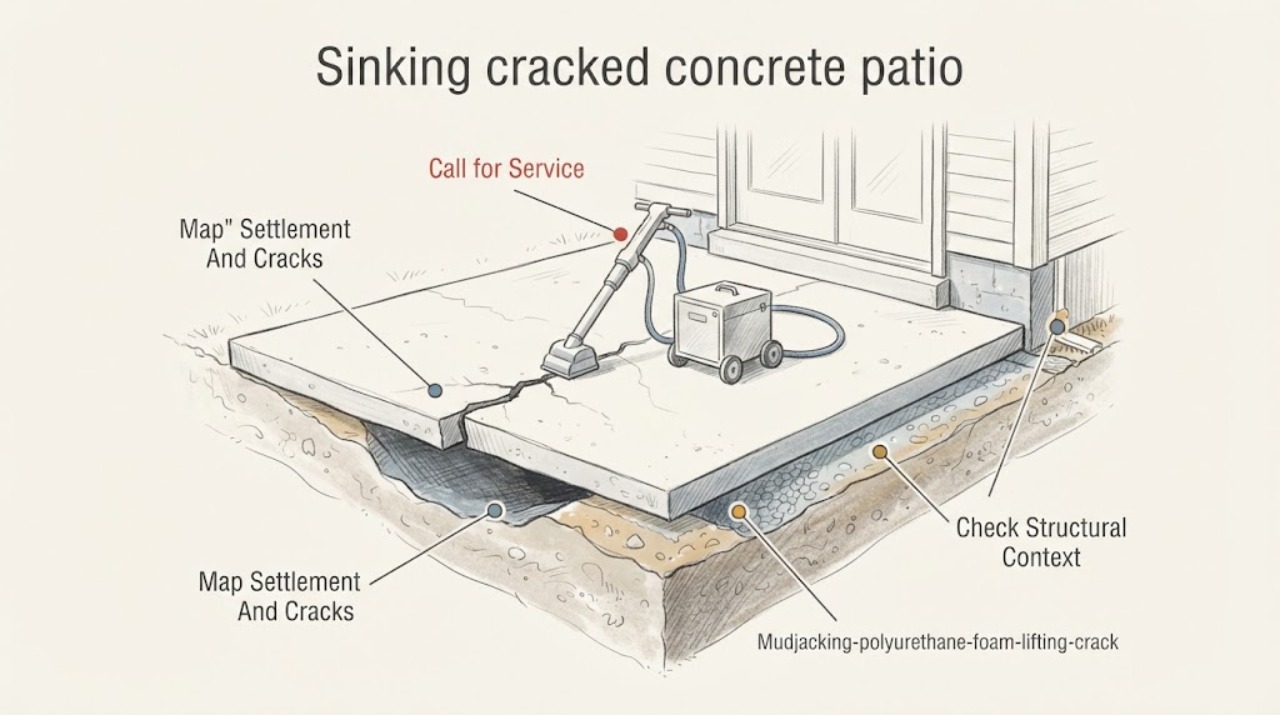
High-density polyurethane foam lifting, often called polyjacking, can be a professional option for a settled patio when the slab is still structurally sound, the settlement is localized, and the underlying void or loss of support can be addressed. A crack does not automatically rule it in or out: a hairline or settlement-related crack may be handled as part of a broader repair plan, while a slab that is broken into pieces, moving, severely cracked, or undermined by active drainage needs a different scope. From a stable adjacent surface, document the slab profile, crack pattern, drainage, soil loss, utilities, and access limits; do not drill or inject foam yourself. Ask a qualified concrete professional to confirm whether foam lifting, crack or joint work, drainage correction, or slab replacement is appropriate.
Before you begin
Safety first
- This article supports safe documentation and observation only. Drilling, foam or grout injection, slab lifting, utility locating, lift monitoring, crack repair, structural evaluation, and replacement are professional construction tasks.
Work through in order
Diagnostic checks
Use only checks that match the exact appliance or system and its official guide.
-
Check 1
From a stable position beside the patio, photograph the slab from its approach direction and side, and map low edges, raised edges, joints, cracks, spalls, rocking sections, pooling areas, and transitions to steps, doors, walls, or adjacent slabs without stepping onto an unstable area.
Expected result: Record whether the patio is one connected slab or separated into pieces, whether the settlement is localized or broad, whether cracks are hairline, open, branching, or offset, and whether the slab moves or changes after ordinary weather without deliberately loading it.
Next step: Give the map and dated photographs to a concrete professional and ask for a method comparison that addresses lifting, crack or joint repair, and replacement rather than assuming foam is suitable.
Stop if: Do not jump, pry, lift, drill, core, cut, or step onto a rocking, undermined, or uncertain section to measure it.
Why this matters
Why: A connected slab with localized settlement and a support void is a different evaluation from a fragmented, rocking, or broadly distressed patio. Research on polyurethane lifting reports that severely cracked slabs can limit the method and that structural soundness matters.
-
Check 2
From safe ground-level access, trace where rainwater, irrigation, downspouts, roof runoff, and surface flow approach or leave the patio, and look at exposed edges for washout, soft soil, voids, or recurring wet areas without excavating.
Expected result: Note active leaks, pooling, water flowing through cracks or joints, eroded soil at the slab edge, a downspout discharging beside the patio, damp or settled fill, roots, or no visible drainage or support issue.
Next step: Photograph flow paths and wet or eroded areas, and request that the quote state whether drainage, leak, soil, or root work must be completed before or with any lifting operation.
Stop if: Do not hose-test the patio, excavate below the slab, inject grout or foam, redirect buried utilities, or enter a flooded or collapsing edge.
Why this matters
Why: Active water or loss of support can continue the settlement after a lift unless the cause is corrected. A dry, stable edge does not prove that hidden voids or subsurface movement are absent, so it still needs professional evaluation.
-
Check 3
Inspect the surrounding context from safe access, including steps, retaining edges, foundation walls, columns, doors, pool or drainage structures, and any visible separation that could move with the patio.
Expected result: Record whether the patio is independent flatwork, bears against a building or retaining structure, is attached to steps or a porch, has a gap or pressure point at a wall, or is accompanied by wall, footing, or structural movement.
Next step: Tell the concrete professional about every adjacent structure and request a separate structural review when the patio movement is connected to a wall, footing, porch, retaining system, or other structural element.
Stop if: Do not shore, jack, separate, demolish, or load-test a wall, step, porch, retaining edge, pool structure, or foundation as part of a patio check.
Why this matters
Why: An independent settled patio may be evaluated as flatwork, while movement at a foundation, retaining wall, porch, pool structure, or other load-bearing connection can require structural or geotechnical assessment before a lifting method is chosen.
-
Check 4
Prepare an access and utility record for the proposed work area using existing plans, visible cleanouts, irrigation controls, lighting, drains, utility markings, and the equipment route, without drilling or exposing buried lines.
Expected result: Identify known or suspected water, sewer, gas, electrical, irrigation, pool, drainage, or communications lines; narrow gates, steps, walls, landscaping, and doors; and areas where equipment or injection points cannot be safely reached.
Next step: Give the record to the contractor and require utility locating, an injection and monitoring plan, and protection measures to be addressed before work begins.
Stop if: Do not drill test holes, cut the slab, probe for utilities, remove buried covers, or move heavy landscaping or structures to create access.
Why this matters
Why: Foam lifting requires drilled access points and controlled placement, so unknown utilities, confined access, or adjacent structures can change the injection plan, cost, risk, or suitability. A missing utility record is a reason to pause construction planning, not permission to guess.
-
Check 5
Use the slab condition, crack pattern, drainage history, structural context, utility record, and route consequence to compare a professional proposal for foam lifting with proposals for drainage correction, crack or joint work, partial or full replacement, or structural assessment.
Expected result: A proposal should state whether the slab is considered structurally sound, what support or void condition is being addressed, what happens to existing cracks and joints, how lift movement is monitored, how holes are sealed, and what conditions are excluded or require other work.
Next step: Ask qualified concrete professionals to explain the diagnosis, method, monitoring, crack and edge treatment, drainage responsibility, access plan, and follow-up criteria in writing before approving work.
Stop if: Do not select a contractor solely from a photo, guarantee, speed claim, or material name, and do not approve injection until the slab and subsurface conditions have been assessed.
Why this matters
Why: A clear scope links the method to the observed failure and acknowledges its limits. A quote that promises a level surface without discussing severe cracks, active water, utilities, adjacent structures, or post-work drainage leaves the key decision unresolved.
Use your observations
Decision map
Find the observation that best matches what you see, then follow the next safe action.
-
PATH 01Safety boundary
What you see
The patio remains a connected, sufficiently sound slab; settlement is localized; access and utilities can be planned; and no active drainage or structural issue is left unexplained.
Do this next
Request a written concrete assessment describing the void or support problem, injection and lift-monitoring plan, crack and joint treatment, hole sealing, and how contributing conditions will be handled.
Why this path and its safety boundary
Why it matters: Professional polyurethane foam lifting may be a candidate for restoring support and level, subject to site-specific design and monitoring.
Safety stop: Do not drill or inject foam yourself and do not treat a candidate assessment as approval until a qualified professional confirms the slab condition.
-
PATH 02Safety boundary
What you see
The slab is broken into pieces, rocks, has severe or widening cracks, has major spalling, or cannot be treated as one sound slab.
Do this next
Keep the area controlled and request concrete replacement or structural repair evaluation alongside any lifting opinion; ask how each piece and the underlying support will be addressed.
Why this path and its safety boundary
Why it matters: Foam lifting may not provide the required repair, and transportation research reports that severe cracking can limit polyurethane use; replacement or reconstruction may be the appropriate comparison.
Safety stop: Do not fill cracks, lift pieces, clamp the slab together, or inject under a fragmented area as a trial.
-
PATH 03Safety boundary
What you see
Water is actively washing soil from an edge, a leak is ongoing, drainage repeatedly undermines the patio, or the support condition changes after rain.
Do this next
Request concrete and drainage or utility assessment, isolate a route hazard, and require the professional plan to address the water or support cause before or with any lift.
Why this path and its safety boundary
Why it matters: A lift-only repair can leave the cause of settlement in place and may not remain level; drainage, leak, or soil correction must be part of the scope.
Safety stop: Do not hose-test, excavate, plug a drain, inject material, or close over the wet or eroded area.
-
PATH 04Safety boundary
What you see
Movement reaches a foundation, retaining wall, porch, steps, pool structure, column, footing, or another load-bearing or connected element.
Do this next
Arrange qualified structural or geotechnical assessment before selecting foam lifting, and provide the full movement and water history to the concrete professional.
Why this path and its safety boundary
Why it matters: The patio may be part of a broader structural or geotechnical movement problem rather than isolated flatwork settlement.
Safety stop: Do not jack, shore, separate, demolish, or inject against a structural connection without qualified direction.
-
PATH 05Safety boundary
What you see
Buried utilities, drains, voids, injection access, or adjacent structures are unknown or cannot be safely protected.
Do this next
Pause the work decision until utilities are located, access is planned, and the contractor explains injection points, monitoring, and protection measures.
Why this path and its safety boundary
Why it matters: The construction plan and risk are unresolved; drilling or injection based on assumptions could damage utilities or structures.
Safety stop: Do not drill exploratory holes, probe the slab, or move heavy objects to create a work route.
-
PATH 06Safety boundary
What you see
The settled patio creates a trip edge, blocks the only safe route, threatens a door or step, or has a section that rocks or could collapse.
Do this next
Close or reroute the path from a safe position and request prompt concrete service, with structural or drainage help if the observations indicate those concerns.
Why this path and its safety boundary
Why it matters: Immediate route control takes priority over choosing a lifting material; a professional must assess stability and access before construction.
Safety stop: Do not step onto the hazard to measure it, place a loose mat over it, or attempt temporary lifting or leveling.
Helpful context
Understand the symptom
A crack changes the evaluation, not the answer by itself
Settlement can leave a patio low on one side, create a trip edge, pool water, and open cracks. Polyurethane foam lifting fills voids and gradually raises a settled slab through drilled injection points, but it is a lifting and support method, not a universal crack repair. The key distinction is whether the patio remains one sufficiently sound slab and whether the cause of lost support is understood. A slab broken into separate pieces, a slab with severe distress, or an area still losing soil or support may need replacement or another engineered scope.
Drainage and subgrade conditions belong in the quote
Water flowing toward the patio, leaking utilities, poor downspout discharge, erosion at an edge, or expansive or poorly compacted fill can continue to move the support below a lifted slab. Record those conditions from safe access before anyone proposes a lift. A professional should explain which cause is being addressed, whether drainage or utility work is needed, how the lift will be monitored, and how cracks, joints, edges, and injection holes will be finished.
Polyjacking is a controlled construction operation
Polyurethane slab lifting uses specialized equipment, drilled access points, staged injection, and observation of slab movement. Utilities, adjacent walls, steps, doors, pool structures, and brittle or fragmented concrete can affect the safe scope. The homeowner role is documentation, access planning, and selection of a qualified contractor; drilling, injection, leveling by expansion, and structural or crack repair decisions belong to the professional team.
Safety boundary
Stop conditions
- Do not drill, cut, core, or inject polyurethane, grout, foam, or another material into the patio as a homeowner test.
- Do not lift, jack, pry, clamp, or load-test a settled, cracked, rocking, or undermined slab or any attached step, wall, porch, or structure.
- Do not hose-test drainage, excavate below the slab, expose buried utilities, or redirect a suspected leak without qualified planning.
- Keep people and pets off a rocking, collapsing, wet, icy, or route-critical section and use a clear alternate path or temporary boundary from a safe location.
- Do not approve foam lifting without a professional assessment of slab soundness, cracks, support or voids, drainage, utilities, adjacent structures, lift monitoring, and post-work scope.
When checks do not resolve it
Need a professional?
Arrange a qualified concrete assessment for a settled or cracked patio before selecting polyjacking, mudjacking, crack repair, or replacement. Seek prompt service for a rocking slab, route-critical trip edge, active washout, widening cracks, water entering a building, or movement at steps, a porch, retaining wall, foundation, pool structure, or other connected element. Polyurethane injection, slab lifting, utility protection, lift monitoring, and structural or crack repair are professional construction work.
Safety scope: This article supports safe documentation and observation only. Drilling, foam or grout injection, slab lifting, utility locating, lift monitoring, crack repair, structural evaluation, and replacement are professional construction tasks.
Common questions
FAQ
Can polyurethane foam lifting fix a cracked and sinking patio?
Sometimes, but the crack and slab condition must be assessed first. Foam lifting is a support and leveling method for some settled slabs; a fragmented, severely cracked, rocking, or actively undermined slab may need replacement, drainage correction, or another scope.
Does a crack mean polyjacking is unsafe?
Not automatically. The important questions are whether the slab remains sufficiently sound, whether the crack reflects localized settlement or broader failure, and whether the underlying support and water conditions are understood. Ask the concrete professional to address the crack explicitly in the written method and repair scope.
Can I inject expanding foam under my patio myself?
No. Do not drill or inject foam as a homeowner experiment. The operation requires controlled equipment, utility protection, staged lifting, movement monitoring, and a plan for cracks, edges, joints, and injection holes.
Will polyjacking stop my patio from settling again?
It cannot be promised from the material name alone. If water erosion, a leak, poor drainage, unstable fill, roots, or another support problem remains, the patio may continue to move. The proposal should identify the cause being addressed and any drainage or soil work required.
What should a foam-lifting quote include?
Ask for the slab-soundness assessment, suspected void or support condition, injection and lift-monitoring plan, utility and access precautions, crack and joint treatment, hole sealing, drainage responsibility, exclusions, and how the finished level will be checked.
Read the exact guide
Official sources
- PolyLevel® SystemPolyLevel · Manufacturer information for the PolyLevel system; it describes a commercial installation process and does not establish that any particular patio is suitable or that all polyurethane systems perform identically.
- Improving Rigid Pavement Smoothness using PolyLevel®National Transportation Library, U.S. Department of Transportation · A transportation research report used for method mechanics and limitations; a residential patio requires site-specific assessment and is not automatically equivalent to a roadway pavement project.
Community feedback
Share a repair observation
Share a plain-text repair observation. Accepted observations are published automatically; this page may take a moment to update.