
On this page
Start here
Quick answer
A sinking or uneven concrete slab can reflect lost support from erosion, drainage, a weak or shifting subgrade, or a slab that has cracked and is moving independently. Start by documenting the low and high areas, checking visible drainage and washout clues from a safe position, and noting whether cracks or movement are worsening. Polyjacking or mudjacking is a professional void-filling or lifting operation; it is not a DIY repair. Do not drill the slab, inject foam or grout, jack against it, or try to lift a slab with a vehicle or improvised equipment. Have a qualified concrete or foundation contractor determine whether the cause is corrected and whether stabilization, controlled lifting, or removal and replacement is appropriate. Keep people, vehicles, and heavy loads off a visibly unsupported, sharply cracked, rocking, or rapidly changing slab until it has been assessed.
Before you begin
Safety first
- The homeowner should not drill, inject, jack, undermine, enter a void, or perform a load test. The professional should establish the cause, select stabilization, lifting, repair, or replacement, and define how unexpected movement or cracking will stop the work.
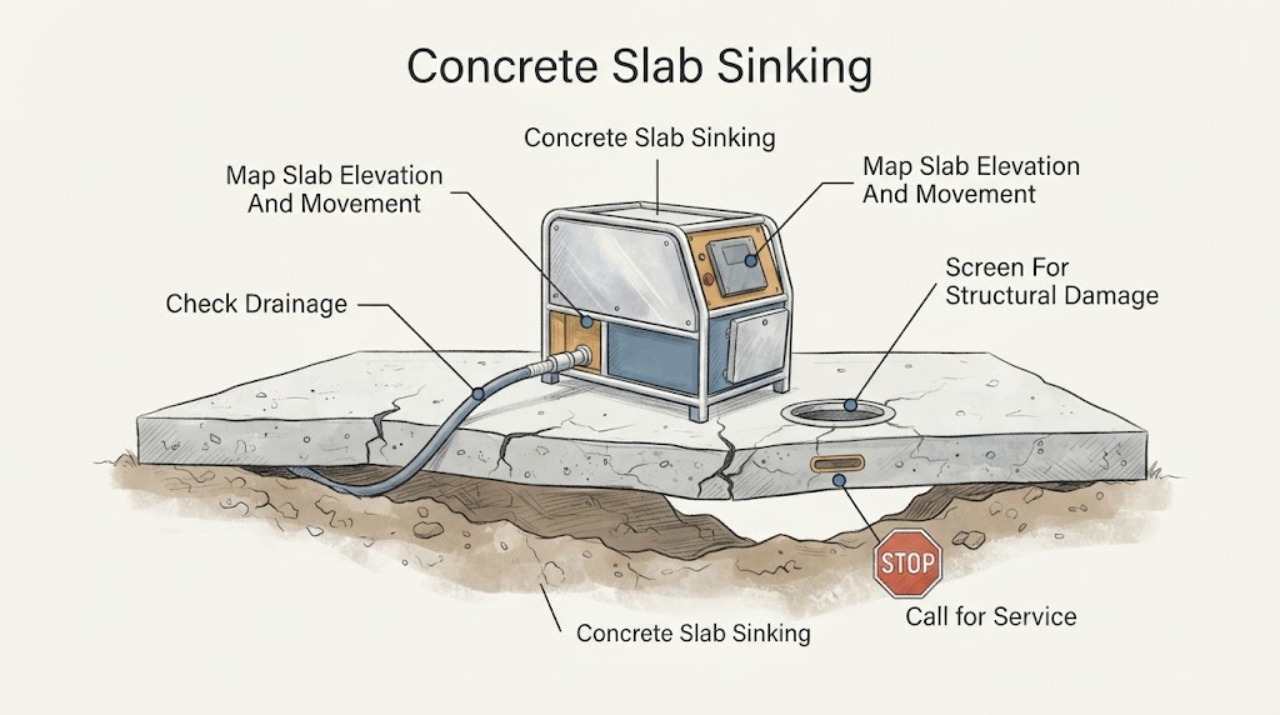
Work through in order
Diagnostic checks
Use only checks that match the exact appliance or system and its official guide.
-
Check 1
From a safe walking position, photograph the slab and mark the visible low edge, high or heaved area, cracks, open joints, trip edges, and any place that rocks or deflects under ordinary foot traffic. Use a straightedge and a level only on stable, accessible areas; do not climb onto unstable sections or place a vehicle on the slab to test it.
Expected result: Record whether the depression is localized at an edge or corner, whether a neighboring section is raised, and whether cracks are tight, widening, offset, or accompanied by rocking.
Next step: Save the photos and measurements for a qualified concrete or foundation assessment. Keep heavy loads off the affected area when it is visibly unsupported or unstable.
Stop if: Stop immediately if the slab shifts, breaks, exposes a deep void, or cannot be crossed safely; keep people and vehicles away and arrange professional assessment.
Why this matters
Why: A localized low area with an adjacent high area suggests differential movement but does not identify whether the cause is an empty subbase, soil movement, drainage, or structural slab damage. Widening cracks, a rocking panel, or a sharp offset means the slab should not be treated as a simple cosmetic level problem.
-
Check 2
Walk the perimeter without entering a gap or excavation and inspect visible ground, joints, edges, downspout discharge, grading, hose or irrigation areas, and signs of soil loss such as muddy paths, washout channels, damp seams, or an exposed underside.
Expected result: Note whether water is directed toward the slab, whether soil is missing at the low edge, and whether the gap changes after rain or irrigation.
Next step: Document the suspected water path and correct only obvious, low-risk surface drainage such as redirecting a loose downspout extension without digging near utilities. Ask the contractor to investigate concealed drainage or plumbing before recommending injection.
Stop if: Do not enter a void, undermine the edge, dig, probe beneath the slab, or handle a leaking utility; stop and call a qualified professional if water is actively removing soil or a support edge is exposed.
Why this matters
Why: A washout or water path supports a loss-of-support hypothesis and means lifting alone could leave the cause active. No visible drainage clue does not rule out a buried leak or a subsurface void.
-
Check 3
From the surface, inspect for intersecting cracks, shattered or spalled concrete, displaced joints, exposed reinforcement, broken corners, heaved sections, and any nearby wall, step, door, or utility feature that moved with the slab.
Expected result: Separate a mostly intact slab with a localized low spot from a slab with extensive cracking, broken edges, differential movement, or movement connected to a building element.
Next step: Give the contractor the complete photo set and ask whether a structural or geotechnical assessment is needed before any lift. Do not select a method based only on the advertised material.
Stop if: Keep off the slab and escalate promptly if there is a large open crack, a broken or rocking panel, exposed undermined edge, sudden change, or movement of an adjoining wall or footing.
Why this matters
Why: Localized loss of support can be a candidate for professional stabilization or lifting, but extensive structural distress or movement tied to a foundation may require a different repair or replacement. Injection can fill a void without restoring damaged concrete or fixing a moving foundation.
-
Check 4
Without intentionally loading the damaged area, note whether ordinary walking, a door or gate crossing, rainfall, or normal non-heavy use causes visible flexing, rocking, new sounds, or water movement at the edge. Do not use a car, jack, pry bar, or stacked weight as a test.
Expected result: Record whether movement is repeatable with normal low-risk activity, only appears after water, or is absent while the surface remains uneven.
Next step: Include the circumstances and video or photographs in the service request. Ask for a support evaluation rather than requesting a predetermined polyjacking dose or lift.
Stop if: Stop all loading if movement increases, a crack opens, material falls away, or the slab rocks; keep the area clear until assessed.
Why this matters
Why: Repeatable deflection is consistent with poor support but cannot determine the void size or safe injection pressure. Movement after water points toward an active drainage or washout issue; a static but badly cracked slab may be damaged even without visible flex.
-
Check 5
Before authorizing work, ask the qualified contractor to identify the suspected cause, explain how support or voids will be evaluated, and state why stabilization, controlled lifting, repair, or replacement fits the observed condition. Ask how drainage, soil movement, cracks, adjoining structures, and post-repair movement will be handled.
Expected result: A sound proposal connects the observed distress to a defined investigation and includes a method-specific safety and verification plan. A proposal that promises to fill or lift based only on surface height, with no cause or damage assessment, leaves the main failure mode unresolved.
Next step: Proceed only after the contractor explains the limits of the proposed repair and any need for drainage, structural, geotechnical, or replacement work. Obtain a second qualified assessment when the slab is connected to a building or has severe damage.
Stop if: Do not drill, inject, mix grout or foam, operate a pump, jack the slab, or authorize work that lacks a cause assessment and a controlled stop plan.
Why this matters
Why: Polyjacking and mudjacking are professional construction processes involving drilled access points, pressure-controlled injection, and monitoring; the homeowner cannot safely choose the hole pattern, material quantity, or lift rate from a visible gap. FHWA also distinguishes filling a void from raising a slab.
Use your observations
Decision map
Find the observation that best matches what you see, then follow the next safe action.
-
PATH 01Safety boundary
What you see
There is a deep or exposed void, sudden movement, a rocking or broken slab, a large open crack, collapse risk, or movement of an adjoining wall, step, footing, or utility.
Do this next
Keep everyone and vehicles away, restrict access without approaching the unstable edge, and contact a qualified structural, foundation, or concrete professional promptly. Use emergency services only for an immediate threat to people or property.
Why this path and its safety boundary
Why it matters: The surface may not safely support people, vehicles, or nearby loads, and a simple void-fill assumption is unsafe.
Safety stop: Do not cross, load, dig under, jack, drill, or inject the area.
-
PATH 02Next step
What you see
Water, irrigation, a downspout, plumbing leak, or visible washout tracks toward or beneath the low area, or the gap changes after water.
Do this next
Redirect only obvious surface discharge when it can be done without digging or approaching the damaged area, then arrange qualified drainage, plumbing, and concrete evaluation before any injection.
Why this path and its safety boundary
Why it matters: The support loss may be active, so lifting without correcting the water path can leave the cause in place.
-
PATH 03Next step
What you see
The slab is generally intact, movement is localized, and a qualified assessment identifies a known void or localized loss of support without severe structural distress.
Do this next
Ask the contractor to distinguish stabilization from jacking, document how the void was identified, and define how lift, cracking risk, and post-work support will be verified.
Why this path and its safety boundary
Why it matters: Professional slab stabilization may be considered to restore support without intentionally raising the slab; a controlled lift may be considered only when the assessment supports it.
-
PATH 04Next step
What you see
The slab is shattered, heavily spalled, sharply offset, tied to moving walls or footings, or continues to heave or sink after the suspected drainage problem is addressed.
Do this next
Have a qualified structural, geotechnical, foundation, or concrete professional compare repair and replacement options; do not treat the slab as a routine leveling job.
Why this path and its safety boundary
Why it matters: Injection may not restore the damaged slab or solve a foundation, soil, or frost-related movement problem.
-
PATH 05Next step
What you see
No visible void or drainage explanation is confirmed, or a contractor cannot explain how the suspected support loss will be evaluated.
Do this next
Pause the repair decision, preserve the documentation, and obtain a qualified assessment that addresses support, drainage, soil movement, and slab condition.
Why this path and its safety boundary
Why it matters: Surface unevenness alone cannot establish that polyjacking or mudjacking is appropriate.
Helpful context
Understand the symptom
What sinking, uneven heave, and a void can mean
A low edge or corner may be losing support as water carries soil or base material away. Repeated loading can worsen a void and increase slab deflection, while frost or swelling soil can push a different area upward. A slab can therefore show both a depressed area and an adjacent high or heaved area. A visible gap is not proof that polyurethane is the right material: the source of water, the condition of the concrete, the size and location of the void, and the relationship to walls, steps, utilities, or footings all change the repair decision.
Polyjacking versus mudjacking is a decision after diagnosis
FHWA uses slab stabilization for filling a known void without intentionally raising the slab, and slab jacking for raising a settled slab through carefully selected injection locations. Polyurethane and cement-based grout are both described as possible materials for these professional operations. The visible symptom alone does not establish the injection pattern, pressure, quantity, or whether a lift is safe. Severe cracking, structural deterioration, an active washout, or a continuing drainage problem may make replacement or a separate foundation or drainage repair more appropriate.
Why the cause must be addressed first
Oregon DOT's follow-up notes that injected polyurethane was used at sites affected by water drainage and unstable subgrades, but also states that the method does not guarantee success and that the cause of settling should be defined before selecting an action. A contractor should explain how the suspected void or weak support was identified, what drainage or soil issue will be corrected, and how the finished slab will be checked for support and movement.
Safety boundary
Stop conditions
- Do not drill the slab, inject polyurethane, foam, grout, or other material, or operate slab-jacking equipment as a homeowner.
- Do not jack, pry, lift, undermine, excavate beneath, or pressure-test the slab with vehicles or improvised weights.
- Do not enter a void, crawl beneath an unsupported slab, or handle a leaking utility or unstable edge.
- Stop loading and keep people and vehicles away if the slab rocks, shifts, cracks further, exposes a deep void, or moves an adjoining wall, step, footing, or utility.
- A professional should stop and reassess if injection does not reach the intended void, if the slab begins to lift or crack unexpectedly, or if water continues to move through the support area.
When checks do not resolve it
Need a professional?
Safety scope: The homeowner should not drill, inject, jack, undermine, enter a void, or perform a load test. The professional should establish the cause, select stabilization, lifting, repair, or replacement, and define how unexpected movement or cracking will stop the work.
Common questions
FAQ
Is a visible gap under a concrete slab proof that I need polyjacking?
No. A gap can reflect drainage-driven erosion, a weak or shifting subgrade, or slab movement, and a visible gap does not establish its extent or the correct material. Have the cause and slab condition assessed before choosing stabilization, lifting, repair, or replacement.
What is the difference between slab stabilization and slab jacking?
FHWA describes stabilization as filling a known void to restore support without intentionally lifting the slab. Slab jacking is intended to raise a settled slab. A professional must decide which objective fits the actual distress.
Can I drill small holes and inject expanding foam myself?
Do not. Drilling and pressure injection can damage the slab, miss the void, lift or crack the concrete, affect nearby structures or utilities, and leave an active drainage or soil problem unresolved. Treat polyjacking and mudjacking as professional construction work.
When should a sinking slab be kept unloaded?
Keep people, vehicles, and heavy loads away when the slab rocks, shifts, has a deep exposed void, a large open or worsening crack, broken edges, sudden movement, or movement connected to a wall, step, footing, or utility. Arrange qualified assessment promptly.
Read the exact guide
Official sources
- Follow Up of Injected Polyurethane Slab JackingOregon Department of Transportation · Reports use of polyurethane slab jacking for drainage and unstable-subgrade problems while emphasizing that the cause of settlement must be defined and success is not guaranteed.
- Techbrief: Concrete Pavement Rehabilitation and Preservation TreatmentsFederal Highway Administration · Explains that stabilization fills known voids, that distress and nondestructive evaluation inform the decision, and that injection is monitored professional construction work.
- Pavements – FHWA InfoTechnologyFederal Highway Administration · States that high edge deflection may indicate a void and that voids represent poor support that can accelerate cracking and other distress.
- Strategies for Concrete Pavement PreservationFederal Highway Administration · Defines void filling versus raising a settled concrete slab and identifies grout and polyurethane as professional treatment materials.
- 2.0 Selection of Candidate Projects - Full-Depth Repairs - ConcreteFederal Highway Administration · Connects marginal support, heavy loading, pumping, voids, cracking, and severe slab distress to different repair decisions.
Community feedback
Share a repair observation
Share a plain-text repair observation. Accepted observations are published automatically; this page may take a moment to update.