
On this page
Start here
Quick answer
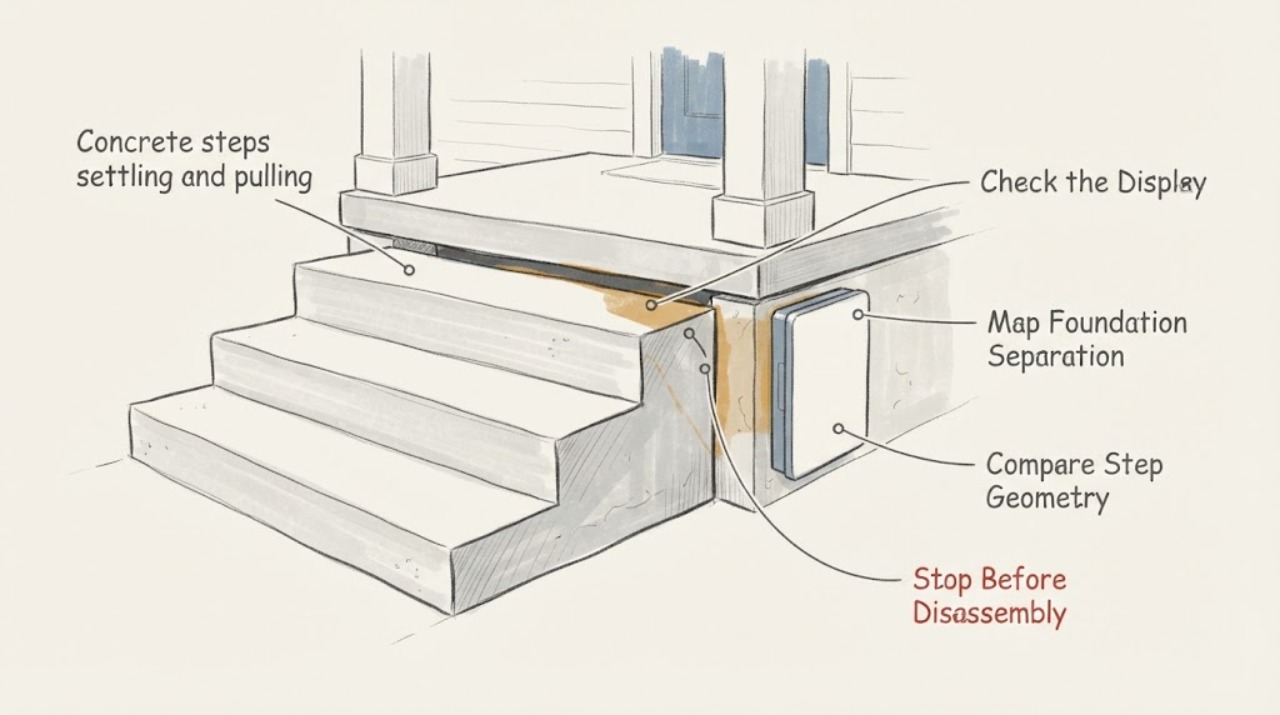
Concrete steps pulling away from a porch or house foundation can reflect different rates of settlement, but the gap alone does not prove that the house foundation has failed. Keep the route controlled, document the gap, cracks, level changes, drainage, and any movement from stable ground, and have a qualified concrete or structural professional assess the support and connection before any lifting, anchoring, grouting, crack injection, or demolition is attempted.
Work through in order
Diagnostic checks
Use only checks that match the exact appliance or system and its official guide.
-
Check 1
From stable ground, control access to the steps and identify whether they are the only entrance, an emergency exit, or the route used by someone with a mobility limitation. Look for a loose handrail, changed riser or tread height, a tilted landing, an opening at the walking surface, or any rocking when viewed from a safe position; do not load-test questionable steps.
Expected result: The route is stable and passable without a loose rail, rocking movement, abrupt level change, exposed void, or a need to step across the separation.
Next step: If the route is not clearly stable, block it and use a known safe alternative while arranging assessment. If it is stable, continue only with non-contact observations from ground level.
Stop if: Stop and keep people off the steps for rocking, a detached or loose handrail, a dropped or tilted tread, exposed soil or voids, falling concrete, or a blocked only exit.
Why this matters
Why: A changed or unstable route is an immediate access and fall concern even if the house foundation itself is unaffected.
-
Check 2
Photograph and mark the visible interface from the front and both sides without probing, wedging, or removing joint material. Record whether the separation is continuous along the porch, localized at one corner, vertical, horizontal, or accompanied by cracks through the step or landing; include a stable reference in each photograph.
Expected result: The gap or crack is isolated or extends through the landing, changes width along the interface, and shows fresh edges, displaced surfaces, or evidence of recent widening.
Next step: Keep the record for the professional and compare it only from the same safe viewpoints over time. Do not make a repair based on the gap width alone.
Stop if: Stop the inspection if the only way to see the joint requires stepping on an unstable surface, lifting a cover, digging, or moving concrete.
Why this matters
Why: A localized interface gap may be a movement joint or differential settlement clue; a widening or displaced gap needs a cause and movement assessment, not cosmetic filling.
-
Check 3
Compare the step and landing geometry with an older photograph or a clearly undisturbed adjacent reference, using only a level viewpoint from stable ground. Note a changed riser, sloped or sunken landing, one corner higher than the other, a step pulled away from the porch, or a stair run that no longer meets the landing squarely.
Expected result: The step or landing has a consistent level change, tilt, sag, heave, or misalignment rather than only a superficial line in the finish.
Next step: Record which step moved and in which direction, then request an assessment of the subgrade, footing, porch attachment, and drainage. Do not compensate with loose shims, blocks, wedges, or a new top layer.
Stop if: Stop if the landing or any step moves, sounds hollow with loose material, has a deep void below it, or cannot be viewed without unsafe access.
Why this matters
Why: A geometric change indicates displacement of the support or slab and is more consequential than an isolated hairline surface crack; it can also create a trip hazard.
-
Check 4
From stable ground and without digging, inspect the soil and drainage around the steps after normal wet weather if practical. Look for water gathering in the separation, runoff directed toward the house, downspout discharge at the porch, softened soil, erosion, or a void under an edge; do not create a hose test or enter a void.
Expected result: Water is collecting at the foundation interface, the grade sends runoff toward the house, or soil has washed out below or beside the steps.
Next step: Keep people off affected areas and have the professional include drainage and soil support in the scope. Do not backfill, regrade against the foundation, or seal the gap before the source and support are assessed.
Stop if: Stop for active flowing water, a visible undermined edge, saturated or collapsing soil, or any need to enter beneath the steps.
Why this matters
Why: Moisture, poor grading, and freeze-thaw movement can contribute to shifting around stairs and porches; erosion or a void can remove support and raise the risk of sudden movement.
-
Check 5
From a safe position, record crack direction and location on the treads, risers, landing, porch, and adjacent foundation, along with spalling, loose pieces, exposed reinforcement, or crumbling edges. Photograph the pattern and avoid scraping, filling, injecting, or striking the concrete.
Expected result: Cracks are only hairline and unchanged, or they are wide-looking, growing, stepped, diagonal, through a corner, paired with displacement, or accompanied by spalling and loose concrete.
Next step: Use the pattern and photographs to request concrete and, when the porch or foundation connection is implicated, structural review. Do not select a filler or repair method until movement has stopped and the cause is known.
Stop if: Stop and close the route for falling or loose concrete, exposed reinforcement with unstable surrounding material, a crack that is opening, or any associated wall or porch movement.
Why this matters
Why: A surface crack can be minor, but a growing or displaced crack, spalling, or loose concrete changes the issue from cosmetic maintenance to an assessment of support and safe access.
-
Check 6
Assemble dated photographs, the direction and approximate location of the separation, prior repair history, recent drainage or freeze-thaw events, and any related changes in the porch, foundation, doors, or nearby slabs. Tell the assessor whether the steps appear independent or connected; do not remove finishes or expose an attachment yourself.
Expected result: The record separates what is visible from what is suspected and identifies access limits, weather, lighting, and any area that could not be inspected safely.
Next step: Request a qualified concrete or structural professional to inspect the complete load path, support, drainage, and connection before repair design. Follow the written scope and local requirements for any corrective work.
Stop if: Do not continue DIY investigation when the connection, footing, load transfer, or a concealed void must be exposed to answer the question.
Why this matters
Why: A clear record helps the professional decide whether a concrete repair visit, foundation investigation, or structural assessment is needed and prevents an unsupported diagnosis from becoming the repair plan.
Use your observations
Decision map
Find the observation that best matches what you see, then follow the next safe action.
-
PATH 01Next step
What you see
The steps rock, have a changed or tilted walking surface, a loose rail, a void, falling concrete, or are the only route and cannot be shown stable.
Do this next
Close or control the route immediately, keep people clear, and arrange urgent qualified assessment. Do not test by walking on it or by adding temporary supports.
-
PATH 02Next step
What you see
The separation is widening, the step geometry has changed, or cracks run with visible displacement through the steps, landing, porch, or adjacent foundation.
Do this next
Treat it as a movement and support question. Request concrete and structural review of the footing, subgrade, load transfer, and house/porch connection before any cosmetic repair.
-
PATH 03Next step
What you see
Water gathers at the interface, runs toward the house, or has eroded or softened soil below the steps.
Do this next
Keep the affected area controlled and have drainage and support assessed together. Do not dig below the steps, redirect water against the foundation, or fill the opening before the cause is documented.
-
PATH 04Next step
What you see
The steps remain stable, the route is safe, there is no visible displacement or water damage, and the separation appears isolated.
Do this next
Keep the dated record and schedule a non-emergency assessment. A stable appearance does not establish whether the gap is a movement joint or completed settlement, so do not assume that sealant or grout is the correct repair.
-
PATH 05Next step
What you see
The porch or steps appear attached to the house, the roof or wall junction has opened, or related foundation and building elements are also moving.
Do this next
Use a qualified structural professional who can assess the connection and load transfer. Keep inspection non-destructive unless the professional defines a safe investigation scope.
Helpful context
Understand the symptom
What the separation can and cannot tell you
A crack or gap where concrete stairs or a landing meets the house foundation may mean the two structures are settling at different rates. It does not, by itself, identify whether the movement is in the steps, their soil or footing, the porch, or the house foundation. Treat the interface as a movement clue and record related changes before choosing a repair.
Look for water and a changed walking route
Settlement, heaving, tilting, gaps, and cracks can deform hard walking surfaces and create accessibility or trip concerns. Water collecting at the separation, running toward the foundation, or washing soil from below can change the urgency. A surface patch or sealant is not a substitute for finding the cause; FHWA notes that sealing does not hold displaced concrete segments together when underlying drainage or structural damage remains.
Why connection and re-support need a professional assessment
Whether the steps are independent, attached to the porch, or tied into the house changes the load path and the repair. A structural assessment should distinguish observed facts from opinions, describe the structural form and load transfer, and state inspection limitations. Do not assume that adding anchors, jacking the steps, filling the gap, or recasting a tread will restore a safe connection.
Only after diagnosis
Potential parts
- concrete step or landing repair material
Consider this category only after an assessment confirms that surface repair or replacement is appropriate and movement or support problems have been addressed.
Match the material and finish to the existing concrete and the written repair scope; do not use a filler to bridge a moving structural separation. - drainage correction component
Consider this category only if the inspection finds runoff, ponding, or erosion contributing to the loss of support.
Confirm the site grade, discharge path, local requirements, and foundation-water-control plan before selecting a component. - structural support or connector
Consider this category only when a qualified professional documents that an attachment, footing, or support repair is required.
Connector size, embedment, corrosion protection, and compatibility depend on the actual concrete, masonry, soil, and load path; do not select from the gap alone.
When checks do not resolve it
Need a professional?
The steps rock, the walking geometry has changed, or the route is a trip or fall hazard., The gap is widening, cracks are growing or displaced, or concrete is loose, spalling, or exposing reinforcement., Water, erosion, softened soil, or a void is affecting support near the steps or foundation., The porch or steps may be attached to the house, or related wall, roof, door, or foundation movement is present.
Common questions
FAQ
Does a gap between concrete steps and the foundation mean the foundation is failing?
Not by itself. The gap can reflect different settlement rates between the steps, porch, and house. Check for displacement, widening, drainage problems, and related building movement, then have the support and connection assessed before choosing a repair.
Can I fill the gap with grout or concrete?
Do not use a filler as a diagnostic or as a bridge across a moving separation. A professional should first determine whether the steps are stable, whether the gap is a movement joint, and whether water or lost support is involved.
What if the steps look stable but the separation is visible?
Photograph and record the gap from safe ground, monitor only from the same viewpoints, and arrange a planned assessment. A stable appearance does not establish the cause or prove that the separation is harmless.
When should I keep people off the steps?
Keep the route closed for rocking or tilted steps, changed risers or treads, a loose rail, exposed voids, falling or crumbling concrete, active erosion or water, widening cracks, or any condition that makes the route unsafe or impassable.
Who should assess steps that may be connected to the porch foundation?
Start with a qualified concrete professional and involve a structural professional when the porch or steps may transfer load to the house, the foundation is also moving, or the connection and support cannot be established by a safe visual inspection.
Read the exact guide
Official sources
- Homeowner's manualCanada Mortgage and Housing Corporation · Canadian government housing maintenance guidance for stairs, porches, decks, drainage, and foundation interfaces
- Structural assessments and investigationsGOV.UK · Government guidance on when and how to obtain professional structural assessment, defining scope, documenting inspection limits, load transfer, findings, and recommendations
- Guide for Maintaining Pedestrian Facilities for Enhanced SafetyU.S. Department of Transportation, Federal Highway Administration · U.S. federal guidance on concrete pedestrian-facility cracking, settlement, heaving, displacement, trip hazards, inspection, and repair limits
Community feedback
Share a repair observation
Share a plain-text repair observation. Accepted observations are published automatically; this page may take a moment to update.