
On this page
Start here
Quick answer
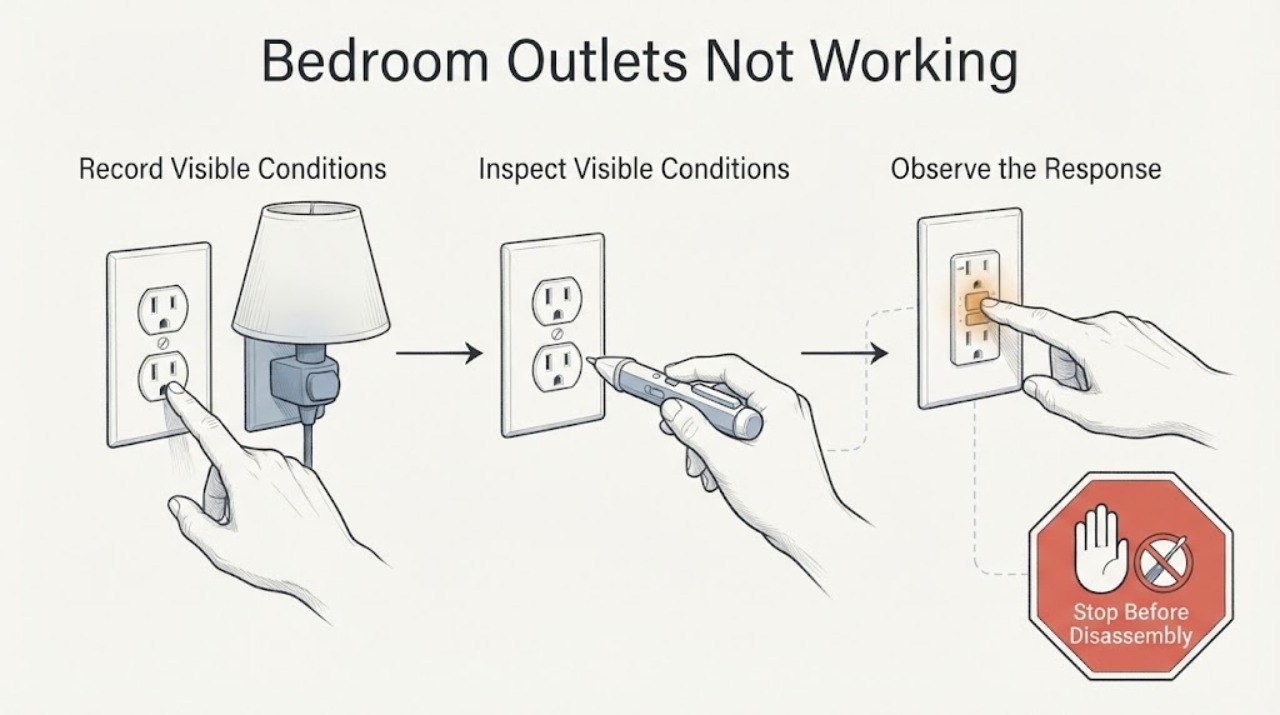
If several bedroom receptacles are dead, first prove the symptom with a known-working lamp, map which outlets and nearby lights are affected, and look for a tripped GFCI receptacle or breaker. A GFCI in a bathroom, garage, kitchen, basement, laundry area, or outside can protect receptacles farther downstream, so a reset may restore the bedroom. If a breaker or GFCI trips again, an outlet is hot, discolored, loose, wet, sparking, or smells burned, stop using the circuit. Do not remove receptacle covers or the panel, probe the slots, bypass the GFCI, or take live measurements; have a qualified electrician trace the branch circuit and its daisy-chain connections.
Work through in order
Diagnostic checks
Use only checks that match the exact appliance or system and its official guide.
-
Check 1
Use a lamp or charger that works in a known-good receptacle, then try it in the bedroom outlets without probing the slots. Record which receptacles are dead, whether a bedroom light or outlets in adjacent rooms also lost power, and whether the device works when returned to the known-good outlet.
Expected result: Only one receptacle is dead, every bedroom receptacle is dead, several rooms are affected, or the test device also fails in a known-good outlet.
Next step: Use the map for the GFCI and breaker checks. If the lamp, receptacle, plug, or wall is hot, discolored, wet, loose, sparking, or smells burned, stop using it and arrange urgent qualified electrical help.
Why this matters
Why: A single dead receptacle points to a local device or connection; a group of dead outlets is more consistent with a shared upstream GFCI, breaker, or branch-circuit interruption. A failed test device is not evidence of an electrical fault.
-
Check 2
With dry hands and no visible moisture or damage, look for accessible GFCI receptacles and their RESET buttons in the bathroom, garage, kitchen, laundry or utility area, basement or crawlspace, and exterior areas. Include GFCI devices near sinks or other wet locations even if they are not in the bedroom.
Expected result: A GFCI is tripped, its RESET button stays in, it resets and the bedroom power returns, or it will not reset or immediately trips again.
Next step: If the device resets and remains stable, reconnect loads one at a time and stop if the protection trips. If it will not reset, trips again, is cracked or wet, or the area is unsafe, leave it alone and call a qualified electrician.
Why this matters
Why: A reset that restores the bedroom supports an upstream GFCI interruption because a receptacle GFCI can protect outlets downstream. A GFCI that will not reset or trips again indicates an unresolved fault, overload, damaged device, or wiring problem rather than a reason to bypass protection.
-
Check 3
If there are no danger signs, look at the breaker labels and handle positions without removing the panel cover. An apparently ON breaker can be tripped into an intermediate position; operate only the identified branch handle by moving it fully OFF and then ON, following the panel labeling and your local equipment instructions.
Expected result: One breaker is visibly tripped, power returns after a single reset, no breaker is tripped, or the breaker trips again immediately or when a load is connected.
Next step: If it trips again, leave it in the safe position and unplug affected portable loads without touching damaged cords or plugs. Do not remove the panel cover, change breaker ratings, or continue resetting; arrange qualified electrical service.
Why this matters
Why: A breaker reset can restore a branch-circuit interruption. A repeat trip is evidence of an overload, short, ground fault, defective appliance, or wiring fault; it is not a signal to use a larger-rated protective device or keep resetting it.
-
Check 4
Unplug portable bedroom loads such as heaters, chargers, lamps, power strips, and fans from the affected outlets, leaving any questionable cord or plug untouched. After a GFCI or breaker has been reset, observe whether the circuit stays on with the loads disconnected; do not reconnect a device with a damaged cord, scorch mark, odor, or wet plug.
Expected result: Power stays on with loads removed, one particular device makes the protection trip, or the protection still trips with all portable loads removed.
Next step: Keep the suspect device disconnected and have it repaired or replaced appropriately. If the empty circuit still trips or will not restore, stop resetting and call an electrician to trace the circuit.
Why this matters
Why: Stability with loads removed makes an appliance, cord, power strip, or overload more likely. A trip with no portable load points more toward the fixed wiring, receptacle, GFCI, or another connected part of the branch circuit.
-
Check 5
From outside the boxes, inspect the affected receptacles and wall area for a loose-fitting plug, cracked cover, discoloration, warmth, moisture, buzzing, or an odor of overheated insulation. Do not remove a cover, pull a receptacle forward, tighten a screw, or insert a tester into the outlet.
Expected result: The receptacle is physically sound and cool, a plug falls out or the cover is cracked, the wall or faceplate is warm or discolored, or there is buzzing, odor, smoke, or visible arcing.
Next step: Stop using and keep people away from any damaged, hot, wet, buzzing, smoking, or sparking outlet. If there is smoke or active arcing, move away and contact emergency or fire services as appropriate; otherwise arrange a qualified electrician without opening the wiring.
Why this matters
Why: A loose plug can indicate worn contact; heat, discoloration, buzzing, odor, smoke, sparks, or a shock are warning signs of a possible fire or shock hazard. A visually normal receptacle can still have a hidden open connection, so appearance alone does not clear the circuit.
-
Check 6
Map the sequence without disassembly: mark the nearest known-live receptacle before the first dead one, note whether an upstream GFCI or breaker was reset, and identify the first dead outlet after any live outlet. Photograph only the exterior labels and location if useful; do not assume the physically nearest outlet is electrically first.
Expected result: All affected outlets are downstream of one GFCI, one live outlet is followed by dead outlets, no accessible protective device explains the pattern, or outlets in multiple rooms share the same interruption.
Next step: Give the electrician the map, breaker/GFCI observations, recent work, and connected loads. Do not remove any receptacle or junction-box cover to follow the daisy chain.
Why this matters
Why: A live-to-dead boundary makes an open device, connection, cable segment, or upstream protective device more likely in the branch path. Several rooms on one branch may share a breaker or GFCI. The pattern identifies where an electrician should start, but cannot safely identify a repair part from outside.
-
Check 7
Stop the homeowner checks once the safe external checks are complete, especially if the bedroom outlets remain dead after one appropriate GFCI or breaker reset. Tell the electrician exactly which outlets are dead, which remain live, which protective devices were checked, whether a load caused a trip, and whether there was heat, odor, buzzing, moisture, or prior electrical work.
Expected result: The reset restored stable power, the group remains dead with no visible hazard, the circuit will not reset, or any shock, heat, smoke, sparks, water, damaged wiring, or repeated trip occurred.
Next step: For an unresolved outage, live-to-dead boundary, failed GFCI, loose receptacle, or repeat trip, schedule qualified electrical service. Do not open the panel or boxes, perform live tests, replace the GFCI, or bypass a protective device as a homeowner shortcut.
Why this matters
Why: Stable restoration supports a protective-device event, but a recurring or unexplained outage requires circuit diagnosis. Repeated trips and warning signs can indicate an electrical safety defect that cannot be assigned to a receptacle by symptoms alone.
Use your observations
Decision map
Find the observation that best matches what you see, then follow the next safe action.
-
PATH 01Next step
What you see
The test lamp fails in a known-good receptacle, or only one bedroom receptacle is dead while the others work.
Do this next
The symptom may be the test device or a local receptacle problem rather than a room-wide upstream outage.
-
PATH 02Next step
What you see
A GFCI in another room resets and the bedroom outlets return, then remain powered with normal loads.
Do this next
The bedroom outlets were likely downstream of that protective device and were interrupted by its trip.
-
PATH 03Next step
What you see
One labeled breaker was tripped, resets once, and the circuit remains on after portable loads are disconnected.
Do this next
A branch interruption, overload, or connected-device fault is more likely than a permanently open outlet.
-
PATH 04Next step
What you see
The GFCI or breaker trips again, will not reset, or trips while all portable loads are unplugged.
Do this next
An unresolved ground fault, short, overload, failed protective device, or fixed-wiring problem is more likely.
-
PATH 05Next step
What you see
One receptacle is live but the next outlets in the apparent path are dead, with no protective device explaining the boundary.
Do this next
An open connection, failed receptacle, cable segment, or hidden junction in the daisy-chain path is more likely; the first physically nearest outlet may not be electrically upstream.
-
PATH 06Next step
What you see
Any outlet or faceplate is hot, wet, cracked, loose, discolored, buzzing, smoking, sparking, or gives a shock, or there is an overheated odor.
Do this next
This is a potential shock or fire hazard, not a routine no-power reset problem.
Helpful context
Understand the symptom
Why one reset can affect several bedroom outlets
Bedroom receptacles are often supplied by one branch circuit, and receptacles can be connected in sequence. The first protective device or connection in that path can affect outlets farther along it. CPSC explains that a receptacle GFCI protects downstream outlets, so the device that needs attention may be in another room rather than beside the dead bedroom outlet. This is a reason to map the symptom and check accessible protective devices, not a reason to open an outlet box.
Keep the checks outside the wiring
The safe homeowner checks here are observation, unplugging loads, operating an accessible GFCI button, and operating a breaker handle only when the circuit shows no danger signs. A dead receptacle can also hide a loose connection, failed device, damaged conductor, or upstream problem. The CPSC wiring guide says that finding and repairing defects in an electrical system is work for qualified electrical professionals; do not remove the receptacle faceplate or service-panel cover to inspect a daisy chain.
What not to infer from a dead outlet
A dark receptacle does not prove that the receptacle itself is the failed part. One live outlet followed by dead outlets suggests a point upstream in the sequence, but the exact fault can be in the device, termination, cable, or protective equipment. OSHA requires electrical work practices that deenergize parts before work and treats parts that are not properly locked or tagged as energized; that professional rule is why a homeowner should stop at external checks and provide the symptom map to an electrician.
Safety boundary
Stop conditions
- Stop immediately for heat, discoloration, buzzing, sparks, smoke, a burning or overheated-insulation odor, moisture, a shock, a cracked or loose receptacle, or a damaged cord or plug.
- Stop after one appropriate GFCI or breaker reset if the device trips again, will not reset, or the bedroom outlets remain dead with no safe explanation.
- Do not remove receptacle covers, pull devices from boxes, remove a panel cover, probe outlet slots, perform live measurements, change protective-device ratings, replace wiring, or bypass a GFCI as a homeowner check.
Only after diagnosis
Potential parts
- GFCI receptacle
Only consider a replacement after an electrician confirms that the GFCI itself has failed and the circuit wiring and load fault have been evaluated.
Confirm the electrical service, installation requirements, and exact device suitability with a qualified electrician; do not substitute a standard receptacle or bypass protection. - branch-circuit protective device
Only consider this category if a qualified electrician diagnoses a failed breaker or GFCI breaker rather than an overload, connected appliance fault, or wiring defect.
Breaker type, rating, panel compatibility, and installation are equipment- and jurisdiction-dependent; never choose a higher rating to stop trips. - receptacle or branch-circuit connection
This category is relevant only when an electrician finds a failed receptacle, open termination, damaged cable, or other fixed connection at the live-to-dead boundary.
The correct repair depends on the existing wiring method and local requirements; the connection must be assessed and repaired by a qualified electrician.
When checks do not resolve it
Need a professional?
Call a qualified electrician for a persistent room-wide outage, a failed or repeatedly tripping GFCI or breaker, a live-to-dead outlet boundary, a loose or damaged receptacle, unexplained loss of power, or any wiring repair. If there is smoke, active arcing, or a developing fire, move away and contact emergency or fire services as appropriate.
Common questions
FAQ
Can a GFCI in another room make bedroom outlets lose power?
Yes. A receptacle GFCI can protect outlets farther downstream on the same branch circuit. Look for accessible GFCI devices in likely wet or utility areas and use the RESET button only with dry hands when the device and area are not damaged or wet. If it will not reset or trips again, stop and call an electrician.
Why are some outlets live while the next bedroom outlets are dead?
That live-to-dead boundary can occur when a receptacle, connection, cable segment, or protective device upstream interrupts the rest of a daisy-chain path. It does not identify a repair part by itself; map the boundary from outside the boxes and give it to a qualified electrician.
Should I keep resetting the breaker if the bedroom outlets remain dead?
No. A single reset may restore a branch interruption when there are no danger signs, but a repeat trip indicates an unresolved fault, overload, connected-device problem, or wiring issue. Leave it in the safe state and arrange qualified electrical service.
Is it safe to remove the bedroom outlet cover to check the daisy chain?
No. Do not remove receptacle covers or the panel cover, tighten terminals, probe slots, or take live measurements as a homeowner check. A qualified electrician can deenergize, verify, and trace the circuit using the required work practices.
When is a dead bedroom outlet an emergency?
Treat heat, discoloration, buzzing, smoke, sparks, a burning odor, moisture, a shock, a cracked or loose receptacle, or a damaged cord or plug as a safety warning. Stop using the area and do not touch or open the device; move away from smoke or active arcing and contact emergency or fire services as appropriate, then arrange qualified electrical help.
Read the exact guide
Official sources
- GFCI Fact SheetU.S. Consumer Product Safety Commission · Residential GFCI receptacles and GFCI breakers
- 1910.333 - Selection and use of work practices.Occupational Safety and Health Administration · Electrical work safety practices used by qualified persons
- CPSC Guide to Home Wiring HazardsU.S. Consumer Product Safety Commission · Home electrical distribution systems and receptacle outlets
Community feedback
Share a repair observation
Share a plain-text repair observation. Accepted observations are published automatically; this page may take a moment to update.