
On this page
Start here
Quick answer
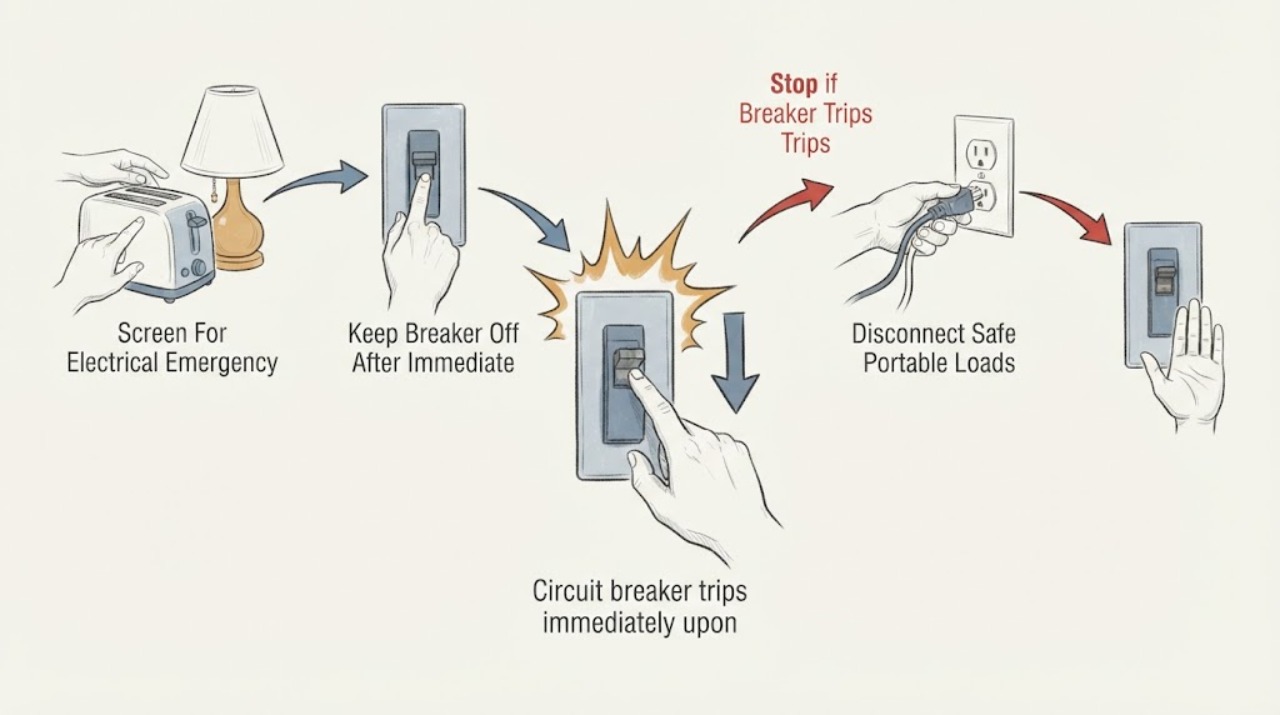
If a circuit breaker trips immediately when you reset it, leave it off and do not keep trying to reset it. A near-instant trip can indicate a short circuit, ground fault, arc-fault condition, a connected appliance or cord failure, miswiring, overload, or a breaker or panel problem. From a dry, safe position, look for smoke, burning odor, buzzing, heat, water, arcing, damaged cords, or a CO or fire warning; leave and call emergency services or the fire department for an active fire or dangerous odor. If there is no immediate hazard, unplug only intact, dry, accessible plug-in loads without touching anything damaged or wet, and note whether the problem followed one appliance or remains with everything disconnected. Do not open the panel cover, touch wiring, remove receptacle plates, bypass protection, perform a live voltage test, change breaker size, or ask the breaker to close again. If it trips again, remains off, or cannot be safely explained by a clearly disconnected portable load, arrange a licensed electrician to isolate and test the circuit.
Work through in order
Diagnostic checks
Use only checks that match the exact appliance or system and its official guide.
-
Check 1
From a safe position, look and listen without touching the panel, outlets, cords, or appliances for smoke, flames, a burning or hot-plastic odor, buzzing or hissing, visible arcing, a hot or discolored plug or switch, water near electrical equipment, a damaged cord, or a fire alarm.
Expected result: There is smoke, flame, an intense burning odor, active arcing, loud buzzing or hissing, heat, water, a fire alarm, or no visible hazard.
Next step: For fire, active arcing, or a dangerous burning condition, leave the area, call emergency services or the fire department from a safe location, and do not throw water on an electrical fire. For water or a suspected energized hazard, keep away and arrange emergency electrical help. If none is present, leave the breaker off and continue only with the dry, accessible-load check.
Why this matters
Why: Fire, arcing, heat, water, or burning odor can indicate an energized fault or fire risk that cannot be safely sorted out by resetting. No visible sign does not clear a hidden short, ground fault, arc fault, or damaged appliance.
-
Check 2
Do not attempt another reset after the breaker trips immediately. Leave the handle in its tripped or OFF state, do not hold it in ON, and do not replace it with a fuse or breaker of a different rating.
Expected result: The breaker remains off, the handle will not stay on, someone has already reset it repeatedly, or the panel label or breaker rating is unclear.
Next step: Stop manual resets and arrange a licensed electrician. Do not open the panel, bypass the breaker, change its rating, or perform a live voltage test to find out why it trips.
Why this matters
Why: An immediate or repeated trip means the protective device is still detecting a condition or needs diagnosis. Reclosing without finding the cause can re-energize a fault; a rating change can remove the protection intended for the circuit conductors.
-
Check 3
Only if the floor, hands, plugs, and equipment are dry and there is no odor, heat, damage, or arcing, unplug intact portable appliances and extension cords that are already accessible on the affected circuit. Do not move furniture to reach a hidden plug, pull a cord through water, or handle a damaged appliance.
Expected result: One appliance or extension cord looks damaged, one known load was connected when the trip began, several loads were connected, or all accessible loads were already disconnected.
Next step: Leave any suspect appliance or cord unplugged and label it for repair or disposal assessment. Do not reconnect it or reset the breaker; if the cause is not clearly isolated without touching hazards, call a licensed electrician.
Why this matters
Why: A malfunctioning product, cord, or concentrated load can create an overload or fault, while a circuit that still trips with portable loads disconnected points more toward fixed wiring, a hidden load, a ground or arc fault, panel work, or the breaker itself. Unplugging does not prove an appliance is safe to reuse.
-
Check 4
From outside the closed panel and without touching wiring, record the breaker label, the room or outlets that lost power, whether a receptacle has Test/Reset buttons, whether the circuit feeds an outdoor, bathroom, kitchen, laundry, or other damp location, and whether a large appliance or recent renovation is involved.
Expected result: Only one room or receptacle is affected, a GFCI or AFCI-style protective device is involved, several rooms or circuits are affected, a high-load appliance is involved, or wiring or remodeling was recent.
Next step: Keep the affected circuit off and give these observations to the electrician. Do not press a GFCI Reset button, remove a receptacle plate, inspect the panel interior, or alter wiring as a way to narrow the cause.
Why this matters
Why: The scope and device type help an electrician distinguish a local appliance or ground-fault path from a broader wiring, load, panel, or installation issue. A damp location increases the importance of ground-fault protection; a recent alteration increases the possibility of an installation or connection fault.
-
Check 5
Visually check only the outside of accessible cords, plugs, receptacle faces, switches, and appliance housings for cuts, crushed sections, melted plastic, discoloration, looseness, moisture, or a hot smell. Do not remove covers, push wires back, tighten terminals, or use a meter.
Expected result: There is visible damage, looseness, discoloration, moisture, a hot smell, or everything visible appears intact.
Next step: Keep the circuit and any suspect equipment out of service and arrange qualified electrical inspection for any abnormal finding. If the exterior looks normal but the breaker trips immediately, do not infer that it is safe to reset; proceed to service.
Why this matters
Why: Visible damage or moisture makes the item or circuit unsafe to energize and may indicate a fault that a breaker is correctly interrupting. Intact exteriors do not rule out a hidden fault inside a cord, appliance, receptacle, wall, or panel.
-
Check 6
Before service, write down when the immediate trip began, what was running, whether the breaker trips with portable loads unplugged, the protective-device label if visible with the panel closed, recent appliance installation or remodeling, any dampness or weather exposure, and any odor, heat, sound, or visible damage. Take photographs only from a safe distance.
Expected result: The event is repeatable with the same appliance, repeatable with all portable loads disconnected, associated with dampness or recent work, or the pattern is uncertain.
Next step: Keep the breaker off and provide the record to a licensed electrician. Do not perform continuity, insulation, voltage, resistance, breaker, or panel tests yourself, and do not restore power merely to reproduce the fault.
Why this matters
Why: A repeatable appliance-linked pattern helps target an appliance or cord inspection; a repeatable no-load trip or post-renovation trip makes fixed wiring, installation, panel, or breaker diagnosis more important. Uncertain history is still safer than repeated energizing.
Use your observations
Decision map
Find the observation that best matches what you see, then follow the next safe action.
-
PATH 01Next step
What you see
Do this next
Leave the breaker off and arrange a licensed electrician to isolate and test the circuit. Do not open the panel, remove receptacles, or reset it to see whether the fault disappears.
-
PATH 02Next step
What you see
Do this next
Keep the suspect item unplugged and do not reconnect it on another outlet to test it. Have the item evaluated by a competent repair person and have an electrician inspect the circuit if the breaker also trips without it.
-
PATH 03Next step
What you see
Do this next
Keep people away from wet equipment, do not press Reset or handle wet plugs, and arrange qualified inspection after the area is safe and dry. Do not defeat GFCI or AFCI protection.
-
PATH 04Next step
What you see
Do this next
Leave the breaker off and have a licensed electrician review the circuit, connections, load, and protection. Do not install a larger breaker, add an extension cord, or move the high-load device around to keep using it.
-
PATH 05Next step
What you see
Do this next
Leave the area and call emergency services or the fire department from a safe location. Do not touch the equipment, throw water on an electrical fire, re-energize the circuit, or re-enter until responders say it is safe.
Helpful context
Understand the symptom
An immediate trip is a protective warning, not a reset problem
A breaker that trips as soon as it is reset is opening because the abnormal condition is still present or because the protective device or its installation needs professional diagnosis. The visible handle does not tell a homeowner whether the cause is a short, ground fault, arc fault, overloaded circuit, damaged appliance, miswire, or a failed breaker. Treat the symptom as a stop-and-isolate event rather than a challenge to hold the handle on.
Safe homeowner checks stop at accessible, dry plug-in loads
If there is no smoke, heat, burning odor, water, or damaged equipment, a homeowner can record the affected room and unplug intact, dry portable loads that are already accessible. Do not pull on damaged cords, handle wet plugs, remove covers, or open receptacles or the panel. The useful result is whether one known appliance or cord is implicated; it is not permission to reconnect the load or reset the breaker repeatedly.
GFCI, AFCI, and ordinary breakers can point to different fault paths
A receptacle with Test and Reset buttons or a breaker with an arc-fault or ground-fault label may be reacting to leakage or arcing rather than a simple overload. A breaker serving one appliance may trip when that appliance or cord is connected; a breaker that trips with every load removed points more toward fixed wiring, a connected hidden load, panel work, or the protective device. These categories guide the electrician's next tests; they do not justify bypassing protection or swapping in a different rating.
Panel and wiring work require a qualified electrician
The panel can contain energized parts even when a branch breaker is off. OSHA requires live parts to be de-energized before work, qualified-person verification and testing before equipment is treated as de-energized, and qualified persons for work on exposed energized parts. This article therefore stops at visual observation and safe unplugging; it does not provide panel-opening, wiring, meter, breaker-replacement, or service-disconnect instructions.
When checks do not resolve it
Need a professional?
Call a licensed electrician promptly for any breaker that trips immediately or trips again, remains off after portable loads are unplugged, is associated with recent remodeling or appliance installation, involves a GFCI or AFCI device, or has no safe, obvious explanation. Give the electrician the affected room, device label, timing, connected loads, recent work, moisture, and visible damage. For smoke, flame, active arcing, or a burning electrical odor, leave and call emergency services or the fire department from a safe location; do not re-energize the circuit until qualified personnel clear it.
Common questions
FAQ
Why does a circuit breaker trip immediately when I reset it?
The fault may still be present. Common categories include a short circuit, ground fault, arc-fault condition, overloaded circuit, failed appliance or cord, miswiring, or a breaker or panel problem. The immediate trip is a reason to leave it off and investigate safely, not to hold it on.
Should I keep resetting a breaker that trips right away?
No. CPSC says to investigate why a breaker trips rather than simply resetting it, and OSHA prohibits repetitive manual reclosing after a repeat trip. Leave the breaker off and call a licensed electrician unless a qualified person has made the circuit safe.
Can I unplug appliances before calling an electrician?
Only from a dry, safe position and only for intact, accessible plug-in loads. Do not touch wet, hot, damaged, sparking, or melted equipment, do not move furniture into a hazard, and do not reconnect a suspect item to test it. Leave the breaker off if the cause is not clearly isolated.
What if the breaker trips even with everything unplugged?
That points away from a single portable appliance and toward fixed wiring, a hidden or hard-wired load, a ground or arc fault, recent installation work, the breaker, or the panel. Keep it off and have a licensed electrician isolate and test the circuit; do not open the panel or remove outlets.
Is an immediate trip from a GFCI or AFCI different?
It may indicate leakage, a ground fault, or arcing rather than a simple overload. Do not defeat or bypass the protection. Keep wet or suspect equipment out of service and arrange qualified inspection, especially in a damp location.
Can I install a larger breaker so it stops tripping?
No. A breaker or fuse must match the circuit design and conductors; changing the rating can remove intended overcurrent protection. Have a licensed electrician determine whether the load, wiring, protective device, or appliance is the problem.
Can I open the panel or test voltage to find the fault?
Not as a homeowner troubleshooting step. The panel may contain energized parts even when a branch breaker is off. OSHA reserves exposed energized work and electrical testing for qualified persons using appropriate procedures and equipment.
When is an immediately tripping breaker an emergency?
Treat smoke, flame, active arcing, a hot or burning smell, loud buzzing or hissing, hot or melted equipment, water near electrical equipment, or a fire alarm as an emergency. Leave, call emergency services or the fire department from a safe location, and do not re-energize the circuit until responders and qualified personnel clear it.
Read the exact guide
Official sources
- eTool : Construction - Electrical Incidents - Ground-Fault Circuit Interrupters (GFCI)Occupational Safety and Health Administration · GFCI purpose, ground-fault current paths, and rapid protective interruption
- Governor Whitmer Proclaims May as Electrical Safety MonthMichigan Department of Licensing and Regulatory Affairs · Michigan home electrical-safety warnings, immediate breaker trips, overloaded outlets, GFCI protection, and licensed-electrician escalation
- Resetting the Circuit Breaker After a Trip Due to an Electrical FaultSchneider Electric · Schneider Electric MasterPact fault-trip reset sequence, isolation before inspection, and prohibition on re-closing onto an electrical fault; equipment-specific guidance
- 1910.333 - Selection and use of work practices.Occupational Safety and Health Administration · Electrical shock protection, de-energized verification, re-energization, and qualified-person requirements for exposed circuit parts
- Commission Closes Investigation Of FPE Circuit Breakers And Provides Safety Information For ConsumersU.S. Consumer Product Safety Commission · Consumer circuit-breaker safety, overload and short-circuit warnings, disconnecting malfunctioning products, and investigating a trip instead of simply resetting
- Qualifications for resetting circuits or replacing fuses; electrical enclosures must be approved.Occupational Safety and Health Administration · OSHA interpretation of safe circuit re-energization, prohibition on repetitive manual reclosing, and qualified-person boundaries
Community feedback
Share a repair observation
Share a plain-text repair observation. Accepted observations are published automatically; this page may take a moment to update.