
On this page
Start here
Quick answer
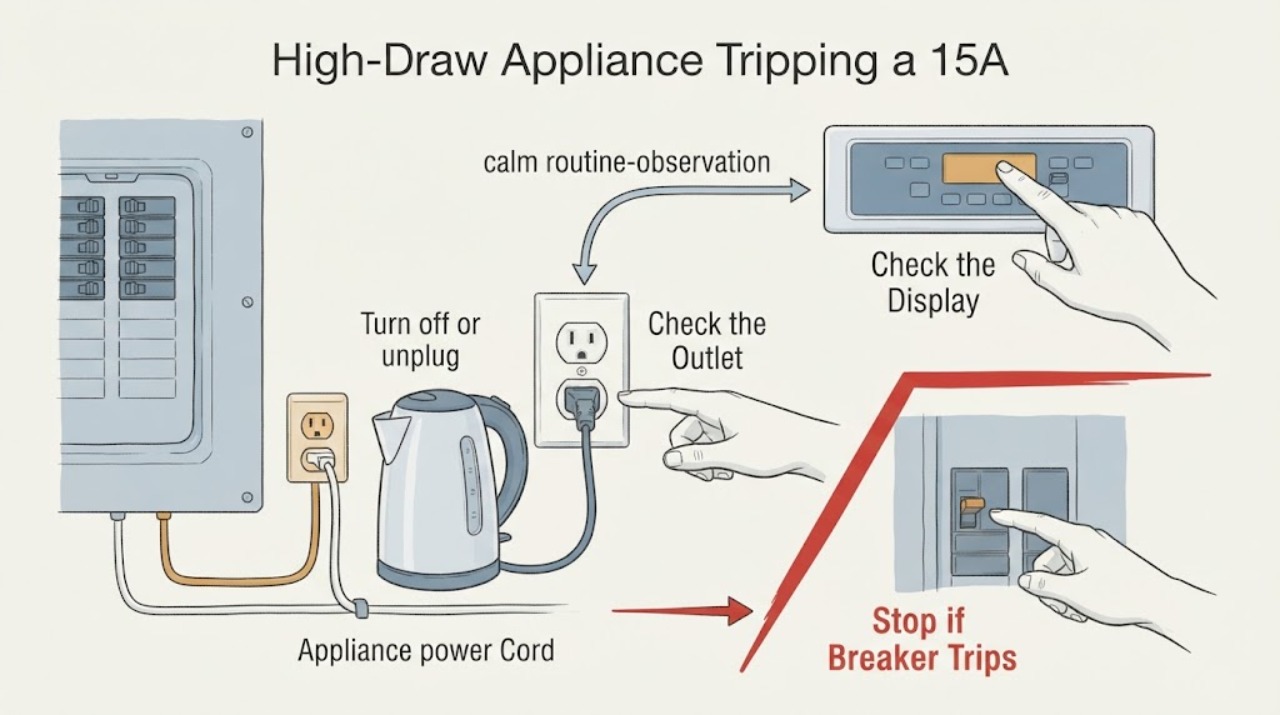
Stop the appliance, disconnect it if the plug and outlet are cool and undamaged, and switch off other devices on the same bedroom circuit. With dry hands and no smoke, scorching, buzzing, water, or heat, reset the breaker once by moving it fully OFF and then ON; do not keep resetting it. If the breaker trips immediately with the appliance disconnected, will not stay on, or the outlet, plug, or cord is hot, discolored, damaged, wet, or buzzing, leave the circuit off when safe and call a qualified electrician. If it holds with other loads removed but trips again when one appliance is connected, leave that appliance unplugged and have the appliance and circuit evaluated. Do not install a larger breaker, bypass an AFCI/GFCI, open the service-panel cover, or perform internal wiring tests.
Work through in order
Diagnostic checks
Use only checks that match the exact appliance or system and its official guide.
-
Check 1
Stop the appliance with its normal control, then disconnect its plug only if the plug and receptacle are cool, dry, and visibly intact; otherwise leave it alone and keep clear.
Expected result: Note whether the breaker opened at startup, after the appliance had run for a while, or only after another device was used. Look at the plug and outlet face for heat, discoloration, melting, looseness, buzzing, sparks, smoke, moisture, or cord damage.
Next step: If any warning sign is present, stop troubleshooting, leave the appliance disconnected, and arrange qualified electrical service. If there are no warning signs, continue with the other-load isolation check without opening any cover.
Why this matters
Why: Repeated opening, a hot or damaged connection, or an odor is a safety fault pattern rather than a routine nuisance trip. Timing can help describe the event but cannot by itself separate an overload from an appliance, receptacle, wiring, or breaker fault.
-
Check 2
Turn off or unplug the other visible devices that may share the bedroom circuit, leaving the suspected appliance disconnected; operate the breaker handle once by moving it fully OFF and then ON only if the handle and surrounding area are dry and undamaged.
Expected result: The breaker stays on with the suspected appliance and other loads disconnected, or it trips immediately or will not stay on even with those loads removed.
Next step: If it will not stay on, stop operating the breaker and call a qualified electrician. If it holds, do not reconnect the high-draw appliance yet; document the result and continue with a visual appliance and connection check.
Why this matters
Why: Holding with the loads removed makes a shared-load condition or a device-specific fault more plausible, but does not prove either one. Immediate re-opening with loads removed makes a circuit, breaker, or other fixed-wiring fault more concerning.
-
Check 3
With the appliance still disconnected, inspect only the visible appliance cord, plug, and outlet face; do not remove the outlet plate or insert tools into the receptacle.
Expected result: The cord insulation is split or crushed, the plug blades or body are damaged, the outlet face is discolored or loose, or there is no visible damage.
Next step: Do not use or repeatedly reconnect equipment with visible damage; have the damaged item or connection assessed. If there is no visible damage, keep the appliance disconnected while checking the circuit's load pattern.
Why this matters
Why: Visible cord, plug, or receptacle damage raises the likelihood of a connection or equipment fault and can create shock or fire risk. A clean appearance does not rule out an internal appliance or wiring problem.
-
Check 4
Identify which outlets and devices lose power when this bedroom breaker opens, and list every device that was operating at the time; use the breaker label as a clue, not as proof of the circuit boundary.
Expected result: Several bedroom or nearby devices lose power together, or the suspected appliance appears to be the only load that was active.
Next step: Keep high-draw equipment off that circuit and do not add a power strip or extension cord. Give the electrician the device list, breaker rating, and exact trip timing so the load and circuit can be checked safely.
Why this matters
Why: Several devices on one branch circuit make a shared-load or circuit-capacity issue more plausible. A single appliance that reliably causes the trip makes an appliance, cord, plug, receptacle, or appliance-specific fault more plausible, although the circuit still needs assessment.
-
Check 5
If the breaker holds with the suspected appliance disconnected and there are no warning signs, restore ordinary low-risk devices one at a time only long enough to observe whether the circuit remains stable; do not repeatedly cycle the high-draw appliance.
Expected result: The breaker remains on with the other devices restored, or it opens when a particular device is connected or operated.
Next step: Disconnect the device associated with a new trip and leave it off. For repeated trips or any uncertainty about the circuit, stop the experiment and use a qualified electrician; do not continue resetting the breaker to collect more data.
Why this matters
Why: A trip tied to a particular device makes that device or its connection more suspect. A trip only after several devices are operating is more consistent with a shared-load problem. Neither pattern authorizes changing the breaker or testing internal wiring.
-
Check 6
Check whether the protective device that opened is a GFCI or AFCI by its visible TEST/RESET buttons or labeling, without bypassing it or opening the panel; note whether moisture or a recently wet appliance is involved.
Expected result: A GFCI/AFCI-type device opens, a reset will not hold, or there is moisture near the appliance, cord, outlet, or floor; alternatively, only the ordinary breaker handle appears to have opened.
Next step: Keep wet or suspect equipment disconnected and dry only from a safe distance; do not reach into water or bypass the protection. If the protective device will not reset or trips again, call a qualified electrician.
Why this matters
Why: GFCI protection can open when leakage or a ground-fault condition is detected, including equipment that becomes wet. AFCI protection addresses arc-fault hazards. A protective-device trip is not evidence that the protection should be defeated, and the visible device type alone does not identify the failed component.
-
Check 7
Record the complete appliance model, the breaker label and visible type, the devices that were on, the trip timing, and any heat, odor, sound, or moisture before arranging service.
Expected result: The event can be reproduced only with one appliance, only with several loads, or even with all user-accessible loads disconnected; warning signs may or may not be present.
Next step: Request evaluation of the appliance connection and the branch circuit, and report every warning sign. Leave the appliance disconnected or the circuit off when the safe-stop criteria apply.
Why this matters
Why: This record helps the electrician distinguish a device-specific complaint from a shared-load or fixed-circuit complaint without requiring a homeowner to perform internal tests. Missing or conflicting observations are a reason to stop, not to guess.
Use your observations
Decision map
Find the observation that best matches what you see, then follow the next safe action.
-
PATH 01Next step
What you see
Do this next
Leave the appliance unplugged and do not keep resetting the breaker. Have the appliance and circuit connection evaluated by the appropriate qualified service professional.
-
PATH 02Next step
What you see
Do this next
Keep the high-draw appliance off that circuit, do not use an extension cord or power strip as a workaround, and ask a qualified electrician whether the circuit and any needed dedicated arrangement are suitable.
-
PATH 03Next step
What you see
Do this next
Stop operating the breaker, keep clear of damaged or warm equipment, and call a qualified electrician. Do not remove a panel cover or perform live internal testing.
-
PATH 04Next step
What you see
Do this next
Stop using the appliance and do not touch or unplug a hot, sparking, wet, or damaged connection. Leave the area and contact an electrician or emergency service as appropriate; disconnect power only if it can be done without approaching the hazard.
-
PATH 05Next step
What you see
Do this next
Do not bypass or replace the protective device with a different rating. Keep suspect equipment disconnected and arrange qualified electrical service if the trip recurs or the reset will not hold.
Helpful context
Understand the symptom
What a 15A trip can and cannot tell you
A breaker opening means the circuit's protective device has interrupted power; the number 15A alone does not identify whether the cause is too many connected loads, a fault in the appliance or cord, a damaged receptacle, branch-circuit wiring, or the protective device itself. A single timing clue is not a diagnosis. The useful distinction is whether the breaker holds with the appliance and other loads disconnected, and whether there are visible or sensory warning signs. Do not change the breaker rating to make a high-draw appliance keep running: the circuit and its wiring must be evaluated together by a qualified electrician.
Bedroom circuit safety boundary
Keep all checks at the appliance, plug, outlet face, and breaker handle. Do not remove a receptacle or service-panel cover, probe internal wiring, touch exposed conductors, or perform tests inside a live panel. Stop immediately for smoke, a burning odor, scorching, a hot plug or outlet, buzzing, sparks, damaged insulation, or moisture. If you cannot identify the correct breaker or safely operate its handle, leave the area and contact an electrician.
Do not use an extension cord to solve a high-draw trip
An extension cord or power strip does not repair an overloaded or faulty branch circuit. ESFI describes extension cords as temporary-use equipment that must be appropriate for the device and kept in good condition, while the CPSC guidance covers cord construction and safety characteristics rather than approving a particular high-draw setup. Use the appliance's intended receptacle arrangement and ask an electrician about the circuit if it cannot support the load.
When checks do not resolve it
Need a professional?
Stop and call a qualified electrician if the breaker will not stay on with the appliance and other accessible loads disconnected; trips repeatedly; the outlet, plug, or cord is hot, discolored, loose, buzzing, sparking, smoky, wet, or damaged; a GFCI/AFCI will not reset; or you cannot identify the circuit safely. For a trip tied to one appliance with no circuit warning signs, leave that appliance unplugged and arrange appliance and electrical evaluation. Smoke, active sparking, or a burning odor requires leaving the area and contacting emergency services as appropriate.
Common questions
FAQ
Why would a high-draw appliance trip a 15A bedroom breaker?
Several loads may be sharing the branch circuit, or the appliance, cord, plug, receptacle, wiring, breaker, or a protective device may have a fault. If the breaker holds with the appliance and other loads disconnected but opens when that appliance is connected, leave the appliance unplugged and arrange an appliance and circuit evaluation. If it opens with loads disconnected, call an electrician.
Can I replace the 15A breaker with a 20A breaker so the appliance stops tripping?
No. Do not change the breaker rating as a workaround. A qualified electrician must assess the branch-circuit wiring, connected loads, receptacle, and appliance; making the protective device larger without that assessment can remove intended protection.
Can I use an extension cord or power strip for the high-draw appliance?
Do not use one to solve a breaker trip. Extension cords are temporary equipment that must be suitable for the device and undamaged, and a power strip does not increase the branch circuit's capacity. Use the appliance's intended connection and ask an electrician to assess the circuit when it cannot support the load.
What if the breaker trips even after I unplug the appliance?
Stop resetting it. With user-accessible loads removed, an immediate trip or a breaker that will not stay on is more concerning for a fixed-circuit, receptacle, breaker, or another connected-load problem. Leave it off when safe and call a qualified electrician; do not open the panel or test internal wiring.
What does it mean if a GFCI or AFCI trips instead of the ordinary breaker?
GFCI protection responds to ground-fault leakage and can trip when equipment becomes wet; AFCI protection addresses arc-fault hazards. Do not bypass either device. Keep suspect equipment disconnected and arrange service if the protective device trips again or will not reset.
Read the exact guide
Official sources
- Extension CordsU.S. Consumer Product Safety Commission · Product-safety and construction guidance for extension cords; it does not approve using an extension cord or power strip for a specific appliance or circuit.
- Understanding Your Home Electrical SystemElectrical Safety Foundation International (ESFI) · General safety guidance for breaker trips, AFCI protection, and extension-cord precautions; it is not a site-specific code or load calculation.
- Appliance Safety TipsElectrical Safety Foundation International (ESFI) · General safety guidance for repeated breaker trips, damaged cords and plugs, and electricity near water; it does not diagnose a particular appliance.
- Home Electrical SafetyElectrical Safety Foundation International (ESFI) · General warning-sign and qualified-electrician guidance; it does not establish the wiring or code requirements for this particular bedroom circuit.
- How to Use GFCIsElectrical Safety Foundation International (ESFI) · General explanation of GFCI shock protection, trips, and reset behavior; it does not identify the failed component in a particular installation.
Community feedback
Share a repair observation
Share a plain-text repair observation. Accepted observations are published automatically; this page may take a moment to update.