
On this page
Start here
Quick answer
If the circuit breaker for an LG product keeps opening, do not keep resetting it or assume that the LG product is the only cause. The fault may be an overloaded extension or shared circuit, a defective receptacle or building circuit, a ground fault or short in the product, or a defective protective device. From a dry, safe position, note what turns on immediately before the trip, whether other outlets or rooms are affected, and whether there is heat, smoke, a burning odor, buzzing, visible arcing, water, or a damaged cord. Stop for any warning sign, leave the breaker off, and contact a licensed electrician or emergency service as appropriate. If the circuit is stable with the LG product left off but opens when that product is used, arrange LG service; identify the exact model before any model-specific check.
Before you begin
Safety first
- Keep the product and affected circuit out of service for smoke, odor, heat, buzzing, arcing, water, shock, damaged insulation, or repeat trips. Panel, receptacle, wiring, protective-device, and internal product work belongs to qualified professionals.
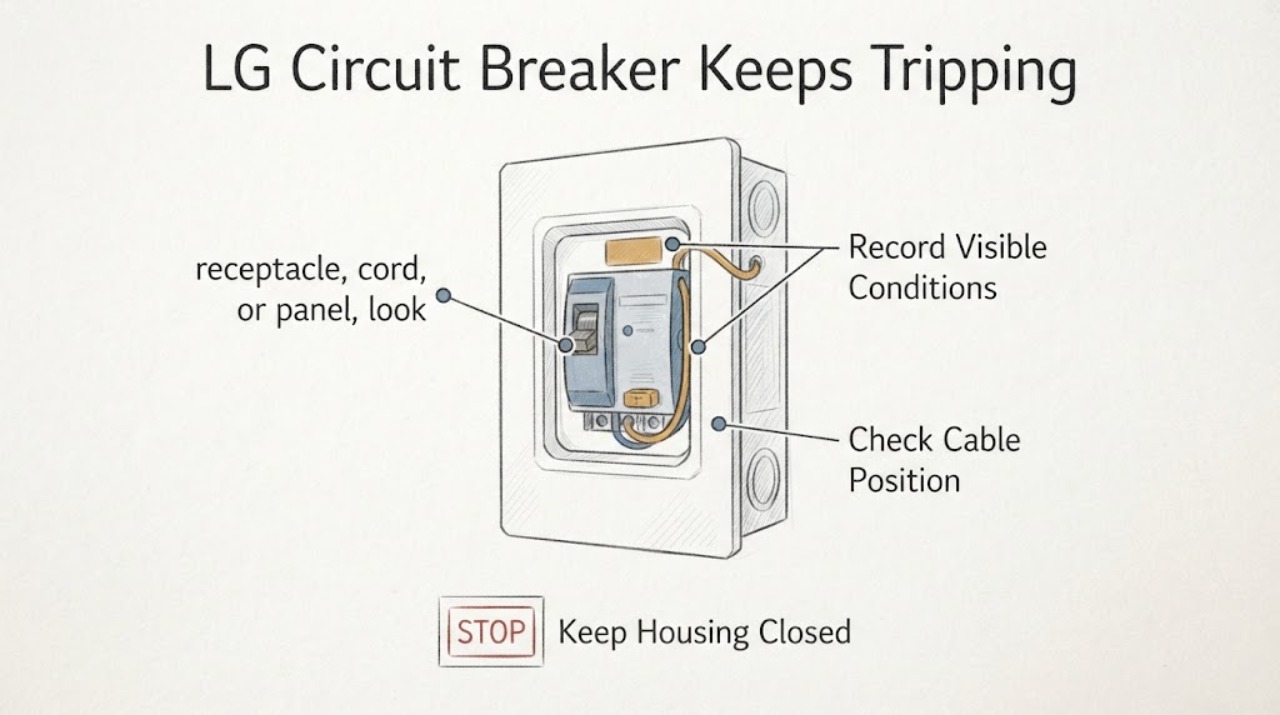
Work through in order
Diagnostic checks
Use only checks that match the exact appliance or system and its official guide.
-
Check 1
From a dry position and without touching the LG product, receptacle, cord, or panel, look and listen for smoke, a burning or hot-insulation odor, visible flash or arc, buzzing or sizzling, a hot or discolored receptacle, damaged insulation, shock or tingling, water near the equipment, or fire.
Expected result: One or more hazard signs is present, or the area is wet, hot, smoky, or visibly damaged.
Next step: Stop using the LG product, keep clear, leave the protective device in its present safe state, and contact a licensed electrician. If there is smoke or fire, leave and use the local emergency route from a safe location.
Stop if: Stop immediately for smoke, fire, arcing, heat, burning odor, buzzing, shock, water near electrical equipment, or damaged insulation.
Why this matters
Why: The repeated trip may be protecting against an electrical fault, fire, water-contact hazard, or damaged wiring; it is not a routine user-reset issue.
-
Check 2
Write down whether the breaker opens before the LG product starts, immediately when a normal control is selected, after a motor or compressor starts, during a heat cycle, after a long run, or only when another high-power load is operating; do not recreate the trip just to obtain a pattern.
Expected result: The trip is immediate, occurs at a repeatable load stage, follows a long run, or only appears when several loads share the circuit.
Next step: Keep the LG product off and give the timing, operating mode, and other loads to the electrician or LG service team; do not perform repeated start attempts.
Stop if: Stop if a new trip, odor, sound, heat, smoke, water, or visible damage appears.
Why this matters
Why: Timing can distinguish a shared-load or supply pattern from a product-triggered symptom, but timing alone cannot identify a failed internal part.
-
Check 3
From normal room controls, note whether lights or outlets in other rooms are also without power and whether the symptom is limited to the LG product's known receptacle; do not open a panel, move the product, or unplug a hard-wired installation.
Expected result: Only the LG receptacle is affected, several outlets on one circuit are affected, or unrelated rooms also lose power.
Next step: Leave the LG product off and arrange electrician service for the circuit or outlet. Tell LG service if the breaker opens only when the product is energized after the building circuit is confirmed stable.
Stop if: Stop for a hot panel or receptacle, buzzing, smoke, water, shock, or any need to remove a cover.
Why this matters
Why: A single receptacle can indicate an outlet or local wiring issue, while a wider loss can indicate a branch-circuit, panel, or building supply problem; the product may still be involved when it alone triggers the trip.
-
Check 4
Without moving or opening the product, observe whether the LG power cord appears to run through an extension cord or power strip, whether other high-load products share it, and whether the plug, cord jacket, receptacle face, or nearby floor shows visible damage or moisture.
Expected result: An extension or power strip is in use, several high-load products share it, or the cord, plug, receptacle, or floor is damaged or wet.
Next step: Stop using the setup. Keep clear of wet or damaged equipment and have an electrician assess the receptacle and circuit; have LG service assess the product if the circuit is sound and the product remains the trigger. Do not improvise a cord, adapter, or circuit change.
Stop if: Stop for moisture, melted or discolored plastic, a loose or damaged plug, hot insulation, exposed conductors, or smoke.
Why this matters
Why: LG identifies extension-cord capacity and multiple high-power loads as possible trip causes, while visible damage or moisture raises an electrical hazard that cannot be resolved by a user rearrangement.
-
Check 5
Read the LG model and product type from an accessible rating label or saved purchase record, then consult that exact LG manual or support page for the required supply and whether the product is intended for a dedicated circuit; do not infer an amp rating from a different LG category.
Expected result: The exact model and product type are known, the model guidance calls for a dedicated circuit, or the identity and requirement remain unknown.
Next step: Give the model, product type, installation age, circuit label, and trip timing to the electrician or LG service team. Leave circuit changes and any rewiring to a qualified electrician.
Stop if: Stop if identification requires moving a heavy product, removing a cover, reaching behind wet equipment, or touching wiring.
Why this matters
Why: The correct circuit rule depends on the LG product and installation. An unknown model prevents a safe compatibility conclusion and should not be filled with a generic rating.
-
Check 6
Compare the recorded pattern without another run: note whether the breaker stays closed while the LG product remains disconnected or switched off, and whether it opens only when the LG product is returned to service; use the state already observed rather than repeatedly cycling either device.
Expected result: The breaker remains stable with the LG product off, or it opens even while the product is off and no other load changed.
Next step: For a product-triggered pattern, arrange LG appliance service and keep the product off. For a trip with the product off, arrange licensed electrician or building service. Do not substitute a larger protective device or continue testing.
Stop if: Stop all testing after a repeat trip or any smoke, heat, odor, buzzing, arcing, shock, or moisture.
Why this matters
Why: A product-triggered trip makes an LG product fault possible, while a trip with the product off points more strongly to the circuit, outlet, protective device, or another load. Neither observation identifies the failed part by itself.
-
Check 7
Prepare a service note with the LG model and product type, the affected receptacle or circuit label, trip timing, other loads, extension-cord or dedicated-circuit status, visible cord and outlet condition, breaker behavior with the product off, and any odor, sound, heat, water, or error display; keep all covers closed.
Expected result: The trip persists, the cause remains uncertain, or diagnosis would require access to the panel, receptacle box, cord termination, product chassis, or internal controls.
Next step: Call a licensed electrician for circuit and outlet safety; call LG service for a product-triggered fault after the supply is confirmed safe. Keep the LG product out of service until the professional gives return-to-use guidance.
Stop if: Stop user diagnosis when any enclosure, wiring, protective device, hard-wired connection, or internal product part would need to be accessed.
Why this matters
Why: The remaining possibilities include a building overload, protective-device or outlet fault, wiring leakage, or a model-specific product fault that cannot be separated safely from external observations.
Use your observations
Decision map
Find the observation that best matches what you see, then follow the next safe action.
-
PATH 01Next step
What you see
Smoke, burning odor, heat, buzzing, arcing, shock, damaged insulation, or water near electrical equipment is visible or reported.
Do this next
Stop, keep clear, leave the protective device alone, and contact emergency service for smoke or fire or a licensed electrician for a non-fire hazard.
Why this path and its safety boundary
Why it matters: This is an electrical or fire hazard, not a normal appliance troubleshooting branch.
-
PATH 02Next step
What you see
The trip appears when multiple high-load products share an extension, strip, or branch circuit.
Do this next
Keep the LG product off and have the electrician verify the circuit and receptacle; do not add an adapter or change protective-device ratings.
Why this path and its safety boundary
Why it matters: Overload or an unsuitable connection is possible, but the wiring and protective device still need professional assessment if the symptom repeats.
-
PATH 03Next step
What you see
The circuit remains stable with the LG product off but opens when that product is turned on or reaches a repeatable operating stage.
Do this next
Keep the product off and request LG service after confirming the circuit is safe; do not keep restarting it.
Why this path and its safety boundary
Why it matters: An LG product leakage, short, power component, or model-specific fault is possible, but the exact part cannot be selected from the symptom.
-
PATH 04Next step
What you see
The breaker opens while the LG product is off, will not remain closed, or other outlets and rooms are also affected.
Do this next
Keep clear and arrange licensed electrician or building service; do not keep resetting the breaker.
Why this path and its safety boundary
Why it matters: The building circuit, outlet, protective device, or another connected load is a priority concern.
-
PATH 05Next step
What you see
The LG product type or model cannot be identified safely, or the installation does not match the exact LG guidance.
Do this next
Give the label details and installation history to an electrician or LG service team and leave the product out of service.
Why this path and its safety boundary
Why it matters: A generic circuit rating or product-specific component claim would be unsafe and unsupported.
Helpful context
Understand the symptom
A repeated trip is a protective warning, not a reset problem
A circuit breaker opens when the circuit sees a condition such as overload, short circuit, or leakage. An LG label identifies the product, but it does not prove that the product is at fault. A shared circuit, extension cord, receptacle, building wiring, or the breaker itself can produce the same symptom. Treat the first repeat trip as a reason to collect safe observations and arrange qualified help, not as an invitation to keep trying the appliance.
Keep the LG identity specific without guessing the appliance
LG makes washers, dryers, refrigerators, ranges, air conditioners, and other products with different power requirements. Record the model from the rating label and the exact stage when the trip occurs. Do not apply a washer, range, refrigerator, or air-conditioner circuit rule to a different LG product. LG's own range guidance shows why the distinction matters: electric and gas ranges have different circuit requirements, while a product that still loses power after the supply and settings are checked needs service.
The safe boundary
User checks in this article are limited to dry, visible conditions, labels, normal controls, and a single record of what happened. Do not remove an electrical panel, handle a breaker repeatedly, open the LG product, touch wiring, make a live electrical measurement, replace a fuse with a larger one, or defeat a protective device. If water is near electrical equipment, isolate the area only when that can be done without contact and keep people away.
Safety boundary
Stop conditions
- Stop immediately for smoke, fire, burning or hot-insulation odor, hot or discolored plastic, buzzing or sizzling, visible arcing, shock or tingling, damaged insulation, or water near electrical equipment.
- Do not repeatedly reset the breaker, keep restarting the LG product after a trip, substitute a larger fuse or breaker, bypass a protective device, or use an extension or adapter to work around the symptom.
- Do not open a panel, receptacle box, hard-wired connection, or LG chassis; do not touch wiring or make a live electrical measurement.
- Stop if the breaker will not remain closed, trips with the LG product off, or several areas lose power; arrange licensed electrical service.
- If smoke or fire is present, leave the area and use the local emergency route from a safe location; do not return to investigate.
Only after diagnosis
Potential parts
- circuit breaker or receptacle
- LG power cord or product electrical component
When checks do not resolve it
Need a professional?
A breaker trips again after the LG product is used or cannot remain closed., The trip occurs with the product off, affects other outlets, or appears linked to a shared circuit, outlet, or building supply., The model-specific LG power requirement or dedicated-circuit status is unknown or does not match the installation., The cord, plug, receptacle, panel, or nearby floor is wet, hot, discolored, damaged, buzzing, or smoky., Diagnosis would require opening an enclosure, touching wiring, changing a protective device, or examining an internal LG component.
Safety scope: Keep the product and affected circuit out of service for smoke, odor, heat, buzzing, arcing, water, shock, damaged insulation, or repeat trips. Panel, receptacle, wiring, protective-device, and internal product work belongs to qualified professionals.
Common questions
FAQ
Should I keep resetting the breaker for my LG product?
No. A repeat trip is a protective warning. Record the safe, visible pattern once, leave the product off, and arrange qualified electrical or LG service depending on whether the product or the building circuit is the repeat trigger.
Does a trip prove that the LG appliance is bad?
No. LG identifies product leakage or a short as possible causes, but also lists wiring, the outlet, the breaker, and an overloaded extension connection. The circuit and the product must be separated by a qualified professional.
Can I use a larger breaker for an LG product that keeps tripping?
Do not change the breaker rating yourself. LG power requirements vary by product, and ESFI identifies an overrated breaker as a wiring hazard. Have an electrician verify the installation against the exact model documentation.
Read the exact guide
Official sources
- Home Wiring Safety TipsElectrical Safety Foundation International · Residential electrical hazard recognition and electrician referral.
- LG Electric Range / Gas Range: Power IssuesLG USA Support · LG electric and gas range power requirements; the opened page distinguishes product categories, dedicated circuits, extension-cord guidance, and model settings.
- LG Washer - Circuit Breaker is TrippedLG USA Support · LG washer power troubleshooting; the opened page covers direct wall connection, extension-cord loading, and service after another trip.
- [LG refrigerator power] The circuit breaker suddenly tripped.LG USA Support · LG product power troubleshooting; the opened page covers leakage, internal shorts, wiring, outlets, breakers, and extension-cord loads.
Community feedback
Share a repair observation
Share a plain-text repair observation. Accepted observations are published automatically; this page may take a moment to update.