
On this page
Start here
Quick answer
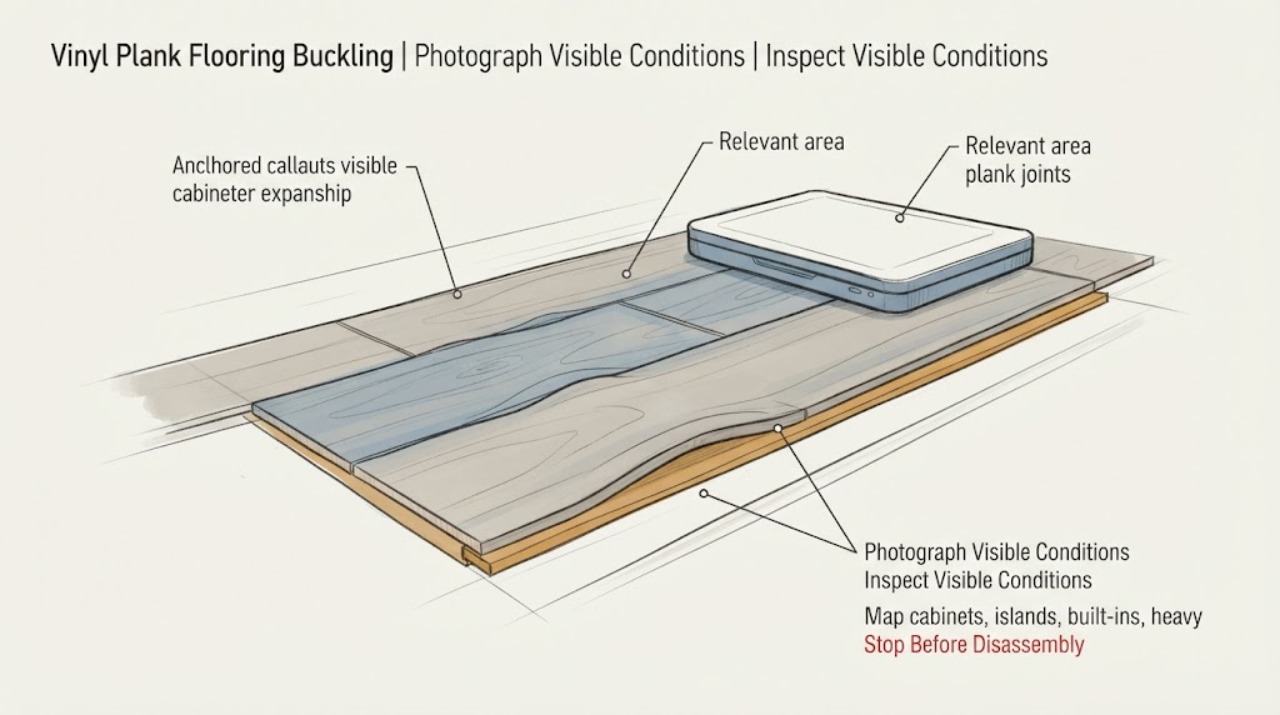
Peaking or buckling in vinyl plank flooring usually means a floating floor has run out of room to move as conditions change, often because an edge, threshold, door frame, or fixed object is pinning it. Temperature or acclimation problems and an uneven or damp subfloor can add to the movement. Photograph when and where the peak appears, inspect only accessible edges and fixed-object boundaries, and use the exact product installation guide before any repair; do not force the planks flat or make an unplanned cut.
Work through in order
Diagnostic checks
Use only checks that match the exact appliance or system and its official guide.
-
Check 1
Photograph the raised area from the side, mark its ends with removable tape, and note the room temperature, direct sunlight, heating or cooling cycle, and time of day when it changes.
Expected result: The ridge grows after a warm or sunny period and reduces as the room returns to its usual condition, or it stays the same regardless of temperature.
Next step: Keep the photos and timing log, then inspect the accessible perimeter and transitions without disturbing the floor.
Why this matters
Why: A repeatable temperature pattern supports a movement or restraint problem; a fixed hump makes subfloor irregularity, moisture, or a damaged joint more important to rule out.
-
Check 2
Use a flashlight to look at exposed plank edges beside baseboards, quarter-round, thresholds, pipes, and door frames; do not pry trim or pull a plank.
Expected result: An edge is visibly tight against trim or a threshold, the floor disappears beneath a door frame without the specified movement space, or an edge has room and is not visibly pinched.
Next step: Record the exact tight boundary and have a flooring installer compare it with the product-specific expansion and finishing instructions.
Why this matters
Why: A blocked edge can prevent a floating floor from accommodating expansion; an apparently open edge shifts attention to another boundary or to the subfloor, but hidden clearance is still unconfirmed.
-
Check 3
Map cabinets, islands, built-ins, heavy appliances, and other fixed objects over or beside the buckled area, and check whether a transition separates the room or a continuous floor runs underneath.
Expected result: The peak terminates at a fixed object or threshold, or the flooring appears to run continuously under an object that was installed after the floor.
Next step: Do not move built-ins or appliances just to test the theory; give the map and installation method to a qualified installer for a concealed-boundary inspection.
Why this matters
Why: A fixed boundary may be restraining the moving floor; if the installation is glued down or uses a self-adhesive underlay, the movement diagnosis and remedy are different from a floating click floor.
-
Check 4
Check the accessible floor around the peak for dampness, staining, swelling, a soft spot, or rocking, and compare the area with the manufacturer's subfloor requirements.
Expected result: There is moisture evidence, a soft or uneven feel, debris under an edge, or no accessible sign of a subfloor problem.
Next step: Stop wet cleaning or address an active leak, keep the area dry, and arrange professional subfloor or moisture assessment before replacing planks when any warning sign is present.
Why this matters
Why: Moisture or an irregular, unstable, or dirty subfloor can damage or distort the installation and can mimic a temperature-only fault; no visible sign does not rule out a concealed issue.
-
Check 5
Locate the flooring carton, product name, installation date, and installation method, then ask a qualified flooring installer to inspect concealed edges and verify the specified expansion space, subfloor condition, and joint damage.
Expected result: The installer confirms a restrained floating floor, finds subfloor or moisture damage, or finds that the product is a glue-down or special underlay system.
Next step: Follow the product's installation instructions and the installer's repair plan; do not order generic planks before exact product and joint compatibility are confirmed.
Why this matters
Why: The repair depends on the confirmed cause: relieving a product-defined restraint may resolve a sound floor, while damaged planks or a subfloor problem require correction after the cause is controlled.
Use your observations
Decision map
Find the observation that best matches what you see, then follow the next safe action.
-
PATH 01Next step
What you see
The peak repeatedly appears after heat or sun and a visible edge or transition is tight.
Do this next
Treat constrained expansion as the leading hypothesis. Have an installer verify the product-specific gap and finishing details before any edge is altered.
-
PATH 02Next step
What you see
The peak ends at a cabinet, island, built-in, appliance, or threshold, or the floor runs continuously beneath a fixed object.
Do this next
Do not move the object or cut the floor as a trial. Escalate the concealed boundary and installation method to a flooring installer.
-
PATH 03Next step
What you see
There is dampness, staining, a soft spot, rocking, or an uneven subfloor near the peak.
Do this next
Stop wet cleaning and control any leak. Arrange moisture and subfloor assessment; replacing only the visible plank can leave the cause in place.
-
PATH 04Next step
What you see
The product was glued down or installed with a self-adhesive underlay rather than as a floating click floor.
Do this next
Do not apply the floating-floor expansion diagnosis automatically. Use the exact product instructions and a qualified installer to determine whether adhesive, substrate, or joint failure is involved.
-
PATH 05Next step
What you see
The peak remains after the restraint or substrate issue is corrected, or the click joint is visibly broken.
Do this next
Have the installer determine whether affected planks need replacement and match the exact product system only after the underlying cause is resolved.
Helpful context
Understand the symptom
A temperature-linked peak is a movement problem to diagnose, not proof that one plank is defective. A floating installation needs the expansion space specified for that product, and the edge may be hidden behind baseboards, thresholds, or door frames. If the floor is glued down or uses a special underlay system, use that system's instructions instead of applying floating-floor assumptions.
The most useful clue is location and timing: a ridge that grows after heat or direct sun and relaxes as the room cools points toward movement being constrained, while a persistent isolated hump, dampness, or rocking underfoot raises concern about the subfloor or moisture. Keep the checks below observational and document the result for the installer.
Do not press, hammer, pry, or cut the flooring to make it lie flat before the cause is identified. A concealed edge or fixed fitting may be holding the whole field of planks in compression, and a damaged click joint may need a product-matched repair after the restraint is corrected.
Only after diagnosis
Potential parts
- matching vinyl plank
Only consider a replacement plank after an installer confirms that the plank or click joint is damaged and the expansion, substrate, or moisture cause has been corrected.
Match the exact product system, thickness, locking profile, color, and installation method; generic vinyl planks are not assumed to fit. - matching transition or edge profile
Only relevant if the installer confirms that a missing, incorrect, or damaged transition is part of the restraint or finishing problem.
Confirm the profile type and clearance requirements from the flooring manufacturer's instructions before selection.
When checks do not resolve it
Need a professional?
Arrange an inspection for recurring or widespread peaking, concealed edge restraint, moisture or subfloor concerns, or a damaged click joint.
Have this ready
- Provide photos showing the peak, the temperature and timing pattern, the room layout and fixed-object boundaries, the flooring carton or product instructions, and the installation method if known.
Common questions
FAQ
Does buckling always mean the vinyl plank itself is bad?
No. A restrained edge, fixed object, unsuitable subfloor, moisture, temperature or acclimation issue, and a damaged joint can all produce peaking. Confirm the installation method and root cause before replacing a plank.
Can I cut a gap around the wall to flatten the floor?
Do not make an unplanned cut. Gap size and finishing details are product-specific, and the restraint may be at a threshold, door frame, pipe, or fixed object. Have an installer verify the instructions and concealed clearance first.
Why does the peak change with hot weather or sunlight?
Temperature changes can expose a movement constraint in a floating installation. If the raised area tracks heat and is tight at an edge or fixed boundary, document that pattern and have the product-specific expansion space checked.
What if the flooring is glued down instead of floating?
Use the exact product instructions and installer assessment. Glue-down and self-adhesive-underlay systems have different movement and substrate requirements, so a floating-floor edge-gap diagnosis does not automatically apply.
Read the exact guide
Official sources
- How to start laying a vinyl floor?Quick-Step · Quick-Step vinyl floor installation
- How to install your vinyl floorQuick-Step · Quick-Step Alpha Vinyl and Vinyl Flex installation
- Vinyl Flooring InstallationShaw Floors · Shaw vinyl flooring installation
- Before you start laying your vinyl floorQuick-Step · Quick-Step vinyl subfloor preparation and acclimation
Community feedback
Share a repair observation
Share a plain-text repair observation. Accepted observations are published automatically; this page may take a moment to update.