
On this page
Start here
Quick answer
Loud squeaking and vibration usually come from dry or worn rollers and hinges, loose hardware, debris, or a track that is bent or out of alignment. With the door closed, inspect for damage first; clean the tracks without lubricating the track itself, tighten only accessible loose hardware, and lubricate the hinge pivots and compatible metal roller bearings with a garage-door lubricant. Do not lubricate nylon roller wheels. A nylon roller upgrade can reduce noise only when the existing rollers are worn and the door, hinges, cables, springs, and tracks are otherwise safe; track alignment, springs, cables, bottom brackets, and off-track doors belong to a qualified garage-door technician.
Work through in order
Diagnostic checks
Use only checks that match the exact appliance or system and its official guide.
-
Make a closed-door safety inspection
Close the garage door fully and leave the opener idle. From the side, inspect the rollers, hinges, tracks, panels, cables, and springs without placing hands between sections or under the door.
Expected result: The rollers are seated, the tracks are straight and attached, and there are no frayed cables, broken springs, crushed panels, loose sections, or signs that the door has left the track.
Next step: If a spring or cable is damaged, the door is off track, or a panel or bracket is displaced, stop operating it and arrange qualified garage-door service. Otherwise continue with the closed-door checks.
Why this matters
Why: A clean visual result leaves low-risk cleaning and lubrication as possibilities; any damaged or displaced load-bearing part can make further operation unsafe.
-
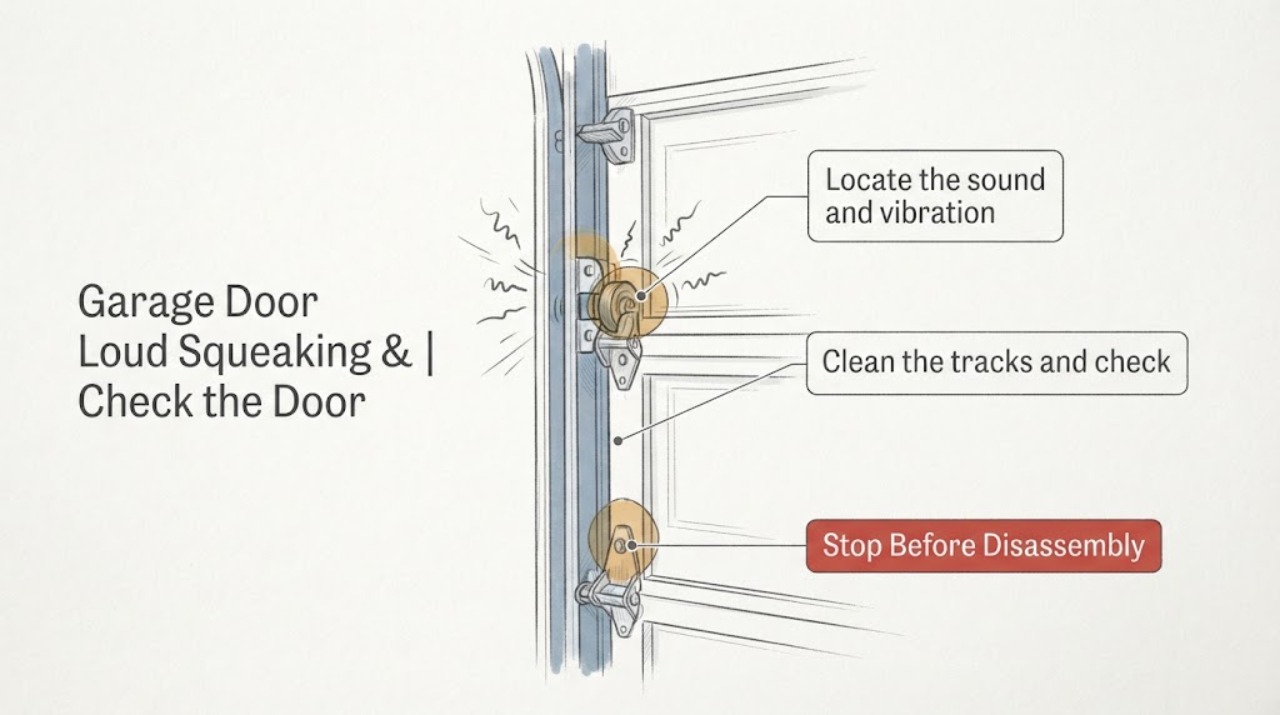
Locate the sound and vibration
From a safe position outside the travel path, run one brief open-and-close cycle only if the visual inspection was clear. Note whether the sound follows one roller or hinge, occurs where the door sticks, or comes from the opener rather than the door.
Expected result: A high-pitched squeak follows one moving joint, a rattle changes when the door vibrates, a grinding sound occurs at one track section, or the opener makes the noise while the door moves smoothly.
Next step: Stop the cycle if the door jerks, binds, leaves the track, becomes unbalanced, or makes a sudden bang. Record the location and use the matching branch instead of repeatedly cycling it.
Why this matters
Why: A joint or roller points toward lubrication or wear; a rattle points toward loose hardware; grinding, sticking, or an opener-only noise needs a more cautious service decision.
-
Clean the tracks and check accessible fasteners
With the door closed, remove loose dirt and debris from both tracks using a small brush and damp cloth, then dry them. Check accessible screws, nuts, bolts, hinge fasteners, and brackets for looseness, but do not loosen track brackets or reach near springs, cables, or bottom brackets.
Expected result: The rollers have a clear path and the vibration decreases after a loose fastener is snugged without force, or the track remains bent, twisted, loose, or visibly uneven.
Next step: Leave the track dry and do not force it into alignment. If it is bent, twisted, detached, or the door still binds, stop and call a qualified technician for track tuning.
Why this matters
Why: Dirt and loose hardware can create noise and vibration; a bent or misaligned track can add stress and is not corrected by adding lubricant.
-
Lubricate only compatible moving points
Apply a light amount of garage-door or silicone lubricant to hinge pivots and to the bearing area of compatible metal rollers, following the door maker's manual. Wipe away excess and keep lubricant off the track surface and off nylon roller wheels.
Expected result: The same joint or metal roller becomes quieter and moves without scraping, while a nylon roller or the track itself should not receive lubricant.
Next step: Run one cautious cycle from a safe position. If the noise remains, changes to grinding, or comes from a spring, cable, or opener, stop treating it as a lubrication issue and arrange service.
Why this matters
Why: Lubrication reduces friction at suitable moving interfaces, but a nylon wheel and the track surface need a different maintenance approach; excess product can attract debris or increase drag.
-
Decide whether a nylon roller upgrade is justified
Compare the affected roller with the other rollers without removing any roller or bracket. Look for a cracked wheel, worn bearing, bent shaft, flat spot, or a metal roller that remains noisy after the surrounding hardware is clean and properly lubricated.
Expected result: The wheel or bearing is visibly worn, or a sound follows that roller; alternatively, the roller looks sound but the door still rubs or binds at the track.
Next step: Treat a nylon roller as a conditional replacement part and verify the door model and roller design first. Have a technician replace rollers if access involves a tensioned bottom bracket, a loaded door, a cable, or any spring hardware.
Why this matters
Why: A high-quality nylon roller may reduce rolling noise when a worn metal roller is the confirmed source, but it cannot correct a bent track, an unbalanced door, or a failing hinge.
-
Check balance and stop conditions without tuning springs
Only if the door has no visible damage and the owner manual permits it, disconnect the opener using its normal release and observe whether the door can remain halfway open while you stand clear. Do not alter spring, cable, or bottom-bracket hardware.
Expected result: The door remains in place, or it rises, falls, feels unusually heavy, binds, or cannot be moved smoothly by hand.
Next step: If it does not stay in place or feels unsafe, leave it out of service and call a qualified technician for balance and track evaluation. If it is stable but still noisy, provide the sound location and maintenance results to the technician if the noise persists.
Why this matters
Why: A door that will not hold position can be unbalanced or mechanically binding, which increases opener load and can make vibration worse.
Use your observations
Decision map
Find the observation that best matches what you see, then follow the next safe action.
-
PATH 01Next step
What you see
The door is aligned, balanced, and safe, and a localized squeak improves after suitable hinge or metal-bearing lubrication.
Do this next
Keep the track clean and dry, wipe excess lubricant, and monitor for a return of the same sound. Do not lubricate nylon roller wheels or the track surface.
-
PATH 02Next step
What you see
A roller is worn and is the clear source, but the track, panels, cables, springs, and brackets are intact.
Do this next
A compatible nylon roller can be considered as a conditional upgrade after model and fitment are confirmed; use professional installation when the roller or bracket is under door tension.
-
PATH 03Next step
What you see
The track is bent, twisted, detached, or binding; the door is off track or unbalanced; or the sound comes from springs, cables, or the opener.
Do this next
Stop cycling the door and arrange qualified garage-door service. Do not loosen track brackets or adjust spring tension to tune the noise.
-
PATH 04Next step
What you see
A spring breaks, a cable frays, the door drops or slams, or a sudden bang or structural damage occurs.
Do this next
Keep everyone clear, leave the door in its current safe position, and request urgent professional inspection before using it again.
Helpful context
Understand the symptom
A squeak that follows one roller or hinge is a different lead from a rattle that follows the whole door. Squeaking often points to friction, while vibration or grinding can indicate loose hardware, a worn part, binding, or a track problem. Watch and listen from outside the door's travel path so you do not need to reach into moving hardware.
Nylon rollers are a noise-reduction option, not a substitute for alignment or balance. Clopay specifically says not to lubricate nylon roller wheels, and its maintenance guidance treats damaged tracks, springs, cables, and tensioned bottom brackets as professional work.
Only after diagnosis
Potential parts
- garage-door nylon roller
Consider this only when a worn or noisy metal roller is confirmed as the source and the track, hinges, balance, springs, cables, and brackets are otherwise sound.
Confirm the door model, roller stem and wheel design, track arrangement, and the manufacturer's fit information before ordering; installation near a loaded or tensioned door may require a qualified technician.
When checks do not resolve it
Need a professional?
Call a qualified garage-door technician for bent or detached tracks, an off-track or unbalanced door, frayed cables, broken or visibly damaged springs, bottom-bracket or hinge work on a loaded door, persistent grinding or vibration, or an opener that strains after the door itself is serviced. Stop immediately for a sudden bang, door drop, structural damage, or any part that appears under tension.
Common questions
FAQ
Will nylon rollers stop a loud garage door from vibrating?
They may reduce rolling noise when a worn metal roller is the confirmed source, but they will not fix a bent track, loose hardware, poor balance, a damaged hinge, or an opener problem. Confirm the cause and fitment first.
Should I lubricate garage door tracks or nylon rollers?
No. Clean the tracks with a brush and damp cloth, then keep them dry. Clopay also says not to apply lubricant to nylon roller wheels; follow the door maker's instructions for hinge pivots and compatible metal roller bearings.
When is garage door track tuning unsafe to do myself?
Stop and call a technician for a bent, twisted, detached, or binding track, an off-track or unbalanced door, frayed cables, damaged springs, or any work involving a loaded bottom bracket. Do not adjust spring tension or force the track into alignment.
Read the exact guide
Official sources
- How to Properly Lubricate Garage Door ComponentsClopay · Garage door lubrication, nylon roller and track restrictions, and pre-lubrication inspection
- How to Fix a Noisy Garage Door: Comprehensive Guide for HomeownersClopay · Garage door noise causes, lubrication, track alignment, rollers, and professional safety boundaries
- Maintaining Your Garage DoorThe Genie Company · Garage door operation, noise observation, lubrication, balance, and safety testing
- Garage Door Maintenance GuideClopay · Garage door rollers, tracks, hinges, springs, balance, and maintenance safety
Community feedback
Share a repair observation
Share a plain-text repair observation. Accepted observations are published automatically; this page may take a moment to update.