
On this page
Start here
Quick answer
A broken torsion spring makes a garage door dangerously heavy and can leave cables, tracks, panels, and the opener carrying loads they were not meant to handle. Do not operate the opener, pull the emergency release, lift the door, wind or unwind a spring, or adjust cables and brackets as a DIY repair. Keep people, vehicles, and pets away, secure an open or partially open door area without standing beneath the door, and call a qualified garage-door service professional. Consider an emergency release only if the door is fully closed, the area is clear, no spring, cable, track, or panel damage is visible, and the exact owner's manual explicitly permits that step; otherwise wait for service.
Before you begin
Safety first
- The homeowner scope ends at stopping commands, isolating people and vehicles, safe visual observation, reading the exact owner manual, and reporting the door position and visible damage. Spring, cable, drum, bracket, track, balance, opener, and release work require trained professional service.
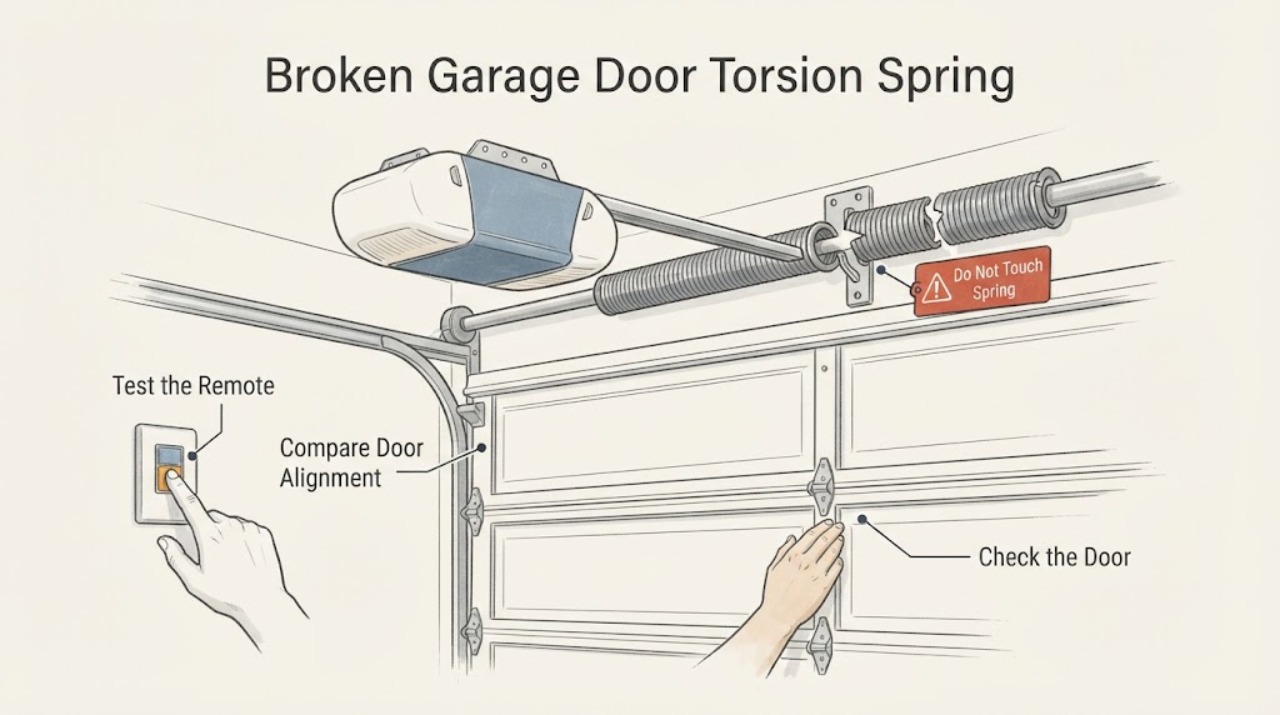
Work through in order
Diagnostic checks
Use only checks that match the exact appliance or system and its official guide.
-
Check 1
Stop all door commands immediately: do not press the remote or wall button, do not drive beneath the opening, and move people, pets, and vehicles away from the door's travel path.
Expected result: The door is fully closed, fully open, partially open, tilted, or moving unexpectedly.
Next step: Keep the area clear and use another entrance. If the door is moving or someone is trapped, keep clear and use local emergency assistance rather than attempting a rescue through the door.
Why this matters
Why: A partial, tilted, or moving door can fall or shift without warning; a closed door is easier to isolate while a technician is contacted.
-
Check 2
From the side and outside the door's travel path, visually inspect the torsion-spring area, lift cables, drums, tracks, panels, hinges, and brackets without touching, pulling, or loosening anything.
Expected result: A spring has a visible gap or separation, a cable is slack or off its drum, the door is off track, or a panel, bracket, or track is bent or displaced.
Next step: Take a photograph from a safe distance if useful, keep the opening isolated, and tell the garage-door professional exactly what is visible.
Why this matters
Why: These observations support a high-risk mechanical failure, but they do not indicate that the door can be safely moved or that the opener can be used.
-
Check 3
Confirm the door's position and the available safe route without standing under it or testing its balance; do not attempt to lift, lower, catch, or brace the door with your body.
Expected result: The door is resting closed, suspended open, partly open, or visibly unstable.
Next step: Keep clear of a suspended or unstable door and request urgent professional service. Do not place a vehicle or stored items under a door that may move.
Why this matters
Why: A broken counterbalance system can make even a door that appears stationary unsafe to move, and an opener may not reliably hold or control it.
-
Check 4
Read the exact garage-door and opener owner's manual from a safe location and check whether it gives an emergency-release procedure for the current configuration; do not pull the release merely to see what happens.
Expected result: The manual is available and explicitly supports the step for this door, or the manual is missing, unclear, or warns of a heavy or unbalanced door.
Next step: If the manual is unclear or any spring, cable, track, panel, or door-position concern exists, do not release the door and wait for a professional. If a manual explicitly permits a controlled release only with the door fully closed and the area clear, follow that manual exactly and stop if any movement or resistance occurs.
Why this matters
Why: The release mechanism is model-specific and only disconnects the opener; it does not make a broken-spring door balanced or safe.
-
Check 5
Keep the opener controls inaccessible to children and tell everyone in the household that the door is out of service; use a separate entrance instead of trying to retrieve a vehicle or object beneath the door.
Expected result: People can use an alternate route, or the garage is the only route or contains an immediate hazard.
Next step: Maintain the exclusion zone and tell the service provider whether the door blocks a required exit, vehicle, or safety-critical area.
Why this matters
Why: A convenience need does not reduce the door's stored energy or fall risk; an inaccessible route may require emergency assistance or controlled professional access.
-
Check 6
Prepare a service handoff with the loud bang or other failure sound, door position, visible spring or cable condition, opener behavior before it was stopped, model information, and any recent impact or weather event; do not attempt a second operation for confirmation.
Expected result: The failure is isolated to a visibly broken spring, or cable, track, panel, and opener damage cannot be ruled out.
Next step: Request qualified garage-door service and leave all tensioned components untouched until the inspection.
Why this matters
Why: Related hardware can be damaged when a spring fails, and the technician needs to inspect the complete counterbalance and opener system rather than replace a spring by assumption.
-
Check 7
After professional repair, ask the technician to verify door balance, track and cable alignment, opener attachment, and the opener's entrapment-protection functions before the door is returned to normal use; do not perform these tests while the spring fault remains.
Expected result: The technician confirms a stable, balanced door and functioning safety systems, or identifies additional damage.
Next step: Follow the technician's return-to-service instructions and keep the door out of use if any balance or reversal function remains abnormal.
Why this matters
Why: A spring replacement alone may not correct a bent track, damaged cable, loose bracket, or opener safety problem.
Use your observations
Decision map
Find the observation that best matches what you see, then follow the next safe action.
-
PATH 01Next step
What you see
A torsion spring has a visible gap, broken coil, displaced winding component, or the door stopped after a loud bang.
Do this next
Do not operate the opener, pull the release, lift the door, or handle the spring. Isolate the area and call a qualified garage-door professional.
Why this path and its safety boundary
Why it matters: The counterbalance system may have failed and the door may be much heavier than normal.
-
PATH 02Next step
What you see
The door is partly open, tilted, sagging, off track, or moving without a command.
Do this next
Keep everyone out from under and beside the door, do not attempt to brace or move it, and request urgent professional service.
Why this path and its safety boundary
Why it matters: The door may fall, bind, or shift if the opener is used or disconnected.
-
PATH 03Next step
What you see
A cable is slack or off the drum, a track or bracket is bent, a panel is damaged, or a bottom bracket is loose.
Do this next
Do not touch the cable, track, bracket, or fasteners. Keep the opening isolated and have the complete door system inspected.
Why this path and its safety boundary
Why it matters: The spring failure may have caused related high-tension hardware damage.
-
PATH 04Next step
What you see
The door is fully closed, no visible damage is present, and the exact opener manual explicitly permits a controlled emergency release for this configuration.
Do this next
Only consider the manual's narrow procedure if the area is completely clear and no person is near or beneath the door; stop at any resistance, movement, imbalance, or uncertainty and wait for a professional. Do not attempt to manually raise the door.
Why this path and its safety boundary
Why it matters: The manual's release step may disconnect the opener, but it does not repair or rebalance a broken spring.
-
PATH 05Next step
What you see
The manual is missing or unclear, the door is not fully closed, or any spring, cable, track, panel, or opener damage is visible.
Do this next
Do not pull the emergency release or operate the door. Use an alternate entrance and wait for qualified service.
Why this path and its safety boundary
Why it matters: The conditions for a narrowly controlled release are not established.
-
PATH 06Next step
What you see
The door or opener cannot provide a safe exit, someone is trapped, or the door is actively falling or crushing an object.
Do this next
Keep clear of the moving door and use local emergency assistance. Do not place a body or tool beneath the door or try to catch it.
Why this path and its safety boundary
Why it matters: This is an immediate life-safety event, not a repair task.
Helpful context
Understand the symptom
Treat a broken spring as a door-isolation event
A torsion spring mounted above the opening counterbalances the door. When it breaks, the door's weight can shift to the opener, lift cables, rollers, tracks, and people trying to move it. The safest immediate decision is not to prove that it is broken by moving the door. Look from a safe position, keep the opening controlled, and arrange professional assessment.
Emergency release is not an emergency repair
An opener's emergency-release mechanism disconnects the motor from the door; it does not restore spring counterbalance. Manufacturer instructions differ by door and opener. With a suspected broken torsion spring, releasing the door can expose a heavy, unbalanced door to uncontrolled movement. Use an alternate entrance and wait for a technician unless the exact manual and the visible condition support a narrowly controlled step with no person beneath or near the door.
Safety boundary
Stop conditions
- Stop immediately for a broken or displaced spring, slack or off-track cable, a bent track, a loose bottom bracket, a tilted or partially open door, or any unexpected movement.
- Do not operate the opener, pull the emergency release, lift or lower the door, catch or brace it, or drive beneath it while a torsion-spring failure is suspected.
- Never wind, unwind, adjust, remove, replace, or otherwise handle a high-tension spring, cable, drum, bottom bracket, or related fastener as a DIY repair.
- Do not stand under a suspended door, enter its travel path, or place hands or tools between sections, rollers, tracks, or panels.
- If someone is trapped, the door is falling, or the opening blocks a required exit, keep clear and use local emergency assistance; do not attempt a rescue through the mechanism.
When checks do not resolve it
Need a professional?
Call a qualified garage-door service professional for any suspected broken torsion spring, loud failure bang, heavy or unbalanced door, cable or track damage, or uncertainty about the emergency-release procedure.
Safety scope: The homeowner scope ends at stopping commands, isolating people and vehicles, safe visual observation, reading the exact owner manual, and reporting the door position and visible damage. Spring, cable, drum, bracket, track, balance, opener, and release work require trained professional service.
Common questions
FAQ
Can I open a garage door with a broken torsion spring?
Usually do not try. The door can be much heavier and may be unsafe to lift, and the opener can be damaged. Keep the area isolated and wait for a qualified professional.
Should I pull the emergency release?
Not as a general test. The release only disconnects the opener and can leave a broken-spring door unbalanced. Consider it only when the door is fully closed, the area is clear, the visible system has no damage, and the exact owner's manual explicitly permits that controlled step; otherwise leave it alone.
Can I replace the torsion spring myself?
No. Torsion springs and related cables are under high tension and require specialized tools and training. Do not wind, unwind, adjust, remove, or replace them yourself.
Read the exact guide
Official sources
- Garage Door Safety InformationOverhead Door · Garage-door emergency release, spring and cable high-tension warnings, visual inspection and professional service
- Garage Door Spring Replacement and RepairWayne Dalton Sales & Service · Garage-door spring replacement safety, broken-spring door weight, opener use and professional service boundaries
- Maintaining Your Garage DoorOverhead Door · Garage-door spring, cable, track, balance, opener and safety-system inspection boundaries
- Publication - 523 Non-Reversing Automatic Garage Door Openers Are a HazardU.S. Consumer Product Safety Commission · Garage-door opener entrapment safety, balanced-door warning and professional service
Community feedback
Share a repair observation
Share a plain-text repair observation. Accepted observations are published automatically; this page may take a moment to update.