
On this page
Start here
Quick answer
A garage door opener motor that hums while the chain and trolley stay still may have a stripped drive gear or sprocket, but the same symptom can come from a locked or binding door, broken spring, disconnected trolley, or another opener fault. From a safe position, turn the opener off, keep people and vehicles clear, and note whether the motor hums briefly or continuously, whether the chain moves at all, whether the trolley is engaged with the door arm, and whether the door is fully closed or raised. Do not pull the emergency release on a raised or unstable door, lift the door against spring tension, open the opener housing, touch the drive gear or motor, or work near springs. A chain that does not move while the motor hums is a service boundary: arrange a trained garage-door technician to inspect the door balance, trolley engagement, chain and sprocket, drive gear, motor, and control system. Stop immediately for a falling or heavy door, slack or broken spring cable, a jammed door, smoke, burning odor, arcing, or repeated electrical trips.
Before you begin
Safety first
- Keep the opener off for a heavy or unstable door, broken spring or cable, bent track, smoke, burning odor, arcing, hot electrical parts, or repeated trips. Do not open the housing, touch springs or cables, or repeat activation tests.
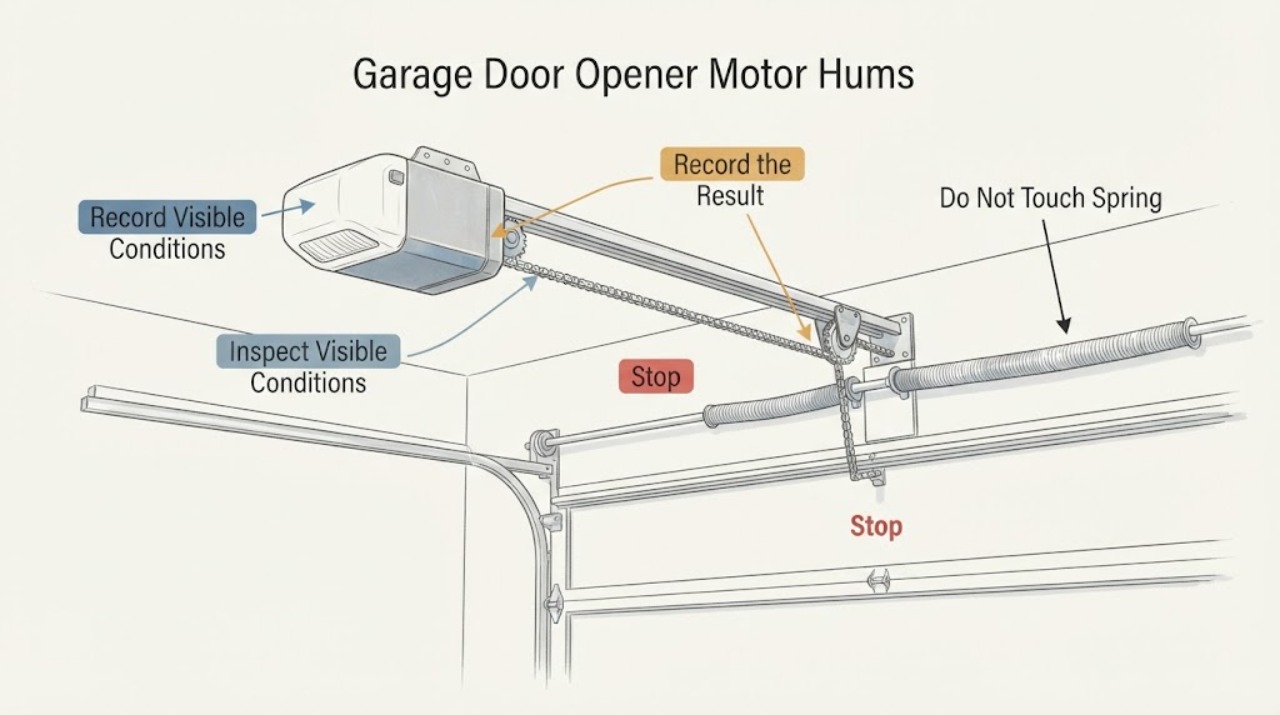
Work through in order
Diagnostic checks
Use only checks that match the exact appliance or system and its official guide.
-
Check 1
Stop the opener from its wall control and keep the doorway clear. From a safe position, record whether the motor hums briefly or continuously, whether the chain moves, whether the trolley moves along the rail, whether the door is open or closed, and whether the symptom began after a jam, power event, installation, or manual release.
Expected result: The motor hums but the chain and trolley remain still, the chain moves without the trolley, the trolley is visibly detached, or the door is heavy, tilted, stuck, or unstable.
Next step: Leave the opener off and arrange a trained garage-door technician for no movement, a detached trolley, or any unstable door. Do not run another cycle to confirm the sound.
Why this matters
Why: A still chain with motor sound points toward the opener drive path, while a moving chain with a still trolley points toward engagement or rail problems. A heavy, tilted, stuck, or unstable door points toward a door or spring hazard rather than a safe gear check.
-
Check 2
Look at the trolley and door arm from outside the travel path without touching the rail, chain, or release cord. Note whether the trolley is visibly coupled to the door arm, whether the chain appears slack or off its track, and whether an obstruction is visible in the closed-door path.
Expected result: The trolley is uncoupled, the chain is slack or displaced, an object blocks the door, or the connection and path look normal.
Next step: If the door is fully closed, stable, and the exact manual authorizes a normal trolley re-engagement step, follow that manual only once. Do not pull the release on a raised door, force the trolley, or touch a slack chain; arrange service when the state is unclear.
Why this matters
Why: A disengaged trolley can leave a moving chain disconnected from the door, while an obstruction or door binding can make the motor stop or hum. A normal-looking exterior does not rule out a worn gear or internal drive fault.
-
Check 3
Inspect the visible garage-door path and track area without moving the door: look for a vehicle, tool, ice, bent track, fallen hardware, or another object that could stop travel. Observe whether the door panels sit level and whether cables appear even and intact; do not handle cables, springs, rollers, or track hardware.
Expected result: The path is blocked, the track is visibly bent, the door is crooked, a cable is slack or broken, or the path and visible door hardware look normal.
Next step: Clear only an object that is fully outside the door and safe to reach, with the door stationary. For a bent track, slack cable, broken spring, crooked or heavy door, keep the opener off and call a trained door technician.
Why this matters
Why: LiftMaster identifies a blocked or binding door and broken spring as possible reasons for a humming opener with no movement. Slack or broken cables, a crooked door, or bent track can make operation unsafe and can damage the opener drive.
-
Check 4
Check the opener's indicator lights or diagnostic display from the floor without opening the motor unit, and note whether the wall control or remote gives a click, hum, light pattern, or no response. Record the exact model and any displayed diagnostic pattern rather than applying a code from another opener.
Expected result: The opener shows a model-specific code, clicks once, hums briefly, has no response, or has no diagnostic indication while the door remains still.
Next step: Use only the exact manual's low-risk external interpretation and stop if the code points to binding, a spring, or an inspection condition. Do not open the housing, change force settings, or bypass safety sensors.
Why this matters
Why: The manual's diagnostic chart separates sensor, travel, logic, motor, lock, and door-binding conditions. A code can guide the service visit, but it does not prove that a drive gear is stripped.
-
Check 5
Compare the symptom with the equipment history: note whether the opener is a chain-drive model, whether the chain or sprocket has visibly shifted, whether the motor has been straining, and whether recent work involved the door, rail, trolley, or opener. Keep the motor cover and electrical area closed.
Expected result: The chain is stationary while the motor hums, the sprocket area shows an unusual gap or debris from a safe distance, the opener has a recent installation or repair, or no external history is known.
Next step: Stop operating the opener and provide the history and observations to a trained technician. Do not remove the cover, clean internal grease, pull at the chain, or order a gear kit before the model and fault are confirmed.
Why this matters
Why: A chain-drive path contains multiple possible fault points, including the drive gear, sprocket, chain, motor, control, and trolley. A history of strain or recent work helps a technician but cannot confirm an internal gear failure.
-
Check 6
Make one final safe record for service: exact model, door position, motor sound duration, chain and trolley movement, trolley engagement, door alignment, visible obstruction, cable and spring appearance, diagnostic pattern, recent work, smoke or odor, and any electrical trip. Do not repeat the activation to reproduce the hum.
Expected result: The motor hums with no chain movement, the door remains heavy or stuck, the same code returns, the trolley will not engage, or any smoke, burning odor, arcing, or electrical damage is present.
Next step: Keep the opener off and arrange qualified garage-door or electrical service as appropriate. For active smoke or fire, leave the area and obtain emergency help; do not touch the opener or door hardware.
Why this matters
Why: These results require a professional inspection of both the door system and opener drive. Smoke, odor, arcing, or electrical damage is an immediate fire or shock warning, not evidence to gather by another run.
Use your observations
Decision map
Find the observation that best matches what you see, then follow the next safe action.
-
PATH 01Next step
What you see
The motor hums but the chain and trolley both remain still.
Do this next
Leave the opener off and arrange a trained garage-door technician. Do not open the motor housing or assume a gear is stripped from sound alone.
Why this path and its safety boundary
Why it matters: The motor-to-drive path, such as a gear, sprocket, motor, or control, is a professional inspection branch; a door fault can still overload the opener.
-
PATH 02Next step
What you see
The chain moves but the trolley or door arm does not move with it.
Do this next
Keep the door stationary and use only the exact model manual for a normal re-engagement check when the door is closed and stable. If engagement is unclear or the chain is slack, call a technician.
Why this path and its safety boundary
Why it matters: The trolley may be disengaged, the chain connection may be damaged, or the rail or trolley may be obstructed.
-
PATH 03Next step
What you see
The door is heavy, crooked, stuck, tilted, or has a slack or broken cable, broken spring, bent track, or other visible door damage.
Do this next
Do not lift, lower, release, or balance the door. Keep people clear and call a trained door-systems technician.
Why this path and its safety boundary
Why it matters: The door or spring system may be unsafe and may be the reason the opener hums or stops.
-
PATH 04Next step
What you see
The trolley is visibly disengaged, the door is fully closed and stable, and the exact manual documents a normal re-engagement procedure.
Do this next
Follow only that model's low-risk re-engagement direction once, without forcing the trolley or reaching near moving parts. Stop and arrange service if it does not engage immediately.
Why this path and its safety boundary
Why it matters: A release state can separate the trolley from the door even when the motor and chain drive are otherwise functional.
-
PATH 05Next step
What you see
A diagnostic code, click, brief hum, or no-response pattern returns after the safe external checks.
Do this next
Leave the opener off and provide the exact pattern and model to a qualified technician. Do not copy a code explanation or adjustment from another model.
Why this path and its safety boundary
Why it matters: Model manuals use different diagnostic patterns for sensors, travel, motor, logic, lock, and door-binding conditions; a returning pattern needs model-specific diagnosis.
-
PATH 06Next step
What you see
The opener or door shows smoke, burning odor, arcing, a hot electrical connection, a falling door, or repeated electrical trips.
Do this next
Stop immediately, keep clear, isolate power only from a safe location if this can be done without approaching the hazard, and obtain qualified or emergency help. Do not retest.
Why this path and its safety boundary
Why it matters: This is an immediate fire, shock, or injury hazard and is outside homeowner troubleshooting.
Helpful context
Understand the symptom
Motor sound does not prove a stripped gear
A hum with no chain or trolley movement is a useful symptom, not a confirmed diagnosis. LiftMaster's model manual lists a brief hum with no movement alongside binding or an obstruction, a broken spring, a door lock, and a possible motor fault. A stripped gear or damaged sprocket is another professional inspection possibility, but the opener housing must stay closed and the door mechanism must not be forced.
Understand the chain and trolley path
Chamberlain explains that a motor drives a trolley along a track and that a chain-drive opener uses a chain to transmit movement. If the motor hums but the chain does not move, the fault may be before the trolley, at the chain or sprocket, or in the motor and control path. If the chain moves but the trolley or door does not, the engagement or door path becomes more important. These observations cannot safely identify a gear without opening the unit.
Springs and a raised door are a hard stop
Garage doors are heavy and their springs can store dangerous energy. The LiftMaster manual directs a trained door-systems technician when the door is unbalanced or a spring may be broken. Do not use a humming opener to lift a door that is stuck, do not pull a release to test a raised door, and do not adjust force, travel, chain tension, or spring hardware as a first response.
Safety boundary
Stop conditions
- Stop for a heavy, falling, crooked, stuck, or unstable door; a slack or broken cable or spring; a bent track; or any need to lift or release the door against stored spring force.
- Stop for smoke, burning odor, arcing, a hot plug or connection, exposed wiring, or repeated electrical trips. Keep clear and obtain qualified garage-door or electrical help.
- Do not open the opener housing, touch the drive gear, motor, chain, sprocket, spring, cable, or wiring; do not test voltage, bypass sensors, change force settings, or pull a release on a raised door.
- Do not keep activating a motor that hums without movement. Do not order or install a gear, sprocket, trolley, or motor until the exact model and professional diagnosis are confirmed.
Only after diagnosis
Potential parts
- drive gear and worm kit
Consider this only after a qualified inspection confirms internal gear wear or stripping and identifies the exact opener model.
LiftMaster lists gear kits by opener model and directs users to the manual or parts diagram. Do not choose a kit from sound or appearance alone. - chain and sprocket assembly
Consider this only when service confirms a damaged chain, sprocket, or related drive part rather than a door, trolley, motor, or control fault.
Chain-drive parts vary by opener design and model. Confirm the exact parts diagram and professional diagnosis before selection. - trolley assembly
Consider this only when the chain moves but a correctly installed trolley cannot engage or travel and service confirms trolley damage.
Trolley rails and connections differ across opener models. Do not force engagement or select a trolley by appearance.
When checks do not resolve it
Need a professional?
Request service for motor hum with no chain movement, a chain that moves without the trolley, a detached trolley, door binding, a returning diagnostic pattern, or any suspected internal drive fault.
Safety scope: Keep the opener off for a heavy or unstable door, broken spring or cable, bent track, smoke, burning odor, arcing, hot electrical parts, or repeated trips. Do not open the housing, touch springs or cables, or repeat activation tests.
Common questions
FAQ
Does a humming garage door opener always have a stripped drive gear?
No. A LiftMaster manual also lists door binding, an obstruction, a broken spring, a door lock, motor, and logic conditions for no movement or brief humming. A technician must inspect the door and opener before identifying a gear fault.
What does it mean if the motor hums but the chain does not move?
It suggests a fault in the motor-to-drive path, such as a gear, sprocket, motor, or control issue, but a locked or binding door can also stop the drive. Keep the opener off and arrange professional service rather than opening the housing.
Could a disconnected trolley cause the problem?
Yes. A trolley connects the door arm to the opener drive path. If the chain moves while the trolley stays still, a release or trolley connection issue is possible. Use only the exact manual's re-engagement guidance when the door is closed and stable; do not force the trolley.
Can I replace a garage door opener drive gear myself?
Do not open the opener or select a gear kit from sound alone. LiftMaster lists model-specific gear kits and directs users to the exact parts guide, while the door and opener can contain stored mechanical or electrical hazards. Arrange qualified diagnosis and repair.
When should I stop testing a humming opener?
Stop for a heavy, crooked, falling, or stuck door, a slack or broken spring cable, a bent track, smoke, burning odor, arcing, hot electrical parts, or repeated trips. Keep the opener off and obtain trained garage-door, electrical, or emergency help as appropriate.
Read the exact guide
Official sources
- Garage Door Opener Buyer's GuideChamberlain · Chamberlain manufacturer guide describing standard opener drive arrangements; exact equipment differs by model.
- LiftMaster Replacement PartsLiftMaster · LiftMaster parts catalog; exact compatibility requires the opener model and parts guide.
- 8500W Wall Mount Wi-Fi Garage Door Opener Installation ManualLiftMaster · LiftMaster 8500W manual; use the matching manual for another opener model.
- Garage Door Opener Repair & MaintenanceLiftMaster · LiftMaster homeowner repair and maintenance guidance; exact safety features vary by model.
- 8164W Wi-Fi Garage Door Opener Contractor Series Chain Drive Owner's ManualLiftMaster · LiftMaster 8164W manual; diagnostic codes and component layout must not be generalized to another model.
Community feedback
Share a repair observation
Share a plain-text repair observation. Accepted observations are published automatically; this page may take a moment to update.