
On this page
Start here
Quick answer
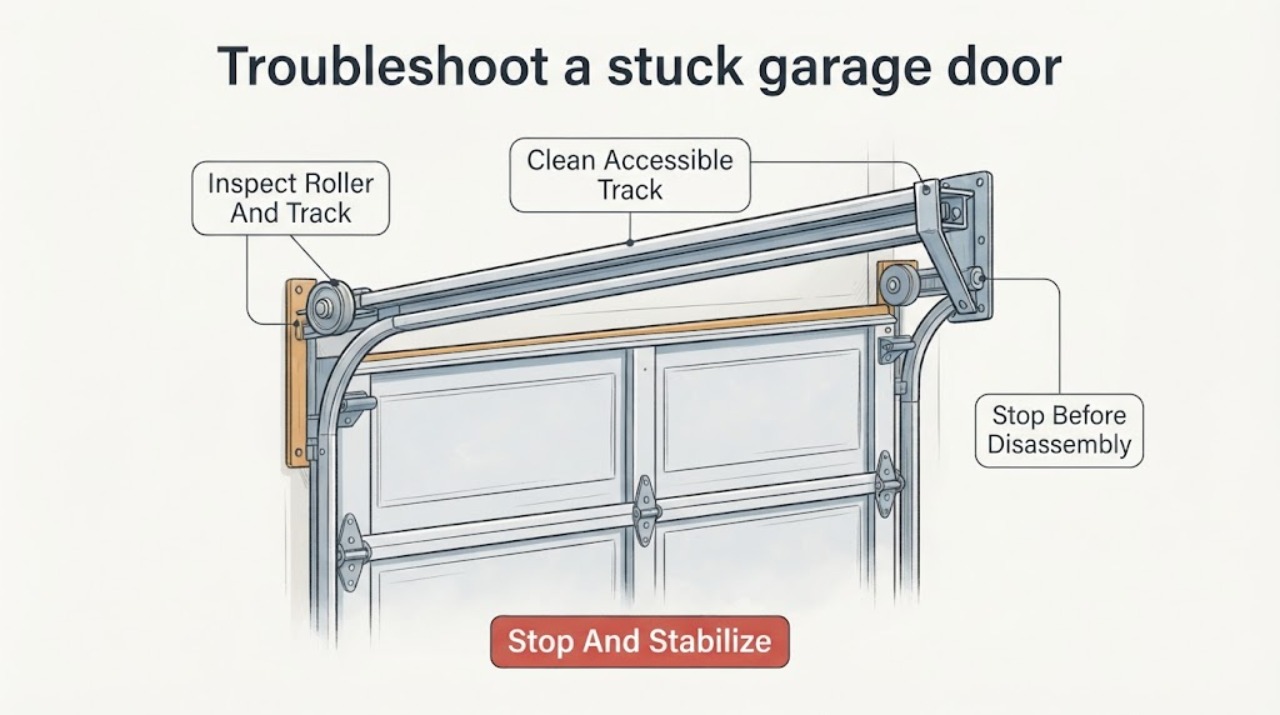
Stop the opener and keep people clear while the door is stationary. With the door closed, inspect the visible roller, track, and cable area for debris, a bent track, a broken roller, or frayed cable; do not force the door or remove brackets. If the door binds, is heavy or unbalanced, is off its track, or any spring, cable, panel, hinge, or track hardware is damaged, stop and have a trained garage-door professional service it. You may clean loose debris from an accessible track, and you may lubricate a metal roller bearing only when the door maker permits it; do not lubricate a nylon roller or adjust springs.
Work through in order
Diagnostic checks
Use only checks that match the exact appliance or system and its official guide.
-
Check 1
Stop using the wall control and remote, clear people and vehicles from the opening, and leave the door in its current stable position. Do not pull, pry, or push a heavy door and do not place hands near the roller or door joints.
Expected result: The door is stable and there is no falling panel, loose cable, exposed spring, or movement when the opener is not being commanded.
Next step: If stable, continue with the door closed or otherwise safely supported. If not, keep clear and arrange professional service.
Stop if: Stop now for a door off its track, a broken or frayed cable, a broken spring, a loose bottom bracket, a hanging panel, or any uncontrolled movement.
Why this matters
Why: A stable door permits a visual check; movement, a falling panel, or a loose counterbalance component is an immediate safety hazard rather than a roller-cleaning problem.
-
Check 2
With the door closed and the opener idle, use a flashlight to inspect the accessible roller wheel and shaft, both track runs, hinge fasteners, and the cable area. Do not loosen bolts, remove a roller, straighten a track, or remove a bottom bracket.
Expected result: Look for a cracked or missing wheel, a bent shaft, a roller that is visibly out of the track, debris in the track, a creased or twisted track, loose supports, or frayed cable.
Next step: If the track is straight and the roller is intact, remove only loose debris from an accessible area. If any component is damaged or displaced, do not operate the door and call a trained technician.
Stop if: Stop for any bent/twisted track, roller outside the track, frayed cable, broken spring, damaged hinge or panel, or hardware that would have to be removed while the door is under tension.
Why this matters
Why: A small amount of loose debris may be cleanable; a damaged roller, out-of-track wheel, bent track, loose support, or cable damage changes the job to repair and alignment work.
-
Check 3
Only if the track is straight, the door is stationary, and no damaged tensioned parts are visible, brush loose dirt from the accessible track and wipe it gently with a damp cloth. Do not insert tools into the track or bend it back into shape.
Expected result: After the track is clean and dry, the roller path is visibly clear and the wheel is still seated in the track.
Next step: Make at most one cautious test from a clear position. If the door still sticks, scrapes, jerks, or stops at the same point, stop and arrange professional diagnosis.
Stop if: Stop if cleaning exposes rust-through, a crease, a loose track hanger, a wheel out of the track, or anything that requires loosening or repositioning hardware.
Why this matters
Why: A clear path removes one possible source of sticking; it does not prove that a seized bearing, bent shaft, misalignment, or spring problem is fixed.
-
Check 4
Identify the roller material without disassembly. If it is a metal roller and the door maker's instructions permit lubrication, apply only the specified garage-door lubricant at the bearing, not to the tire. Do not lubricate a nylon roller and do not use lubrication to mask a damaged or off-track roller.
Expected result: The wheel remains seated, has no cracked tire or bent shaft, and turns without visible wobble after the permitted maintenance.
Next step: Retest once only if the door and track remain stable. If symptoms remain or return, stop using the opener and have the roller and track inspected.
Stop if: Stop if the roller is nylon and the instructions do not allow lubricant, or if access would require lifting the door, removing a bracket, or entering the spring/cable hardware.
Why this matters
Why: A smooth, intact roller may have been dry or dirty; a seized, noisy, wobbly, cracked, or missing wheel needs replacement or repair, not more lubricant.
-
Check 5
Do not use the opener to overpower a stuck roller. A manual movement check is optional only when the door is fully closed, no spring/cable/track damage is visible, the manufacturer permits the procedure, and an adult can control the door safely; otherwise leave it alone and call a professional.
Expected result: If safely disconnected according to the owner's instructions, the door moves smoothly and remains balanced without lifting force, sudden travel, or binding.
Next step: Reconnect only according to the owner's manual after a safe check. For any heavy, unbalanced, jerky, or sticking movement, keep the opener disengaged and arrange professional service.
Stop if: Never perform this check on an off-track or damaged door, and stop immediately if the door starts to fall, rises, binds, or needs more than light controlled movement.
Why this matters
Why: Smooth, balanced manual movement points away from a roller/track bind and toward opener or control diagnosis; a heavy, jerky, unbalanced, or sticking door indicates a mechanical or counterbalance problem.
Use your observations
Decision map
Find the observation that best matches what you see, then follow the next safe action.
-
PATH 01Next step
What you see
The door is stable, the track is straight, the roller is intact and seated, and loose debris is the only visible obstruction.
Do this next
Clean the accessible track without disassembly and make one cautious retest.
-
PATH 02Next step
What you see
The roller wheel is cracked, missing, seized, noisy, wobbly, or has a bent shaft.
Do this next
Do not force the door or remove the roller from a loaded door; keep the opener out of service.
-
PATH 03Safety boundary
What you see
The track is bent or twisted, a support is loose, or the roller has climbed out of the track.
Do this next
Stop operation and keep people away from the door; do not straighten the track or lift the door back into place.
Why this path and its safety boundary
Safety stop: True
-
PATH 04Safety boundary
What you see
A spring is broken, a cable is frayed or loose, a bottom bracket is damaged, or the door is heavy, unbalanced, or falling.
Do this next
Stop immediately. Do not adjust springs, wind or unwind hardware, remove brackets, or continue using the opener.
Why this path and its safety boundary
Safety stop: True
-
PATH 05Next step
What you see
The door passes a safe manual check with no binding, but the opener stalls or stops when it is connected.
Do this next
Treat the roller as not proven faulty; inspect the owner's manual for opener-specific diagnostics without increasing force to overcome resistance.
Helpful context
Understand the symptom
Start with a stationary, safe door
Do not keep cycling the opener while a roller is stuck. Keep children, pets, and vehicles away from the opening, and do not put fingers between door sections or beside a roller. Work only with the door in a position that is stable and safe to leave there. A sectional garage door can be heavy and counterbalanced by springs; a stuck, binding, or unbalanced door can move unexpectedly.
What the visible inspection can tell you
Look at the roller wheel and shaft, the vertical and curved portions of the track, the hinges, and the lift cables without loosening anything. A wheel that is cracked, missing, seized, or wobbling points toward roller service; a track that is creased, bent, twisted, or pulled away from its support points points toward track service. Dirt or hardened lubricant can also make rollers stick, but cleaning and lubrication are appropriate only when the door is otherwise intact and the product instructions allow them.
Use one controlled retest
After a safe visible cleanup, make one cautious test from a clear position. Stop immediately if the door jerks, cants to one side, scrapes, becomes heavy, or the roller climbs out of the track. Do not compensate by increasing opener force: a mechanical bind can damage the door or opener and can create an entrapment hazard.
When checks do not resolve it
Need a professional?
The door binds or sticks after visible debris is removed., A roller is cracked, seized, missing, wobbly, or out of the track., The track is bent, twisted, loose, or damaged., Any spring, cable, bottom bracket, hinge, panel, or balance condition is abnormal.
Common questions
FAQ
Can I force the garage door past a stuck roller?
No. Forcing a sticking door can worsen a track or roller fault and can make an unbalanced door move unexpectedly. Stop and arrange service if it binds or sticks.
Should I lubricate a stuck garage door roller?
Only after confirming the door and track are intact and the door maker permits it. Clopay distinguishes rollers that may be lubricated from nylon rollers, which should not be lubricated; lubrication will not correct a cracked, seized, wobbly, or displaced roller.
What if the roller is outside the track?
Do not lift or pry the door back into the track. Keep the opener out of use and have a trained technician inspect the track, roller, hinges, cables, and balance.
Can I replace the roller myself?
A roller may be a replaceable part, but the safe procedure depends on the door's tension and hardware. Do not remove a roller, hinge, or bottom bracket from a loaded door; professional service is the safe choice when the door is stuck or any damage is present.
Why should I stop if the door feels heavy?
A heavy or unbalanced door can indicate a counterbalance or hardware problem and can move unexpectedly. Keep it stable and have a professional inspect it instead of increasing opener force or trying to adjust springs.
Read the exact guide
Official sources
- Garage Door Maintenance GuideClopay · Garage door rollers, tracks, springs, cables, maintenance, and repair boundaries
- Non-Reversing Automatic Garage Door Openers Are a HazardU.S. Consumer Product Safety Commission · Garage door binding, balance, manual checking, and opener safety
- How to Install a Clopay Garage DoorClopay · Garage door weight, roller/track inspection, spring and cable hazards, and maintenance limits
Community feedback
Share a repair observation
Share a plain-text repair observation. Accepted observations are published automatically; this page may take a moment to update.