
On this page
Start here
Quick answer
If a key has broken off in a lock cylinder, stop turning the key or pushing the fragment farther in. Confirm that the lock is yours or that you are authorized to service it, and proceed only when the cylinder is in its normal key-in position, the fragment is visible or its location is clear, and the extractor can enter without force. A dedicated broken-key extractor may use a hook, double-hook, or saw profile; choose the thinnest profile that fits the available space and pull outward in line with the keyway. Stop if the cylinder is turned, the fragment is deep or flush, the tool binds, the lock is high-security or electronic, or the door must remain secured, and call a qualified locksmith. After removal, use only the lock maker's recommended spray sparingly, test a spare key gently, and replace a visibly worn key.
Before you begin
Safety first
- This article covers authorized, low-force observation and one controlled extractor attempt only. It does not cover lock bypass, picking, drilling, disassembly, or hazardous work.
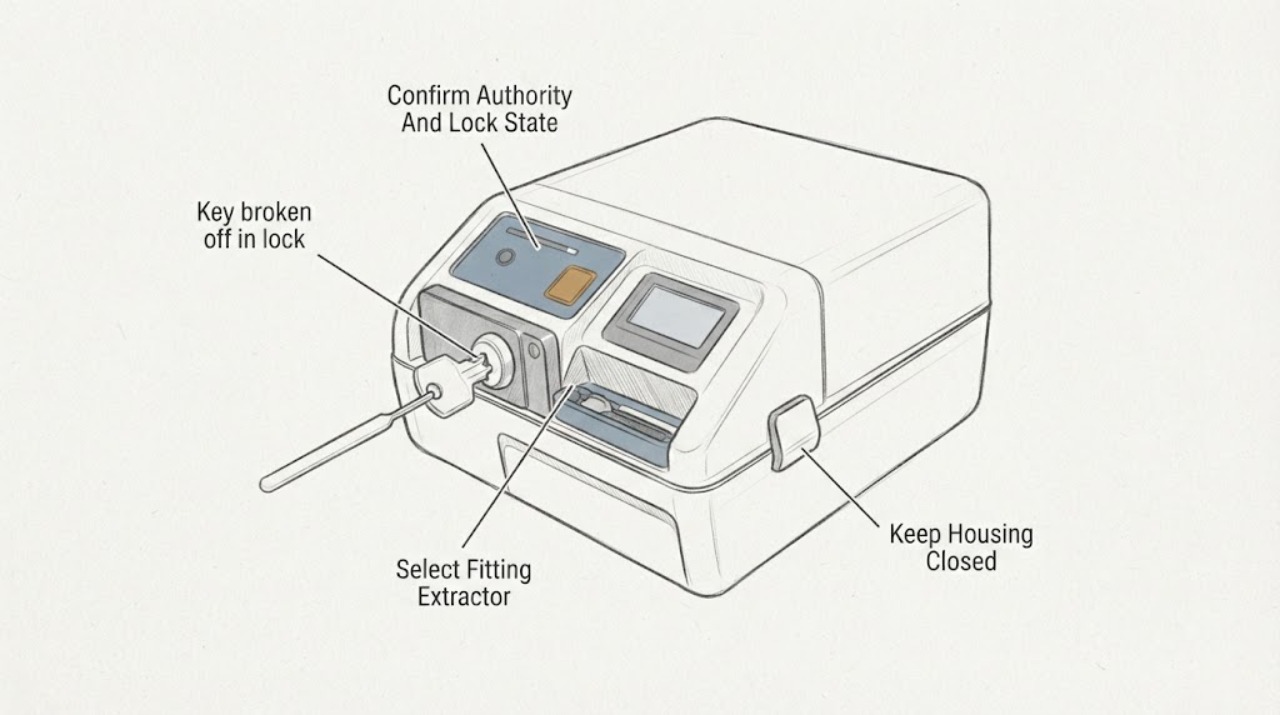
Work through in order
Diagnostic checks
Use only checks that match the exact appliance or system and its official guide.
-
Check 1
From a stable, well-lit position, confirm that you own or are authorized to service the lock and record whether it is a residential, commercial, cabinet, padlock, or vehicle cylinder. Do not turn the fragment, insert another key, or apply force while making this assessment.
Expected result: Note whether the lock is in the normal key-in position, whether any part of the broken key is visible, whether the fragment is shallow or fully recessed, and whether the property must remain locked or provide an emergency exit.
Next step: Continue only for an authorized, accessible lock with a clear and safe extraction path. Otherwise keep the lock undisturbed and contact a qualified locksmith or the responsible property manager.
Stop if: Stop for unclear authorization, an occupied or emergency-access situation, a vehicle security concern, a restricted/master-key system, an electronic cylinder, or any need to defeat or bypass the lock.
Why this matters
Why: A visible or shallow fragment in a normal key-in position is a different extraction situation from a turned cylinder, a deep fragment, an electronic or restricted cylinder, or a lock whose access and security cannot be interrupted.
-
Check 2
Read the extractor set's own instructions and compare the hook, double-hook, saw, or other supplied profile with the open space beside the broken key. Work from the keyway opening and choose a profile that can enter beside the fragment without wedging it or contacting the lock face aggressively.
Expected result: The selected tool should remain straight and have visible clearance beside the fragment; it should not need prying, twisting the cylinder, or pushing the broken key inward to enter.
Next step: Proceed to one gentle extraction attempt only when the tool fits without force; otherwise stop and arrange locksmith service.
Stop if: Do not substitute a lock-picking, bypass, drilling, heating, adhesive, or improvised tool, and do not force a profile that does not fit.
Why this matters
Why: Clearance supports a controlled extraction attempt. No clearance, an uncertain fragment position, or a tool that bends or catches on the cylinder means the tool is not a safe fit for this attempt.
-
Check 3
With the cylinder left in its normal key-in position, follow the extractor manufacturer's instructions to place the fitted extractor alongside the fragment, engage the fragment's edge or cut, and draw the tool straight outward along the keyway. Use light, steady hand pressure and keep the lock face supported; do not twist the cylinder or lever the tool against the housing.
Expected result: The fragment may begin moving toward the opening, remain stationary, or cause the extractor to slip, bind, bend, or move farther inward.
Next step: If the fragment moves, keep the pull straight and stop as soon as it can be grasped without reaching deeper. If it does not move easily, stop and call a locksmith rather than repeating forceful attempts.
Stop if: Stop immediately for tool breakage, a fragment pushed deeper, cylinder rotation, increasing resistance, damage to the keyway, or any need to use leverage.
Why this matters
Why: A fragment that moves with light outward pressure supports continuing the same controlled pull. Slipping, binding, bending, inward movement, or resistance means the tool is not engaged safely or the fragment is not suitable for user extraction.
-
Check 4
After the first controlled attempt, inspect only from the opening to determine whether the complete fragment is out and whether any part of the extractor remains in the cylinder. Do not add a second tool or try to push the fragment through.
Expected result: The key fragment may be fully out, partly out, still flush or deep, or accompanied by a broken or stuck extractor piece.
Next step: Keep the lock untouched and arrange locksmith extraction when the fragment or tool is not completely out. Tell the locksmith which profile was used and whether the cylinder moved.
Stop if: Do not use glue, magnets, drills, heat, picks, forceful probes, or repeated attempts to retrieve a fragment or broken extractor.
Why this matters
Why: A complete, undamaged removal is a handoff to post-removal inspection. A partial fragment, a stuck tool, or uncertainty about what remains is a service problem that can worsen if probed.
-
Check 5
Once the fragment is fully removed, visually check the keyway opening for remaining metal or obvious damage, then apply only the lock manufacturer's recommended lock spray if maintenance is needed. Insert a known-good spare key once, gently, without forcing or repeatedly cycling the cylinder.
Expected result: The spare key may enter and turn smoothly, stop partway, feel rough, or fail to operate the cylinder; the keyway may look clear or show remaining debris or damage.
Next step: If operation is not smooth, stop using the lock and request repair, rekeying, or cylinder replacement advice. Replace the broken or visibly worn key rather than copying a damaged key.
Stop if: Do not use oil, grease, excess lubricant, force, or a damaged key as a test. Stop for a lock that cannot secure the property or an emergency-access problem.
Why this matters
Why: Smooth operation after a clear removal supports normal service. Roughness, incomplete insertion, binding, visible damage, or a missing fragment indicates that the cylinder needs locksmith inspection; extraction alone does not prove the lock is sound.
Use your observations
Decision map
Find the observation that best matches what you see, then follow the next safe action.
-
PATH 01Next step
What you see
The lock is authorized and accessible, the cylinder is in the normal key-in position, the fragment is visible or its location is clear, and a supplied extractor fits with clearance.
Do this next
Use the fitted extractor according to its instructions and pull outward with light, steady pressure; stop at the first resistance.
Why this path and its safety boundary
Why it matters: A single controlled extractor attempt may be reasonable.
-
PATH 02Next step
What you see
The cylinder is turned, the fragment is deep or flush, the lock type is restricted or electronic, or the extraction path cannot be seen clearly.
Do this next
Leave the lock undisturbed and call a qualified locksmith or authorized property manager; do not rotate, probe, drill, or bypass the lock.
Why this path and its safety boundary
Why it matters: The fragment may be bound or the lock may have additional security or access consequences that a general user procedure cannot safely resolve.
-
PATH 03Next step
What you see
The extractor slips, bends, binds, pushes the fragment inward, or requires leverage.
Do this next
Stop immediately, keep the lock in its current state, and arrange professional extraction.
Why this path and its safety boundary
Why it matters: The tool and fragment are not in a controlled engagement, and further force can leave two obstructions or damage the cylinder.
-
PATH 04Next step
What you see
The fragment is out but the spare key does not enter or turn smoothly, debris remains, or the cylinder face is damaged.
Do this next
Stop testing and request locksmith inspection, repair, rekeying, or cylinder replacement advice.
Why this path and its safety boundary
Why it matters: The cylinder may have another fragment, internal damage, or a pre-existing wear problem.
-
PATH 05Next step
What you see
Authorization is unclear, occupants or emergency egress are involved, or the lock must remain secure for a vehicle, business, restricted system, or shared property.
Do this next
Contact the responsible property manager, authorized locksmith, roadside service, or emergency service as appropriate, and do not attempt bypass methods.
Why this path and its safety boundary
Why it matters: The priority is authorized access and security continuity, not a do-it-yourself extraction attempt.
Helpful context
Understand the symptom
Check the situation before inserting the extractor
A broken-key extraction is appropriate only for a lock you own or are authorized to service. Keep the door, vehicle, cabinet, or other property in a safe state, and do not use this procedure to defeat a lock or bypass access controls. If the break affects an occupied property, an emergency exit, a shared or restricted key system, or a vehicle that must remain secure, arrange authorized locksmith service instead.
The extractor should solve a removal problem, not become a second obstruction
Dedicated extractor sets are made in different profiles because the fragment may be shallow, recessed, or positioned differently in the keyway. The tool should slide beside the fragment with clearance. If it needs force, wedges the fragment deeper, or starts to bend, stop rather than switching to glue, drilling, improvised picking, or another bypass method.
A successful pull is not the same as a healthy cylinder
Once the metal fragment is out, look for another piece at the keyway opening and keep the broken key for comparison. A spare key that still feels rough, will not enter fully, or will not turn normally is a reason for locksmith inspection; do not keep cycling it to test the lock.
Safety boundary
Stop conditions
- Do not use this procedure to defeat a lock, bypass access controls, or enter property without authorization.
- Stop for a turned, deep, or flush fragment, a restricted or electronic cylinder, a broken extractor, or any fragment pushed farther inward.
- Do not use glue, magnets, drills, heat, picks, oil, grease, forceful probes, or leverage against the cylinder.
- Stop when the lock must remain secured, an emergency exit or occupied property is involved, or the cylinder will not operate smoothly after removal.
When checks do not resolve it
Need a professional?
Call a qualified locksmith when the cylinder is turned, the broken key or extractor is deep or flush, the tool binds, the lock is restricted or electronic, the property must remain secure, authorization is unclear, or the cylinder is rough after removal. Provide the lock type, fragment depth and visibility, cylinder position, extractor profile used, any movement or damage, and whether the spare key turns normally.
Safety scope: This article covers authorized, low-force observation and one controlled extractor attempt only. It does not cover lock bypass, picking, drilling, disassembly, or hazardous work.
Common questions
FAQ
Can I use a broken-key extractor if the key broke while turned?
Do not proceed with a general user extraction when the cylinder is turned. Leave it undisturbed and call a qualified locksmith, because the fragment may be bound and the lock may need to remain secure.
Which extractor profile should I choose?
Choose only among the profiles supplied for the extractor set and use the one that fits beside the fragment without force. If no profile has clear clearance, stop rather than switching to an improvised or bypass tool.
What if the extractor slips or pushes the key deeper?
Stop immediately. Do not add another tool, glue, magnet, drill, or probe; tell the locksmith what happened so the fragment and cylinder can be assessed without more damage.
How do I know the lock is okay after the fragment comes out?
Check that no metal remains, then gently try a known-good spare key once. Roughness, incomplete insertion, binding, visible damage, or a missing fragment calls for locksmith inspection rather than repeated testing.
Should I lubricate the lock after removing the broken key?
Use only the lock maker's recommended lock spray and a small amount; do not assume oil, grease, or a large amount of lubricant is suitable. ASSA ABLOY specifically advises lock spray rather than oil or grease for its cylinder-maintenance guidance.
Read the exact guide
Official sources
- Key ExtractorLAB Locksmith Tools · Manufacturer product information for dedicated broken-key extractor tools; it does not establish that every fragment or lock is suitable for user extraction.
- Maintaining your locksASSA ABLOY · General ASSA ABLOY cylinder-maintenance guidance; the specific lock manufacturer's instructions control when they differ.
Community feedback
Share a repair observation
Share a plain-text repair observation. Accepted observations are published automatically; this page may take a moment to update.