
On this page
Start here
Quick answer
A mailbox key that will not turn can be caused by the wrong key, a misaligned or loaded door, debris or weather exposure, or a worn lock. Start with safe observations and normal key operation only: confirm that you are responsible for the box, identify the box type, check the key and door alignment without forcing anything, and document the symptom. Do not pry, pick, drill, bypass, or force the key. If the key bends or cracks, the box is damaged, the mailbox cannot stay secured, or mail privacy is at risk, stop and contact the owner or manager, USPS as appropriate, or a qualified locksmith.
Before you begin
Safety first
- Do not pry, pick, drill, bypass, force the key, force the door, handle another person’s compartment, or provide keys to an unauthorized person. Do not apply an unknown lubricant or use heat on an icy lock.
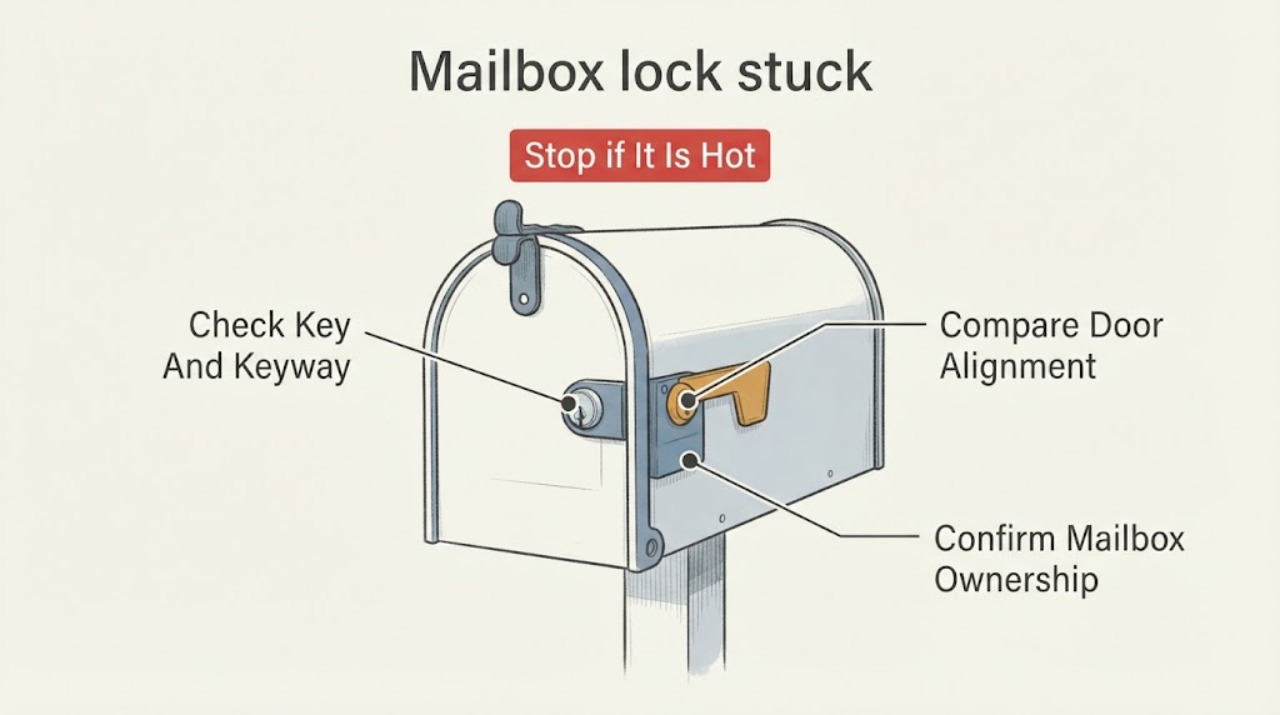
Work through in order
Diagnostic checks
Use only checks that match the exact appliance or system and its official guide.
-
Check 1
From a safe position, identify whether the box is a private curbside receptacle, a centralized cluster box, or a building-managed box, and confirm that you are the owner or an authorized user before any repair request.
Expected result: Note the box location and arrangement, any visible owner or property-management information, and whether the problem affects only your compartment or the shared unit.
Next step: Contact the responsible owner or manager with the location and symptom. For a postal-owned or centralized arrangement, ask the appropriate USPS or property contact how access and repair should be handled.
Stop if: Stop if you cannot establish authorization, if the box is shared, or if observing it would expose another person’s mail or private information.
Why this matters
Why: A private box generally follows the customer or property owner’s repair path; a centralized or managed box may require the owner, manager, superintendent, or the responsible postal process. A shared-unit issue should not be modified by an individual resident.
-
Check 2
Using only the key you are authorized to use, compare it with any known spare and observe whether it enters the keyway fully and smoothly; use ordinary pressure only and do not twist against resistance.
Expected result: Record whether one key or every authorized key behaves the same, whether the key stops short, whether it is bent or cracked, and whether the keyway appears visibly obstructed from the outside.
Next step: Keep the keys and a photo of the exterior identification available for the owner, manager, or locksmith. Do not insert a substitute object or attempt to extract anything from the keyway.
Stop if: Stop immediately if the key bends, cracks, sticks, will not withdraw normally, or requires more than light ordinary pressure.
Why this matters
Why: One key failing can point to a damaged or incorrect key; every key failing makes a lock, alignment, or obstruction concern more likely. A bent or cracking key creates a risk of leaving part of the key in the lock and requires a stop, not more force.
-
Check 3
With the key removed, look at the mailbox door, latch edge, hinges, and surrounding face from outside. If the design allows normal closing, observe whether the door rests evenly and closes without pushing, pulling, or lifting; do not manipulate the latch or force the door.
Expected result: Note a door sitting high or low, a visible gap, a bent face, a loose hinge, a latch that appears loaded, or a door that will not sit closed on its own.
Next step: Leave the door in the safest normal position and report the alignment result with photos. Have the authorized owner or locksmith assess the box before a replacement lock is selected.
Stop if: Stop if the door is loose, sharp, damaged, cannot stay closed, or would need force to align.
Why this matters
Why: A door pressing on its latch can make a lock feel stuck even when the cylinder is not the only issue; bent, loose, or uneven hardware points to a mailbox or mounting repair rather than a key-only remedy.
-
Check 4
Observe the outside of the lock and door without inserting anything: note visible rust, dirt, ice, water marks, paint, or other debris, and record whether the failure follows rain, freezing conditions, or a recent impact.
Expected result: Distinguish a recurring weather-linked symptom from a sudden failure after impact or from a lock that has gradually become harder to operate; do not scrape, flush, heat, or spray an unapproved substance into the lock.
Next step: Give the timeline and exterior photos to the authorized owner or locksmith and ask which cleaning or lubrication, if any, is approved for that specific lock.
Stop if: Stop if there is ice that would require heat, active water intrusion, a damaged housing, exposed sharp metal, or any need to use a tool or chemical.
Why this matters
Why: Weather exposure or contamination may affect the lock or door interface, while impact or progressive stiffness can indicate wear or damage. These observations do not identify a compatible lubricant or replacement lock by themselves.
-
Check 5
Observe whether the compartment is currently closed and secure, whether the door can remain locked by normal operation, and whether mail access has been interrupted; do not open, pry, or interfere with a carrier door or another person’s compartment.
Expected result: Record whether the box is unsecured, the lock only turns partway, the key is trapped, the door will not close, or the key problem is preventing retrieval of mail.
Next step: Contact the owner or manager, USPS channel, or a qualified locksmith as appropriate, and provide the access status without sharing mail contents or key codes.
Stop if: Stop all attempts if the box cannot secure, mail privacy is at risk, the key is trapped, the housing is damaged, or anyone suggests bypass or forced entry.
Why this matters
Why: An unsecured or non-locking box is a privacy and delivery concern and needs an authorized repair path. A key trapped or a box that cannot be safely closed requires professional handling rather than repeated attempts.
Use your observations
Decision map
Find the observation that best matches what you see, then follow the next safe action.
-
PATH 01Next step
What you see
Only one authorized key fails, while the lock and door show no visible damage.
Do this next
Ask the owner or manager to verify the key and arrange an authorized replacement key or locksmith assessment; do not force or copy an unidentified key.
-
PATH 02Next step
What you see
All authorized keys stop short or will not turn with ordinary pressure.
Do this next
Stop using the key and arrange a qualified locksmith or responsible owner/manager inspection. Do not spray an unknown product, pick, drill, or bypass the lock.
-
PATH 03Next step
What you see
The key works only when the door is pushed, pulled, lifted, or otherwise loaded.
Do this next
Treat this as an alignment, hinge, latch, or box-condition concern and request professional assessment rather than forcing the door or lock.
-
PATH 04Next step
What you see
Rust, ice, water, debris, or impact is visible, or the symptom follows weather.
Do this next
Document the condition and ask an authorized owner or locksmith which model-specific, label-approved service is safe. Do not scrape, heat, flush, or apply an unapproved chemical.
-
PATH 05Next step
What you see
The box is unsecured, cannot remain locked, has a trapped key, damaged housing, or an access/privacy risk.
Do this next
Stop immediately and contact the owner or manager, USPS as appropriate, or a qualified locksmith. Keep mail and the lock area secure; never pry, pick, drill, or use forced entry.
Helpful context
Understand the symptom
First identify who can authorize the repair
The right next step depends on the mailbox arrangement. A private curbside box, a centralized cluster box, and a building-managed receptacle may have different owners and service paths. USPS guidance says customers are responsible for maintenance and replacement of their receptacles, while the owner, manager, or superintendent is the contact for replacement keys in centralized housing. Confirm that responsibility before ordering a lock or asking anyone to work on it.
Keep the lock and mail secure
Treat a stuck lock as a security and access problem, not as an invitation to defeat the lock. A normal key may be observed in the keyway, but do not twist against resistance, insert tools, pry the door, or interfere with a carrier compartment. If the box is unsecured or cannot stay locked, arrange repair promptly and use the appropriate USPS or property-management channel for temporary mail access.
What to document for service
Record whether the key enters fully, whether it turns at all with ordinary pressure, whether the door is visibly pressing against its frame, and whether the problem began after rain, freezing weather, impact, or a change in the mailbox hardware. Photograph the exterior identification and the key only without exposing a readable key code or private mail.
Only after diagnosis
Potential parts
- mailbox-lock-replacement
Consider this category only after the authorized owner or locksmith confirms that the lock itself is defective and identifies the mailbox type and replacement pattern.
Confirm the mailbox manufacturer, model or compartment type, mounting pattern, key orientation, and delivery arrangement before ordering; a visually similar lock may not secure or comply with the box. - lock-lubricant
Consider a lubricant only if the lock manufacturer or qualified locksmith identifies a compatible product for that specific cylinder and the issue is suitable for non-destructive service; visible damage or misalignment still needs repair.
Follow the lock maker’s instructions and label, avoid products that can attract debris or damage the cylinder, and never use lubricant as a way to force a key or conceal a security failure.
When checks do not resolve it
Need a professional?
Arrange service when the key will not turn with ordinary pressure, the lock is damaged or worn, the box will not stay secured, the key is trapped, or the cause is not clear after safe observation.
Safety scope: Do not pry, pick, drill, bypass, force the key, force the door, handle another person’s compartment, or provide keys to an unauthorized person. Do not apply an unknown lubricant or use heat on an icy lock.
Have this ready
- Provide the box arrangement, authorization or owner contact, whether it is private or centralized, key-entry result, door-alignment result, weather or impact history, visible damage, and safe exterior photos without mail contents or exposed key codes.
Common questions
FAQ
Can I force a mailbox key that will not turn?
No. Use ordinary pressure only. A key that bends, cracks, sticks, or will not withdraw is a reason to stop and contact the responsible owner, manager, USPS channel, or a qualified locksmith.
Who handles a stuck lock on a centralized mailbox?
Start with the owner, manager, or superintendent for the property-managed box. USPS guidance distinguishes customer or property-owner lock service from the carrier’s master access, so do not hand a key to a carrier or interfere with a shared compartment.
Should I pry the mailbox open if I need my mail?
No. Do not pry, pick, drill, bypass, or use forced entry. An unsecured box can create a privacy and delivery problem; use the responsible repair and mail-access process instead.
Is a stuck key always a failed lock?
No. The key, door alignment, latch load, debris, weather exposure, housing, or lock may be involved. Safe observations can narrow the handoff, but they do not justify forcing the mechanism or choosing a replacement without confirming the mailbox type.
Read the exact guide
Official sources
- 3-2 Mailbox Locks and KeysUnited States Postal Service · Applies to the USPS delivery-planning context described in the handbook, especially centralized or cluster mailbox units.
- 8-1 Mail Receptacles and Customer ObligationsUnited States Postal Service · General USPS handbook guidance for mail receptacle responsibility; local delivery arrangements can vary.
- Tips for Postal Customers with Centralized MailboxesUnited States Postal Service · Applies to centralized or cluster mailbox customers; use the owner or manager path where the box is privately managed.
- SPUSPS-STD-7B01United States Postal Service · Technical standard for the mailbox designs and functional requirements within its scope; it is not a repair procedure for an individual lock.
Community feedback
Share a repair observation
Share a plain-text repair observation. Accepted observations are published automatically; this page may take a moment to update.