
On this page
Start here
Quick answer
Dark growth on a bathroom ceiling should be treated as visible mold-like growth and a moisture-control problem, not identified by color alone. Find and correct the moisture source, verify that the exhaust fan actually vents outdoors, and size replacement ventilation from the bathroom volume and the installed duct resistance rather than choosing a fan by its box rating. As a starting residential sizing reference, the U.S. Department of Energy describes the larger of 50 CFM or 8 air changes per hour; a ceiling with extensive, hidden, soft, or water-damaged material, or a room used by a sensitive occupant, needs an experienced mold and building professional. Antimicrobial chemicals are not a substitute for removal and drying, and must never be mixed or improvised.
Before you begin
Safety first
- A qualified team should determine the moisture source, ceiling and hidden-space condition, containment, removal or replacement of porous material, safe cleaning, drying, ventilation performance, and any verification. This article does not identify mold species, prescribe a universal antimicrobial, or authorize electrical, roof, attic, duct, or ceiling work.
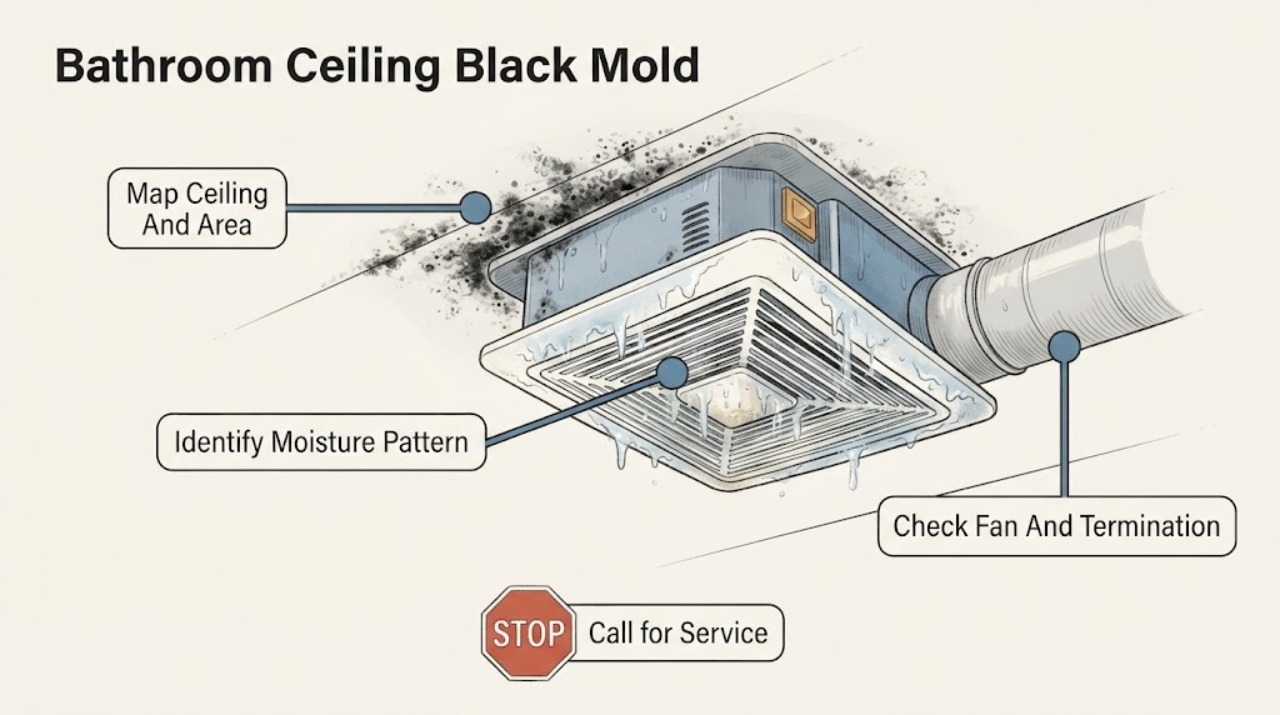
Work through in order
Diagnostic checks
Use only checks that match the exact appliance or system and its official guide.
-
Check 1
From the bathroom doorway or another stable dry position, photograph and map the dark or mold-like growth on the ceiling, including its distance from the fan, shower, light, wall joints, and any plumbing or attic space above; do not scrape or touch it.
Expected result: The growth is a small isolated surface patch, spreading across the ceiling, centered around the fan or shower, associated with a stain or leak, or accompanied by sagging, softness, peeling, or a musty odor.
Next step: Record approximate dimensions and material type without climbing or opening the ceiling, then continue only with moisture and ventilation observations. Keep the room away from children, pets, and people who should not be exposed to mold.
Stop if: Stop for a sagging or unstable ceiling, active dripping, water near a light or fan, crumbling material, visible wiring, or any need to use a ladder or open the ceiling.
Why this matters
Why: A localized hard-surface patch may have a different scope from porous ceiling board, insulation, or hidden growth. Soft, sagging, stained, spreading, or concealed material raises the chance that surface cleaning will not address the affected assembly.
-
Check 2
Record when the ceiling becomes damp, spotted, or odorous in relation to showers, baths, weather, plumbing use, and the fan's operation; inspect visible adjacent walls and the ceiling below only without removing finishes.
Expected result: Moisture follows showers and clears slowly, appears after rain or plumbing use, is present even when the room is unused, or has no visible source.
Next step: Fix or report the water source promptly and keep a dated moisture and odor log for the remediation or building professional. Do not paint, caulk, or cover growth before it is cleaned and dry.
Stop if: Do not enter wet electrical areas, disturb a wet ceiling, or use a fan to blow across loose growth or contaminated debris.
Why this matters
Why: A shower-linked pattern supports condensation or inadequate moisture removal; weather- or plumbing-linked dampness points toward a building-water source. An unexplained pattern may be hidden above the ceiling and should not be investigated by cutting into it.
-
Check 3
From floor level, switch the bathroom exhaust fan on using its normal control and observe or listen for operation and airflow at the grille without removing the grille, reaching into it, or working near the wiring; check only visible exterior termination information from the ground or an existing safe view.
Expected result: The fan is silent, weak, noisy, runs but the ceiling remains damp, or the visible duct appears to discharge outdoors; the termination is unknown, blocked, recirculating, or directed into an attic or crawl space.
Next step: Document the fan model and visible route if safely available, then have an HVAC or qualified ventilation professional confirm airflow and outdoor termination. Use the fan during showers only if it operates safely and is not suspected to be contaminated.
Stop if: Do not remove the cover, touch wiring, enter an attic, climb to a roof termination, clear a duct, or continue if the fan is sparking, hot, wet, or near a damaged ceiling.
Why this matters
Why: A working motor does not prove adequate delivered airflow. A blocked, long, bent, undersized, leaking, or non-outdoor duct can leave moisture in the bathroom or create condensation in an attic. A fan that does not run is an electrical or equipment service issue, not a mold-cleanup test.
-
Check 4
Measure or obtain the bathroom length, width, and height from a safe location and calculate room volume in cubic feet; use volume multiplied by 8 and divided by 60 as the 8-ACH reference, then compare that result with 50 CFM and keep the larger number for the sizing discussion.
Expected result: The 8-ACH calculation is below 50 CFM, above 50 CFM, or cannot be trusted because the room dimensions, ceiling shape, or boundaries are unclear.
Next step: Give the calculation, existing fan rating, duct diameter and approximate route, number of elbows, and termination details to a qualified HVAC or building professional. Check the local code and the selected fan's performance at the applicable static pressure before replacing it.
Stop if: Do not cut the ceiling, resize wiring, change a roof or wall penetration, or install a fan based only on the nominal CFM number.
Why this matters
Why: This gives a starting intermittent-fan capacity reference, not a guaranteed installed airflow or a universal code approval. DOE says duct type, length, turns, termination, and static pressure affect delivered capacity; longer or restrictive ductwork may deliver less than the rating.
-
Check 5
From a dry accessible position, note condensation on the ceiling, walls, mirror, or cold pipes and, if desired, record room relative humidity with a meter placed away from the growth; do not use a reading to justify opening the ceiling or spraying a chemical.
Expected result: Condensation is visible, humidity stays above 60 percent, humidity is lower but growth returns, or the reading changes substantially after showers and fan use.
Next step: Compare readings before and after normal bathing, improve safe ventilation and drying while the source is being assessed, and share the log with the professional. Do not rely on a dehumidifier or fan to compensate for a leak or concealed damage.
Stop if: Stop if the meter or observation requires a ladder, contact with wet electrical equipment, or handling of contaminated or unstable material.
Why this matters
Why: EPA identifies condensation as a sign of high humidity and gives below 60 percent, ideally 30–50 percent, as a moisture-control target where possible. A normal-looking reading at one moment does not exclude intermittent leaks or hidden wet materials.
-
Check 6
Use the mapped area, ceiling material, moisture history, occupant sensitivity, and hidden-space clues to decide whether this is a limited accessible surface issue or a professional remediation and building-repair assessment.
Expected result: Choose professional assessment for more than about 10 square feet, extensive water damage, porous or soft ceiling material, hidden growth above the ceiling, HVAC contamination, sewage or contaminated water, recurring growth, or a sensitive occupant; a small hard-surface patch with a resolved source still needs a safe cleanup plan.
Next step: Request an experienced mold-remediation and moisture/building assessment, providing photos, dimensions, material type, source timeline, fan and CFM information, and occupant concerns. Ask how containment, removal, drying, and verification will be handled.
Stop if: Do not cut, sand, scrape, demolish, or remove ceiling materials to determine the scope; do not run a suspected contaminated HVAC system.
Why this matters
Why: EPA uses area as one planning factor and advises consultation for more than about 10 square feet or substantial water damage. Size alone is not a guarantee: heavy growth, high exposure potential, hidden contamination, and occupant vulnerability can require a more cautious scope.
-
Check 7
Before using an antimicrobial, disinfectant, bleach, or mold-killing product, identify the surface material and the moisture and exposure controls, and check whether the proposed work is within a small, accessible, nonporous area that can be safely cleaned and dried.
Expected result: The material is porous, damaged, concealed, larger than the small-area boundary, occupied by a sensitive person, or the product label and ventilation requirements are unclear; or the product would be used to cover an unresolved moisture problem.
Next step: Prefer experienced professional remediation for ceiling assemblies and uncertain conditions. If a qualified plan uses a chemical on an appropriate surface, follow its label exactly, use required PPE and outdoor ventilation, and keep people out of the work area.
Stop if: Never mix bleach with ammonia or any other cleaner, never improvise a concentration, and never spray an unknown product into a fan, duct, ceiling cavity, or occupied room.
Why this matters
Why: EPA says routine biocide use is not recommended, dead mold can remain allergenic, and porous materials may need removal rather than surface treatment. Killing growth without removing it or fixing moisture does not complete remediation.
Use your observations
Decision map
Find the observation that best matches what you see, then follow the next safe action.
-
PATH 01Safety boundary
What you see
The ceiling is sagging, soft, actively wet, crumbling, or wetness is near a light, fan, or visible wiring.
Do this next
Keep the room clear, avoid electrical equipment and the ceiling surface, and arrange qualified building and electrical assessment from a safe position.
Why this path and its safety boundary
Safety stop: Do not climb, open the ceiling, touch wiring, or operate a wet or damaged fan.
-
PATH 02Safety boundary
What you see
Growth appears limited to a small, accessible, nonporous surface, with no hidden damage, sensitive occupant, contaminated water, or active moisture source.
Do this next
Have the moisture source controlled, follow the surface and product instructions, use appropriate protection and ventilation, remove residue, and dry completely; seek professional guidance if the patch returns.
Why this path and its safety boundary
Safety stop: Do not paint or caulk over growth and do not mix cleaning products.
-
PATH 03Safety boundary
What you see
The affected area exceeds about 10 square feet, has extensive water damage, or includes porous, soft, peeling, or concealed ceiling materials.
Do this next
Arrange experienced mold-remediation and building-moisture assessment with a containment and material-removal plan; do not disturb the ceiling to estimate hidden extent.
Why this path and its safety boundary
Safety stop: Keep people out and do not sand, scrape, cut, demolish, or remove ceiling material as a test.
-
PATH 04Safety boundary
What you see
The fan does not operate, airflow is weak, the duct does not vent outdoors, or shower-linked condensation remains after ordinary fan use.
Do this next
Have a qualified HVAC or ventilation professional verify the installed airflow, duct resistance, termination, controls, makeup-air path, and local code before selecting a replacement fan.
Why this path and its safety boundary
Safety stop: Do not choose a fan by nominal CFM alone or perform electrical, roof, attic, or duct modifications yourself.
-
PATH 05Safety boundary
What you see
A person with asthma, COPD, immune suppression, underlying lung disease, severe allergies, or symptoms may be exposed.
Do this next
Keep that person away from the bathroom during assessment and cleanup and obtain appropriate health and experienced remediation guidance.
Why this path and its safety boundary
Safety stop: Do not ask a symptomatic or vulnerable person to inspect, sample, clean, or supervise remediation.
-
PATH 06Safety boundary
What you see
Growth returns, the water source is unknown, the fan or duct may be contaminated, or condensation continues despite apparent cleaning.
Do this next
Escalate to coordinated mold, moisture, and ventilation assessment; provide the timeline, photos, humidity readings, CFM calculation, and fan/duct observations.
Why this path and its safety boundary
Safety stop: Do not conceal the growth or keep applying antimicrobial products as a substitute for source correction and removal.
Helpful context
Understand the symptom
Black is a description, not a diagnosis
Mold can appear in many colors, and EPA says that “black mold” is not a species or a specific kind of mold. The useful questions are where the moisture comes from, whether the ceiling material is porous or damaged, whether growth is hidden above the ceiling, and whether ventilation removes shower moisture outdoors. A photo or color label cannot answer those questions.
CFM is only useful when the installed duct can deliver it
For a first sizing conversation, calculate bathroom volume from length, width, and height. DOE's reference is the larger of 50 CFM or 8 air changes per hour. The fan's delivered airflow also depends on duct length, diameter, bends, material, termination, and static pressure, so the number printed on a fan is not proof of the airflow at the ceiling grille.
Antimicrobial treatment does not replace remediation
EPA explains that dead mold can remain allergenic and that routine biocide use is not recommended. Cleaning or treating a surface without fixing condensation, leakage, or failed exhaust allows growth to return. Porous ceiling materials may not be cleanable in place, especially when they are soft, sagging, or contaminated above the visible surface.
Only after diagnosis
Potential parts
- bathroom exhaust fan
Consider a replacement only after the room-volume reference, installed duct resistance, outdoor termination, electrical requirements, local code, and the fan's performance data have been reviewed by a qualified professional.
Nominal CFM, grille size, sones, voltage, housing dimensions, controls, insulation contact, and duct connection must match the actual installation; do not infer compatibility from appearance. - bathroom humidity meter
Use only as a low-risk logging aid outside the growth area; one reading cannot diagnose a leak, prove remediation, or determine fan airflow.
Follow the meter instructions and keep it away from wet surfaces and electrical equipment. - PPE for mold cleanup
Protective equipment may be appropriate only for a safe, permitted small-surface task; it does not make ceiling demolition, hidden-mold investigation, or large-area remediation a DIY job.
Follow CDC guidance and the product instructions; people with relevant respiratory or immune conditions should not take part in cleanup.
When checks do not resolve it
Need a professional?
Arrange experienced mold-remediation and moisture/building assessment for more than about 10 square feet, extensive water damage, porous or soft ceiling materials, hidden growth, recurring growth, contaminated water, a suspected contaminated HVAC system, a failed or non-outdoor exhaust path, a sensitive occupant, symptoms, or any electrical, fall, ceiling, or chemical hazard. Arrange urgent qualified help for active leaking, unstable ceiling material, or water near electrical equipment.
Safety scope: A qualified team should determine the moisture source, ceiling and hidden-space condition, containment, removal or replacement of porous material, safe cleaning, drying, ventilation performance, and any verification. This article does not identify mold species, prescribe a universal antimicrobial, or authorize electrical, roof, attic, duct, or ceiling work.
Have this ready
- Dated photos, approximate area, ceiling material, visible damage, and safe access limits
- Shower, weather, plumbing, condensation, humidity, odor, and recurrence timeline
- Bathroom length, width, height, 8-ACH calculation, existing fan rating, and known duct route
- Whether the duct termination is outdoors, unknown, blocked, or directed toward an attic or crawl space
- Occupant respiratory or immune concerns and any symptoms without assuming mold caused them
Common questions
FAQ
What CFM should a bathroom exhaust fan have?
As a residential starting reference, calculate the bathroom volume in cubic feet, multiply by 8, divide by 60, and use the larger of that result or 50 CFM. The installed duct, bends, termination, static pressure, local code, and the fan's performance data still determine whether the room receives adequate ventilation.
Does black mold on a bathroom ceiling mean a dangerous species?
No. EPA says black mold is not a species or specific kind of mold, and color cannot identify what is present or whether it produces mycotoxins. Treat visible growth as a moisture and exposure issue rather than attempting color-based identification.
Should I spray an antimicrobial or bleach on bathroom ceiling mold?
Do not use a chemical as a substitute for correcting moisture, removing mold, and drying the material. EPA does not recommend routine biocide use, and chemicals must never be mixed. Porous, damaged, concealed, large, or recurring ceiling growth should be assessed by an experienced professional.
When is bathroom ceiling mold a professional remediation job?
Arrange professional assessment for growth over about 10 square feet, extensive water damage, porous or soft ceiling material, hidden growth, recurring moisture, suspected HVAC contamination, contaminated water, an unstable or electrical ceiling hazard, or a household member with significant respiratory or immune vulnerability.
Read the exact guide
Official sources
- Mold Clean Up Guidelines and RecommendationsCenters for Disease Control and Prevention · Supports keeping people with asthma, COPD, immune suppression, or underlying lung disease out of cleanup and using appropriate respiratory, eye, and skin protection when permitted.
- Mold Remediation in Schools and Commercial Buildings Guide: Chapter 3U.S. Environmental Protection Agency · Supports area and material-based professional judgment, sensitive-occupant and hidden-growth caution, containment boundaries, removal rather than kill-only treatment, and remediation completion criteria.
- Mold Course Chapter 1: Introduction to MoldsU.S. Environmental Protection Agency · Supports not identifying species by color, moisture as the growth control, non-routine biocide use, the need to remove dead mold, and the no-mixing boundary.
- Cleaning and Disinfecting with BleachCenters for Disease Control and Prevention · Supports the no-mixing, label-following, ventilation, and PPE boundaries when a qualified plan uses a disinfectant.
- Spot Ventilation: Source Control to Improve Indoor Air QualityU.S. Department of Energy, Office of Energy Efficiency and Renewable Energy · Supports the larger-of-50-CFM-or-8-ACH sizing reference, room-volume calculation, static-pressure caveat, duct resistance, and outdoor termination requirement.
- Mold Cleanup in Your HomeU.S. Environmental Protection Agency · Supports the approximately 10-square-foot decision point, moisture correction, porous ceiling-material caution, HVAC contamination boundary, and professional cleanup scope.
- Chapter 16: Ventilation and InfiltrationASHRAE · Supports outdoor-vented local exhaust for moisture sources, ventilation as part of moisture balance, and checking the applicable residential ventilation standard and local requirements.
Community feedback
Share a repair observation
Share a plain-text repair observation. Accepted observations are published automatically; this page may take a moment to update.