
On this page
Start here
Quick answer
Black-looking growth on drywall does not identify a mold species or prove that it is more toxic; color is not a safe diagnostic. With a suspected pipe leak behind a baseboard, do not pull the baseboard, cut the drywall, scrape the growth, or drill to look behind it. From a safe position, document the visible area, dampness, swelling, odor, staining, and when the condition changes with plumbing use. Arrange qualified plumbing help to stop or locate the leak and experienced mold or water-damage assessment to determine hidden extent. Keep the area isolated, escalate sooner for active or contaminated water, a large or spreading area, HVAC involvement, vulnerable occupants, or symptoms, and repair the moisture source before cosmetic work.
Before you begin
Safety first
- The reader-level scope is safe visual documentation and ordinary observation only. Qualified professionals must locate or repair concealed pipes, open or contain the wall, assess hidden mold, handle contaminated materials, dry or remove porous drywall, and determine rebuild scope.
Work through in order
Diagnostic checks
Use only checks that match the exact appliance or system and its official guide.
-
Check 1
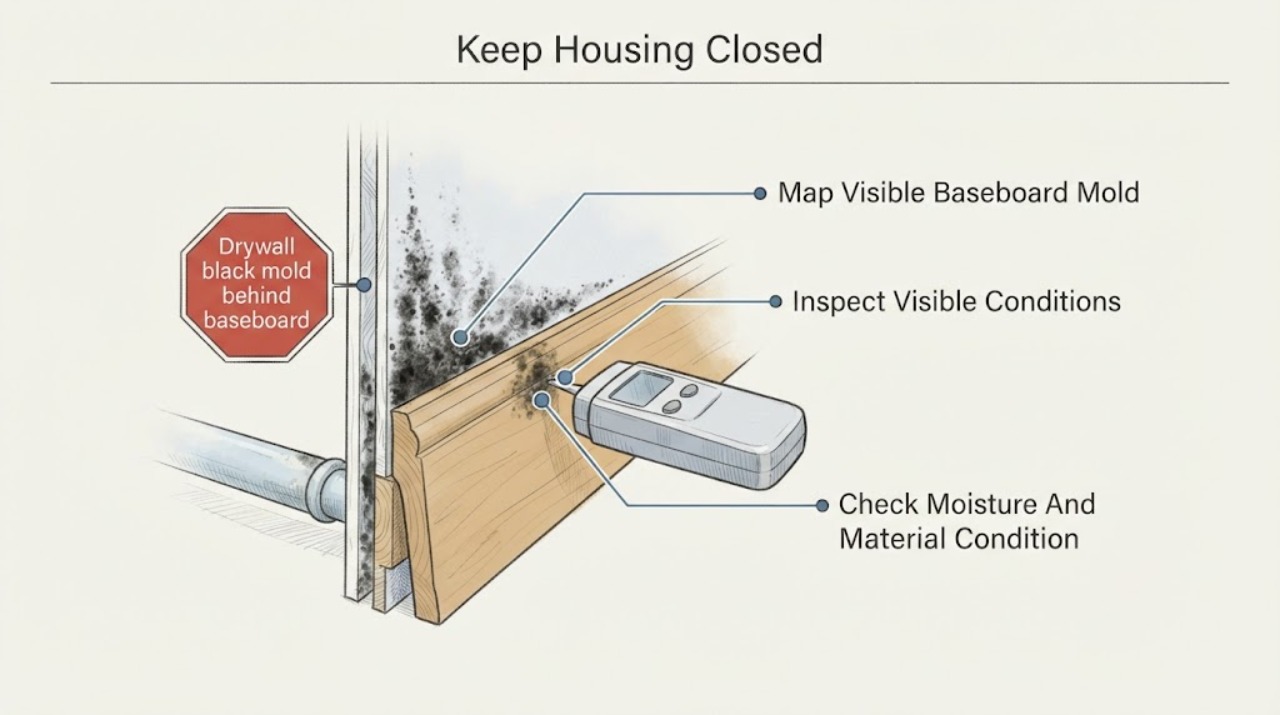
From a safe standing position, photograph and map the visible dark or mold-like material on the drywall, baseboard, trim, floor edge, and nearby contents without touching, scraping, vacuuming, or removing the baseboard.
Expected result: Record the room and wall, approximate visible extent, sharp or diffuse edges, staining, peeling paint, swollen or crumbling drywall, dampness, musty odor, and whether the material continues behind furniture or trim.
Next step: Keep people and pets away, preserve the photos, and arrange plumbing plus mold or water-damage assessment. Treat a spreading or inaccessible edge as potentially larger than the visible patch.
Stop if: Stop for loose material, airborne dust, strong odor, active water, sewage, damaged electrical equipment, respiratory or eye irritation, or any need to kneel on wet flooring or disturb the baseboard.
Why this matters
Why: Visible growth, water staining, and damaged porous material establish a moisture and material-damage concern but cannot identify species, toxicity, or the full cavity extent from color or appearance.
-
Check 2
Without opening the wall or creating a flow test, observe whether dampness, staining, dripping, swelling, or odor changes after ordinary use of nearby sinks, toilets, showers, laundry, radiators, or other known plumbing fixtures.
Expected result: Record a repeatable connection with fixture use, continuous dampness, a dry surface with an old stain, no visible change, or an unknown plumbing route behind the wall.
Next step: If active water or a use-linked change is present, stop using the affected fixture when practical and contact a qualified plumber. Do not remove trim or drywall to trace the route.
Stop if: Stop for flooding, sewage or contaminated water, water near outlets or wiring, ceiling or wall movement, or any attempt to test by cutting, drilling, pressurizing, or opening the cavity.
Why this matters
Why: A repeatable or continuing pattern supports urgent plumbing source control, but a dry surface does not rule out a concealed or intermittent pipe leak. The pattern cannot distinguish a supply, drain, condensation, or other source without professional inspection.
-
Check 3
From outside the suspected cavity, observe the baseboard, drywall face, floor edge, and adjacent trim for moisture and material change; use only a non-invasive visual check and do not press swollen material or insert a probe.
Expected result: Note wetness, water beads, condensation, swelling, softness, crumbling, peeling finish, efflorescence, staining, musty odor, or a dry but previously damaged surface.
Next step: Send the location and photos to the plumber and remediation professional. Keep the wall unaltered until they decide whether moisture mapping, limited access, drying, or material removal is needed.
Stop if: Do not peel paint, press soft drywall, move heavy furniture against the wall, use a fan to blow across mold, or open a cavity to check behind the baseboard.
Why this matters
Why: Moisture or porous-material damage makes ongoing or past water entry plausible and helps a professional prioritize the pipe route and drying assessment. A dry reading at the surface cannot clear the back of drywall or the cavity.
-
Check 4
Estimate the visible patch from photographs and note whether there has been extensive water damage, repeated wetting, a large area, or possible spread behind the baseboard or into adjacent materials; do not treat the visible patch as a demolition boundary.
Expected result: Record a small isolated surface area versus a patch approaching or exceeding about 10 square feet, multiple wall sections, wet insulation or flooring, extensive swelling, or suspected hidden growth.
Next step: Arrange experienced mold or water-damage assessment for a large, spreading, recurrent, or hidden condition and coordinate it with plumbing source repair. Do not start a cleanup or rebuild based solely on a size estimate.
Stop if: Stop for a large or spreading area, wet insulation, contaminated water, HVAC involvement, vulnerable occupants, airborne dust, or any need for containment, demolition, or disposal beyond ordinary safe observation.
Why this matters
Why: EPA says that a moldy area under about 10 square feet may often be handled with its household guidance, but a larger area or a lot of water damage should be assessed by experienced professionals. A hidden pipe leak and porous drywall make the true extent uncertain even when the visible patch is small.
-
Check 5
From outside the affected area, record whether anyone has asthma, mold sensitivity, immune compromise, or persistent symptoms and whether the suspected moisture or mold is near an HVAC intake or return; do not run equipment to circulate air through the area.
Expected result: Note no known occupant concern and no HVAC connection versus vulnerable occupants, persistent respiratory or eye symptoms, a musty odor spreading through the building, or suspected contamination near an air intake.
Next step: Keep occupants out as practical, arrange professional assessment sooner, and consult a health professional for persistent or severe symptoms. Follow the exact HVAC safety advice from the remediation professional.
Stop if: Do not investigate an air handler, remove a grille, clean ductwork, use fans to spread air, or continue if anyone has breathing difficulty or a severe reaction; seek appropriate urgent medical help for severe symptoms.
Why this matters
Why: Occupant vulnerability and HVAC proximity change the exposure-control and urgency decision. EPA advises not running an HVAC system known or suspected to be contaminated because it could spread mold; symptoms are not proof of a species or cause.
-
Check 6
Prepare a service record with the safe photos, wall and room location, plumbing-use timing, moisture and material observations, visible extent, occupant or HVAC concerns, and any prior leak or cleanup work.
Expected result: The record may show an active use-linked pipe leak, an old but recurring damp area, a dry surface with hidden-mold indicators, or an unresolved source with no safe way to inspect behind the baseboard.
Next step: Give the record to qualified plumbing and mold or water-damage professionals and ask them to coordinate before any wall or baseboard removal. Keep the area isolated until the source and scope are addressed.
Stop if: Do not sample, scrape, cut, drill, remove baseboards, open walls, paint, caulk, or dispose of moldy porous materials as part of preparing the record.
Why this matters
Why: A combined timeline helps the plumber locate and stop the water source and helps the remediation professional plan hidden-cavity assessment, drying, removal, containment, and rebuild. It does not establish a species, toxicity, or exact material scope.
Use your observations
Decision map
Find the observation that best matches what you see, then follow the next safe action.
-
PATH 01Next step
What you see
The visible material is black or dark, but no qualified assessment has identified its species or hazard profile.
Do this next
Treat it as visible mold-like growth associated with a moisture problem, document it without disturbing it, and focus on source control and safe scope rather than color-based testing or claims.
Why this path and its safety boundary
Why it matters: Color alone cannot identify mold species or establish that the growth is more toxic; different molds can look different and one species can change appearance.
-
PATH 02Next step
What you see
Dampness, dripping, swelling, staining, or odor changes track nearby plumbing use, or water is actively entering behind the baseboard.
Do this next
Stop using the affected fixture when practical, keep clear of electrical or contaminated water, and request qualified plumbing source control plus experienced mold or water-damage assessment.
Why this path and its safety boundary
Why it matters: An active or intermittent pipe leak may be feeding hidden moisture and mold behind porous drywall; a dry face does not exclude a cavity leak.
-
PATH 03Next step
What you see
The baseboard or drywall conceals the suspected source, musty odor persists without a visible source, or water damage is known behind the wall.
Do this next
Do not remove the baseboard or open the drywall as a test. Arrange experienced hidden-moisture and mold assessment with controlled access and source repair.
Why this path and its safety boundary
Why it matters: EPA identifies the backside of drywall and wall areas around leaking pipes as hidden-mold locations and warns that disturbance can spread mold.
-
PATH 04Next step
What you see
The visible growth approaches or exceeds about 10 square feet, spans multiple wall sections, follows extensive water damage, or extends into flooring, insulation, or adjacent materials.
Do this next
Arrange experienced mold remediation and water-damage assessment coordinated with plumbing repair. Keep occupants away and do not start demolition or cleanup yourself.
Why this path and its safety boundary
Why it matters: The area or water-damage scope exceeds a simple small-surface decision, and hidden porous-material contamination may be larger than the visible patch.
-
PATH 05Next step
What you see
The water may be sewage or otherwise contaminated, or the suspected mold and moisture are connected to an HVAC intake, return, or air-handling path.
Do this next
Keep people out, avoid circulating air through the area, and call experienced remediation and plumbing professionals; do not clean or open the HVAC path as a DIY task.
Why this path and its safety boundary
Why it matters: Contaminated water and HVAC distribution raise exposure and cleanup complexity beyond ordinary surface observation.
-
PATH 06Next step
What you see
An occupant has persistent or severe respiratory, eye, skin, or other symptoms, or is especially vulnerable to damp or moldy environments.
Do this next
Keep the person away from the area, seek medical advice for symptoms, and arrange professional moisture and mold assessment without disturbing the site.
Why this path and its safety boundary
Why it matters: Health needs change the exposure-control decision, but symptoms cannot identify a mold species or prove that this wall is the cause.
-
PATH 07Next step
What you see
The visible area was cleaned or the plumbing was repaired, but dampness, odor, staining, or growth returns.
Do this next
Stop cosmetic work and request coordinated plumbing and remediation reassessment of the cavity, adjacent materials, and drying outcome.
Why this path and its safety boundary
Why it matters: The moisture source may not be fully corrected, hidden materials may remain wet or contaminated, or another water path may be involved.
Helpful context
Understand the symptom
Treat the color as an appearance, not a species diagnosis
CDC/NIOSH states that different mold species can have different colors and that color does not indicate whether mold is more or less dangerous. The CDC also says the type does not need to be identified before addressing a building mold problem. Focus on moisture, location, material damage, and safe cleanup scope rather than trying to name the growth from a photograph.
A baseboard can hide the actual wet area
A pipe leak can wet the back of drywall, the bottom edge, insulation, flooring, or the wall cavity while only a dark mark is visible at the baseboard. EPA lists the back side of drywall and areas inside walls around leaking pipes as possible hidden-mold locations, and warns that investigating them can disturb and spread mold. Do not use the visible patch as the full boundary of the problem.
Stop the leak before restoring the wall
Cleaning or painting the face of the drywall without stopping the pipe leak leaves the moisture driver in place. EPA recommends fixing plumbing leaks and drying materials, while porous materials that remain moldy may be difficult or impossible to clean completely. A plumber and an experienced remediation professional should coordinate the source repair, cavity assessment, drying, removal, and rebuild scope.
Safety boundary
Stop conditions
- Do not remove the baseboard, cut or drill the drywall, scrape, sand, vacuum, paint, caulk, or disturb suspected hidden mold as a test.
- Stop for active or contaminated water, sewage, flooding, water near electrical equipment, loose or crumbling drywall, airborne dust, or strong odor.
- Keep people and pets away from a large, spreading, recurrent, hidden, HVAC-connected, or extensive water-damage area and use qualified remediation help.
- Do not diagnose species or toxicity from black color, rely on routine air sampling to determine health risk, or select a pipe or drywall part before the source and scope are confirmed.
Only after diagnosis
Potential parts
- pipe repair fitting or section
Consider only after a qualified plumber locates and confirms the leaking pipe, connection, material, and repair scope behind the baseboard.
Match the exact pipe material, size, connection method, access, and local requirements; do not order from mold color or a stain. - drywall or gypsum board replacement section
Consider only after the leak is stopped and a remediation professional confirms that porous drywall cannot be dried or cleaned within the approved scope.
Confirm thickness, moisture exposure, fire or acoustic requirements, and the surrounding wall assembly before ordering. - baseboard or trim replacement
Consider only when the baseboard is water-damaged or must be removed as part of controlled access and cannot be safely restored.
Match profile, dimensions, material, finish, and the dry rebuilt wall condition before ordering.
When checks do not resolve it
Need a professional?
Call a qualified plumber promptly for an active, recurring, or suspected pipe leak behind the baseboard. Arrange experienced mold or water-damage assessment for hidden cavity involvement, porous drywall damage, a visible area approaching or exceeding about 10 square feet, extensive or contaminated water, recurrence after repair, HVAC involvement, vulnerable occupants, or persistent symptoms. Keep the area isolated and do not disturb the wall while arranging service.
Safety scope: The reader-level scope is safe visual documentation and ordinary observation only. Qualified professionals must locate or repair concealed pipes, open or contain the wall, assess hidden mold, handle contaminated materials, dry or remove porous drywall, and determine rebuild scope.
Common questions
FAQ
Does black mold on drywall mean it is toxic?
No. CDC/NIOSH says mold color does not indicate whether it is more or less dangerous, and color cannot identify a species. Treat visible growth as a moisture and material problem and address the water source safely.
Should I remove the baseboard to see if mold is behind it?
No. EPA warns that investigating hidden mold can disturb growth and spread spores. Photograph from a safe position and have an experienced professional plan controlled access after the suspected pipe leak is addressed.
Can I paint over the black area after fixing the leak?
Not before the affected materials are assessed, cleaned or removed as appropriate, and dried. EPA advises fixing plumbing leaks and not painting or caulking moldy surfaces; paint over mold is likely to peel.
How large does a mold area have to be before I call a professional?
EPA uses about 10 square feet as a general small-area boundary, but a hidden pipe leak, porous drywall, extensive water damage, contaminated water, recurrence, or HVAC involvement can justify professional help even when the visible patch is smaller.
What should I do if the mold keeps returning after the pipe is repaired?
Stop cosmetic work and request coordinated plumbing and remediation reassessment. Hidden drywall, insulation, flooring, or another unresolved moisture path may still be wet or contaminated.
Read the exact guide
Official sources
- Mold, Testing, and RemediationCDC/NIOSH · CDC/NIOSH guidance for damp and moldy buildings; it does not identify a species or replace site-specific medical, plumbing, or remediation assessment.
- Mold Course Chapter 3: Finding Mold and MoistureU.S. Environmental Protection Agency · EPA mold-investigation training guidance used for hidden pipe-leak and drywall boundaries; it does not authorize untrained wall opening or demolition.
- Facts About Stachybotrys chartarumCenters for Disease Control and Prevention · CDC information about one greenish-black mold; used to prevent species or toxicity claims from color and not as a diagnosis of the visible drywall growth.
- Mold Cleanup in Your HomeU.S. Environmental Protection Agency · EPA residential cleanup guidance; the hidden pipe-leak and porous drywall condition may require professional assessment even below the general small-area threshold.
- A Brief Guide to Mold, Moisture and Your HomeU.S. Environmental Protection Agency · EPA residential mold and moisture guidance used for source control and hidden-wall escalation; local requirements and qualified professionals control project execution.
Community feedback
Share a repair observation
Share a plain-text repair observation. Accepted observations are published automatically; this page may take a moment to update.