
On this page
Start here
Quick answer
Mold on a window sill is a moisture problem first, not a color-identification problem. From a safe position, document whether water appears as repeatable interior condensation at a cold edge or as streaking, seepage, swelling, or staining that could indicate a failed seal or flashing. Do not scrape, sand, open the wall, paint or caulk over growth, or rely on an antimicrobial product to solve the source. Reduce recurring indoor moisture only in safe, ordinary ways, keep the area undisturbed, and arrange mold and window/building-envelope assessment when there is active leakage, wet or porous materials, hidden growth, a broad area, recurrence, or occupant health concerns.
Before you begin
Safety first
- This article is limited to non-contact documentation, ordinary safe humidity observation, and a visible boundary check. Do not scrape, sand, brush, vacuum, sample, open walls, remove trim, paint, caulk, mix chemicals, fog, apply repeated biocide, or run a potentially contaminated HVAC system. Do not disturb porous, hidden, broad, recurring, or water-damaged growth.
Work through in order
Diagnostic checks
Use only checks that match the exact appliance or system and its official guide.
-
Check 1
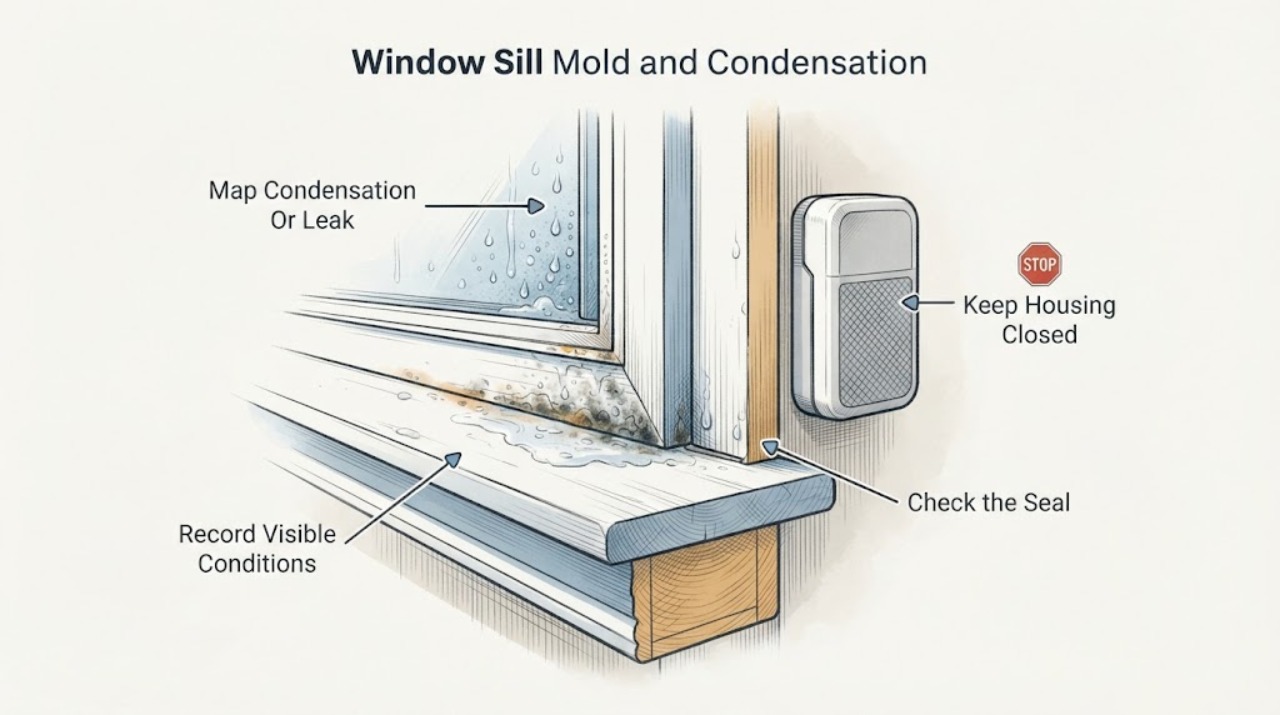
From a dry, stable position, photograph the window sill, frame, glazing edge, jambs, and the adjacent wall and floor without scraping, wiping mold, opening finishes, or moving trim. Record whether moisture appears during cold weather, after rain, during humid conditions, or after window use.
Expected result: Droplets or fogging repeat at the glass or frame edge without a rain-linked path; alternatively, water streaks, dampness after rain, swollen or soft wood, peeling finish, staining beyond the sill, or moisture in the wall are present.
Next step: Keep a dated photo and weather or humidity record. Request window/building-envelope and mold assessment promptly for leakage, swollen materials, or wall spread; for apparent condensation, continue to the humidity and cold-surface observations without disturbing the growth.
Stop if: Stop for active water entry, soft or collapsing material, an electrical or structural hazard, a need to remove trim or drywall, or any attempt to test the seal with tools, hoses, or pressure.
Why this matters
Why: A repeatable cold-edge pattern can be consistent with surface condensation and a cold spot, while rain-linked paths, swelling, or spread into the wall raise concern for a failed seal, flashing, drainage detail, or concealed water damage. The observation does not identify a single failed component.
-
Check 2
Without touching the mold-like growth, record indoor humidity using an ordinary room humidity meter if one is already available, and note the room temperature, outdoor weather, window covering position, nearby airflow, and whether the affected sill is colder or more exposed than adjacent wall surfaces.
Expected result: Condensation returns during humid periods, concentrates at a frame or corner, is worse behind closed coverings or blocked airflow, or appears at several windows; alternatively, the sill remains wet despite ordinary indoor humidity and ventilation conditions.
Next step: Share the humidity, weather, location, and recurrence record with a qualified moisture or window professional. Use normal safe ventilation or dehumidification as appropriate for the home, but do not direct a fan at disturbed growth or treat lower humidity as proof that the window assembly is sound.
Stop if: Do not drill the sill, open the wall, remove insulation, insert probes into moldy material, or change a vapor or air barrier based on a meter reading.
Why this matters
Why: Recurring condensation at cold edges can involve indoor moisture, a cold surface, restricted air movement, glazing or frame performance, or a thermal bridge. Persistent wetness despite reasonable moisture conditions makes a seal, flashing, drainage, or concealed assembly problem more important to investigate; readings alone cannot prove the cause.
-
Check 3
From the room side and only where plainly visible, inspect the seal line, frame corners, sill finish, and surrounding wall for gaps, failed-looking sealant, staining, paint lifting, swelling, soft spots, or a change that continues behind trim; do not pull trim, press soft material, or add caulk.
Expected result: The visible seal line is cracked or separated, the sill or trim is swollen or soft, staining continues into the jamb or wall, or the visible hard surface is intact with mold-like spotting limited to the exposed sill.
Next step: Photograph the boundary and request the appropriate window/building-envelope professional plus mold-remediation input when materials are porous, damaged, or concealed. Do not seal over growth or use an antimicrobial coating as a substitute for repair and drying.
Stop if: Stop before caulking, painting, replacing trim, opening a cavity, removing wallpaper, or disturbing any material that may release spores or reveal hidden wet damage.
Why this matters
Why: A broken-looking seal or damaged porous assembly can allow water or humid air into places that a surface cleaner cannot correct. An intact exposed surface with localized spotting may support a narrower cleaning discussion only after the moisture source and occupant risk are assessed; neither appearance nor color proves the species.
-
Check 4
From a safe position, map the visible mold-like growth by room, sill, frame, jamb, adjacent wall, floor, and nearby porous contents, estimating the affected extent without relying on color and without touching, brushing, vacuuming, or collecting a sample.
Expected result: Growth is limited to a small, exposed, non-porous area with no active leak, hidden cavity, porous spread, recurring moisture, or vulnerable occupant; alternatively, it reaches wood, drywall, insulation, curtains, or wall cavities, covers a broad area, follows substantial water damage, or keeps returning.
Next step: Keep people and pets away from disturbed material and provide the map and photos to an experienced mold professional. Do not open the wall, remove porous materials, run HVAC that may be contaminated, or attempt a broad cleanup based on an area estimate.
Stop if: Stop all cleaning and sampling for hidden growth, extensive spread, sewage or contaminated water, structural damage, strong musty odor without a visible source, breathing symptoms, asthma, immune suppression, or any need to create dust.
Why this matters
Why: A small exposed area may allow a carefully scoped cleaning decision under applicable guidance, but antimicrobial use is not automatically needed and moisture correction remains essential. Porous or hidden growth, extensive or recurring contamination, substantial water damage, or higher occupant vulnerability changes the job to professional assessment and containment planning.
-
Check 5
After a qualified professional has addressed the suspected moisture source or confirmed a safe small-surface plan, compare dated photos of the sill during the same weather or occupancy conditions; do not scrub harder or apply additional antimicrobial product to force a result.
Expected result: Condensation, dampness, odor, staining, or growth returns, or the material remains wet; alternatively, the surface stays dry and no new growth or odor appears while the surrounding assembly remains intact.
Next step: Stop DIY cleaning, keep the area separated as practical, and arrange follow-up moisture and mold assessment; escalate urgently for active leakage, worsening material damage, health concerns, or HVAC contamination.
Stop if: Do not paint, caulk, sand, scrape, fog, or repeatedly apply biocide over a recurring or wet condition.
Why this matters
Why: Recurrence means the moisture path, cold surface, air leakage, seal, or contaminated material has not been adequately resolved; disappearance of visible spotting alone does not prove the assembly is dry or remediated. EPA's completion framing requires the moisture problem to be fixed and visible mold or moldy odors to be absent.
Use your observations
Decision map
Find the observation that best matches what you see, then follow the next safe action.
-
PATH 01Next step
What you see
Water enters after rain, the sill or trim is swollen or soft, staining spreads into the jamb or wall, or a wall cavity may be wet.
Do this next
Keep the area undisturbed and arrange prompt window/building-envelope and mold-moisture assessment. Do not caulk, paint, remove trim, or open the wall to chase the leak.
-
PATH 02Next step
What you see
Moisture repeatedly beads at the cold glass, frame, or sill edge, especially during humid or cold conditions, without a clear rain-linked path.
Do this next
Track indoor humidity, weather, window coverings, and recurrence; use ordinary safe ventilation or dehumidification as appropriate and ask a professional to assess glazing, air leakage, insulation, thermal bridging, and the sill finish if it persists.
-
PATH 03Next step
What you see
Growth reaches wood, drywall, insulation, curtains, or a wall cavity; follows substantial water damage; covers a broad area; or recurs after cleaning.
Do this next
Stop disturbance and arrange experienced mold-remediation and moisture assessment. Keep occupants away as practical and do not run a potentially contaminated HVAC system or attempt broad cleaning.
-
PATH 04Next step
What you see
Growth appears limited to a small exposed hard surface, with no active leak, porous or hidden spread, recurrence, or health concern.
Do this next
Use the applicable EPA cleaning guidance or choose an experienced professional; correct the condensation or moisture source first, avoid color-based identification, and do not paint or caulk over growth.
-
PATH 05Next step
What you see
The main question is whether a dark, light, green, or other color identifies a dangerous species or whether a routine test is needed.
Do this next
Do not infer species or danger from color and do not use routine sampling as a substitute for visual moisture assessment. Focus on the moisture source, material condition, extent, recurrence, and occupant risk; consult a qualified professional when testing would change a remediation decision.
Helpful context
Understand the symptom
Start with moisture, not the color of the growth
EPA identifies condensation around window sills as a way that enough moisture can collect for mold to grow. CDC/NIOSH also says molds appear in many colors and that color does not indicate whether mold is more or less dangerous. Treat the visible material as mold-like growth that needs moisture control and safe assessment; do not label it by appearance or promise an antimicrobial treatment based on color.
Condensation and leakage can look similar from the room
Repeated droplets or fogging concentrated at a cold glass or frame edge can fit a condensation pattern. Streaks after rain, wet or swollen wood, peeling finish, staining that extends into the jamb or wall, or moisture inside a cavity raises a different question about seal, flashing, drainage, or concealed damage. The sill alone does not prove which mechanism is present.
Antimicrobial cleaning is not a moisture repair
A cleaner or biocide cannot correct a leaking window, a cold thermal bridge, poor air movement, or indoor moisture. EPA advises fixing the water problem, drying materials, and avoiding painting or caulking over moldy surfaces. Stop before disturbing porous or hidden materials, and use an experienced professional when the problem is broad, water-damaged, recurring, or beyond a safely accessible hard surface.
Only after diagnosis
Potential parts
- window weather seal or gasket
Consider this category only if a qualified window professional confirms that a failed or damaged seal is allowing air or water entry; condensation or mold alone does not identify a gasket failure.
Match the exact window frame, sash, glazing arrangement, material, and approved installation method; do not seal over mold or concealed wet damage. - window sill or frame repair material
Consider this category only after the moisture source, material condition, and repair scope are assessed. Swollen, soft, or porous material may require removal or a broader building-envelope repair rather than a surface coating.
A professional must confirm the substrate, exposure, drainage, flashing, finish, and local installation requirements before selecting a repair material. - room humidity meter
Consider this only as an observation aid for tracking recurring condensation; a humidity reading cannot identify mold species, prove a thermal bridge, or replace leak and moisture assessment.
Use it according to the instrument instructions in the room, keep it away from wet growth, and interpret trends with weather and professional assessment.
When checks do not resolve it
Need a professional?
Arrange prompt mold-moisture and window/building-envelope assessment for any rain-linked water, swollen or soft sill, staining into the wall, hidden or porous growth, broad contamination, recurrence, substantial water damage, contaminated water, a musty odor without a visible source, suspected HVAC contamination, or occupant health concerns. A qualified professional should also review persistent condensation when humidity control does not stop it.
Safety scope: This article is limited to non-contact documentation, ordinary safe humidity observation, and a visible boundary check. Do not scrape, sand, brush, vacuum, sample, open walls, remove trim, paint, caulk, mix chemicals, fog, apply repeated biocide, or run a potentially contaminated HVAC system. Do not disturb porous, hidden, broad, recurring, or water-damaged growth.
Have this ready
- Dated photos of the sill, glazing edge, frame, jamb, adjacent wall, and floor
- Weather, condensation, humidity, ventilation, window-covering, and recurrence timeline
- Whether moisture follows rain or appears only at a cold edge
- Material condition and extent, including wood, drywall, insulation, curtains, hidden cavities, or HVAC proximity
- Any water damage, musty odor, occupant symptoms, asthma, immune suppression, or other access and safety limits
Common questions
FAQ
Can the color of window-sill mold tell me what type it is?
No. CDC/NIOSH says molds occur in many colors and color does not show whether mold is more or less dangerous. EPA also explains that labels such as black mold are not a species identification. Focus on moisture, material, extent, recurrence, and safe remediation rather than color.
Is mold on a window sill always caused by a leaking window?
No. Repeated droplets at a cold glass or frame edge can fit indoor condensation, while rain-linked streaks, swelling, soft wood, or moisture extending into the wall raises concern for a seal, flashing, drainage, or concealed water problem. Document the pattern and have the assembly assessed when it persists.
Will an antimicrobial cleaner fix window-sill mold?
Not by itself. A cleaner cannot correct high indoor moisture, a cold thermal bridge, air leakage, failed flashing, or wet porous materials. Correct the moisture source first, do not paint or caulk over growth, and use professional guidance when the area is broad, hidden, porous, recurring, or water-damaged.
When does window-sill mold need a professional?
Arrange professional assessment for active leakage, swollen or soft materials, growth in wood, drywall, insulation, or a wall cavity, substantial water damage, a broad or recurring area, suspected HVAC contamination, contaminated water, or occupant health concerns. A window or building-envelope professional may also be needed for persistent condensation or failed seals.
Should I open the wall to see whether mold is hidden behind the sill?
No. EPA warns that investigating hidden mold requires caution because disturbing a site can release spores. Photograph the visible boundary and arrange experienced moisture and mold assessment rather than removing trim, drywall, wallpaper, or insulation yourself.
Read the exact guide
Official sources
- Mold, Testing, and RemediationNational Institute for Occupational Safety and Health, CDC · Supports not judging species or danger by color, prioritizing moisture, avoiding routine air-sampling assumptions, and using appropriate remediation controls.
- Moisture Control, Part of Indoor Air Quality Design Tools for SchoolsU.S. Environmental Protection Agency · Building-science reference for window-sill condensation and thermal-bridging patterns; it does not prescribe a model-specific window repair.
- A Brief Guide to Mold, Moisture and Your HomeU.S. Environmental Protection Agency · Supports treating condensation and leaks as moisture problems, drying and correcting the source, avoiding disturbance of hidden mold, and checking that moisture and visible growth are resolved.
- Mold Cleanup in Your HomeU.S. Environmental Protection Agency · Supports the small-exposed-surface versus broad, water-damaged, porous, hidden, HVAC-related, contaminated-water, and health-concern boundaries in this article.
- Purchasing Energy-Efficient Residential Windows, Doors, and SkylightsU.S. Department of Energy · General window performance context used to distinguish condensation and air-leakage questions from a confirmed mold or seal diagnosis.
- Mold Course Chapter 1:U.S. Environmental Protection Agency · Supports the explicit warning that color labels such as black mold do not identify a species and that mold cannot be identified for toxin production by looking at it.
Community feedback
Share a repair observation
Share a plain-text repair observation. Accepted observations are published automatically; this page may take a moment to update.