
On this page
Start here
Quick answer
Mud tubes rising from soil or a foundation are a strong sign of subterranean termite activity, while a pile of dry, pellet-like frass pushed from wood is more associated with drywood termites. Seeing both clues near a foundation or baseboard does not identify one species or prove that all damage is active; the material may represent different activity, old evidence, or another source. Photograph and map the tube, frass, holes, and damaged wood without breaking them, inspect only safely reachable areas for moisture and wood-to-soil contact, and arrange a prompt inspection by a licensed pest-management professional. Do not spray a generic pesticide, open walls, remove foundation soil, or repair damaged wood before the activity and structural scope are confirmed.
Before you begin
Safety first
- This article supports documentation and safe visual observation only. Do not disturb evidence, apply pesticides, open walls, excavate, remove structural wood, or perform load or treatment tests.
Work through in order
Diagnostic checks
Use only checks that match the exact appliance or system and its official guide.
-
Check 1
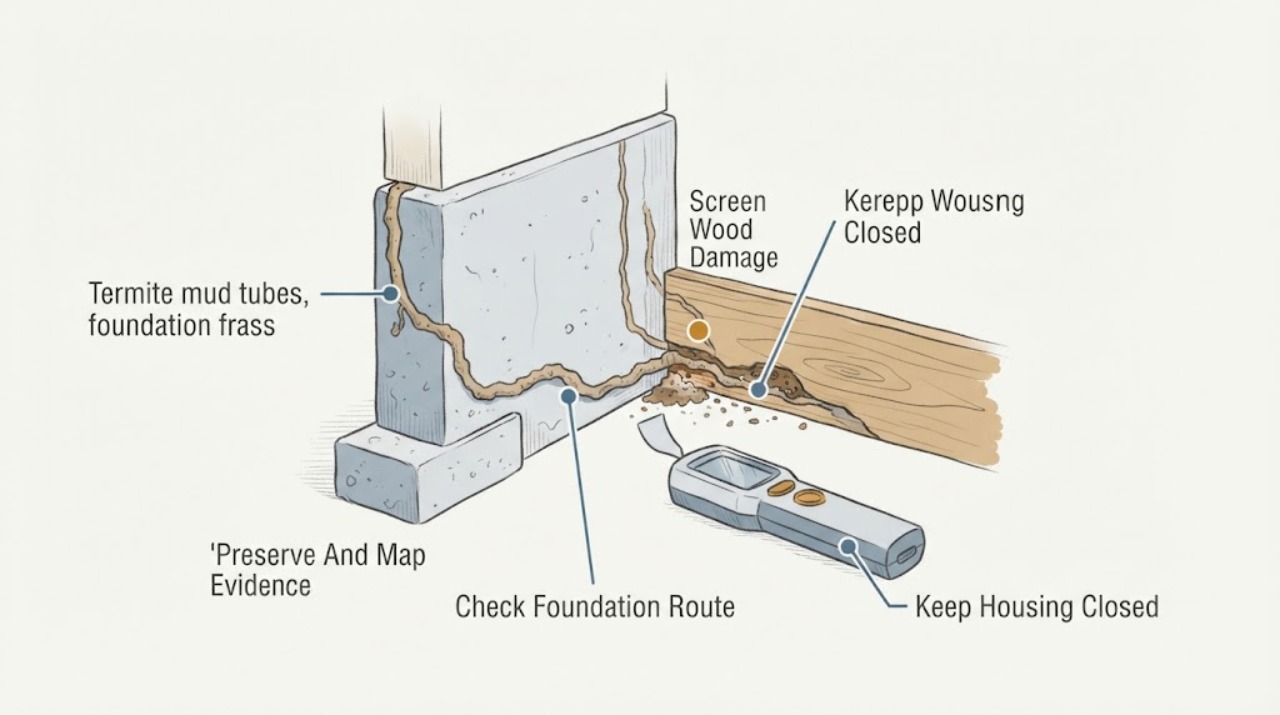
From a stable, ordinary-access position, photograph each mud tube, frass-like pile, exit or kick-out hole, stain, and damaged baseboard or exposed wood before disturbing the area; map each sign to the room, foundation face, crawlspace edge, or wall section.
Expected result: Record whether the tube appears to connect soil or the foundation to wood, whether pellets are loose or concentrated below a small opening, whether the wood is visibly split, blistered, soft, or hollow-looking, and whether the evidence is new, old, or changing in dated photographs.
Next step: Keep the evidence in place and give the map and dated photographs to a licensed pest-management professional; include both the foundation-side and interior/baseboard views.
Stop if: Do not scrape, break, vacuum, wash, seal, spray, pull trim, or open a wall to expose more evidence.
Why this matters
Why: A soil-to-wood mud tube supports a subterranean-termite inspection path, while dry pellet-like material emerging from wood supports a different wood-infesting inspection path. The two clues together do not prove one species, current activity, or a single source of damage.
-
Check 2
From safe ground-level access or an already accessible crawlspace or basement position, follow the visible route around the foundation and nearby wood without moving soil, insulation, stored items, or finishes.
Expected result: Note additional tubes, gaps or cracks, utility penetrations, wood touching soil, blocked inspection space, leaks, dampness, standing water, poor grading, wet downspouts, or vegetation and debris against exposed wood.
Next step: Photograph the route and drainage conditions, keep vents and inspection areas accessible where safe, and ask the pest professional to assess entry paths before anyone fills cracks, excavates, or changes the foundation interface.
Stop if: Stop if entry requires crawling into an unsafe space, moving heavy materials, disturbing insulation, contacting contaminated water, approaching electrical hazards, or removing a finish.
Why this matters
Why: A continuous or concealed route and moisture or access conditions increase the need for prompt pest inspection and moisture correction. A dry, unobstructed area with no additional visible signs does not rule out hidden activity behind finishes or in inaccessible foundations.
-
Check 3
At the baseboard and any already exposed adjacent wood, use a flashlight and ordinary visual inspection to compare sound-looking surfaces with the damaged area without prying, cutting, or removing paint or trim.
Expected result: Record whether damage follows the grain, forms galleries or grooves, leaves a thin surface veneer, has a soft or crumbling area, is limited to trim, or extends toward a sill, joist, stud, door frame, or other structural connection.
Next step: Keep the area undisturbed and provide the photographs, location, and access limits to the pest professional; request separate structural evaluation before remodeling or replacing concealed wood.
Stop if: Do not probe forcefully, remove trim, drill, cut drywall, pull flooring, load-test the wood, or enter a crawlspace or wall cavity to investigate.
Why this matters
Why: Termites can hollow wood with little outside indication, so an apparently minor baseboard defect does not establish minor damage. Damage near a structural connection or a soft, collapsing, or broadly affected area raises the need for a building or structural assessment as well as pest inspection.
-
Check 4
Compare the locations and timing of the tube and frass evidence, using dated photographs and notes rather than repeatedly disturbing the signs.
Expected result: Classify the record as mud tubes only, frass-like pellets only, both in one connected area, or both in separate areas; note new tubes, repaired or reopened holes, fresh particles, swarmers, or no change after the initial observation.
Next step: Tell the professional exactly which pattern was observed and ask for species identification, activity assessment, inspection of concealed routes, and a written treatment and monitoring plan.
Stop if: Do not use household insecticide, fumigate, set fire, inject chemicals into the foundation, or dismantle the area to force a species identification.
Why this matters
Why: Mud tubes and pellet piles lead to different inspection questions. New or changing evidence makes current activity more concerning, while unchanged or dry evidence may be old but still warrants assessment when wood damage is present; neither pattern can be confirmed as active from appearance alone.
-
Check 5
Use the evidence map, wood condition, foundation route, moisture observations, and access limits to decide what professional scope to request.
Expected result: Choose prompt pest inspection for any mud tube, unexplained frass-like pellets, swarmers, reopened evidence, or wood damage; request urgent escalation when wood is collapsing, a structural member may be affected, water or electrical hazards are present, or safe access is unavailable.
Next step: Contact a state-licensed pest-management professional and provide the evidence map, dated photographs, moisture history, prior treatments, building access limits, and any suspected structural concern.
Stop if: Do not apply a termiticide, remove foundation soil, repair load-bearing wood, or close over a tube or damaged area before the appropriate professional has assessed it.
Why this matters
Why: The service need is based on evidence and risk, not on a homeowner's visual species guess. Pest control addresses identification, activity, and treatment; building or structural service addresses the safety and repair of compromised wood; moisture or drainage service may be needed for contributing conditions.
Use your observations
Decision map
Find the observation that best matches what you see, then follow the next safe action.
-
PATH 01Safety boundary
What you see
A continuous or partially concealed earthen tube runs from soil, a foundation, or a foundation opening toward wood.
Do this next
Preserve and photograph the tube, check only safely reachable adjacent areas, and arrange prompt inspection by a licensed pest-management professional.
Why this path and its safety boundary
Why it matters: This is a strong subterranean-termite inspection clue, but the visible tube alone does not show how far the termites traveled or whether activity is current.
Safety stop: Do not break the tube, seal the foundation, excavate, or spray as a test.
-
PATH 02Safety boundary
What you see
Pellet-like or sawdust-like material is pushed from a small opening in wood, but no foundation or soil-to-wood tube is visible.
Do this next
Preserve the pile and opening, photograph the nearby wood, and ask for species-specific inspection rather than assuming a soil treatment or removing the trim.
Why this path and its safety boundary
Why it matters: The clue fits a drywood-termite inspection pattern more closely than a subterranean mud-tube pattern, but material identification and other wood-infesting causes still need professional confirmation.
Safety stop: Do not fill the hole, paint over the pile, vacuum the evidence, or use a generic pesticide.
-
PATH 03Safety boundary
What you see
Mud tubes and frass-like pellets appear in the same area or in separate areas of the structure.
Do this next
Tell the professional that both patterns are present, preserve each location separately, and request identification, activity assessment, and concealed-wood inspection before treatment is selected.
Why this path and its safety boundary
Why it matters: The combination does not prove one colony or one termite type. It may require separate inspection of soil-linked routes and wood-contained evidence, and the apparent frass may not be correctly identified from appearance alone.
Safety stop: Do not combine samples, discard evidence, or choose treatment based only on the fact that both materials are present.
-
PATH 04Safety boundary
What you see
The baseboard or adjacent wood is soft, crumbling, broadly hollow-looking, visibly collapsing, or near a sill, joist, stud, beam, or other structural connection.
Do this next
Keep people away from an unstable area, stop remodeling, arrange prompt pest inspection, and obtain qualified building or structural assessment for the wood scope.
Why this path and its safety boundary
Why it matters: The visible defect may understate concealed or load-bearing damage. Pest treatment alone does not determine whether the building is safe or how wood should be repaired.
Safety stop: Do not load, pry, cut, remove, or temporarily support structural wood without qualified direction.
-
PATH 05Safety boundary
What you see
The evidence is dry or unchanged, no additional signs are visible from safe accessible areas, and the wood appears sound without an active leak or unsafe condition.
Do this next
Keep the record and arrange a scheduled licensed inspection, especially if the location is near a foundation, crawlspace, or previously damaged wood; correct visible drainage or leak conditions only through appropriate service when needed.
Why this path and its safety boundary
Why it matters: The evidence may be old or localized, but a quiet surface does not rule out concealed activity or past damage.
Safety stop: Do not treat the absence of fresh particles or live insects as clearance and do not close the inspection path before assessment.
Helpful context
Understand the symptom
Mud tubes and frass are not interchangeable clues
A narrow earthen tube that connects soil, a foundation, or another concealed route to wood is the kind of evidence associated with soil-nesting subterranean termites. Missouri's field guide describes drywood termites differently: colonies live in wood and may push sawdust-like fecal pellets, called frass, from an opening. Those patterns help prioritize the inspection, but a photograph or a handful of particles cannot establish species, activity, or the extent of damage. Treat the combination as a reason to preserve evidence and obtain a professional assessment, not as proof that one colony caused every sign.
Protect the evidence while checking the route to the wood
Take close and wider photographs of each tube, pellet pile, opening, stain, soft area, and baseboard location before cleaning or remodeling. From a safe position, look for the route from soil or foundation to sill, joists, wall framing, or trim, and note leaks, dampness, poor drainage, wood-to-soil contact, cracks, or blocked inspection areas. HUD guidance explains why the foundation-to-wood interface and visible inspection strip matter, while EPA emphasizes keeping foundation soil dry, fixing leaks, and periodically inspecting. Do not excavate, seal, remove the tube, or open a wall as a homeowner test.
Separate pest treatment from wood repair
A treatment decision and a repair decision answer different questions. EPA says termiticides must be used according to their labels and that structural applications are usually best performed by a trained, licensed professional. The pest professional determines whether evidence is active and what treatment is appropriate; a qualified building or structural professional determines whether a sill, joist, stud, or other load-bearing member needs repair. Replacing a damaged baseboard or painting over a hole cannot establish that termites are gone.
Safety boundary
Stop conditions
- Do not break, scrape, vacuum, wash, seal, or spray the mud tubes or frass-like evidence before it is documented and assessed.
- Do not apply a generic pesticide, fumigate, inject chemicals into the foundation, or choose treatment from a photograph; termiticide work must follow the product label and applicable licensing requirements.
- Do not open walls, pull baseboards, remove flooring, excavate foundation soil, or disturb insulation to look for hidden activity.
- Stop and keep people away if wood is collapsing, a structural connection may be compromised, water or electrical hazards are present, or access is unsafe.
- Do not repair, paint over, or close a damaged area until pest activity and any structural or moisture scope have been assessed.
When checks do not resolve it
Need a professional?
Arrange prompt inspection by a state-licensed pest-management professional for any foundation mud tube, unexplained frass-like pellets, swarmers, reopened evidence, or termite-like wood damage. Request urgent assessment when wood is soft or collapsing, a sill, joist, stud, beam, or other structural connection may be affected, water or electrical hazards are present, or the area cannot be reached safely. A building or structural professional determines repair safety and scope; pest treatment alone does not certify damaged wood.
Safety scope: This article supports documentation and safe visual observation only. Do not disturb evidence, apply pesticides, open walls, excavate, remove structural wood, or perform load or treatment tests.
Common questions
FAQ
Do mud tubes and termite frass mean I have two kinds of termites?
Not necessarily. Mud tubes are associated with soil-nesting subterranean termites, while dry pellet-like frass pushed from wood is more associated with drywood termites. Seeing both may represent different activity, old evidence, or material that has not been correctly identified. Preserve each location and request professional species and activity assessment.
Should I remove a termite mud tube from my foundation?
Do not remove or break it as a first step. Photograph and map it, then arrange a licensed pest inspection. Disturbing the tube can discard useful evidence and does not eliminate hidden termites or the route into the structure.
Is frass proof that the baseboard is being damaged by termites right now?
No. A pellet pile can be a useful clue, but it does not establish species, current activity, or the extent of damage by itself. Photograph the opening and nearby wood, note whether new material appears, and have the evidence assessed before replacing trim or treating the area.
Can I spray a store-bought termite product around the foundation?
Do not choose or apply a generic pesticide as a diagnostic or treatment substitute. EPA says termiticides must be used according to their labels and that structural applications are usually performed by trained pest-management professionals. Ask a state-licensed professional to identify the activity and provide a label-compliant plan.
When does termite-related baseboard damage need more than pest control?
Arrange additional building or structural assessment when wood is soft, crumbling, collapsing, broadly hollow-looking, or near a sill, joist, stud, beam, or other structural connection. Pest treatment addresses the insects; it does not certify the safety or repair of compromised wood.
Read the exact guide
Official sources
- TermitesMissouri Department of Conservation · Supports the field-identification distinction used here; regional species and a professional inspection control any site-specific identification.
- GUIDE TO FOUNDATION AND SUPPORT SYSTEMS FOR MANUFACTURED HOMESU.S. Department of Housing and Urban Development · Used as general foundation-interface context; the guide concerns manufactured-home foundation systems and does not replace local building requirements or a site inspection.
- Termites: How to Identify and Control ThemU.S. Environmental Protection Agency · Supports the distinction between soil and mud-tube evidence, prevention around foundations and moisture, label-directed termiticide use, and referral to trained licensed professionals.
Community feedback
Share a repair observation
Share a plain-text repair observation. Accepted observations are published automatically; this page may take a moment to update.