
On this page
Start here
Quick answer
A bathtub push drain plug that sits high or lets the bath drain needs to be identified before it is adjusted. With the tub empty, dry and safe to inspect, compare the mechanism with the manufacturer's instructions: a Watco PUSH PULL closure is pushed down to close and pulled up to open without rotation, while a Kohler bath clicker can require a fully tightened stopper, a correctly seated gasket and a matching thread adjustment. Clean only visible hair or mineral residue and use hand pressure only. If the plug spins, jams, remains above the seat, or the drain connection leaks, stop before forcing or replacing it and have a plumber identify the unbranded assembly.
Work through in order
Diagnostic checks
Use only checks that match the exact appliance or system and its official guide.
-
Check 1
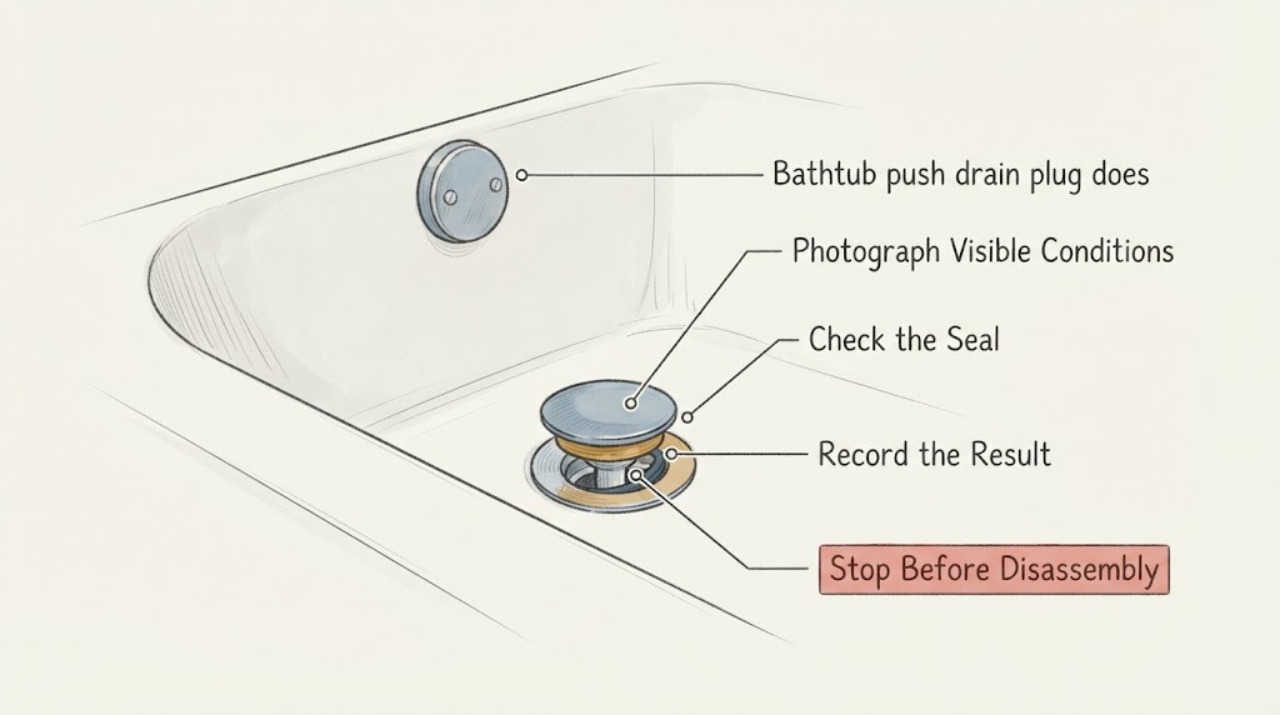
Empty the tub and dry the drain area. Operate the plug once with a fingertip, watching whether it clicks between open and closed, pulls up and down, or turns as it moves. Photograph the top, seal edge and drain opening before removing anything.
Expected result: The plug closes by a click, by pushing down and pulling up, or through a lift/turn or overflow-linked mechanism; the cap may also be visibly tilted or loose.
Next step: Use the matching branch below. If the motion is unclear, stop at identification and provide the photo, any brand mark and the drain assembly details to a plumber or fixture manufacturer.
Why this matters
Why: The observed motion identifies which manufacturer instructions can be relevant. A push-pull closure should not be treated like a clicker or lift-and-turn stopper, and a tilted cap can prevent the seal from seating.
-
Check 2
With the stopper open and the tub dry, inspect the visible sealing edge and drain seat for hair, soap film, scale, a displaced rubber gasket or a cross-threaded cap. Wipe away only loose surface residue with a soft cloth and non-abrasive cleaner that is safe for the tub finish.
Expected result: Residue or a gasket visibly blocks the seating surface, or the surfaces look clean while the plug still stops above the drain seat.
Next step: Remove only what is plainly reachable without tools or force, then test the motion once. If the gasket is torn, swollen or displaced, do not glue or stretch it; identify the exact assembly before ordering a seal.
Why this matters
Why: A visible obstruction can keep a stopper from closing, but a clean seat with a high plug points toward mechanism height, thread engagement or an incompatible/worn assembly rather than a clog alone.
-
Check 3
If the stopper clearly matches a bath clicker with a threaded stopper and gasket, check that the stopper is tightened by hand onto the clicker mechanism and that the gasket sits flat under it. Only if the assembly matches the Kohler-style instructions, make the documented small thread adjustment so the mechanism can travel farther down.
Expected result: The stopper or gasket was loose/out of position and the plug now sits on the seat, or the stopper remains high after the matching adjustment.
Next step: Fill only a shallow amount of water to confirm that the seal holds. If the plug remains high, the threads spin, or the mechanism differs from the Kohler design, stop adjusting and obtain model-specific service.
Why this matters
Why: On the matching clicker design, tight threads, gasket position and exposed thread control how far the stopper travels; this does not apply to every push-pull, toe-tap or overflow-linked drain.
-
Check 4
If the stopper clearly matches a push-pull closure, press it down to close and pull it up to open without twisting the knob. Confirm that the seal contacts the drain seat evenly and that the stopper returns fully when pulled up.
Expected result: The plug closes flush and holds shallow water, or it remains high, will not latch, rotates when it should not, or leaks around the seal.
Next step: If it still will not seat, leave the tub unused for bathing and have a plumber identify the stopper and waste assembly. Do not substitute a seal or stopper from a similar-looking drain.
Why this matters
Why: Watco's push-pull documentation describes press-to-close and pull-to-open operation without rotation; failure under that matching operation indicates a worn seal, wrong travel or damaged assembly, not a reason to force the knob.
-
Check 5
If cleaning requires removal, use only the removal method for the identified style. Delta's tub guidance says its lift-and-turn and toe-tap stoppers are unscrewed counterclockwise in the fully raised position; do not apply that instruction to a push-pull or clicker unless its own instructions say the same.
Expected result: The stopper releases with the expected gentle hand motion and its parts remain intact, or it spins without releasing, is seized, or begins to pull the drain flange.
Next step: Clean and reinstall only if the assembly and its instructions are known. If it will not release without force, stop and call a plumber rather than loosening the flange or drilling the cap.
Why this matters
Why: A correctly identified removable stopper can be cleaned above the drain, while spinning or seized threads can transfer force to the bath waste and require access below the tub.
Use your observations
Decision map
Find the observation that best matches what you see, then follow the next safe action.
-
PATH 01Next step
What you see
The stopper has a clear clicker mechanism, the cap and gasket are fully seated, and the documented thread adjustment makes it sit flush and hold a shallow test of water.
Do this next
Recheck the seal without force and monitor for renewed leaking; keep the exact assembly details for any future replacement.
Why this path and its safety boundary
Why it matters: The symptom is consistent with clicker stopper travel or gasket positioning rather than a confirmed drain-pipe failure.
-
PATH 02Next step
What you see
The stopper clearly operates as a push-pull closure, but pressing down does not bring its seal evenly onto the drain seat or pulling up does not open it.
Do this next
Do not twist, pry or force the knob. Stop using the tub for bathing and have a plumber identify the assembly before any part is selected.
Why this path and its safety boundary
Why it matters: A matching push-pull design is not behaving as its manufacturer operation describes; the seal, travel or assembly may be worn or misidentified.
-
PATH 03Next step
What you see
The plug closes but water drains away, while the visible seat and gasket are clean and the plug is not sitting low enough.
Do this next
Avoid chemical drain products and improvised shims. Obtain model/assembly-specific guidance or plumber service for seal and height diagnosis.
Why this path and its safety boundary
Why it matters: The seal is not being compressed or seated correctly; a clean surface alone does not prove that the stopper or drain flange is compatible.
-
PATH 04Next step
What you see
The stopper spins without releasing, is stuck below the seat, pulls the flange, or water appears below the tub after the attempted adjustment.
Do this next
Stop, do not drill or loosen the flange, keep the tub out of service and call a plumber with access to the waste connection if needed.
Why this path and its safety boundary
Why it matters: Force may damage the waste connection or create a hidden leak, and the opened manufacturer sources do not support a universal recovery procedure for an unidentified tub.
Helpful context
Understand the symptom
Why the plug may not sit flush
A high or leaking stopper can be caused by a displaced gasket, debris on the seat, incorrect thread or travel adjustment, or a different drain style than the one being adjusted. The opened manufacturer materials describe different mechanisms and do not support choosing a universal replacement or a universal number of turns for an unidentified tub.
Keep the drain connection intact
These checks stay above the tub and at the removable stopper. Do not loosen the drain flange, cut the stopper, drill it, reach through an access opening without knowing the assembly, or use force that could damage the tub finish or waste connection. A failed adjustment or a leak below the tub needs a plumber with the assembly identified.
When checks do not resolve it
Need a professional?
Call a plumber when the stopper style cannot be identified, the plug remains above the seat after a matching adjustment, it spins or jams, the seal is damaged, the drain flange moves, or any water appears below the tub. Ask for the stopper and waste assembly to be identified before ordering a part.
Have this ready
- Photos of the stopper open and closed, the operating motion, any brand or part mark, the drain opening and overflow area, whether water leaks below the tub, and which gentle cleaning or matching adjustment was attempted.
Common questions
FAQ
Can I keep turning the cap until the bathtub plug sits flush?
No. Watco push-pull closures are operated by pushing down and pulling up without rotation, and other tub mechanisms have their own adjustment rules. If the stopper spins, stop before damaging the waste connection.
Is a push drain plug the same as a Kohler bath clicker?
Not necessarily. Kohler's clicker instructions address a threaded stopper, exposed-thread travel and a gasket; an unidentified push or toe-operated stopper may use a different assembly. Match the motion and visible parts before applying an adjustment.
Can I replace only the rubber seal?
Do not choose a seal by appearance or diameter alone. The opened sources describe different stopper assemblies and do not establish a universal seal for an unbranded tub. Identify the assembly or have a plumber identify it before ordering.
Read the exact guide
Official sources
- Cable Drain for Walk in Bathtubs Installation Instruction ManualNuWhirl Systems Corp · Used only to establish the professional boundary that stopper stem adjustment and below-tub leak checks are assembly-specific; no NuWhirl part or procedure is transferred to the assigned tub.
- Bath Clicker Drain Not Clicking or SealingKohler Co. · Conditional only if the unidentified stopper matches the illustrated clicker mechanism with a threaded stopper and gasket; supports hand tightening, thread travel and gasket-position checks.
- How do I remove my tub drain stopper for cleaning?Delta Faucet Company · Conditional removal and stop boundary only when the tub stopper visibly matches Delta's described lift-and-turn or toe-tap type; does not authorize applying the method to push-pull or clicker designs.
- PUSH PULL TC Specs 1-10-1WATCO Manufacturing Company · Conditional family guidance only when the tub stopper visibly matches a push-pull closure: push down to close, pull to open, no rotation, and a replaceable seal is described by the manufacturer.
Community feedback
Share a repair observation
Share a plain-text repair observation. Accepted observations are published automatically; this page may take a moment to update.