
On this page
Start here
Quick answer
If a Kohler toilet is running continuously, turn the toilet's water supply stop clockwise only until the flow stops, without forcing a stiff or brittle valve. Then identify whether water is leaking from the tank into the bowl, spilling into the overflow, or failing to shut off at the fill valve. A float that sinks, sediment at the fill-valve head or seat, a fill hose below the waterline, an over-high tank level, or a worn flush seal can each produce a running refill. Kohler models use different fill and flush valve designs, so clean, adjust, or replace a valve only when the model guidance supports it. Call a plumber for an overflowing tank, a shutoff that will not close, a floor leak, a cracked tank, or a fault that returns.
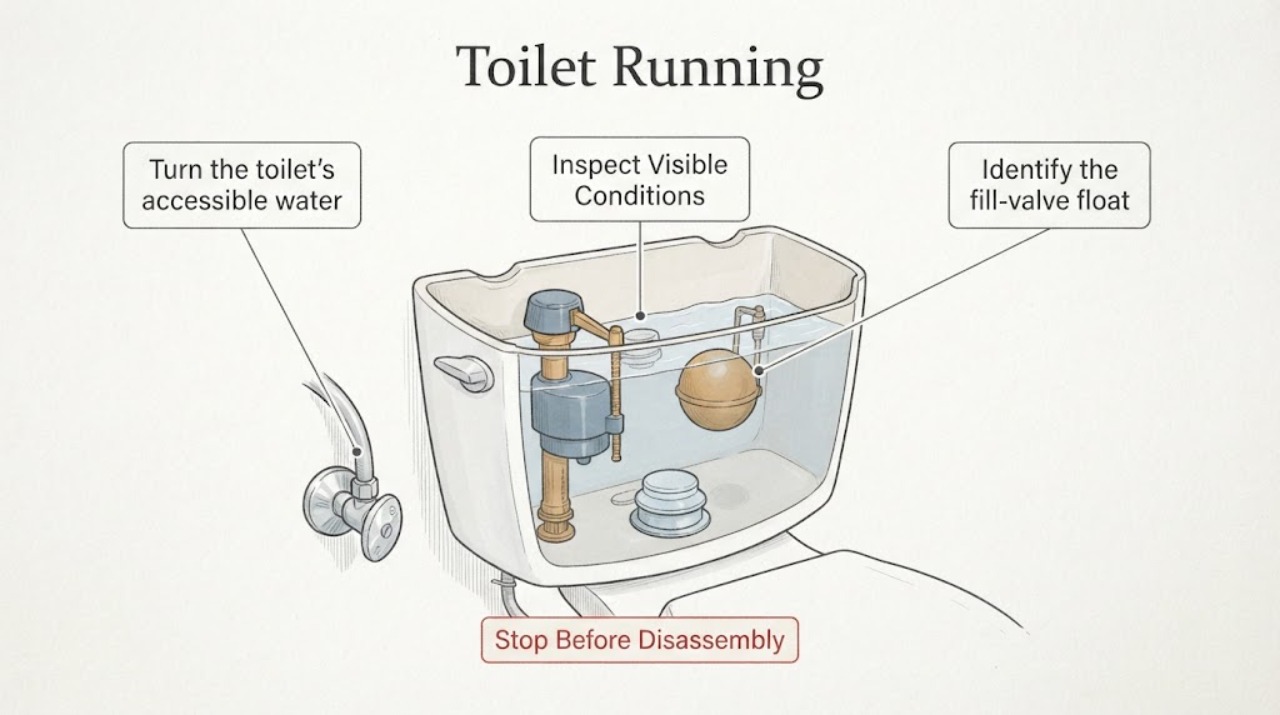
Work through in order
Diagnostic checks
Use only checks that match the exact appliance or system and its official guide.
-
Check 1
Turn the toilet's accessible water supply stop clockwise slowly until the running water stops, then leave it off while you inspect. Stop if the handle is stiff, the valve twists in the wall, or water starts leaking around the stem or connection.
Expected result: The flow may stop cleanly, slow but continue, or the shutoff may not close or may leak at the wall or supply connection.
Next step: If the stop will not close or the floor becomes wet, keep clear of the connection and call a plumber. Do not use pliers or force a brittle valve.
Why this matters
Why: Stopping the supply prevents overflow and limits water loss. A failed or leaking stop is a plumbing fault and makes tank work unsafe to continue.
-
Check 2
Remove the tank lid only after the supply is controlled, then observe the water level, overflow tube, fill-valve outlet, and bowl for a short period. Do not touch the valve or flush mechanism while water is uncontrolled.
Expected result: Water may be entering continuously through the fill valve, rising into the overflow, or appearing as a steady ripple in the bowl while the tank level slowly falls.
Next step: Keep the supply off and continue with the matching fill-valve or flush-seal observation. If the tank threatens to overflow or the tank, bowl, or base is cracked, stop and call a plumber.
Why this matters
Why: Water into the overflow suggests the tank level or fill valve is not shutting off. A bowl ripple with a falling tank level shifts attention toward the flush seal, canister, flapper, chain, or trip lever.
-
Check 3
Identify the fill-valve float and watch whether it rises and stops the inlet as the tank reaches its marked waterline. Do not bend an arm, force a plastic adjustment, or hold the valve open with a tool.
Expected result: The float may rise normally, remain low, sink, catch on the tank wall, or reach the top while water continues into the overflow.
Next step: If the manual provides a gentle model-specific height adjustment, use only that adjustment after the supply is controlled. If the float sinks, catches, or the valve still runs, request a plumber and avoid guessing a universal valve.
Why this matters
Why: A sinking or obstructed float can prevent shutoff; a float that rises but does not stop flow points to debris, the valve seat, a seal, or the valve assembly. Kohler states that a fill valve with a sinking float may need replacement.
-
Check 4
With the supply off and the model guidance in hand, inspect the accessible fill-valve head, inlet, and seat area for visible sediment or debris. Clean or flush it only by the Kohler procedure for that valve design; do not remove a pressurized part.
Expected result: The valve head or inlet may show sediment, the seat may be dirty, or the accessible area may be clear; a previously noisy or intermittent valve may become quiet after approved cleaning.
Next step: Restore the supply slowly only for a controlled check when the model procedure permits it. If running continues, water sprays, or the valve body is cracked, turn the supply off and call a plumber.
Why this matters
Why: Kohler identifies debris at the fill-valve cap, head, inlet, or seat as a possible reason that water does not shut off or the valve refills intermittently. A clear valve that still runs suggests wear or another leak path.
-
Check 5
Inspect the refill hose routing from the fill valve to the flush valve without pulling it loose. Confirm the end is secured in the model's intended port and is not submerged below the tank waterline.
Expected result: The hose may be below the waterline, disconnected from a canister port, loose at its clip, kinked, or correctly positioned above the waterline.
Next step: Correct only a clearly loose, model-supported hose position without forcing the fitting. If the hose, clip, port, or valve is brittle or unclear, leave the supply off and request service.
Why this matters
Why: Kohler explains that a low or disconnected refill hose can siphon water slowly into the bowl, causing the fill valve to turn on again at intervals even when the valve itself can shut off.
-
Check 6
Compare the tank waterline with the mark or level specified for the exact Kohler toilet, and observe the flapper or canister seal and trip-lever chain after a normal flush if the supply is safely restored.
Expected result: The level may sit above the mark, the seal may not seat, the chain may be tight or caught, or the level and seal may appear normal while the bowl still ripples.
Next step: Use only the manual's model-specific water-level or chain adjustment. If the seal is worn, the tank leaks at its base, or the running returns, ask a plumber to confirm the correct valve or seal before replacement.
Why this matters
Why: An over-high level can spill into the overflow, while a worn, dirty, misaligned seal or tight chain can let tank water escape and trigger refilling. These are different from a fill valve that fails to close.
-
Check 7
Record the Kohler toilet model, one-piece or two-piece design, fill-valve style, waterline result, float behavior, hose position, bowl ripple, and whether the supply stop closes before contacting service.
Expected result: The record may show a fill-valve shutoff failure, a flush-seal leak, a siphoning refill hose, a level problem, or an unsafe supply or tank condition.
Next step: Keep the supply off for an uncontrolled or recurring run and provide the record to a licensed plumber. Do not order or install a generic valve from the symptom alone.
Why this matters
Why: Kohler states that fill-valve part identification varies with the toilet model. The observation record prevents a plumber or parts lookup from treating every Kohler tank as the same design.
Use your observations
Decision map
Find the observation that best matches what you see, then follow the next safe action.
-
PATH 01Next step
What you see
The toilet is overflowing, the supply stop will not close, or water is reaching the floor or nearby electrical equipment.
Do this next
Arrange qualified service and follow the exact model guidance.
Why this path and its safety boundary
Why it matters: Stop the water at the safest accessible upstream control if possible, protect the area, and call a plumber. Do not force the stop or continue tank work.
-
PATH 02Next step
What you see
Water rises into the overflow while the fill valve continues to admit water.
Do this next
Arrange qualified service and follow the exact model guidance.
Why this path and its safety boundary
Why it matters: Leave the supply off and request plumbing service if the float, valve seat, head, or valve assembly does not respond to the exact model procedure.
-
PATH 03Next step
What you see
The tank level falls and the bowl has a steady ripple, but the fill valve can stop at the proper level.
Do this next
Arrange qualified service and follow the exact model guidance.
Why this path and its safety boundary
Why it matters: Inspect the flapper or canister seal, trip lever, chain, and flush-valve seat; a flush-seal leak may be causing repeated refills rather than a fill-valve failure.
-
PATH 04Next step
What you see
The fill valve runs at intervals and the refill hose is below the waterline or disconnected from its intended port.
Do this next
Arrange qualified service and follow the exact model guidance.
Why this path and its safety boundary
Why it matters: Use the exact model guidance to restore the hose position without forcing a clip or port, then monitor for recurrence. Request service if the routing is unclear or the hose is damaged.
-
PATH 05Next step
What you see
The float sinks, catches, or rises fully while water still does not stop, or debris and wear are visible.
Do this next
Arrange qualified service and follow the exact model guidance.
Why this path and its safety boundary
Why it matters: Keep the supply off and arrange plumbing service for the fill valve or its model-specific seal and seat; do not assume a universal replacement fits.
-
PATH 06Next step
What you see
The tank level, float, hose, and flush seal appear normal but the toilet starts running again.
Do this next
Arrange qualified service and follow the exact model guidance.
Why this path and its safety boundary
Why it matters: Leave the supply off between uses and give the plumber the model and observation record for a leak, valve, or tank diagnosis.
Helpful context
Understand the symptom
A running Kohler toilet does not automatically mean the fill valve is the failed part. The fill valve adds water after a flush, but a leaking flapper or canister seal can make the tank level fall and cause the fill valve to start again. Start by stopping water loss, then watch where the water goes and what the float and tank level do.
Kohler toilets may be one-piece or two-piece and may use flapper-style or canister-style flush valves. A fill-valve cap, float, refill hose, and adjustment method can differ by model. Use the toilet model information and Kohler's model guidance before selecting a replacement or removing a component.
Keep water away from the floor and nearby electrical equipment. Do not force the supply stop, over-tighten plastic nuts, pull on a brittle tube, or leave the tank open and unattended while the water is on. If the supply cannot be stopped or water is escaping onto the floor, use a plumber.
Safety boundary
Stop conditions
- Stop immediately for an overflowing tank, a supply stop that will not close, a floor leak, a cracked tank or bowl, water near electrical equipment, or a connection that starts leaking.
- Do not force a stiff supply stop, over-tighten plastic fittings, bend a float arm, pull a brittle tube, or use pliers on a valve that is turning in the wall.
- Do not work on the fill valve while the supply is uncontrolled or pressurized, and do not leave an open tank unattended with the water on.
- Do not assume a flapper, canister seal, fill valve, float, or hose is interchangeable across Kohler toilet models; confirm the model before selecting parts.
- Call a plumber when approved cleaning or adjustment does not stop the run, the valve or seal is damaged, or the symptom returns after a controlled check.
When checks do not resolve it
Need a professional?
Call a plumber for an overflowing tank, a supply stop that will not close, a floor or tank leak, a cracked ceramic part, a fill valve that continues running after the model-supported cleaning or adjustment, a sinking float, damaged hose or valve, or a recurring run whose cause is not clear. Keep the supply off when the fault is uncontrolled and do not force or over-tighten brittle parts.
Have this ready
- Give the plumber the Kohler model, one-piece or two-piece design, whether water enters the overflow or bowl, float behavior, valve and hose observations, waterline result, supply-stop condition, and any visible leak or ceramic damage.
Common questions
FAQ
What should I do first when a Kohler toilet keeps running?
Turn the accessible water supply stop off slowly without force, then identify whether water is entering the overflow or leaking into the bowl. Keep the supply off and call a plumber for overflow, floor leaks, or a stop that will not close.
How do I know if the Kohler fill valve or flapper is causing the run?
If the fill valve keeps admitting water and the level rises toward the overflow, inspect the float, valve head, seat, and level. If the tank level falls and the bowl ripples while the valve can stop, inspect the flapper or canister seal and trip lever.
Can a Kohler refill hose make the toilet run periodically?
Yes. Kohler explains that a refill hose below the tank waterline or disconnected from its intended port can siphon slowly into the bowl and trigger intermittent refilling. Routing depends on the valve design.
Should I replace the Kohler fill valve with any universal valve?
No. Kohler states that fill-valve part identification varies by toilet model. Confirm the model and valve design before selecting a part, and use a plumber if the valve, tank, or supply connection is damaged.
When is a running Kohler toilet a plumbing emergency?
Treat an overflowing tank, a supply stop that will not close, water on the floor, a cracked tank or bowl, or water near electrical equipment as an immediate stop condition. Control water safely if possible and call a plumber; do not force brittle fittings.
Read the exact guide
Official sources
- Installation and Care GuideKohler Co. · Kohler toilet fill-valve float, seat, inlet, water-level, supply-stop, and safe troubleshooting guidance
- Toilet Occasionally Leaking or RunningKohler Assist · Kohler toilet intermittent refill, trip lever, tank level, flapper or canister seal, and one-piece or two-piece distinctions
- Tank Leak - Fill Valve Hose PositionKohler Assist · Kohler toilet refill-hose siphoning, waterline position, canister and non-canister routing, and intermittent refill symptoms
- Toilet Constantly Leaking or RunningKohler Assist · Kohler one-piece and two-piece toilet constant running, fill valve debris, float, water level, flush seal, hose, and model-dependent service parts
- How to Fix a Running ToiletKohler · Kohler running-toilet diagnostic split among flapper, fill valve, float, water level, model identification, and plumber escalation
Community feedback
Share a repair observation
Share a plain-text repair observation. Accepted observations are published automatically; this page may take a moment to update.