
On this page
Start here
Quick answer
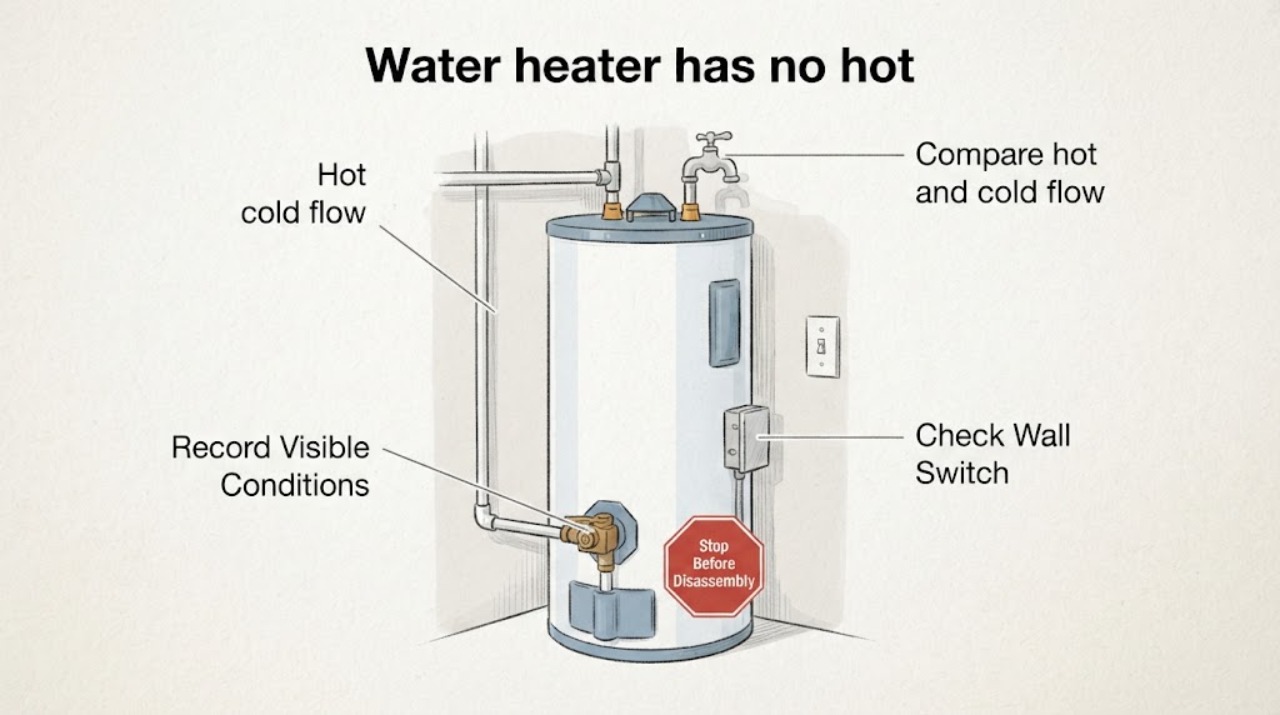
First determine whether no hot water affects one fixture or the whole home, and whether the Rheem unit is a storage tank, tankless, gas, electric, or heat-pump model. Check hot versus cold flow and the model display from a safe position. If the area is dry and there is no gas odor, leak, smoke, scorching, or electrical damage, verify clearly labeled water or electrical controls are in their normal position and allow a tank to recover after unusually high use. Do not open the cover, remove heating parts, adjust gas pressure, relight a pilot without model-specific instructions, bypass a safety limit, or touch wet electrical equipment. A leak, gas odor, combustion concern, relief-valve discharge, repeated breaker trip, error that returns, or no hot water after the safe external checks needs a qualified plumber or Rheem service professional.
Work through in order
Diagnostic checks
Use only checks that match the exact appliance or system and its official guide.
-
Check 1
Compare hot and cold flow at the affected faucet, another fixture, and the nearest fixture to the Rheem heater; note whether cold water is normal and whether the lack of hot water is local or throughout the home.
Expected result: Cold flow with no hot flow at one outlet suggests a local fixture or mixing issue. No hot water at multiple outlets points toward the heater, its supply, or a system-wide condition. Weak flow on both temperatures may be a plumbing restriction rather than heating failure.
Next step: Keep the heater and affected fixture in normal safe use only when there is no leak or hazard. Arrange a plumber for a local mixing issue or whole-home loss that remains after the external checks.
Why this matters
Why: The symptom map separates a fixture problem from a Rheem heating or supply problem before the heater is touched.
-
Check 2
Identify the Rheem model type from its label or records: storage tank, tankless, gas, electric, or heat pump. From outside the unit, record the display, status light, error indication, and whether the unit appears to be calling for heat; do not remove covers or panels.
Expected result: A storage tank may show a recovery or heating state; a tankless model may report an inlet, flow, ignition, vent, or control issue; an electric model may have no display when its supply is interrupted. The exact code and model determine the permitted next step.
Next step: Photograph or record the model and exact indicator without exposing internal parts. Use the matching Rheem guide or arrange qualified service; do not clear a recurring code by repeated resets.
Why this matters
Why: Rheem troubleshooting is model-specific, and a code or blank display cannot safely be interpreted across gas, electric, tankless, and tank designs.
-
Check 3
If the area is dry and free of gas odor, smoke, heat, water, and electrical damage, verify that clearly labeled water shutoff controls and the heater's normal electrical switch or breaker are in their expected position; do not force a valve or open an electrical cover.
Expected result: A closed water valve can prevent a tankless unit from operating correctly, while an electric heater with no supply may not heat. A control that will not stay set, a breaker that trips again, or a valve that leaks when operated is not a user reset problem.
Next step: If a control position is uncertain, leave it alone and contact the installer or plumber. Leave a tripped breaker off after a repeat event and request electrical or Rheem service; never bypass a safety device.
Why this matters
Why: A post-service or maintenance control left closed can explain no hot water, but a recurring electrical interruption or damaged valve needs professional diagnosis.
-
Check 4
For a storage tank with no warning sign, record whether hot water was recently used by several people or appliances and allow normal recovery without changing safety limits. For a tankless model, record whether the display shows flow or ignition activity and whether the symptom occurs at every hot fixture; do not adjust gas controls or venting.
Expected result: Rheem says water use can exceed a storage tank's capacity and require recovery. Tankless no-hot-water symptoms can be linked to flow, gas, ignition, vent, or control conditions that depend on the model.
Next step: If hot water returns after normal recovery, monitor the demand pattern. If it does not return, the unit shows an error, or gas or venting is suspected, leave it unused and arrange qualified Rheem or plumbing service.
Why this matters
Why: High demand is a temporary capacity branch, while a persistent or model-specific failure needs service rather than a higher temperature or improvised gas adjustment.
-
Check 5
Inspect only visible areas around the Rheem heater for puddles, drips, corrosion, relief-valve discharge, wet insulation, unusual venting, soot, or a gas odor; do not touch hot water, cap a relief outlet, move the unit, or enter a wet electrical area.
Expected result: Pooling water is a fault, while condensation may be normal in some conditions. Gas odor, soot, abnormal venting, hot discharge, or water near electrical parts is an immediate safety boundary rather than a no-hot-water troubleshooting branch.
Next step: Stop using the heater for a leak, relief discharge, gas odor, smoke, soot, or wet electrical area. Isolate water, gas, or power only when the control is safe and clearly accessible, then call a qualified plumber, gas professional, electrician, or emergency service as appropriate.
Why this matters
Why: A leak or combustion, pressure, or electrical issue can injure people and damage the home even if the water temperature problem seems minor.
-
Check 6
Prepare a service handoff with the Rheem model and fuel type, tank or tankless design, fixtures affected, hot and cold comparison, display or code, control positions, demand and recovery history, leak or vent observations, and any breaker or gas event; leave internal parts untouched.
Expected result: The information separates a local fixture issue, depleted tank, closed control, electrical supply fault, gas or ignition problem, vent restriction, relief condition, or internal safety-device fault.
Next step: Call a qualified plumber or Rheem service professional, adding an electrician for supply faults and a gas professional or emergency responder for combustion or gas concerns. Do not return the unit to service when a warning sign or recurring code remains.
Why this matters
Why: The same no-hot-water wording can require plumbing, electrical, gas, or Rheem-certified diagnosis; exact model evidence prevents unsafe cross-model advice.
Use your observations
Decision map
Find the observation that best matches what you see, then follow the next safe action.
-
PATH 01Next step
What you see
Only one faucet has no hot water while other hot fixtures work normally.
Do this next
Arrange qualified service and follow the exact model guidance.
Why this path and its safety boundary
Why it matters: Treat it as a local faucet or mixing issue and call a plumber if an external flow comparison does not identify a simple fixture-side condition. Do not change the heater settings to correct one outlet.
-
PATH 02Next step
What you see
A storage tank recently supplied unusually high demand and shows no leak, gas odor, smoke, or electrical warning.
Do this next
Arrange qualified service and follow the exact model guidance.
Why this path and its safety boundary
Why it matters: Allow normal recovery and monitor. If hot water does not return or the condition repeats, arrange qualified Rheem or plumbing service.
-
PATH 03Next step
What you see
The display is blank, a breaker opens, a control will not stay set, or an electric heater has no confirmed supply.
Do this next
Arrange qualified service and follow the exact model guidance.
Why this path and its safety boundary
Why it matters: Do not open the cover or repeatedly reset it. Leave the heater off and arrange qualified electrical or Rheem service.
-
PATH 04Next step
What you see
A tankless unit shows a code, no flow or ignition response, or an inlet, vent, gas, or control issue is suspected.
Do this next
Arrange qualified service and follow the exact model guidance.
Why this path and its safety boundary
Why it matters: Record the exact model and code and arrange qualified Rheem service. Do not adjust gas pressure, bypass a limit, or alter venting.
-
PATH 05Next step
What you see
Puddles, active discharge, corrosion, gas odor, soot, unusual venting, smoke, hot water, or water near electrical parts is present.
Do this next
Arrange qualified service and follow the exact model guidance.
Why this path and its safety boundary
Why it matters: Stop immediately, keep people away, isolate utilities only if safe and accessible, and seek urgent plumbing, gas, electrical, or emergency help. Do not cap a relief outlet or touch wet equipment.
Helpful context
Understand the symptom
No hot water is not one diagnosis. A single cold fixture can have a local mixing or flow problem, while cold water everywhere points toward the heater, its energy supply, a shutoff, or a larger plumbing issue. A storage tank may simply be recovering after demand; a tankless unit may show a flow, ignition, venting, or code condition. The model label and exact display or indicator are more useful than guessing a universal reset.
Rheem's electric manual warns users not to repair electrical wiring, temperature sensors, controls, heating elements, or other safety devices. Gas and tankless systems add combustion and venting hazards. Keep the checks external and stop before opening any cover or changing a gas or safety setting.
Safety boundary
Stop conditions
- Stop immediately for gas odor, soot, smoke, flame, unusual venting, hot uncontrolled water, relief-valve discharge, an active leak, flooding, water near electrical equipment, shock, scorching, or a repeated breaker trip.
- Do not open an electrical cover, remove heating elements, adjust gas pressure or venting, bypass a safety limit, cap a relief outlet, relight or test a gas appliance without model-specific safe instructions, or touch wet equipment.
- Leave the heater unused when the exact model or fuel type is uncertain, an error returns, a control will not stay set, no hot water persists after safe checks, or the cause requires an internal part diagnosis.
Common questions
FAQ
Why does my Rheem water heater have no hot water?
The cause may be high demand, a local fixture issue, a closed control, lost electric supply, a gas or ignition problem, a tankless flow or vent condition, or an internal safety fault. Identify the model and compare hot and cold flow before arranging service.
Can I reset my Rheem water heater myself?
Only use a model-specific, clearly documented external control when the area is dry and free of gas, heat, leak, smoke, and electrical warning signs. Do not open covers, bypass a limit, or repeat a reset after a fault returns; use qualified service.
What should I do if my Rheem water heater is leaking and there is no hot water?
Stop using it, keep away from hot water and wet electrical areas, and isolate water or power only when the control is safe and accessible. A leak, relief discharge, gas odor, smoke, or major damage needs urgent qualified plumbing, gas, electrical, or emergency help.
Read the exact guide
Official sources
- What to Do Before Calling a Plumber or Replacing Your Water HeaterRheem Manufacturing Company · Rheem water-heater model identification, shutoffs, visible leaks, and professional safety escalation
- Before You Call For ServiceRheem Manufacturing Company · Rheem gas and tankless-style water-heater ignition, gas, venting, control, and service boundaries
- Before You Call For ServiceRheem Manufacturing Company · Rheem electric water-heater no-hot-water causes and electrical safety boundaries
Community feedback
Share a repair observation
Share a plain-text repair observation. Accepted observations are published automatically; this page may take a moment to update.