
On this page
Start here
Quick answer
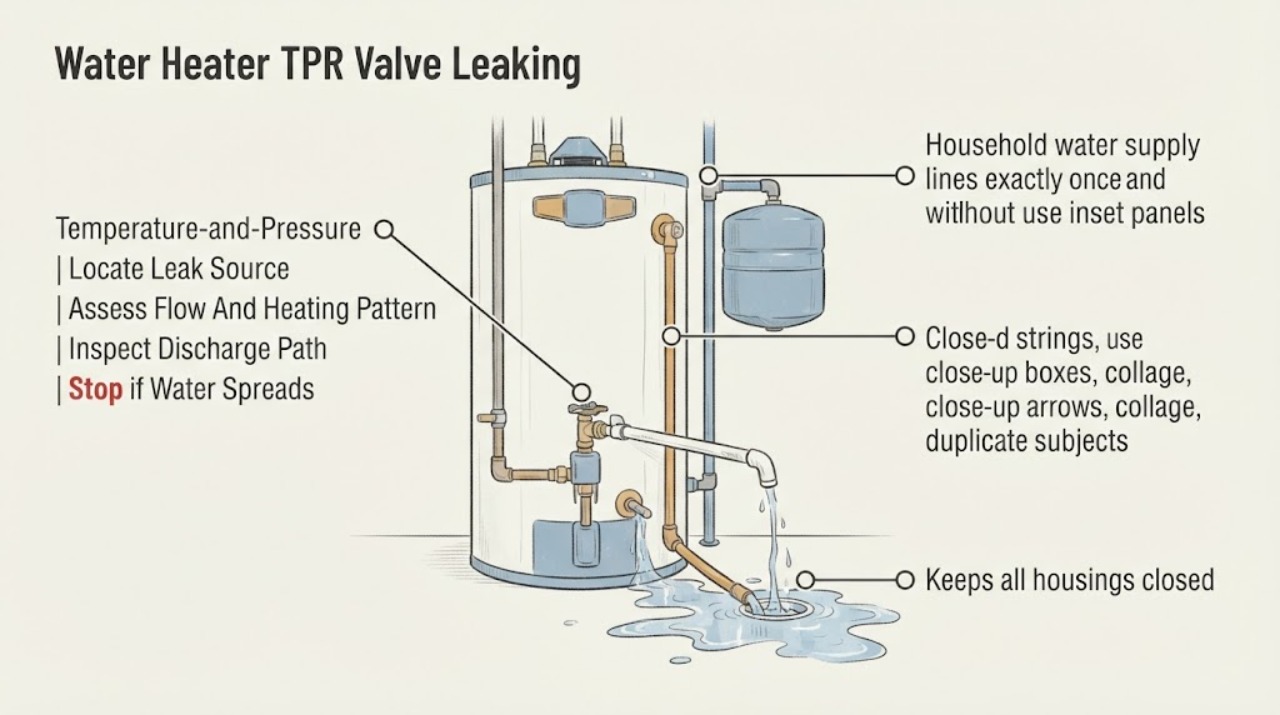
A leaking water-heater TPR (also called T&P) valve is a safety signal, not a normal faucet leak. First determine whether water is coming from the discharge-pipe outlet, the valve's threaded connection, another fitting, or the tank, and whether it is a small intermittent drip or a continuous or large flow. Manufacturer guidance identifies high household pressure and thermal expansion as common causes of drips from the discharge pipe; a large amount of hot water can indicate overheating. Keep the discharge path open and unobstructed: never cap, plug, clamp, valve off, or remove the relief valve to stop the leak. Do not touch or lift the lever on a hot valve. If hot water is flowing strongly, steam or scalding is possible, the tank appears overheated, the tank is damaged, or the leak is near electrical or gas components, keep people away and call qualified emergency plumbing service; shut off energy or the cold-water supply only when the appliance label and a safe, dry location make that clear.
Work through in order
Diagnostic checks
Use only checks that match the exact appliance or system and its official guide.
-
Check 1
From a safe position, observe where water first appears: at the open end of the TPR discharge pipe, around the valve body or threaded connection, at another hot/cold fitting, from the tank wall or base, or from a nearby drain or condensate line. Do not touch water, the valve, insulation, or hot piping to identify it.
Expected result: Water exits the discharge-pipe termination; moisture begins at a valve or pipe connection; water comes from the tank or base; or the source cannot be safely distinguished.
Next step: If the source is unclear, hot, fast, near electrical/gas components, or coming from the tank/base, keep clear and arrange qualified service. If it is a safe, visible discharge-pipe drip, continue with the non-contact pattern and discharge-path checks.
Stop if: Do not wipe or handle a hot discharge, remove insulation, loosen a fitting, or reach behind the heater to trace water.
Why this matters
Why: Discharge-pipe water suggests the TPR valve is opening or not seating. A connection leak, tank leak, or nearby condensate source follows a different repair path and cannot be diagnosed as a bad TPR valve from location alone.
-
Check 2
Without operating the relief lever, note whether the discharge is a single occasional drip, a drip that repeats while the heater recovers after hot-water use, a steady trickle, or a strong/large flow. Note steam, unusually hot surroundings, a hot-water complaint, or a burner/heating cycle only from a safe distance.
Expected result: The leak is a small intermittent drip, occurs during or after heating, continues when the heater is not heating, or is a large amount of hot water/steam.
Next step: For a small safe drip, continue to the visual discharge-path and pressure/expansion checks. For continuous or large hot flow, steam, or overheating signs, keep people away and call qualified emergency service; do not test the valve yourself.
Stop if: Do not stand in front of the discharge outlet, place a hand or container under hot water, or repeatedly cycle the heater to reproduce the leak.
Why this matters
Why: A small heating-related drip makes thermal expansion or high system pressure more likely. A continuous drip can also reflect debris or a valve that is not seating. Strong hot discharge or signs of overheating make an unsafe temperature or pressure condition more likely and cannot be treated as a routine valve replacement.
-
Check 3
Visually inspect the accessible TPR discharge pipe from a cool, safe position. Confirm that its outlet is open and not capped, plugged, clamped, blocked, or fitted with a shutoff valve, and that no insulation or tape obstructs the valve opening or lever. Do not remove the pipe or alter its routing.
Expected result: The line is open and unobstructed; a cap, plug, valve, crushed section, blockage, or insulation obstruction is visible; or the line is missing or terminates in an unsafe location.
Next step: If any obstruction, missing section, or unsafe termination is visible, do not operate or modify the heater; keep clear and have a qualified plumber correct it. If the path is open, continue with pressure and thermal-expansion history rather than capping the outlet.
Stop if: Never cap, plug, clamp, valve off, disconnect, or reduce the discharge pipe to stop dripping, and never operate the heater without a functioning relief path.
Why this matters
Why: DOE guidance requires an adequate discharge line with no cap, plug, reducing restriction, or intervening valve and says it must drain both the valve and line. A blocked, missing, or incorrectly terminated line removes the safe relief path; it does not explain away the underlying pressure or temperature condition.
-
Check 4
Review whether the home has a pressure-reducing valve, backflow/check valve, or thermal-expansion tank, and whether plumbing or a water heater was recently installed or changed. If a water-pressure gauge is already installed and can be read without touching hot equipment, note static pressure and whether it rises during a heating cycle; otherwise have a plumber measure it rather than opening a connection.
Expected result: Pressure is high or rises substantially during heating; a closed-system device is present without a correctly sized/charged expansion tank; the expansion tank is known to be failed or incorrectly pressurized; or pressure and expansion appear normal but the drip continues.
Next step: Have a qualified plumber correct excessive pressure or evaluate the expansion tank and closed-system arrangement before choosing a TPR valve. Do not adjust a pressure-reducing valve, charge an expansion tank, or change heater settings without the applicable instructions and safe tools.
Stop if: Do not connect a gauge to a hot-water outlet, puncture or pressurize an expansion tank, remove a valve, or make a pressure adjustment while water is hot or the heater is energized.
Why this matters
Why: A.O. Smith identifies high pressure and thermal expansion as common causes of discharge-pipe drips. Its guidance says plumbing codes require household pressure at or below 80 psi and describes 50–60 psi as a common expert target, but local code, the heater rating plate, and the installed system control. A pressure rise with heating makes thermal expansion more likely; normal pressure does not prove the valve is sound.
-
Check 5
If pressure and thermal-expansion conditions have been professionally assessed, have the technician follow the TPR valve's label and the water-heater manual to decide whether a safe valve-operation check is appropriate. The technician should verify that discharge can go to a safe location before operating the lever and should inspect for mineral debris or failure to reseat.
Expected result: The valve reseats and stops after an approved professional check; it continues to drip; water does not flow freely when the valve is operated; or the technician finds debris, overheating, pressure, expansion, or installation problems.
Next step: Have the qualified plumber correct the confirmed cause and install only a new, properly rated and sized TPR valve when replacement is warranted. If the valve or discharge path cannot be safely assessed, leave the heater out of service until it is inspected.
Stop if: Do not lift the lever as a homeowner test on a hot or unknown installation, reuse an old relief valve, substitute a valve by thread size alone, or run the heater with the relief device removed or blocked.
Why this matters
Why: A valve that continues to drip after pressure/expansion causes are controlled may be contaminated or defective, but a failed reseat is not proof that the valve is the only problem. A discharge path that does not flow freely, overheating, or pressure outside the heater's requirements is an urgent safety issue.
Use your observations
Decision map
Find the observation that best matches what you see, then follow the next safe action.
-
PATH 01Next step
What you see
A small drip comes from the open discharge pipe mainly during or after the heater recovers, with no steam, large flow, or visible obstruction.
Do this next
Have a plumber measure static and heating-cycle pressure and evaluate any pressure-reducing/check-valve and expansion-tank arrangement. Do not replace the TPR valve first or cap the pipe.
-
PATH 02Next step
What you see
A large or continuous amount of hot water, steam, unusually hot surfaces, a hot-water complaint, or an apparently overheating tank accompanies the discharge.
Do this next
Keep everyone away from the outlet and heater, do not touch the valve or lever, and call qualified emergency plumbing service. Follow the heater label for shutting off energy or water only from a safe, dry location.
-
PATH 03Next step
What you see
Water starts around the TPR threads, another top fitting, the tank wall/base, or a nearby line rather than at the discharge-pipe outlet.
Do this next
Leave the heater off if the leak is active or near electrical/gas parts and have a qualified plumber trace and repair it. Do not tighten, remove, or reseal a hot threaded connection.
-
PATH 04Next step
What you see
The discharge line is open, pressure and thermal-expansion conditions have been addressed, and a qualified technician finds that the valve still drips or does not reseat.
Do this next
Have the technician replace the TPR valve with a new properly rated/sized valve and verify the discharge path; do not select a replacement by appearance or thread size alone.
Helpful context
Understand the symptom
Trace the water without touching the hot discharge
Water at the end of a TPR discharge pipe means the relief device may be responding to pressure or temperature, while moisture around the valve threads, another fitting, or the tank can be a different leak. Observe from a safe position and use a dry paper towel only on a cool, accessible exterior connection if it can be done without contacting discharge water or hot metal. Do not touch the outlet, lift the relief lever, or remove insulation to chase a hot leak.
A small drip and a hot flow do not have the same urgency
A small drip that occurs during a heating cycle is consistent with pressure rise from thermal expansion or excessive household pressure, but it is not a diagnosis. State Water Heaters warns that a large amount of hot water from the discharge pipe may indicate overheating. Treat continuous flow, steam, very hot surroundings, a bulging or damaged tank, or a blocked discharge route as an immediate stop condition.
Never defeat the relief path
The TPR valve and its discharge pipe are emergency protection against excessive temperature and pressure. The discharge line must remain correctly sized, open, and able to drain; DOE guidance says there must be no cap, plug, or intervening valve. Pressure-reducing valves, expansion tanks, and TPR replacement are installation or plumbing work that must match the heater, valve label, local code, and the technician's diagnosis.
Only after diagnosis
Potential parts
- temperature-and-pressure relief valve
Consider replacement only after a qualified technician verifies that pressure and thermal-expansion causes are controlled and the existing valve still drips or fails to reseat.
The replacement must be new, properly rated and sized for the exact water heater and installed according to the valve label, heater manual, and local code; thread size or appearance alone is not enough. - thermal expansion tank
Consider this only when pressure rises during heating in a closed plumbing system or a qualified plumber confirms the existing tank is absent, incorrectly sized, incorrectly charged, or failed.
Sizing, pre-charge, connection location, and code requirements depend on system pressure and heater capacity; have a qualified plumber verify the system before ordering or installing. - pressure-reducing valve
Consider this only when measured household pressure exceeds the applicable limit or a plumber confirms pressure control is required; a TPR drip alone does not prove a PRV is needed.
Confirm local code, flow requirements, system layout, and pressure settings with a qualified plumber; do not infer fit or adjustment from a generic pressure number.
When checks do not resolve it
Need a professional?
Stop and call qualified emergency plumbing service for a large or continuous hot discharge, steam, suspected overheating, a blocked or missing discharge path, a damaged or bulging tank, water near electrical or gas components, a leak that cannot be safely traced, or a TPR valve that continues to discharge. Arrange prompt service for any recurring drip even when it is small; do not treat a relief-valve leak as a normal nuisance leak.
Common questions
FAQ
Why is water dripping from my water heater TPR discharge pipe?
The most common documented possibilities are excessive household pressure and thermal expansion as water heats in a closed system. A continuous or large amount of hot water can indicate overheating, and a valve that does not reseat can be affected by debris or failure. Have pressure, expansion control, valve condition, and the discharge path assessed rather than capping the pipe or replacing the valve first.
Can I cap or plug the TPR valve discharge pipe to stop the leak?
No. DOE and State Water Heaters guidance require the relief valve and discharge line to remain functional, open, and able to drain; capping or plugging the line can remove protection against excessive pressure or temperature and create an explosion hazard. Call a qualified plumber instead.
Should I lift the TPR valve lever to clear the drip?
Do not use the lever as a casual homeowner test, especially when the valve or discharge may be hot or the termination is not known to be safe. Manufacturer guidance permits manual operation only with a safe discharge location and the applicable valve label/manual; hot water can be released. Have a qualified person assess persistent dripping, debris, pressure, and reseating.
Is a small TPR drip caused by a bad relief valve?
Not necessarily. A.O. Smith and State Water Heaters identify high pressure and thermal expansion as common causes, and a valve may drip because debris prevents it from seating. If pressure and expansion conditions are controlled and a qualified technician confirms the valve still drips or fails to reseat, replacement with a new correctly rated valve may be appropriate.
What pressure is too high for a residential water heater?
The A.O. Smith guidance says plumbing codes require household pressure at or below 80 psi and describes 50–60 psi as a common expert target, but local code, the heater rating plate, and the installed system control. Pressure should be measured safely, including changes during heating when thermal expansion is suspected; have a plumber install or adjust pressure equipment.
Read the exact guide
Official sources
- 327306-000 State Service HandbookState Water Heaters · Official manufacturer service handbook used for general T&P discharge patterns and safety warnings; fuel type, model, valve label, and local code must control the actual service.
- What to Do If It LeaksA. O. Smith Water Heaters · Official manufacturer guidance used for tracing water, T&P discharge drips, pressure, thermal expansion, and service boundaries; the exact heater manual and local code control installation.
- Thermal Expansion TanksA. O. Smith Water Heaters · Official manufacturer guidance for closed-system pressure rise and expansion-tank evaluation; sizing, charging, and installation are not universal homeowner steps.
- Water Heater Installation and Temperature & Pressure Relief Valve GuidanceU.S. Department of Energy · Government installation guidance used for relief-valve rating and discharge-line safety; the appliance manual and applicable local code control the installed system.
- Safety Features in Tank Water HeatersState Water Heaters · Official manufacturer safety overview used to explain the relief function and urgency of a leaking T&P valve; it is not a model-specific repair procedure.
Community feedback
Share a repair observation
Share a plain-text repair observation. Accepted observations are published automatically; this page may take a moment to update.