
On this page
Start here
Quick answer
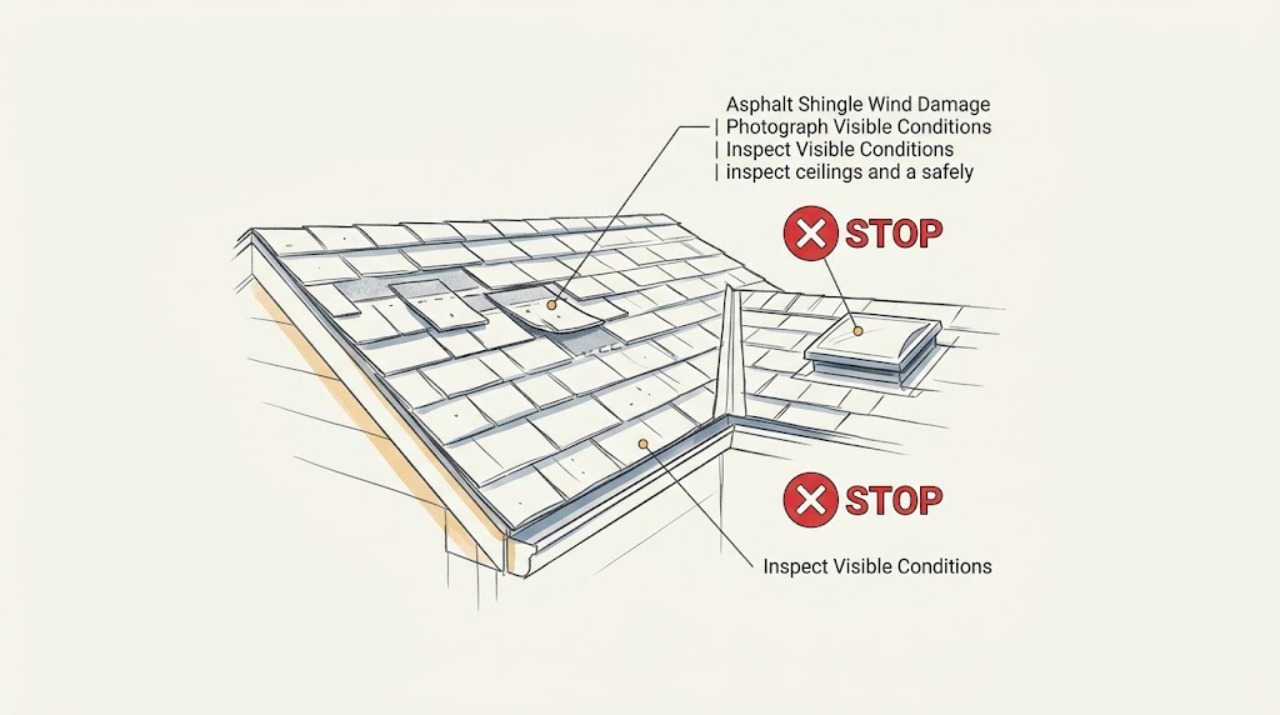
A lifted, creased, or missing asphalt-shingle tab after strong wind is a roof-cover failure, not just a cosmetic defect. A tab that is merely unsealed may be repairable by a qualified roofer under the shingle manufacturer's instructions, but a crease, tear, puncture, missing piece, or exposed underlayment usually calls for shingle replacement and an inspection of the roof deck and neighboring courses.
Work through in order
Diagnostic checks
Use only checks that match the exact appliance or system and its official guide.
-
Check 1
From the ground, photograph the roof face and use binoculars or camera zoom to inspect the affected shingle and nearby courses; do not climb onto the roof.
Expected result: The tab is raised but intact and flat, or it is creased, torn, punctured, missing, or exposing the layer beneath.
Next step: Give the photographs to a qualified roofer; ask for hand-sealing only if the shingle is otherwise intact and the product instructions support it, and ask for replacement when the tab or shingle is physically damaged.
Why this matters
Why: An intact raised tab can indicate a broken sealant bond, while a crease, tear, puncture, or missing material is physical shingle damage that cannot be judged as a simple resealing job.
-
Check 2
Walk the ground around the building and look for loose shingle fragments, exposed underlayment, granule piles, damaged soffit or fascia, and wind-borne debris; keep clear of anything still falling or unstable.
Expected result: Fragments are present below one area, several adjacent shingles are lifted, or the roof covering looks continuous from the ground.
Next step: Photograph the debris in place before moving it and arrange a roof inspection, especially if underlayment or deck is visible.
Why this matters
Why: Fragments or a cluster of lifted shingles suggest the wind event affected more than one tab; an apparently continuous surface does not rule out an unsealed or creased tab that needs a closer professional inspection.
-
Check 3
From inside the house, inspect ceilings and a safely accessible attic area below the damaged roof face for new discoloration, damp insulation, wet sheathing, or daylight through a gap.
Expected result: The interior is dry, or there is fresh moisture, a drip, wet sheathing, or daylight below the wind-damaged area.
Next step: Contain drips without touching wet electrical equipment, move belongings away, and call a qualified roofer for temporary weather protection and inspection; do not open the roof from inside.
Why this matters
Why: A dry interior does not prove the roof is watertight, but fresh moisture or daylight confirms that the roof-cover failure may already be allowing water entry and needs prompt attention.
-
Check 4
Ask a qualified roofer to inspect the damaged tab and surrounding courses, including fastener placement, sealant contact, roof edges, nearby penetrations, underlayment, and the deck where accessible.
Expected result: The roofer finds only a released sealant bond, or finds a crease, tear, puncture, missing shingle, exposed underlayment, loose fastener, or deck damage.
Next step: Request a written scope identifying whether each affected shingle will be resealed or replaced and whether adjacent courses, underlayment, flashing, or deck need repair; do not accept a surface adhesive as the default for a creased or missing tab.
Why this matters
Why: A bond-only failure may be suitable for manufacturer-approved hand-sealing, but physical damage or a fastening/deck defect requires a repair scope that restores the roof's water-shedding layers and wind resistance.
Use your observations
Decision map
Find the observation that best matches what you see, then follow the next safe action.
-
PATH 01Next step
What you see
The tab is intact, lies flat again, and the roofer finds no tear, puncture, granule-related surface failure, or exposed underlayment.
Do this next
Ask whether the manufacturer allows hand-sealing for a released sealant bond and have the roofer complete it under the product instructions; monitor the surrounding courses after the next wind and rain.
-
PATH 02Next step
What you see
The tab is creased, torn, punctured, or missing, or the whole shingle has blown off.
Do this next
Treat it as physical roof-cover damage: arrange replacement of the affected shingle or tab and inspection of the underlayment, fasteners, deck, and adjacent courses before closing the repair.
-
PATH 03Next step
What you see
Several shingles are lifted or missing, damage continues along an edge, or underlayment is visible.
Do this next
Request a broader roof-face and edge inspection rather than a one-tab patch; a failed tab can begin a cascade that leaves nearby shingles and the underlayment vulnerable.
-
PATH 04Next step
What you see
The interior is wet, the ceiling is sagging, water is near electrical equipment, or wind and debris remain hazardous.
Do this next
Leave the unsafe area, avoid wet electrical equipment, contain water only from a safe location, and call the appropriate qualified professional for urgent stabilization and roof protection.
Helpful context
Understand the symptom
What the damage means
Wind damage can separate a shingle from its sealant bond, lift a tab, crease the shingle, tear a tab, or remove the shingle entirely. A tab that no longer lies flat can admit wind-driven rain and can start a larger area of shingles failing. A missing or badly damaged shingle also leaves the underlayment and roof deck exposed to weather.
Check from safe locations first
After the wind has subsided, photograph the roof and collect any shingle fragments from the ground without climbing. Look from the ground for lifted or creased tabs, missing shingles, exposed underlayment, and debris. From inside, check the ceiling and a safe attic access point for new stains, wet spots, or daylight through a roof-cover gap.
Repair depends on the failure mode
If the shingle is intact and only its sealant bond has released, a roofer may be able to hand-seal it when the product instructions allow. A crease, tear, puncture, missing tab, or missing shingle is a different condition: the damaged piece generally needs replacement, and the roofer should check the fasteners, neighboring courses, underlayment, and deck for related damage. Do not choose a generic replacement based only on color; the roof system and installation instructions determine what is suitable.
Document before cleanup
Keep wide and close photographs showing the whole roof face, the damaged tab, nearby roof edges and penetrations, and any fragments on the ground. Record when the damage was first seen and whether rain entered afterward. Those details help a roofer distinguish a broken seal from a torn or missing shingle and let an insurer or manufacturer evaluate the event if coverage or warranty questions apply.
Only after diagnosis
Potential parts
- matching asphalt shingle
Consider a replacement only after a qualified roofer confirms that the tab or shingle is creased, torn, punctured, or missing rather than merely unsealed.
Match the existing shingle profile, exposure, roof system, installation instructions, and local requirements; do not assume a color-only match is compatible.
When checks do not resolve it
Need a professional?
Call after a wind event when a tab is lifted, creased, torn, punctured, or missing, or whenever safe ground-level checks cannot establish that the roof cover is intact.
Have this ready
- Provide the storm timing, wide and close photographs, locations of loose fragments, whether the roof has exposed underlayment, and any interior stain or drip information.
Common questions
FAQ
Can I glue down a lifted shingle tab myself?
Do not climb onto the roof to do this. If a roofer confirms the shingle is intact and only the sealant bond released, the manufacturer may allow hand-sealing under its instructions. A crease, tear, puncture, or missing tab generally needs replacement instead of surface adhesive.
Is a creased shingle still protecting the roof?
Do not rely on a creased tab to shed water or resist another wind event. Have the shingle replaced and ask the roofer to check adjacent courses, fasteners, underlayment, and the deck for related damage.
What should I photograph after wind damage?
Photograph the whole roof face, the close-up tab condition, nearby roof edges and penetrations, any exposed underlayment, loose fragments on the ground, and interior stains or drips. Record when the damage was found and whether rain followed.
Read the exact guide
Official sources
- SkywarnNational Weather Service, Boston/Norton · Post-storm observation of roof and shingle damage
- Damage To Shingles Caused By Wind EventsGAF Residential Consumer Services · Asphalt shingle wind-event damage, including lifted, creased, and missing tabs
- STEEP-SLOPE PRO FIELD GUIDE GENERAL FASTENING AND WIND RESISTANCEGAF · Steep-slope asphalt shingle roofs and wind-related shingle failures
Community feedback
Share a repair observation
Share a plain-text repair observation. Accepted observations are published automatically; this page may take a moment to update.