
On this page
Start here
Quick answer
Stump grinding usually removes the visible stump and some exposed root material, but it is not the same as excavating the entire underground root system. Before any digging or planting, have buried utilities located through 811 or the applicable local service, and ask the tree professional exactly what was ground, what roots or wood remain, and who will remove the chips and restore the hole. Do not plant directly into a cavity full of grinding debris or assume the ground will stay level: remaining wood and roots can change soil moisture, nutrient availability, rooting space, and grade as they decay. A nearby planting site is generally easier; Iowa State Extension recommends at least 3 feet, ideally 6–8 feet, from the removed tree. If the new tree must occupy the same spot, remove debris and as many roots as practical, rebuild the soil, screen for the former tree’s pest or disease issue, and plan on at least a year or two for decomposition to make a meaningful difference. Local utility, right-of-way, species, and planting-season rules still control the final location and timing.
Before you begin
Safety first
- Do not operate a stump grinder or excavator, pull or cut roots, dig near utility marks, burn or inject the stump, apply herbicide as a home experiment, enter an unstable hole, or plant into an unresolved chip-filled or settling cavity. Obtain utility, arborist, soil, or other qualified direction for work outside ordinary observation.
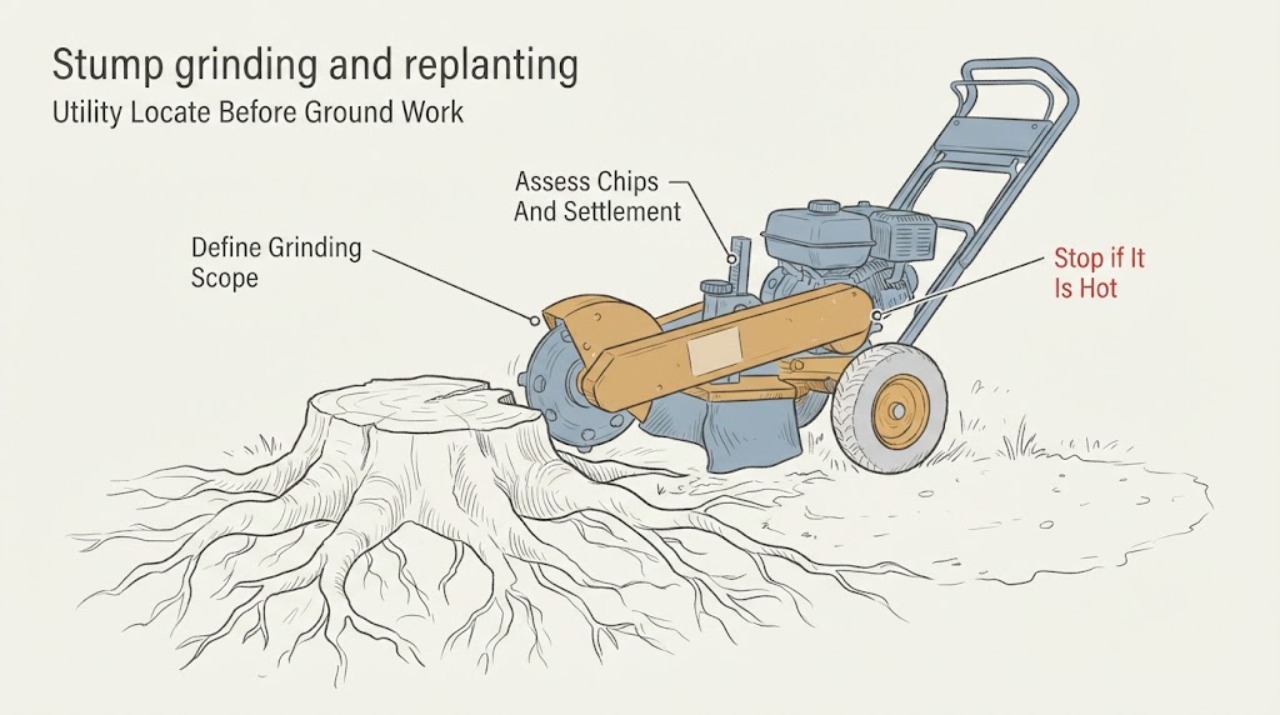
Work through in order
Diagnostic checks
Use only checks that match the exact appliance or system and its official guide.
-
Check 1
Before anyone digs, removes roots, deepens the grind, or plants a replacement, submit an 811 locate request or use the applicable local before-you-dig service and mark the proposed work area as requested.
Expected result: Record the locate ticket, the utilities that responded, the marked routes, any no-conflict response, private lines or irrigation that are not covered, and whether the stump or proposed planting hole overlaps a mark or utility box.
Next step: Give the marks and ticket information to the tree professional, and arrange a private locate for private utilities before any work not covered by the public response.
Stop if: Do not grind, pull, dig, cut roots, drive stakes, or plant when markings are missing, unclear, expired, incomplete, or close to the proposed work without the required utility direction.
Why this matters
Why: A stump can hide or sit beside buried electric, gas, communications, water, sewer, or irrigation lines. A public locate is not proof that private lines are clear, and an unclear or missing response leaves the ground-work decision unresolved.
-
Check 2
From the completed work area and the contractor's description, document whether the job was stump grinding, exposed-root grinding, or full stump-and-root excavation; do not probe the soil or attempt to uncover roots yourself.
Expected result: Record the treated footprint and depth if supplied, whether exposed lateral roots were included, what underground wood remains, and whether the hole was left open, filled, or lightly mounded for expected settlement.
Next step: Ask the tree professional to quote any additional root or stump removal and soil restoration separately, especially when the replacement tree must occupy the original spot.
Stop if: Do not infer the treatment boundary by digging, cutting, pulling, or operating a grinder, excavator, saw, or other machinery yourself.
Why this matters
Why: Stump grinding can leave underground roots and stump portions outside the treated area. A visually flat surface does not establish full root removal or stable future planting depth.
-
Check 3
Visually inspect the surface from a stable position and ask whether the grinding chips, sawdust, root fragments, and fill soil were removed or mixed into the planting area; do not walk into an open or unstable hole.
Expected result: Record visible wood debris, soft or low areas, a mound, cracks, pooling, dry soil, exposed roots, and whether the finished grade differs from the surrounding ground.
Next step: Request chip removal and suitable soil restoration when replanting or turf is planned, and have the professional define how later settlement will be monitored and corrected.
Stop if: Stop for a collapsing edge, open cavity, unstable fill, flooding, strong odor, contaminated material, or any need to enter the hole or handle debris unsafely.
Why this matters
Why: Wood debris can temporarily reduce nitrogen availability, change moisture behavior, restrict rooting, and create voids as it decays. A mound or low area may change as remaining wood loses volume, so surface appearance on the day of grinding is not a long-term grade guarantee.
-
Check 4
Observe the stump area and the surrounding former root zone over time from ordinary ground level, and record any new shoots, suckers, fungal growth, recurring decline, or signs associated with the old tree's removal.
Expected result: Record whether shoots emerge from the stump or nearby roots, whether the old tree was removed for disease, insects, storm damage, or unknown reasons, and whether the new site has the same soil or drainage problem.
Next step: Provide photographs and the old tree history to a qualified arborist or extension plant clinic, and do not apply herbicide or plant a susceptible replacement based only on a visual guess.
Stop if: Do not cut, drill, burn, inject, or spray the stump or roots as a home experiment, and stop if the material may be hazardous or the diagnosis is uncertain.
Why this matters
Why: Some live stumps or remaining roots can resprout, and a disease or pest that contributed to the old tree's removal can affect a replacement. Regrowth or an unknown removal history makes species and treatment selection a professional arboricultural question.
-
Check 5
Compare the original stump cavity with nearby possible planting locations using the utility marks, property constraints, mature size, access needs, and the old tree's health history; keep the comparison on a site plan rather than digging trial holes.
Expected result: Record whether a nearby location is available at least 3 feet, and preferably 6–8 feet, from the removed tree; whether it avoids utility lines, boxes, easements, structures, and access routes; and whether the new species fits the available overhead and underground space.
Next step: Prefer the clear nearby site when it meets local utility, right-of-way, species, and site requirements; otherwise obtain a written planting recommendation from an arborist and the affected utility or authority.
Stop if: Do not plant or dig near a marked utility, utility box, overhead line, easement, foundation, pipe, or uncertain obstruction until the responsible utility or professional confirms the location and clearance.
Why this matters
Why: A nearby site usually avoids the old roots, depleted or debris-filled soil, and disease or pest residue that make the exact cavity difficult. Utility and right-of-way restrictions can override a horticultural preference, and a fixed distance is not a substitute for local clearance rules.
-
Check 6
Choose the replanting timing only after the location, debris removal, soil replacement, disease history, and utility clearance are resolved; treat same-spot planting as a separate restoration project from ordinary seasonal planting nearby.
Expected result: For a nearby site, record whether the soil is debris-free, stable, adequately prepared, and within the locally recommended planting season. For the original spot, record whether the stump and chips were removed, roots were addressed as practical, the soil was rebuilt, and whether the planned wait is at least a year or two when decomposition is a limiting factor.
Next step: Plant nearby when the prepared site and local season are suitable; delay same-spot planting or obtain an arborist site plan when debris, settling, old roots, disease, or clearance remains unresolved.
Stop if: Do not plant into a decomposing stump, a chip-filled cavity, unstable or wet fill, unresolved utility corridor, or a site with an unassessed disease or pest concern.
Why this matters
Why: There is no universal wait time that makes every stump cavity ready. Iowa State Extension says same-spot establishment is difficult and that at least a year or two may be needed for decomposition to make a difference, while site preparation and the former tree's disease or pest history still matter.
Use your observations
Decision map
Find the observation that best matches what you see, then follow the next safe action.
-
PATH 01Next step
What you see
An 811 response is missing or unclear, private utilities or irrigation may be present, or the stump, roots, or new planting hole overlaps a mark, box, or easement.
Do this next
Pause all grinding, excavation, root cutting, and planting and obtain the required public re-mark, private locate, or utility direction.
Why this path and its safety boundary
Why it matters: The ground-work boundary is not safe to infer from appearance or expected depth.
-
PATH 02Next step
What you see
The stump was ground but underground roots or stump portions remain, or the contractor did not remove the chips and define the fill or settlement plan.
Do this next
Request a separate root, debris, soil-restoration, and grade assessment before selecting a replacement tree or planting date.
Why this path and its safety boundary
Why it matters: The job produced surface clearance, not necessarily a stable, root-free planting bed.
-
PATH 03Next step
What you see
A nearby location meets the utility, right-of-way, species, access, and mature-size requirements and is at least 3 feet, preferably 6–8 feet, from the removed tree.
Do this next
Have the nearby site prepared and plant according to local horticultural guidance once the soil is stable and the required clearance is confirmed.
Why this path and its safety boundary
Why it matters: Moving the planting site can avoid much of the old root and debris problem, but it does not remove the need for a locate or local planting-season decision.
-
PATH 04Next step
What you see
The replacement must occupy the original spot and the stump, chips, remaining roots, settlement, and former tree health history have been evaluated.
Do this next
Use a qualified arborist's site plan, remove debris and as many roots as practical through professional work, rebuild with suitable soil, and consider waiting at least a year or two when decomposition is limiting.
Why this path and its safety boundary
Why it matters: Same-spot planting is possible but difficult; decomposition, soil reconstruction, rooting space, moisture, and disease or pest carryover remain decision variables.
-
PATH 05Next step
What you see
Shoots emerge from the stump or surrounding roots, or the old tree was removed for an unknown, disease-related, or insect-related reason.
Do this next
Pause planting and obtain arborist or plant-clinic guidance on diagnosis, species selection, and safe regrowth management.
Why this path and its safety boundary
Why it matters: A replacement species or treatment chosen without diagnosis could repeat the original problem or leave live root material uncontrolled.
-
PATH 06Next step
What you see
The hole or fill is unstable, sinking, flooded, contaminated, close to a structure, or unsafe to enter or inspect.
Do this next
Keep people and equipment away and request tree-removal, soil, drainage, or structural assessment as applicable.
Why this path and its safety boundary
Why it matters: The site needs professional restoration or hazard control before any planting decision.
Helpful context
Understand the symptom
Grinding is not full root excavation
The finished surface can look clear while larger lateral roots and underground stump portions remain outside the grinder's treated area. Montgomery County describes its grinding work as the stump and exposed roots radiating out until those roots first enter the ground, and notes that remaining underground portions can rot and cause later settlement. Ask for the actual treatment depth and width instead of treating a flat-looking patch as proof that every root is gone.
Chips are a soil and grade issue, not just cleanup
Wood chips, sawdust, and small root fragments mixed into the planting area can change moisture and nutrient availability. As bulky wood decomposes, voids can form and the surface can settle. The tree professional should specify whether chips will be removed, how the lost volume will be replaced with suitable soil, and whether the finished grade is expected to settle.
Choose the new tree site around utilities and the old tree history
A nearby site is usually easier than the exact stump cavity, but the new location still needs a utility locate and a clearance review. Utility corridors, boxes, easements, overhead lines, local rules, mature canopy size, and the reason the old tree was removed can all change the planting decision. There is no universal clearance number that overrides the local utility or jurisdiction.
When checks do not resolve it
Need a professional?
Arrange qualified tree-removal or arborist service before any root excavation, deeper grinding, unstable-hole work, species selection after disease or pest loss, or same-spot replanting. Obtain 811 and private utility locates before ground disturbance. Stop and keep people away for unclear utility marks, an unstable or contaminated cavity, major settlement, flooding, unexpected regrowth, or an unresolved disease or pest concern.
Safety scope: Do not operate a stump grinder or excavator, pull or cut roots, dig near utility marks, burn or inject the stump, apply herbicide as a home experiment, enter an unstable hole, or plant into an unresolved chip-filled or settling cavity. Obtain utility, arborist, soil, or other qualified direction for work outside ordinary observation.
Common questions
FAQ
Does stump grinding remove all underground roots?
Usually not. Grinding treats the stump and the root material within the agreed work area; larger lateral roots and underground stump portions can remain and decay outside or below it. Ask for the actual scope and depth rather than assuming the entire root system was excavated.
Can I plant a new tree in the exact same spot after grinding?
It is possible but difficult. A nearby site is generally better; Iowa State Extension suggests at least 3 feet and ideally 6–8 feet from the removed tree. Same-spot planting needs debris and practical root removal, soil rebuilding, health-history review, and often at least a year or two when decomposition is limiting.
Should stump-grinding chips stay in the planting hole?
Do not treat a cavity full of chips as ready planting soil. Chips, sawdust, and root fragments can affect nitrogen, moisture, rooting, and settling. Have the debris and soil-restoration plan confirmed before planting.
Do I need 811 before stump grinding or planting?
Yes, in the United States contact 811 or the applicable state service a few business days before any digging, including stump grinding, root work, and planting. Arrange a private locate for private utilities or irrigation that public marking does not cover.
What if the old tree was diseased or the stump is sprouting?
Pause replacement planting and obtain arborist or plant-clinic guidance. Sprouts may indicate live stump or root material, and the former disease or pest can affect a replacement species or the site. Do not choose herbicide or a replacement species from appearance alone.
How do I choose clearance for a replacement tree?
Use utility marks, boxes, easements, local rules, mature canopy and root size, structures, access, and the utility's own guidance. There is no single distance that overrides local utility or right-of-way requirements; locate before digging and confirm uncertain clearance with the responsible utility or arborist.
Read the exact guide
Official sources
- Safe planting begins with youSunshine 811 · Florida 811 education page used for the specific warning that buried utilities can be under a stump and for utility-box access considerations; local 811 rules control elsewhere.
- Stump RemovalMontgomery County Department of Transportation, Division of Highway Services · Montgomery County public-tree work description used to explain the difference between grinding treated material and all underground roots; private projects may have different scopes.
- 811 Before You Dig. Every Dig. Every Time.Contact 811 Before You Dig, a Common Ground Alliance initiative · United States public utility locate guidance; private utilities, local timing, and jurisdiction-specific requirements may require additional steps.
- Tree Trimming and Vegetation Management Landowners FAQFederal Energy Regulatory Commission · U.S. federal transmission-line context; local distribution utilities, rights-of-way, state and local rules may control residential planting decisions.
- Can I replant a new tree in the same spot after an old tree is removed?Iowa State University Extension and Outreach, Yard and Garden · Consumer horticulture guidance for deciding whether and how to replant after tree removal; local site, utility, and plant-health advice still applies.
- How to Remove Tree StumpsIowa State University Extension and Outreach, Yard and Garden · General consumer horticulture information about stump-removal methods and consequences; this article does not turn high-risk machinery or root work into user instructions.
- How to Plant Grass After Tree Stump RemovalIowa State University Extension and Outreach, Yard and Garden · Turf and site-preparation guidance that also describes the soil effects relevant to a replacement planting; tree planting decisions need species-specific advice.
Community feedback
Share a repair observation
Share a plain-text repair observation. Accepted observations are published automatically; this page may take a moment to update.