
On this page
Start here
Quick answer
A tree leaning toward a house is a target-and-stability problem, not a pruning or bracing project. Stay outside the likely fall area and keep people, pets, vehicles, and movable property away while you look from a distance for a recent lean, raised or cracked soil on the opposite side, exposed or broken roots, root-collar decay, cavities, trunk cracks, dead or hanging branches, and storm or construction changes. A new lean with soil movement or root damage can indicate root failure, and advanced decay or multiple defects can increase failure risk. Do not climb, cut, pull, brace, cable, bolt, dig around, or try to straighten the tree. Contact a qualified arborist or tree-removal professional promptly; contact the power company first when branches or the tree are over or adjacent to power lines.
Before you begin
Safety first
- This article supports remote or ground-level observation and temporary target isolation only. Qualified arborists and trained tree-removal or line-clearance crews perform hazard evaluation, pruning, support, rigging, and removal.
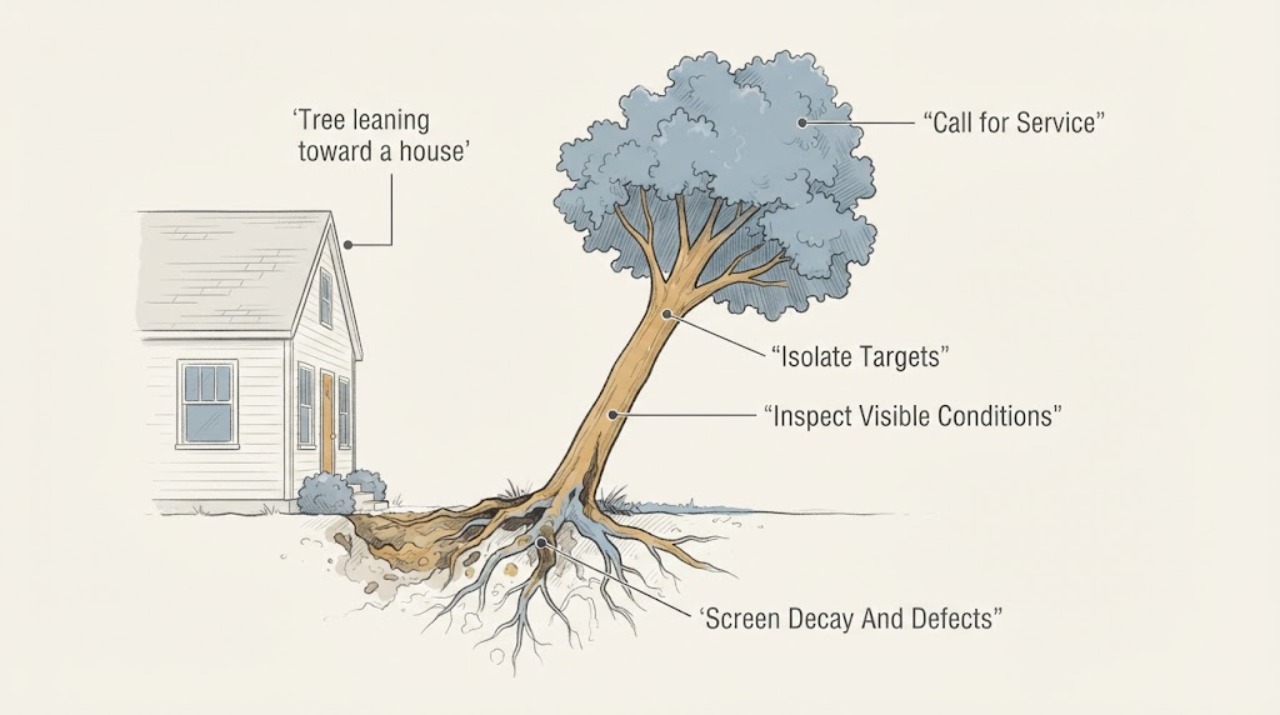
Work through in order
Diagnostic checks
Use only checks that match the exact appliance or system and its official guide.
-
Check 1
From a location outside the likely fall area, identify the house walls, roof, vehicles, paths, play areas, fences, utility lines, and places where people or pets could be struck if the tree or a major branch failed.
Expected result: Record which targets are within the tree's apparent reach, whether an entry or driveway is blocked, and whether movable items can be relocated without approaching the tree or entering its drop area.
Next step: Keep people and pets away, move only items that can be moved from a safe location, and request prompt arborist or tree-removal assessment with the target map.
Stop if: Do not walk under the crown, approach the trunk to measure reach, move heavy items through the fall area, or use a vehicle as a shield.
Why this matters
Why: The same tree defect has greater immediate consequence when a house, occupied route, vehicle, or utility is in the potential fall area. Target reduction changes the temporary safety decision but does not stabilize the tree.
-
Check 2
From outside the likely fall area, compare the tree's current lean with dated photographs or a known earlier view, and visually inspect the soil around the base without digging, probing, or stepping onto lifted ground.
Expected result: Look for a new or worsening lean, raised or cracked soil on the far side of the lean, soil separation at the root collar, exposed or broken roots, root lifting, washout, or a recent change after wind, saturated soil, grading, paving, trenching, or construction.
Next step: Photograph the base and soil from a safe distance, note the weather and site-change timeline, and tell the arborist whether the lean appears new, worsening, or storm-related.
Stop if: Do not dig, cut roots, remove soil, add fill, compact the ground, anchor the tree, or approach the base to test movement.
Why this matters
Why: A recent lean combined with soil movement or root damage is a strong warning of possible root-system failure and can precede uprooting. An old, stable-looking lean is not clearance when decay, defects, or a house target is present.
-
Check 3
Use ground-level viewing or binoculars from outside the likely fall area to scan the trunk, root flare, major branches, and crown for visible defects without climbing or entering the canopy.
Expected result: Record cavities, soft or crumbly wood, mushrooms or conks, missing bark, deep trunk or branch cracks, split unions, dead or hanging branches, broken tops, dieback, and whether several defects occur together.
Next step: Send clear ground-level photos and the defect list to a qualified arborist and request an in-person hazard and target assessment before any pruning or removal plan is chosen.
Stop if: Do not climb, use a ladder, tap or drill the trunk, cut a branch, pull a hanger, scrape decay, or touch a fungal growth near an unstable tree.
Why this matters
Why: Advanced decay, cracks, root problems, dead wood, and multiple nearby defects can increase failure potential. Healthy-looking leaves do not prove that the trunk or roots are sound, and a homeowner cannot safely determine the remaining strength from appearance alone.
-
Check 4
From a safe location, note overhead and nearby utility lines, recent or forecast wind and storms, saturated or icy ground, structures that limit retreat, and whether the tree or branches already contact a line or building.
Expected result: Classify the site as clear of visible lines and severe weather, adjacent to power lines or utility equipment, affected by high wind or storm damage, or inaccessible without entering the likely fall area.
Next step: Keep everyone away, contact the utility company first when a line is involved, and give the arborist the line, weather, storm, access, and contact information before an arrival is planned.
Stop if: Do not trim or remove the tree near lines, work during high winds, approach a downed line, drive equipment into the area, or enter a storm-damaged crown.
Why this matters
Why: Power lines and adverse weather add separate hazards and change who can safely perform the work. Contact or proximity to an energized line requires utility coordination and trained line-clearance professionals; an inaccessible or storm-damaged tree should not be approached for a closer look.
-
Check 5
Use the target map, lean and soil history, defects, utility conditions, weather, and access limits to request the appropriate professional scope: hazard evaluation, pruning, removal, utility coordination, or structural and site assessment.
Expected result: A qualified proposal should identify the apparent failure concern, targets, work zone, access and utility controls, whether pruning or removal is appropriate, how people and property will be protected, and what site or root conditions remain unresolved.
Next step: Provide dated photos, target locations, weather and site-change history, prior work, utility details, and the areas that were not approached; keep the zone isolated until the professional arrives.
Stop if: Do not select a cutting direction, tie-back, brace, rope, cable, bolt, root treatment, or removal method from a photograph or online diagram.
Why this matters
Why: Professional evaluation determines whether the risk can be reduced by moving a target or removing a specific branch, or whether the whole tree requires removal. Improvised support, topping, root cutting, or a homeowner felling attempt can increase the hazard.
Use your observations
Decision map
Find the observation that best matches what you see, then follow the next safe action.
-
PATH 01Safety boundary
What you see
The lean appears new or worsening and the soil is raised, cracked, separated, washed out, or lifted near the base, or roots are exposed or broken.
Do this next
Move people and movable targets away from a safe location, isolate the area, and request immediate professional arborist or tree-removal assessment.
Why this path and its safety boundary
Why it matters: This pattern is consistent with a possible root-system failure and a high-risk change in anchoring, especially when the house is in the potential fall area.
Safety stop: Do not approach the trunk, dig or cut roots, brace the tree, or wait for a closer visual inspection during wind or storm conditions.
-
PATH 02Safety boundary
What you see
The tree has advanced soft or crumbly decay, a cavity, deep trunk or branch cracks, split unions, dead hanging branches, fungal growth at the base, or several defects together.
Do this next
Keep targets out of the area and arrange qualified arborist evaluation before pruning, cabling, bracing, or removal is discussed.
Why this path and its safety boundary
Why it matters: Decay and structural defects can weaken the tree or its parts; multiple defects close together increase concern, and appearance alone cannot establish remaining strength.
Safety stop: Do not climb, cut, pull hangers, scrape decay, install supports, or park beneath the crown while waiting.
-
PATH 03Safety boundary
What you see
The tree or a branch contacts or is adjacent to an overhead power line, the tree is storm-damaged, a line is down, or weather makes the area unstable.
Do this next
Stay away, keep others away, contact the utility company for line concerns, and request trained line-clearance or emergency tree professionals as appropriate.
Why this path and its safety boundary
Why it matters: Electrical and storm hazards require specialized coordination and can make ordinary tree-service access unsafe.
Safety stop: Do not approach a downed line or attached branch, use a ladder or saw, move equipment into the area, or work in high wind, lightning, or icing.
-
PATH 04Safety boundary
What you see
The house, roof, driveway, vehicle, walkway, utility, play area, or occupied space is within the potential fall area, even if the lean looks old or slight.
Do this next
Relocate movable targets only from a safe position, block access, and arrange professional risk evaluation with the target map.
Why this path and its safety boundary
Why it matters: A target makes the consequence of failure significant; an old or corrected lean is not homeowner clearance when defects or decay are present.
Safety stop: Do not enter the drop zone to move property, estimate the fall line, or create a restraint with rope, cable, wire, or bolts.
-
PATH 05Safety boundary
What you see
The lean appears long-standing, no new soil movement or exposed roots are visible from a safe distance, and no obvious severe defect is seen.
Do this next
Keep the concern documented and schedule a qualified arborist assessment; reassess from a safe position after severe weather or visible change.
Why this path and its safety boundary
Why it matters: This lowers the urgency compared with a new root failure but does not certify safety, especially with a house target, hidden decay, or limited visibility.
Safety stop: Do not use apparent stability to justify climbing, pruning, digging, bracing, or placing people or vehicles beneath the crown.
Helpful context
Understand the symptom
The house makes the lean a target problem
A defect becomes a hazard when part of the tree could strike a house, vehicle, walkway, utility, or place where people gather. A tree that has leaned for years is not automatically safe, and a green crown does not rule out defective roots or wood. Start by moving people and movable property out of the potential fall area from a safe position, then arrange professional assessment rather than trying to calculate a safe cutting direction yourself.
Soil uplift can show root movement, not just a landscaping issue
Raised or cracked soil on the side opposite a new lean, exposed or broken roots, and a soil mound near the trunk can indicate that part of the root system has shifted or failed. Root decay, fungal growth, cavities, trunk cracks, dead branches, and storm or excavation history add context. These clues are useful for triage, but they cannot establish the tree's remaining stability from a homeowner inspection.
Removal and support are professional work
Tree removal near a home is inherently hazardous because the tree, branches, ropes, equipment, and surrounding structures can move in unexpected ways. The New York State Department of Environmental Conservation advises against improvised rope, cable, wire, or bolt support and recommends professional tree care for a leaning tree with root failure. Power-line work has an additional electrical boundary: only appropriately trained line-clearance crews should perform work near energized conductors.
Safety boundary
Stop conditions
- Stay outside the likely fall area and keep people, pets, vehicles, and movable property away from the tree and major branches.
- Do not climb, use a ladder, operate a chainsaw, cut branches or roots, dig around the base, pull a hanger, or try to fell, straighten, or lift the tree.
- Do not support the tree with improvised rope, cable, wire, bolts, or braces; trained arborists determine whether any support is appropriate.
- Do not approach or work on a tree or branch that contacts or is adjacent to power lines, and do not approach downed lines; contact the utility company and trained line-clearance professionals.
- Stop for a new or worsening lean, raised or cracked soil, exposed or broken roots, advanced decay, deep cracks, hanging branches, storm damage, high wind, lightning, ice, or any unsafe access.
When checks do not resolve it
Need a professional?
Contact a qualified arborist or tree-removal professional promptly for a tree leaning toward a house, especially when the lean is new or worsening, soil is raised or cracked, roots are exposed or broken, root or trunk decay is visible, branches are dead or hanging, or the tree has a deep crack or cavity. Treat a tree or branch near power lines, a downed line, storm damage, or an occupied or route-critical target as an urgent safety situation; contact the utility company first for line concerns. Keep people away and do not attempt DIY pruning, bracing, root work, or removal.
Safety scope: This article supports remote or ground-level observation and temporary target isolation only. Qualified arborists and trained tree-removal or line-clearance crews perform hazard evaluation, pruning, support, rigging, and removal.
Common questions
FAQ
Is a tree leaning toward my house automatically dangerous?
Not every old lean means imminent failure, but a house is a potential target and a lean with raised or cracked soil, exposed roots, decay, cracks, dead branches, or recent change needs professional assessment. Keep people and property away until the risk is evaluated.
What does raised soil on the side opposite the lean mean?
Raised or cracked soil on the far side of a new lean can indicate root movement or root-system failure. Do not dig or test the base; photograph it from a safe distance and contact an arborist promptly.
Can I tie or brace a leaning tree to save it?
Do not improvise rope, cable, wire, bolts, or braces. Incorrect support can create a greater hazard, and a professional must determine whether support is appropriate or whether the tree should be pruned or removed.
Should I cut branches off a tree leaning toward the house?
Do not climb or cut it as a homeowner correction. Branch weight, decay, roots, weather, utility lines, and the fall area affect the work plan; have a qualified arborist evaluate the tree and targets first.
What if the leaning tree touches a power line?
Stay away and keep everyone else away. Do not approach a downed line or use a ladder, saw, rope, or equipment; contact the utility company and trained line-clearance professionals for the electrical and tree hazards.
Read the exact guide
Official sources
- HOW to Recognize Hazardous Defects in TreesUnited States Forest Service, U.S. Department of Agriculture · USDA Forest Service hazard-tree guidance for homeowner recognition and triage; it provides guidelines rather than a site-specific risk determination.
- Managing Risk In Urban TreesNew York State Department of Environmental Conservation · New York State urban-tree risk guidance used for general safety triage; local utility, licensing, and emergency requirements may also apply.
- eTool: Electric Power Generation, Transmission, and Distribution - Overhead Line Work - Line-Clearance Tree Trimming OperationsOccupational Safety and Health Administration · OSHA occupational safety guidance for trained tree and line-clearance workers; homeowners should not perform work near energized lines.
Community feedback
Share a repair observation
Share a plain-text repair observation. Accepted observations are published automatically; this page may take a moment to update.