
On this page
Start here
Quick answer
Treat a suspected squirrel entry hole as an active wildlife-occupancy question, not a simple hole-patching job. From the ground and from safe living spaces, record the opening's location, fresh gnawing or track marks, sounds, activity timing, signs of young, and any visible utility or structural damage. Do not climb, enter a roof or attic, touch the animal, trap or poison it, clean droppings or nests, or seal the hole while an animal or young may still be inside. Arrange professional wildlife exclusion, urgently if squirrels are in living space, near wiring or vents, or actively entering.
Work through in order
Diagnostic checks
Use only checks that match the exact appliance or system and its official guide.
-
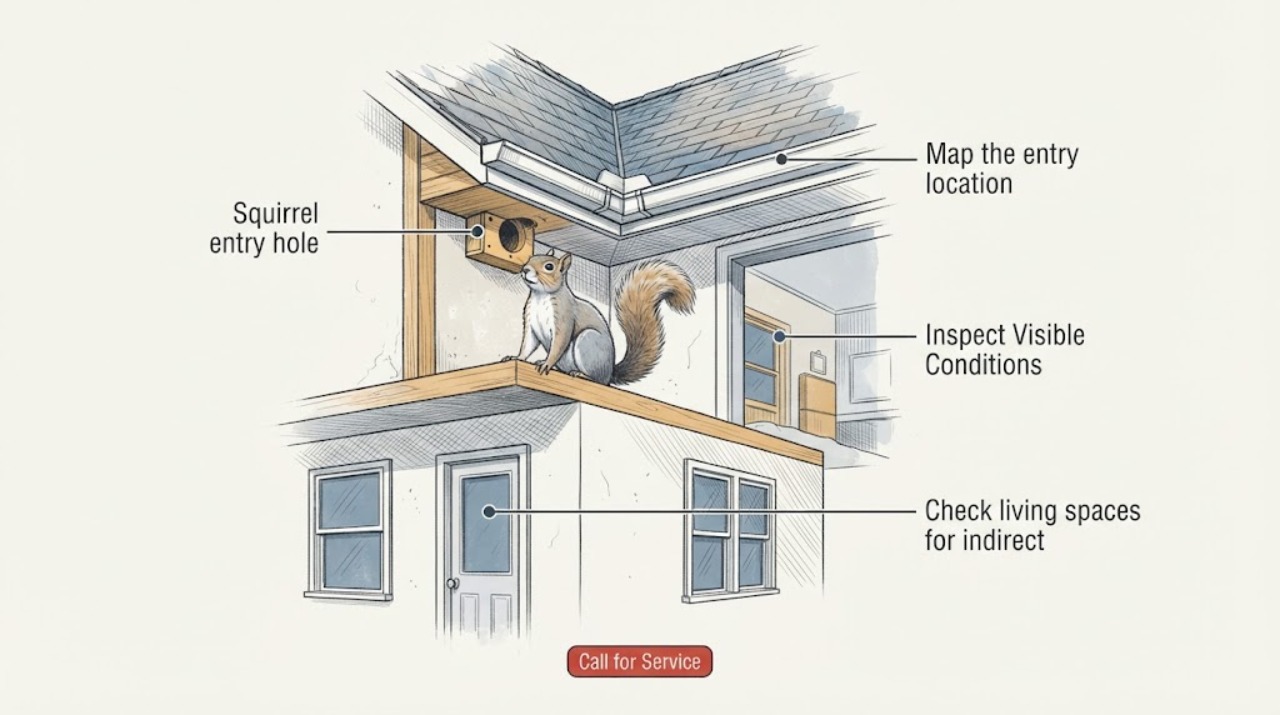
Map the entry location from ground level
From a stable position on the ground, observe the exterior without a ladder or roof access. Identify whether the suspected opening is at a soffit, eave, vent, siding joint, trim, roof edge visible from below, chimney exterior, or around a utility line. Do not approach the hole or put anything into it.
Expected result: Record the side of the building, approximate height, opening type, visible size relative to nearby features, and whether material looks chewed, displaced, cracked, or weather-damaged. Take a zoomed photo only from the ground and do not use it as a reason to climb closer.
Next step: Keep the area below and around the opening clear, and give the location and photo to a wildlife exclusion professional. Do not patch or cover the opening during this first observation.
Stop if: Stop if the opening is above a drop-off, near a roof edge, unstable trim, power equipment, a chimney, or any place that would require climbing or reaching.
Why this matters
Why: The location helps a professional plan a safe inspection and distinguish an animal entry from ordinary building damage. Connecticut wildlife guidance identifies sheltered eaves and attic areas as common squirrel access points and notes that concealed nests or young may not be visible.
-
Look for current activity without contact
From a safe distance and at times when activity was already noticed, observe whether a squirrel enters, exits, carries material, or returns repeatedly. A passive camera may be placed only from a stable ground location if it can be done without approaching the opening; do not wait at the hole, shine into it, or use a hand-held object to probe it.
Expected result: Record live entry or exit, fresh chewing, new debris, tracks, repeated daytime sounds, or no activity during the observation. Note direction of travel and whether activity is centered at one opening or several, without claiming that a quiet period proves vacancy.
Next step: Leave the opening unchanged and request wildlife exclusion service. Keep children and pets away and do not use noise, lights, repellents, or a barrier as a substitute for an occupancy assessment.
Stop if: Stop if the animal approaches, appears injured, becomes cornered, or the observation requires moving closer, climbing, or blocking its route.
Why this matters
Why: Michigan DNR recommends a trail camera when the animal causing damage is uncertain. Repeated entry, fresh damage, or a live animal means sealing now could trap it inside and can cause more damage as it tries to regain access.
-
Check living spaces for indirect signs
From normal floors and rooms, listen for scratching, gnawing, or pattering in walls or ceilings and look only at already-visible signs near occupied rooms. Do not open ceilings or walls, enter the attic, move insulation, touch droppings, or clean nests or contaminated material.
Expected result: Record the room, wall or ceiling area, time of day, sound type, and whether there is a visible odor, stain, torn material, or animal in the living space. Distinguish a one-time noise from repeated activity and record whether the sound is near a vent or electrical fixture.
Next step: Keep the room closed off from children and pets where practical and request wildlife service. If an animal is in a living room, bedroom, or other occupied space, leave it an unobstructed exit only if this can be done from a safe position without contact; otherwise leave the room and call a professional.
Stop if: Stop and leave the area for an animal encounter, bite or scratch, strong odor, visible contamination, smoke, sparking, or any need to open a wall or ceiling.
Why this matters
Why: Connecticut guidance associates gnawing, scratching, and pattering with squirrel presence and warns that squirrels can damage insulation and electrical wiring. Evidence inside the occupied building raises urgency and changes the response from exterior documentation to professional removal.
-
Check for young or a dependent nest without disturbing it
From the ground or normal living space, note only indirect signs such as repeated adult traffic, squeaks, movement sounds, or nesting material visible from outside. Do not look into an opening, move a nest, touch young, shine a light inside, or seal the suspected hole.
Expected result: Record whether activity is solitary or repeated, whether small vocalizations are heard, and whether torn insulation, leaves, or other nest material is visible without entry. Mark the observation as uncertain if young cannot be confirmed.
Next step: Tell the wildlife professional exactly what was heard or seen and leave all openings unchanged. Keep pets indoors or controlled and do not attempt a family removal or relocation.
Stop if: Stop if young, a nest, an injured animal, or an animal inside the building is visible or audible at close range. Do not touch or move it.
Why this matters
Why: A concealed nest or young means the opening may remain active even when no adult is visible. An adult may chew a new route if blocked from young, so occupancy must be resolved by a qualified wildlife professional before exclusion repair.
-
Record utility and building hazards from a safe position
From outside and from normal room viewpoints, note whether the opening is near electrical wires, exterior lights, HVAC or exhaust vents, a chimney, water intrusion, loose siding, or structural trim. Do not operate a suspect vent, touch wiring, open a junction box, enter a duct, or test a damaged fixture.
Expected result: Record visible chewed wiring, a blocked or damaged vent, a broken grille, water staining, loose material, unusual odor, or no visible utility involvement. Note whether heating, cooling, or electrical behavior changed, without repeatedly operating a suspect system.
Next step: Keep the affected system off when there is smoke, sparking, burning odor, or visible damage, and contact the appropriate qualified electrical, HVAC, chimney, or building professional along with wildlife service. Provide photos only from safe positions.
Stop if: Stop immediately for smoke, sparks, burning odor, exposed conductors, a blocked exhaust, water entering electrical equipment, or unstable exterior material.
Why this matters
Why: Squirrels can damage wiring and insulation, while entry near a vent or chimney can create additional air-quality or fire concerns. A utility or structural clue requires coordinated professional assessment, not a wildlife-only patch.
Use your observations
Decision map
Find the observation that best matches what you see, then follow the next safe action.
-
PATH 01Safety boundary
What you see
A squirrel is actively entering or exiting, fresh chewing is visible, or young may be present.
Do this next
Leave the opening open for professional occupancy assessment and arrange wildlife exclusion service promptly. Keep people and pets away.
Why this path and its safety boundary
Safety stop: Do not seal, block, trap, poison, handle, or disturb the opening, nest, or animal.
-
PATH 02Safety boundary
What you see
The opening appears old and no activity is observed, but vacancy cannot be confirmed from safe ground-level checks.
Do this next
Request professional confirmation before exclusion repair. Provide the location, photographs, activity times, and any sound or damage history.
Why this path and its safety boundary
Safety stop: Do not treat one quiet observation as proof that the building is empty or patch the hole yourself.
-
PATH 03Safety boundary
What you see
Squirrel signs are inside living space, near HVAC or exhaust ventilation, or near wiring or electrical fixtures.
Do this next
Leave the affected area or system alone and arrange urgent wildlife service plus the relevant qualified building, HVAC, chimney, or electrical assessment.
Why this path and its safety boundary
Safety stop: Do not enter an attic or duct, clean contamination, operate damaged equipment, or touch wiring or the animal.
-
PATH 04Safety boundary
What you see
There is an injured or trapped animal, a person or pet has had contact, or there is smoke, fire, sparking, or structural instability.
Do this next
Move people and pets away without approaching the animal or hazard and use appropriate emergency, health, utility, or licensed wildlife response from a safe location.
Why this path and its safety boundary
Safety stop: Do not handle, feed, corner, trap, or relocate the animal or enter the damaged area.
Helpful context
Understand the symptom
Why the hole should be assessed before sealing
Squirrels can use eaves, vents, soffits, roof edges, utility penetrations, and other sheltered openings, and an adult may enlarge an opening to reach young. A hole that looks empty during one observation may still be active. The safe sequence is to document location and occupancy clues, keep people and pets away, and have a qualified wildlife professional confirm removal and exclusion before repair.
Safety boundary
Do not climb onto a roof, ladder, attic, crawlspace, or soffit; reach into an opening; corner or handle a squirrel; set a trap or poison; block an entry; or disturb droppings, urine, insulation, or nests. If the opening involves wiring, a vent, chimney, or structural damage, do not investigate inside—report it to the appropriate wildlife and building professional.
When checks do not resolve it
Need a professional?
Arrange professional wildlife exclusion when a squirrel entry hole is suspected, especially with active traffic, fresh gnawing, young, living-space sounds, wiring or vent damage, or uncertain occupancy. Use urgent emergency or utility response for fire, smoke, sparking, exposed conductors, or structural instability.
Have this ready
- Provide the opening location and ground-level photos, activity times and direction, fresh damage, sounds, possible young, visible contamination, wiring or vent clues, building history, and whether a person or pet had contact.
Common questions
FAQ
Should I seal a squirrel entry hole as soon as I find it?
Not until a qualified wildlife professional confirms that no squirrel or young remains inside. An active adult may chew a new route to reach young, causing more damage.
How can I tell whether a squirrel is still using the hole?
From the ground, record repeated entry or exit, fresh chewing, new debris, sounds, or passive-camera activity. A quiet period alone does not prove that the opening is vacant.
Can I clean squirrel droppings or nesting material myself?
Do not sweep, vacuum, touch, or disturb droppings, nests, dead animals, or contaminated insulation as part of this check. Keep people and pets away and obtain appropriate wildlife or health guidance.
Read the exact guide
Official sources
- How to Clean Up After RodentsCenters for Disease Control and Prevention · Supports not vacuuming or sweeping rodent waste and escalating contaminated insulation, nests, dead animals, or ventilation-system access; it is not a squirrel exclusion diagnosis.
- Squirrel Nuisance ProblemsConnecticut Department of Energy and Environmental Protection · Supports identifying eave/attic activity and young risk and not blocking an opening before occupancy is resolved; state guidance and rules may vary.
- Fish and Wildlife: Gray SquirrelIndiana Department of Natural Resources · Supports resolving squirrel occupancy before sealing an entry point and using a licensed nuisance-wildlife operator; local laws and species rules may differ.
- SquirrelsMichigan Department of Natural Resources · Supports passive activity observation, trail-camera identification, pet distance, and waiting for the squirrel to leave before sealing; local rules may differ.
Community feedback
Share a repair observation
Share a plain-text repair observation. Accepted observations are published automatically; this page may take a moment to update.