
On this page
Start here
Quick answer
Stop using the air fryer immediately. If it is safe to do so, switch it off and unplug it by the plug; if the plug or outlet is hot, smoking, sparking, melted or unsafe to touch, turn off the circuit and keep clear instead of pulling the cord. Do not reconnect it to 120V or 220V, try a transformer, change the plug, replace a fuse, or perform a live test until the rating label and the appliance have been assessed by the manufacturer or a qualified appliance/electrical professional. A voltage label such as 120V, 220–240V or 100–240V is model-specific; the label, not the plug shape, determines whether the appliance is rated for that supply.
Before you begin
Safety first
- Do not reconnect for a test, use a transformer, change the plug, bypass protection, replace a fuse, open the housing or perform live measurements.
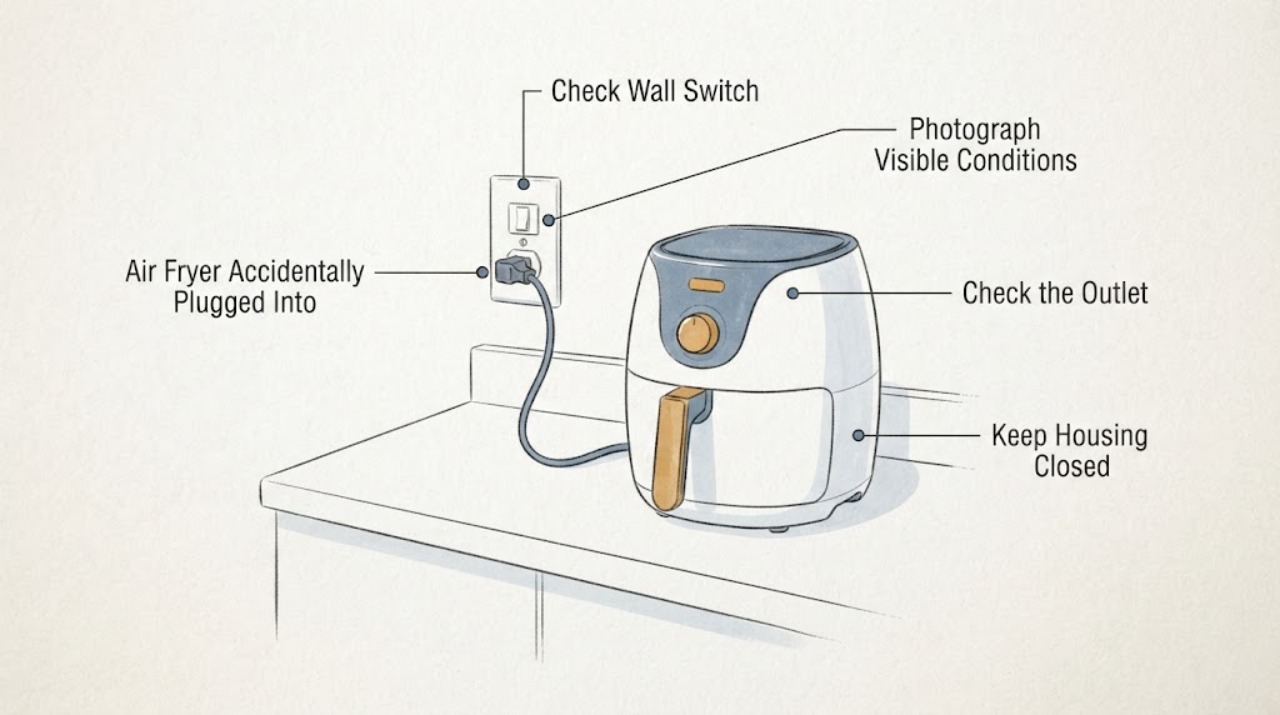
Work through in order
Diagnostic checks
Use only checks that match the exact appliance or system and its official guide.
-
Check 1
Stop cooking and isolate the air fryer. If the plug, cord and outlet are cool and safe to handle, switch the appliance off and unplug it by gripping the plug. If there is smoke, active sparking, a hot/melted plug or outlet, or a shock hazard, do not touch it; turn off the circuit from a safe location and call a qualified electrician or emergency service as appropriate.
Expected result: The appliance is now disconnected with no visible smoke, or the plug/outlet/appliance is hot, charred, smoking, sparking or has caused a shock.
Next step: Keep the air fryer and any suspect outlet out of service. Do not reconnect it to either voltage or reset a tripped protective device as a test.
Why this matters
Why: A wrong-voltage event may have damaged the appliance or its supply connection. CPSC and ESFI treat smoke, sparking, shock, damaged insulation and overheating as stop-use conditions.
-
Check 2
With the appliance unplugged and cool, photograph the rating label and transcribe the input voltage, frequency, wattage and model. Compare the printed range with the supply that was used; do not infer compatibility from the plug shape, country, adapter or the fact that the display once lit.
Expected result: The label says a single voltage such as 120V, a different range such as 220–240V, or a wide range such as 100–240V; the label is missing or unreadable.
Next step: Do not power the appliance again while the model-specific rating and damage assessment are unresolved. Provide the label details to the manufacturer or qualified service.
Why this matters
Why: Only the manufacturer-rated input range determines whether that supply is permitted. ESFI notes that permitted voltage ranges are displayed on the device and that different electrical systems use different voltages.
-
Check 3
After confirming the air fryer is disconnected, inspect only the outside of the plug, cord, housing, control area and outlet face for melting, discoloration, cracks, odor or moisture. Do not open the air fryer, remove a fuse, change the plug, probe contacts or touch exposed wiring.
Expected result: There is any melted plastic, darkening, cracked insulation, electrical odor, moisture, loose plug fit or other visible damage, or the exterior looks normal.
Next step: For any damage, keep the appliance isolated and arrange qualified repair or replacement. If the exterior is normal, still wait for model-specific professional assessment before reconnection.
Why this matters
Why: Visible damage is evidence that the appliance or supply may be unsafe. A normal exterior does not rule out internal overvoltage damage, so it is not clearance to test.
-
Check 4
Contact the manufacturer or qualified appliance/electrical professional with the model label, the supply voltage used, how long it was energized, whether a breaker tripped, and any smell, sound, smoke, spark or display change. Ask for a model-specific safety assessment; do not request a transformer, modified plug or fuse substitution as a trial.
Expected result: The professional confirms the appliance and supply are safe under the exact model documentation, or finds damage/uncertain insulation, controls, heating circuit or protection components.
Next step: Follow only the professional or manufacturer disposition. Keep the air fryer out of service until they explicitly clear it for the rated supply.
Why this matters
Why: An overvoltage event cannot be cleared by a user-level power-on check. The correct disposition may be authorised repair or replacement, depending on the exact appliance and damage.
Use your observations
Decision map
Find the observation that best matches what you see, then follow the next safe action.
-
PATH 01Next step
What you see
The plug or outlet is hot, melted, smoking, sparking, loose or has caused a shock.
Do this next
Do not touch or reuse it; turn off the circuit if safe and have a qualified electrician assess the outlet and appliance.
Why this path and its safety boundary
Why it matters: The supply connection itself may be an immediate shock or fire hazard.
-
PATH 02Next step
What you see
The rating label is readable and lists a single voltage that does not match the supply used, or the label cannot be read.
Do this next
Keep it disconnected and give the exact label and event details to the manufacturer or qualified service. Do not try a transformer or alternate outlet.
Why this path and its safety boundary
Why it matters: The appliance cannot be cleared by a plug change or a display test; its permitted input remains unverified or mismatched.
-
PATH 03Next step
What you see
The label appears compatible but the air fryer was energized at 220V, or any smell, noise, trip, display change or heat occurred.
Do this next
Do not power it again; arrange model-specific professional assessment before use.
Why this path and its safety boundary
Why it matters: A compatible-looking label does not establish that the event caused no internal damage.
Helpful context
Understand the symptom
Treat the 220V mistake as an electrical safety event
The supply voltage and the air fryer's rated input must be compared from the rating label and exact manual. A plug adapter only changes the connector; it does not establish that an appliance is safe on a different voltage. If the appliance was energized at the wrong voltage, the safe next decision is isolation and assessment, not another power-up.
Inspect from the outside only after power is removed
Once the appliance is disconnected and cool, look for melted or darkened plastic, a distorted plug, cord damage, a hot or discolored outlet, smoke residue or an electrical odor. Do not open the housing, probe the cord, replace an internal fuse or touch the circuit while energized. The absence of visible damage does not prove that the electronics or heating circuit survived the overvoltage event.
Have the exact model assessed before any further use
No brand or model was supplied, so no air-fryer voltage range, fuse, converter or replacement part can be identified. Record the full rating-label information and what happened, then use the manufacturer's support route or a qualified appliance/electrical professional. Do not let a breaker reset or a display light be treated as proof that the appliance is safe.
When checks do not resolve it
Need a professional?
Call qualified electrical or appliance service before any further use if the appliance was energized at a possibly incorrect voltage, or immediately if there was smoke, sparking, overheating, shock, a hot outlet, a tripped breaker or visible damage. Keep it disconnected; do not test with a transformer, modified plug or replacement fuse.
Safety scope: Do not reconnect for a test, use a transformer, change the plug, bypass protection, replace a fuse, open the housing or perform live measurements.
Have this ready
- Provide the full model/rating label, country and supply voltage, duration of the connection, breaker behavior and all visible or smelled symptoms.
Common questions
FAQ
Can I use a transformer to see whether the air fryer still works?
Do not use a transformer as a user test after a wrong-voltage event. The exact model rating and internal condition must be assessed first; reconnecting can worsen hidden damage or create a shock/fire risk.
If the display turns on, is the air fryer safe?
No. A display or fan response does not clear the cord, protection, controls or heating circuit after a voltage incident. Keep it unplugged and obtain model-specific professional assessment.
Can I replace the fuse or fit a different plug?
No. Do not substitute a fuse, alter the plug or open the housing. Give the exact appliance and supply information to the manufacturer or a qualified repair professional.
Read the exact guide
Official sources
- CPSC Guide to Home Wiring HazardsU.S. Consumer Product Safety Commission · Opened CPSC guide. It supports unplugging and qualified repair for damaged appliance cords/plugs and stop-use responses to overheating, smoke or sparks; it does not diagnose the unidentified air fryer or clear it for reuse.
- Home SafetyElectrical Safety Foundation International · Opened ESFI consumer electrical-safety guidance. It supports checking the device label for its permitted voltage range and not assuming a plug adapter establishes compatibility; it does not authorize reconnecting this unidentified air fryer after a wrong-voltage event.
- Appliance Safety TipsElectrical Safety Foundation International · Opened ESFI appliance safety guidance. It supports immediate unplugging and authorised repair or replacement for damaged or repeatedly tripping appliances; it does not identify any air-fryer-specific component or repair.
Community feedback
Share a repair observation
Share a plain-text repair observation. Accepted observations are published automatically; this page may take a moment to update.