
On this page
Start here
Quick answer
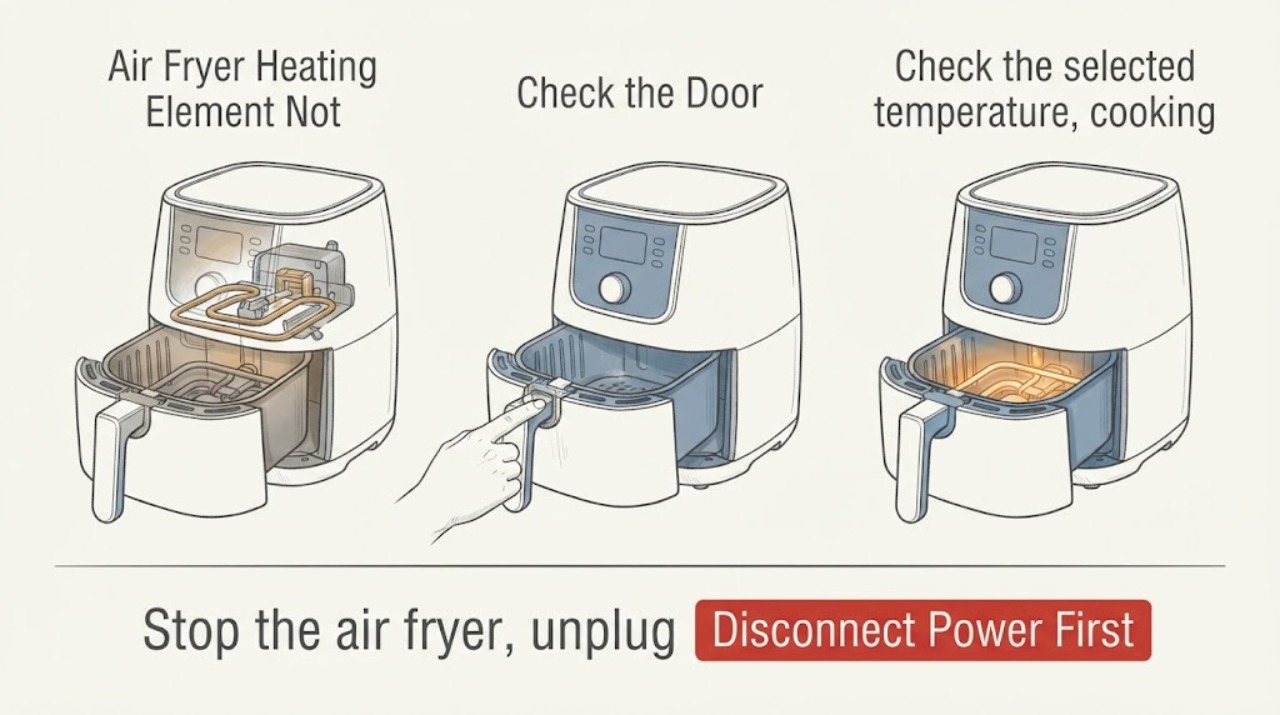
Unplug the air fryer and let it cool before inspecting anything. A fuse that looks intact does not prove that the heating circuit or thermal protection is working, so do not bridge a fuse, open the housing, or probe live wiring. From the outside, confirm the cord and outlet, make sure the pan or drawer is fully seated and closed, verify that a time and a meaningful cooking temperature are set, and check the exact model instructions. Philips support lists an incompletely closed drawer or pan-detection condition, a temperature at or below 40°C/100°F on applicable models, and a missing or too-short timer setting as reasons an air fryer may appear not to heat; Philips says a heater that still does not work needs support. If the outlet trips, the cord or housing is damaged, there is smoke or a burning smell, or the heater remains off after the no-risk checks, stop using the appliance and arrange qualified service.
Work through in order
Diagnostic checks
Use only checks that match the exact appliance or system and its official guide.
-
Check 1
Stop the air fryer, unplug it from a dry and safe position, and let the cooking chamber cool completely before checking the cord, plug, housing, pan, or drawer.
Expected result: The cord or plug is damaged, the housing is cracked or dented, there is smoke or a burning smell, the outlet or breaker trips, or the appliance is intact and cool.
Next step: Do not reconnect a damaged or repeatedly tripping appliance. Keep it out of service and arrange manufacturer or qualified appliance service. If it is intact and cool, continue with external fit and control checks only.
Why this matters
Why: Damage, abnormal smoke or odor, and repeated protection trips are stop conditions; they cannot be safely resolved by checking the fuse visually.
-
Check 2
With the appliance unplugged and cool, remove and reseat the basket or pan and close the drawer or door fully; inspect only for visible cracks or obstructions at the seating edges.
Expected result: The pan or drawer is not fully seated or closed, visible plastic damage is present, or it seats and closes normally.
Next step: Remove only an accessible obstruction and close the drawer or door normally. Do not hold, defeat, tape, or jumper an interlock. If the condition is correct but there is still no heat, continue only to the model-appropriate control check.
Why this matters
Why: On applicable designs, pan detection or a closed-drawer interlock can keep the heater and fan off. Visible damage can prevent that condition and requires support rather than a bypass.
-
Check 3
Check the selected temperature, cooking time, and start command against the exact model manual without touching the heating element or opening the housing.
Expected result: No time was set, the analog timer is too short to engage, the temperature is at a model-specific low setting, or the programmed settings are appropriate.
Next step: Set a normal cooking time and temperature supported by the exact manual for one supervised test only if the appliance is undamaged and the outlet is stable. Stop immediately for smoke, burning odor, sparking, or a trip.
Why this matters
Why: Philips documents timer and low-temperature conditions for applicable models; a similar control layout on another brand does not prove the same threshold or sequence.
-
Check 4
Check the wall outlet and plug seating externally, and remove other appliances from the same outlet only if doing so is dry and safe; do not repeatedly reset a breaker to test the air fryer.
Expected result: The plug is loose, other appliances overload the outlet, the outlet or breaker trips, or the outlet is stable and the air fryer still does not heat.
Next step: Use the exact manual's power requirements and a known-good outlet only for a cautious test when there is no damage or trip history. A repeat trip or persistent no-heat condition requires service; do not replace or bypass a fuse yourself.
Why this matters
Why: Philips and Instant Pot both identify the power connection as an external check, while Instant Pot directs owners not to continue operating an appliance that keeps tripping the breaker.
-
Check 5
Record the brand, full model and serial number, display messages, whether the fan runs, the selected settings, and any odor or trip before contacting support.
Expected result: The model is identified and the heater remains off after the external checks, or the model cannot be identified.
Next step: Use the manufacturer support channel or qualified appliance service with the recorded information. Do not open the case, test live wiring, bridge the fuse, or order a heater from a visual comparison.
Why this matters
Why: Heater, thermal-protection, interlock, and control behavior vary by model. Philips directs owners to use the model number for specific support, and its no-heat guidance sends an unresolved heater problem to support.
Use your observations
Decision map
Find the observation that best matches what you see, then follow the next safe action.
-
PATH 01Next step
What you see
The cord or housing is damaged, the unit smokes or smells of burning insulation, or the breaker or outlet trips when the air fryer is used.
Do this next
Do not continue operating or repeatedly reset the breaker. Keep clear of wet or hot areas and arrange manufacturer or qualified service.
Why this path and its safety boundary
Why it matters: This is an electrical or fire stop condition, not a fuse-replacement diagnosis.
-
PATH 02Next step
What you see
The pan or drawer is not fully seated or closed, or visible damage affects its seating or detection area.
Do this next
Reseat the pan and close the drawer normally if there is no damage. If damage remains or the heater stays off, stop and contact support; never bypass the interlock.
Why this path and its safety boundary
Why it matters: On applicable models, the interlock or pan-detection condition can keep the heater and fan off.
-
PATH 03Next step
What you see
The model's timer or temperature is not set to a cooking program, and the appliance is otherwise cool, dry, and undamaged.
Do this next
Follow the exact manual for one supervised test. Stop for any smoke, burning smell, spark, or trip.
Why this path and its safety boundary
Why it matters: A control setting can make the appliance appear not to heat, but the exact threshold and timer behavior are model-specific.
-
PATH 04Next step
What you see
The drawer, settings, plug, and outlet are correct, but the heating element still does not operate, or a visual fuse check is the only evidence available.
Do this next
Leave the appliance unplugged and arrange manufacturer or qualified service. Do not open the housing, bridge the fuse, or perform live electrical testing.
Why this path and its safety boundary
Why it matters: The remaining fault cannot be narrowed safely to a fuse, heater, thermal protector, sensor, or control from the public generic guidance.
Helpful context
Understand the symptom
Treat the visible fuse result as a limit, not a diagnosis
A fuse can look normal while a heater, thermal protector, interlock, control, or connection still needs service. The assigned appliance has no brand or model, and the opened manufacturer guidance does not authorize a universal continuity test, housing removal, fuse bypass, or live-voltage check. Keep the unit unplugged and use only the external checks that match the appliance's own manual.
Check whether the appliance is being allowed to heat
Philips says some air fryers disable the heater and fan when the pan is removed or the drawer is not fully closed. Its support page also calls out a temperature setting at or below 40°C/100°F on applicable models and an unset or too-short analog timer. Those checks explain a no-heat symptom only when they match the model; do not transfer a Philips-specific temperature or timer behavior to an unknown design.
Stop at electrical, heat, or damage warning signs
Do not continue operating an air fryer that trips a breaker, has a damaged cord or housing, smokes abnormally, or smells of burning insulation. Instant Pot's official FAQ says not to continue operating when its air-fryer appliance keeps tripping the breaker and says not to use a damaged or dented appliance. Unplug only from a dry, safe position; if the area is wet or the appliance is hot, keep clear and use qualified service.
Find the exact model before any repair decision
The topic supplies no manufacturer or model. Philips explains that the model and serial number are on the type plate under the base and are needed for model-specific support; other brands place the rating label elsewhere. Record the appliance identity and any display code, then use that manufacturer's manual or support channel. A generic fuse appearance cannot establish a compatible heater, thermal fuse, control board, or replacement procedure.
When checks do not resolve it
Need a professional?
Stop using the air fryer and arrange service for a persistent no-heat condition after the model-specific external checks, any breaker trip, damaged cord or housing, abnormal smoke or burning smell, a pan-detection or drawer fault, or any need to open the housing or test the fuse or heater.
Common questions
FAQ
If the fuse looks good, can I replace the heating element?
No. A visual fuse check does not identify whether the heater, thermal protection, interlock, wiring, or control is safe and functional. Use the exact model manual and qualified service; do not open the housing or bridge a fuse.
Why does the air fryer run but not heat?
On applicable Philips models, an incompletely closed drawer or pan-detection condition, a low temperature, or an unset or too-short timer can prevent heating or cooking. If those external conditions are correct and the heater remains off, Philips directs the owner to support rather than an internal DIY diagnosis.
Can I keep resetting the breaker to test the air fryer?
No. Instant Pot's official FAQ says not to continue operating an air fryer when its circuit breaker keeps tripping. Leave the appliance out of service and arrange support or qualified electrical/appliance service.
What information does service need when the model is unknown?
Find the rating-plate model and serial number, usually on the base or another manufacturer-specified label, and record the settings, fan or timer behavior, pan fit, error message, trip history, odor, and visible damage. Exact model identity is needed before a heater or thermal-protection procedure can be selected.
Read the exact guide
Official sources
- Frequently Asked QuestionsInstant Pot · Instant-specific safety and support guidance used only for the explicitly labeled stop-use boundary; it does not define the unknown appliance's fuse or heater circuit.
- Where is the model and serial number on my Philips Airfryer?Philips Support · Philips identification guidance; used to explain why the unknown appliance needs its own rating-plate identity before repair decisions.
- My Philips Airfryer does not work or switch onPhilips Support · Philips-specific support page used for clearly labeled applicable-model examples; it does not establish universal air-fryer thresholds or procedures for an unknown brand.
Community feedback
Share a repair observation
Share a plain-text repair observation. Accepted observations are published automatically; this page may take a moment to update.