
On this page
Start here
Quick answer
Do not plug the air fryer in again after a 110V appliance has been connected to a 220V receptacle. If it is still connected and there is no smoke, arcing, heat or burning smell, disconnect it only from a safe position or switch off the circuit; if any hazard is present, leave it alone and call local emergency help. A voltage above an appliance's intended rating can damage electrical components, but the task has no brand, model, label details, design or observed failure, so it cannot establish whether a fuse, control, heater or another part is damaged. Record the label and visible condition without opening the case, then ask the manufacturer or a qualified appliance/electrical technician whether the unit should be tested, repaired or replaced.
Before you begin
Safety first
- Do not reconnect the air fryer, use a converter or extension cord as a test, replace its plug or fuse, open the case, measure live circuits, bypass protection, or order a board/heater based on a generic symptom.
Work through in order
Diagnostic checks
Use only checks that match the exact appliance or system and its official guide.
-
Check 1
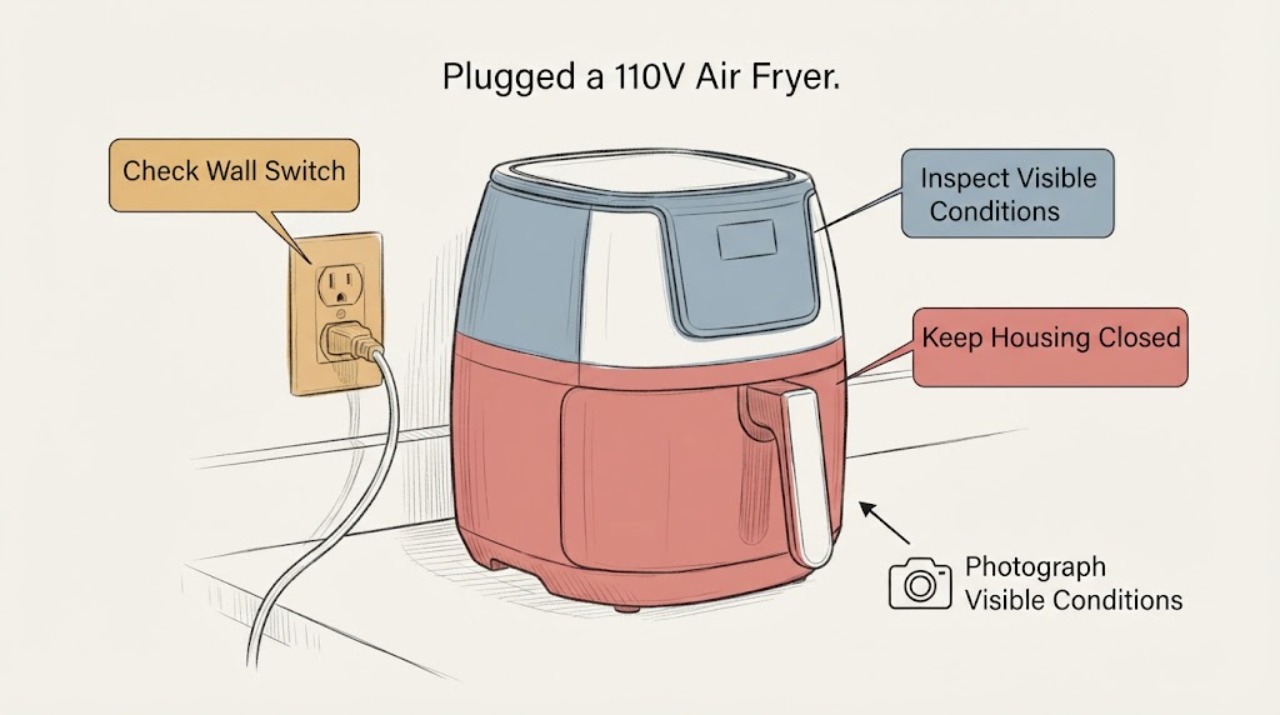
If the air fryer is still connected, do not touch it if there is smoke, arcing, a burning smell, a hot or discolored plug/receptacle, or water nearby. Leave the area and call local emergency help. If none of those hazards is present, disconnect it from a dry, safe position or switch off the circuit before handling it.
Expected result: The unit or receptacle shows heat, smoke, arcing, odor, melting, discoloration, or a protective device has tripped.
Next step: Keep away from the appliance and have the receptacle/circuit and appliance assessed by the appropriate qualified professional. Do not reset repeatedly or reconnect the air fryer.
Why this matters
Why: The connection may have created an electrical or fire hazard; a tripped breaker or visible damage is not a safe invitation to reset and retry.
-
Check 2
With the appliance unplugged and cool, photograph or transcribe the rating label and plug information, including the stated voltage, frequency and model. Compare those details with the outlet or circuit information only from the label or a qualified electrician; do not insert a tester or open the receptacle.
Expected result: The label clearly states 110/120V, lists a different range, is unreadable, or the outlet/circuit rating cannot be confirmed.
Next step: Give the exact label information and outlet history to the manufacturer or qualified technician. Leave the air fryer unused until they advise a safe disposition.
Why this matters
Why: A clear rating confirms the intended supply but does not show which component was damaged. An unreadable or conflicting identity prevents a model-specific repair or converter decision.
-
Check 3
Inspect only the exterior of the air fryer, cord, plug and receptacle after power is isolated. Look for melted plastic, scorch marks, a cracked or loose cord, deformation, unusual odor or evidence of arcing; do not remove covers, reach inside, or turn the controls on.
Expected result: Any exterior damage, odor, looseness, residue or heat mark is present, or the exterior looks normal but the appliance was energized at the wrong voltage.
Next step: Keep it out of service and request manufacturer-authorized or qualified appliance/electrical assessment; do not order a fuse, board, heater or other part based on the symptom alone.
Why this matters
Why: Visible damage requires professional electrical safety assessment. A normal exterior cannot rule out internal overvoltage damage, because ESFI notes that excess voltage can damage electronic components.
-
Check 4
Ask the manufacturer or a qualified appliance/electrical technician to decide whether the air fryer can be safely tested, repaired or should be replaced. Supply the exact model, voltage error, duration if known, breaker behavior and photographs, and disclose any smoke, sound, smell or loss of function.
Expected result: A qualified professional confirms a model-specific inspection path, or the model/voltage history remains uncertain.
Next step: Follow the professional's written disposition. Do not energize the unit for a customer test, replace a plug, bypass a fuse or use an improvised voltage converter while the decision is unresolved.
Why this matters
Why: The exact design and safety approvals control whether repair is possible; generic advice cannot establish component compatibility or a safe post-overvoltage test.
Use your observations
Decision map
Find the observation that best matches what you see, then follow the next safe action.
-
PATH 01Next step
What you see
There is smoke, arcing, burning odor, melting, a hot/discolored plug or receptacle, water nearby, or a breaker has tripped after the connection.
Do this next
Leave the area if necessary, call local emergency help for active smoke/fire, and have the circuit and appliance inspected. Do not touch, reset or reconnect it.
Why this path and its safety boundary
Why it matters: The situation may involve fire or shock risk, and the appliance and circuit cannot be safely cleared by another plug-in attempt.
-
PATH 02Next step
What you see
The appliance label confirms 110/120V and it was connected to 220V, but the exterior and receptacle look normal.
Do this next
Keep the appliance unplugged and obtain a model-specific manufacturer or qualified technician disposition. Do not run a brief test or use a converter to find out.
Why this path and its safety boundary
Why it matters: No visible damage does not prove the internal electronics or heating circuit survived the overvoltage; ESFI states that excess voltage can damage components.
-
PATH 03Next step
What you see
The label is missing/unreadable, the outlet voltage has not been verified, or the plug/circuit was misidentified.
Do this next
Keep the appliance out of service and have a qualified person identify the appliance rating and receptacle/circuit before any further use.
Why this path and its safety boundary
Why it matters: The assumed 110-to-220 mismatch may be incomplete, and no safe compatibility or repair claim can be made.
-
PATH 04Next step
What you see
The exact model and incident history are available and a qualified professional has completed the safety assessment.
Do this next
Follow the professional's documented repair or replacement decision and keep the appliance disconnected if any warning sign returns.
Why this path and its safety boundary
Why it matters: Only that model-specific assessment can establish whether a repair or replacement path is safe; the public guidance does not support a generic part choice.
Helpful context
Understand the symptom
Treat the voltage mistake as a stop-use event
A 110V appliance connected to a 220V supply has been exposed to a voltage outside the assigned rating. The exact damage depends on the appliance design and how long it was energized, so a breaker that did not trip does not prove that the air fryer is safe. Do not make a second connection to see whether it still heats.
Separate visible evidence from an internal diagnosis
After the circuit and appliance are safe, look only at the rating label, plug, cord and exterior for heat, discoloration, melted plastic, smoke residue, cracks or a loose connection. Those findings justify service or replacement consideration, but they do not identify a fuse, board, heater or other part.
Why a plug adapter or converter is not a repair decision
A plug shape does not establish the voltage an appliance needs, and a travel adapter does not convert voltage. Whether any transformer or regional version is permitted depends on the exact appliance instructions and ratings. Do not improvise a converter, change the plug or bypass a protective device to test this unit.
When checks do not resolve it
Need a professional?
Arrange manufacturer-authorized or qualified appliance/electrical service after a 110V air fryer has been energized from a 220V supply, especially if a breaker tripped or any heat, odor, arcing, smoke or loss of function occurred. Use emergency help for active smoke or fire.
Safety scope: Do not reconnect the air fryer, use a converter or extension cord as a test, replace its plug or fuse, open the case, measure live circuits, bypass protection, or order a board/heater based on a generic symptom.
Have this ready
- Provide the model/rating label, stated voltage and frequency, receptacle/circuit information, how long it was connected, breaker behavior, and photographs of the exterior, plug and receptacle taken only when safe.
Common questions
FAQ
Can I plug it into 110V now to see whether it still works?
No. A normal-looking exterior or a breaker that did not trip cannot show that the internal components survived the overvoltage. Keep it disconnected and obtain a model-specific professional assessment.
Can I repair it by replacing the fuse or control board?
Not from this information. Overvoltage can damage more than one component, and the task supplies no model or parts evidence. Do not open the appliance or choose a fuse, board or heater without a qualified diagnosis and exact fit information.
Will a plug adapter or transformer make it safe?
A plug adapter changes the plug shape, not necessarily the supply voltage. Any transformer or regional conversion would have to be explicitly permitted for the exact appliance by its manufacturer and installed safely; do not improvise one as a test.
What if there is no smoke or visible damage?
Leave the air fryer unplugged anyway. Electrical Safety Foundation International explains that excess voltage can damage internal components without giving you a reliable external diagnosis. Have the unit and the receptacle assessed before use.
Read the exact guide
Official sources
- Ratings of electrical appliancesElectrical Safety First · Opened Electrical Safety First page used for checking the appliance rating and external plug/socket warning signs; its indicative air-fryer rating is not treated as the assigned unit's rating.
- Surge and Protect 2014Electrical Safety Foundation International · Opened ESFI page used to support the general overvoltage damage and no-generic-component-diagnosis boundary; it does not identify this air fryer's internal design.
- Appliance and Electrical Fire SafetyU.S. Fire Administration · Opened USFA government page used for fire-safe handling of the appliance, plug and receptacle; it does not diagnose overvoltage damage.
- Appliance Safety TipsElectrical Safety Foundation International · Opened ESFI appliance-safety page used for the stop-use, authorized repair and no-live-testing boundary; it does not establish a repair part for any air-fryer model.
Community feedback
Share a repair observation
Share a plain-text repair observation. Accepted observations are published automatically; this page may take a moment to update.