
On this page
Start here
Quick answer
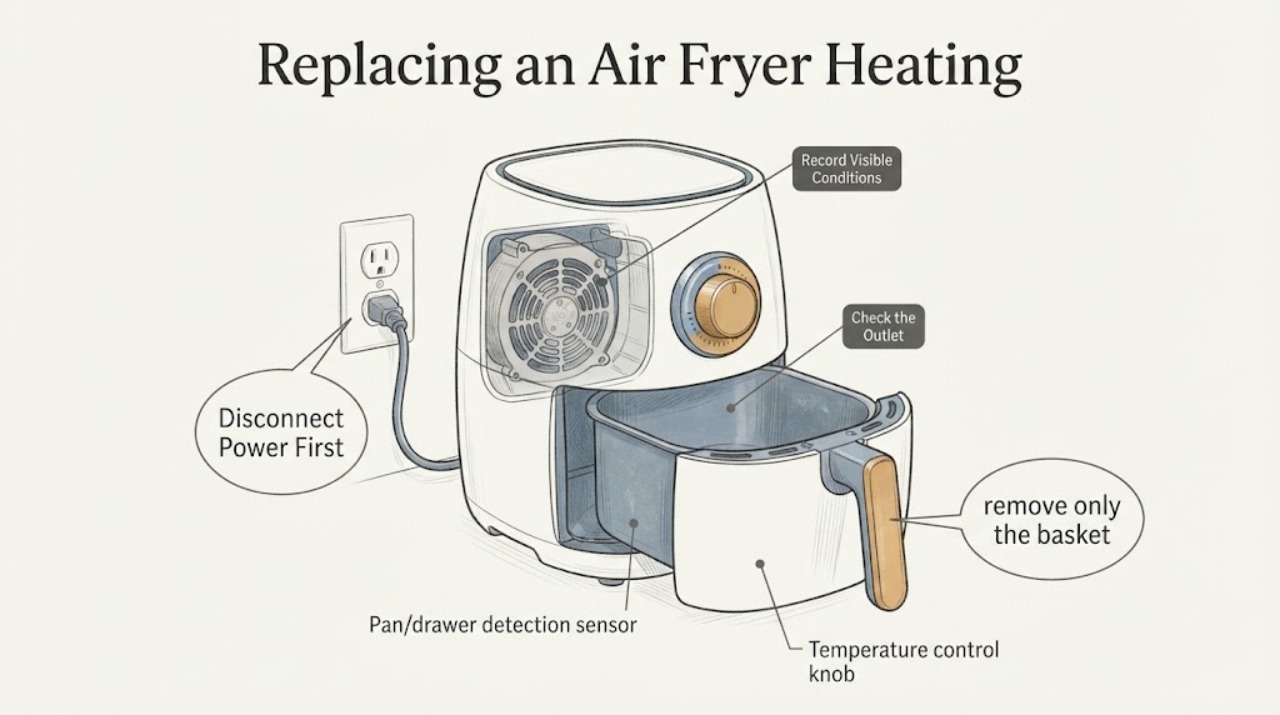
There is no safe universal heating-element replacement procedure for an unbranded, unmodeled air fryer. First record the exact model and serial number, then check its owner instructions and repair policy. A unit that does not heat may have a closed-drawer or pan-detection condition, no time or temperature set, or a dirty heater rather than a confirmed failed element. Philips' official support says to unplug the appliance, let it cool, and clean accessible food residue from the heater with a soft sponge or suitable soft/medium brush; it also says that if the earlier checks do not solve a no-heat problem, the heater might be broken and support should be contacted. Do not open the housing, bridge a thermal fuse, test live wiring, or order a generic element. If the cord, plug, housing, heater support, or element is damaged, stop using the air fryer and arrange model-specific authorized service.
Work through in order
Diagnostic checks
Use only checks that match the exact appliance or system and its official guide.
-
Check 1
Unplug the air fryer, wait until it is fully cool, and record the model and serial information from the type-plate sticker under or on the base without opening the housing. Keep the basket or pan secured while turning the unit only as the manufacturer's instructions permit.
Expected result: A complete model suffix is available, the label is missing or unreadable, or the appliance has a damaged cord, plug, housing, or signs of overheating.
Next step: Use the full model in the manufacturer's support/manual lookup. If the label cannot be read or the cord, plug, housing, or heater support is damaged, stop using the appliance and arrange qualified service instead of opening it.
Why this matters
Why: Model identity determines whether a heater is a service part, whether the unit has pan detection, and which cleaning or repair instructions apply. Damage to the power or heat enclosure is a safety condition, not a parts-search problem.
-
Check 2
With the appliance unplugged and cool, remove only the basket and pan/drawer. Inspect the visible upper chamber and heater area for grease, crumbs, or a light ingredient touching the heater; do not bend the element, remove a guard, or scrape the coating.
Expected result: Food residue or grease is visible, a light ingredient has reached the heater, or the accessible area is clean but the element appears cracked, distorted, loose, or burned.
Next step: If the model's cleaning instructions permit it, clean the accessible area with a soft sponge or suitable soft/medium brush and no abrasive tool. If the element or support looks damaged, stop and request model-specific service.
Why this matters
Why: Philips says residue and light food pieces can reach the heater and contribute to smoke; a visible structural or heat-damage sign is not safely corrected by cleaning. A clean-looking element still does not prove its electrical condition.
-
Check 3
Check the model manual for the normal start conditions: pan or drawer fully inserted, timer or cooking time set, and temperature selected within the model's supported range. Confirm the plug is seated in a suitable outlet without using a damaged cord or improvised adapter; do not open the plug or outlet.
Expected result: The pan/drawer is not fully seated, no time is set, the temperature is below the model's heating range, or all documented start conditions and the outlet are correct but the unit still does not heat.
Next step: Correct only the visible setting or pan/drawer condition described by the exact manual and perform at most one normal supervised test without food. If it still does not heat, stop testing and contact authorized or qualified service.
Why this matters
Why: Philips documents pan detection, low temperature, and missing/short timer settings as reasons an air fryer may appear not to heat. Correcting a start condition does not prove the heater is healthy; persistent no-heat after those checks is a service clue.
-
Check 4
If cleaning and the documented start checks do not restore heat, record whether the display or timer runs, whether the fan operates, whether there is smoke or an electrical smell, and whether a model-specific error indication appears. Do not measure heater resistance, short a thermal fuse, bypass pan detection, or probe energized contacts.
Expected result: The unit remains cold, shows a fault, produces dark smoke or a burning smell, trips power, or heats normally after the permitted external correction.
Next step: Stop use and unplug when safe if there is smoke, burning odor, damage, or a power trip. Arrange model-specific service with the model, symptoms, and photos; do not continue cooking cycles or install a generic element.
Why this matters
Why: Philips directs users to contact support when the prior no-heat solutions fail and states that the heater might be broken. Smoke, burning odor, a trip, or a fault can also involve wiring, thermal protection, control, or the power supply, none of which can be identified from observation alone.
-
Check 5
Before requesting service, gather the model and serial number, purchase or warranty information, symptom timing, selected temperature and time, pan/drawer state, cleaning performed, and any visible damage or error indication. Keep the appliance unplugged if the heater or housing is damaged.
Expected result: The complete identity and symptom history are available, or the model and safe service path remain unknown.
Next step: Use the manufacturer's model-specific support route or a qualified small-appliance technician. Do not buy or install an element based only on dimensions, appearance, voltage, or a generic marketplace listing.
Why this matters
Why: Manufacturer support uses the model number to provide the applicable manual, repair, exchange, and parts information. Without that identity, element fit, wiring, thermal protection, and authorized repair status cannot be safely scoped.
Use your observations
Decision map
Find the observation that best matches what you see, then follow the next safe action.
-
PATH 01Next step
What you see
The heater area has grease or food residue, the cord and housing are intact, and the exact manual permits user cleaning.
Do this next
Unplug, cool, and clean only the accessible heater area with the model-approved non-abrasive method. If heat does not return afterward, request service rather than opening the appliance.
Why this path and its safety boundary
Why it matters: Contamination may be contributing to smoke or poor performance, but it does not establish that the element itself has failed.
-
PATH 02Next step
What you see
The pan/drawer is not fully inserted, no time is set, or the selected temperature is below the model's heating range.
Do this next
Correct the documented start condition and perform one normal supervised test without food. Stop and request service if the unit remains cold or displays a fault.
Why this path and its safety boundary
Why it matters: The control or pan-detection condition can prevent the heater from energizing; this is not evidence of a broken element.
-
PATH 03Next step
What you see
The pan/drawer, timer, temperature, outlet, and permitted cleaning checks are correct, but the appliance still does not heat.
Do this next
Leave the air fryer unplugged and use model-specific authorized or qualified service. Do not replace a heating element without the exact manual, service documentation, and fitment confirmation.
Why this path and its safety boundary
Why it matters: A heater or another internal power, sensing, control, or thermal-protection issue is possible, but the official evidence does not identify which component failed.
-
PATH 04Next step
What you see
The cord, plug, housing, heater support, or element is damaged, or the appliance produces dark smoke, a burning smell, or trips power.
Do this next
Stop using it and unplug only when safe; keep it away from combustible materials and arrange qualified service or replacement evaluation. Do not energize it to confirm the fault or bypass a safety device.
Why this path and its safety boundary
Why it matters: This is a safety stop condition involving possible electrical or thermal damage, not a routine heating-element replacement decision.
Helpful context
Understand the symptom
Confirm the appliance before looking for a part
Heating elements are built into different air-fryer housings, and some models use a pan or drawer detection system that disables both the heater and fan when the pan is removed. The task has no brand or model, so a replacement element, resistance value, connector, fastener, or disassembly route cannot be identified safely. Find the type plate and retain the complete model suffix before searching the manufacturer's support or service path.
Clean only the user-accessible heater area
A coated or grease-covered heater can cause smoke or poor cooking and can be mistaken for a failed element. Philips' official instructions require the appliance to be unplugged and cool before cleaning; they permit a soft sponge and, where needed, a soft to medium bristle brush, while warning against steel wire and hard bristles. This is cleaning, not a permission to remove the heater, cover, thermal fuse, or wiring.
A no-heat symptom does not prove the element is open
Before service, check only the model-documented external conditions: a fully inserted pan or closed drawer, a set cooking time, a temperature above the model's minimum, and an intact plug and outlet. Philips lists these conditions before treating its heater as possibly broken. A timer that runs, a display that works, or a fan that moves does not prove that the element or its thermal protection is safe to replace yourself.
When checks do not resolve it
Need a professional?
Arrange model-specific authorized or qualified service when the air fryer remains cold after the documented pan/drawer, timer, temperature, outlet, and accessible-cleaning checks; when the heater, support, cord, or housing is damaged; or when smoke, burning odor, a fault, or a power trip occurs. Do not attempt generic heating-element replacement or bypass thermal protection.
Common questions
FAQ
Can I replace an air-fryer heating element myself?
Not safely from a generic procedure. The task has no model, and heater shape, mounting, wiring, thermal protection, and serviceability vary. Identify the full model first; use only model-specific repair documentation and qualified service. Philips' official support sends persistent heater faults to support rather than publishing a universal replacement procedure.
Could a dirty heating element look like a failed element?
Yes. Grease or food residue can cause smoke or poor performance. Unplug and cool the unit, then clean only the accessible heater area with the non-abrasive method in the exact manual. If it still does not heat, do not open the housing; request service.
What should I do if the air fryer runs but does not heat?
Check the model-documented pan/drawer, timer, temperature, and outlet conditions once. Philips notes that pan detection, a low temperature, or no/short timer can prevent heating. If those checks are correct and the unit remains cold, stop using it and contact model-specific support instead of testing live wiring or bridging a thermal fuse.
Read the exact guide
Official sources
- How to clean my Philips AirfryerPhilips Support · Official Philips cleaning guidance; only the non-abrasive, user-accessible cleaning boundary is generalized, not a heater replacement procedure.
- My Philips Airfryer does not work or switch onPhilips Support · Official Philips support article with model-dependent examples; used only for external checks and the persistent-heater-fault service boundary.
- Repair and exchangePhilips Support · Official Philips repair route used for the generic service boundary; it does not authorize a cross-brand heating-element replacement.
- Where is the model and serial number on my Philips Airfryer?Philips Support · Official Philips model-identification guidance used to establish the identity gate before any parts or repair decision.
- White smoke comes out of my Philips AirfryerPhilips Support · Official Philips support page applying to listed Philips models; used for residue/stop-cleaning logic, not cross-brand part fit.
Community feedback
Share a repair observation
Share a plain-text repair observation. Accepted observations are published automatically; this page may take a moment to update.