
On this page
Start here
Quick answer
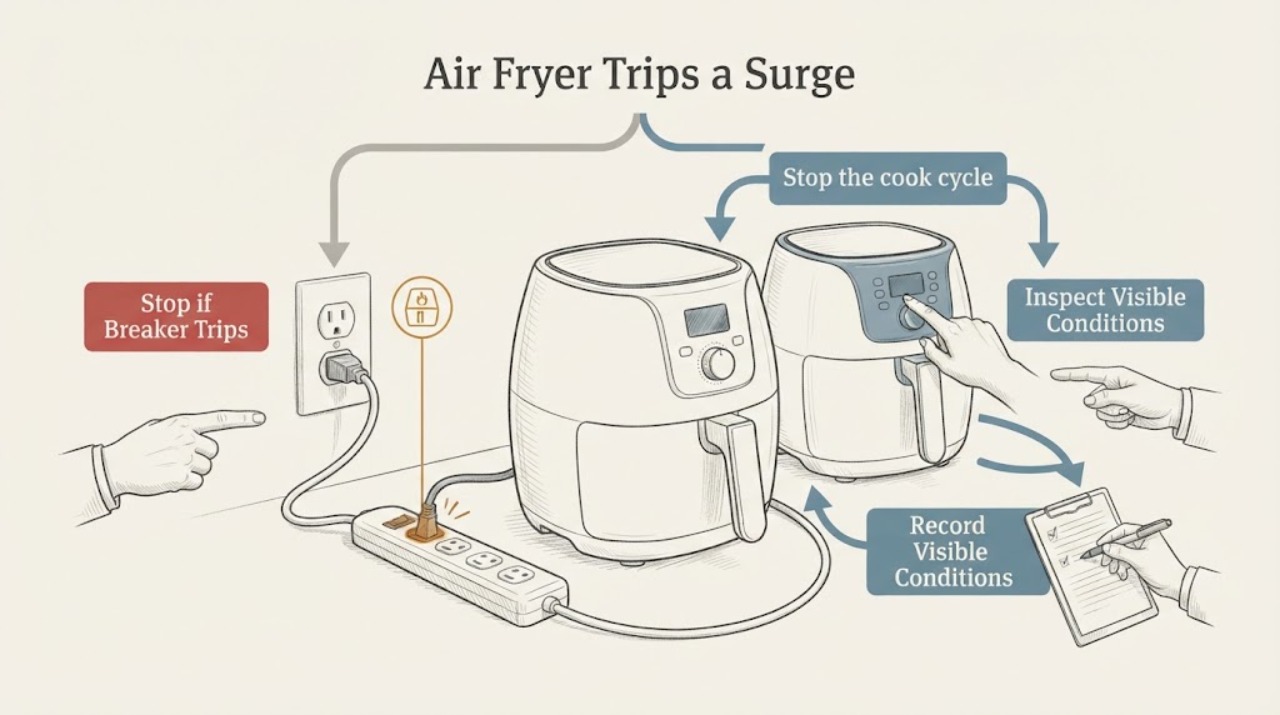
Stop using the air fryer and the surge protector when the protector trips; do not keep resetting it, move the plug to an extension cord, or reconnect the fryer to see whether it trips again. A trip can reflect an overloaded or damaged power strip, a damaged outlet or cord, or a fault in the unbranded air fryer, and the symptom alone cannot identify which one. With everything disconnected and cool, record what else shared the strip and inspect only for heat, scorch marks, melting, smoke, a burning smell, moisture or cord damage. Any visible damage, repeated trip, hot connection or unusual smell needs qualified appliance or electrical service; smoke or fire needs emergency response.
Work through in order
Diagnostic checks
Use only checks that match the exact appliance or system and its official guide.
-
Check 1
Stop the cook cycle and leave the air fryer and surge protector disconnected after the trip. Do not press the protector reset, plug the fryer into another strip or extension cord, or reconnect it as a test. If smoke, flame or an active burning smell is present, leave the area and use emergency fire guidance rather than approaching the appliance.
Expected result: The trip has cleared and there is no heat, smoke, odor or visible damage; or a hazard remains at the appliance, strip, plug or outlet.
Next step: Keep the fryer and protector out of use. For smoke or fire, evacuate and contact emergency services. For a cooled appliance with no active fire, continue only with the de-energized external record below and arrange assessment before reuse.
Why this matters
Why: A cleared protector only says its protective device opened; it does not prove that the air fryer or wiring is safe. A continuing odor, heat, smoke or fire is an immediate safety event.
-
Check 2
With the plug removed and everything cool, inspect the surge protector, its cord, the air-fryer plug and the accessible wall receptacle from outside. Look for a hot or discolored face, scorch marks, melted plastic, a loose fit, cracking, fraying, moisture or a burning smell; do not remove covers or touch exposed wiring.
Expected result: Any heat, discoloration, melting, loose connection, damaged insulation, moisture or odor is present; or all accessible surfaces look normal.
Next step: Do not reuse a damaged item or receptacle; keep the circuit and appliance out of service and call a qualified electrician or appliance technician as appropriate. If no sign is visible, do not perform a reconnect test; continue by documenting the setup and identifying the model.
Why this matters
Why: A visible electrical or heat sign makes the strip, receptacle, cord or appliance unsafe to keep testing. A normal-looking exterior does not rule out an internal fault or a protective-device problem.
-
Check 3
Record the surge protector's label, rating and overload indicator if present, and list every device that was connected when the trip occurred. Check whether any cord was pinched, covered or daisy-chained, but do not reconnect the air fryer or substitute an extension lead to compare results.
Expected result: Several heat-producing devices shared the strip, the strip was overloaded or daisy-chained, a rating is missing, or the air fryer was the only connected load.
Next step: Retire an overloaded, damaged or unverified protector and have the outlet/circuit assessed before choosing a replacement. If the fryer alone caused the event, keep it disconnected and arrange manufacturer or qualified appliance evaluation; do not use another strip as a workaround.
Why this matters
Why: Multiple loads or an unknown/damaged strip provide a plausible overload path, while a trip with only the fryer leaves an appliance, strip or circuit fault unresolved. Neither pattern identifies a specific failed component.
-
Check 4
Identify the air fryer from its bottom or rear label and owner manual without powering it. Record the model, electrical rating, region, purchase source, and whether the appliance recently got wet, was cleaned, moved, or showed a burning smell or unusual noise; compare only with the manufacturer's safety and recall information for that exact model.
Expected result: A complete model is available and the manual or recall notice gives a specific safety instruction; or the model remains unknown and no matching notice can be verified.
Next step: Follow only an exact-model stop-use or remedy instruction and provide the model details to service. If no exact information is available, keep the appliance disconnected and use qualified evaluation rather than guessing at wattage, fuse, heater or board repairs.
Why this matters
Why: Exact model identity can reveal a manufacturer-specific stop-use notice or allowed operating setup, but an unverified or generic air-fryer page cannot prove compatibility or a component failure for this unit.
-
Check 5
Treat recurrence, a tripped household breaker or RCD/GFCI, a hot receptacle, or any trip after a qualified inspection as a service boundary. Give the technician the protector label, outlet location, connected-load list, exact model and timing; do not reset protection repeatedly or perform live electrical measurements.
Expected result: The protection device trips again, the receptacle or plug heats, the appliance trips a different protective device, or the problem does not recur only because the appliance remains disconnected.
Next step: Leave the air fryer and suspect protector isolated and arrange qualified electrical and/or appliance service. Do not bypass overload, RCD/GFCI or grounding protection and do not open the air fryer.
Why this matters
Why: Repeated protection operation or heating indicates an unresolved electrical risk, not a harmless nuisance trip. No recurrence while disconnected cannot distinguish a faulty protector from a faulty air fryer or circuit.
Use your observations
Decision map
Find the observation that best matches what you see, then follow the next safe action.
-
PATH 01Next step
What you see
The protector tripped once, nothing is hot or damaged, and the air fryer and protector remain disconnected.
Do this next
Document the load and model, then obtain manufacturer or qualified electrical/appliance guidance before reuse. Do not try a different outlet, extension lead or repeated reconnect.
Why this path and its safety boundary
Why it matters: The event is not yet attributable to the strip, circuit or fryer; a reset would not safely identify the cause.
-
PATH 02Next step
What you see
Several appliances shared the protector, the protector is old or damaged, or the cord was pinched or daisy-chained.
Do this next
Retire the suspect protector, keep the fryer disconnected, and have the outlet/circuit and appliance assessed before selecting a compliant replacement setup.
Why this path and its safety boundary
Why it matters: An overload or power-strip condition is plausible, but the trip still does not certify the air fryer as safe.
-
PATH 03Next step
What you see
The air fryer alone triggered the protector, or the trip recurs after a qualified check of the protector and outlet.
Do this next
Keep the fryer out of use and arrange exact-model manufacturer or qualified appliance service. Do not move it to an extension cord or bypass protection.
Why this path and its safety boundary
Why it matters: A fryer cord, plug, internal appliance fault or circuit issue remains possible; the external symptom cannot select a heater, fuse, board or other part.
-
PATH 04Next step
What you see
There is smoke, flame, a continuing burning smell, arcing, melted plastic, an exposed conductor, or a hot wall connection.
Do this next
Leave the area and contact emergency services for fire or smoke. Isolate power only if it can be done without approaching the hazard, and do not re-enter or reuse the appliance until qualified responders or service say it is safe.
Why this path and its safety boundary
Why it matters: This is an immediate fire or shock hazard rather than a routine appliance troubleshooting question.
Helpful context
Understand the symptom
A surge protector is part of the electrical safety path, not a diagnostic meter. When it trips during air-fryer use, the useful first distinction is whether the protector, receptacle or cord shows a hazard and whether other loads were sharing the strip. No visible mark does not clear the air fryer: an internal fault cannot be confirmed or ruled out from one trip, especially without a model or rating.
This page stays at external, de-energized checks. It does not recommend a direct-wall trial, repeated reset, extension lead, opening the fryer or testing live voltage. Use the exact owner instructions and a qualified technician for any model-specific electrical assessment.
When checks do not resolve it
Need a professional?
Arrange qualified appliance and/or electrical service before reusing an air fryer that trips a surge protector. Provide the exact model and rating, protector label and condition, outlet location, all connected loads, whether the trip occurred at startup or during heating, and any odor, heat, noise, smoke, scorch or moisture observation. Do not open the fryer, replace an internal fuse or heater, bypass protective devices, or perform live measurements.
Common questions
FAQ
Should I plug the air fryer straight into the wall to see whether the surge protector was the problem?
Do not perform that experiment after a protective trip. Keep the fryer and protector disconnected, document the setup, and have the outlet, protector and appliance assessed. A direct-wall trial could remove a protective layer without identifying the fault.
Can too many devices on one surge protector cause the trip?
Yes, an overloaded or damaged power strip is one possible path. Official guidance says not to overload power strips and to replace worn or damaged cords, but a trip with only the air fryer still needs assessment rather than a guessed appliance part.
What if the air fryer smells hot or makes an unusual noise?
Switch it off and keep it disconnected. Air-fryer fire guidance treats a burning smell or unusual noise as a reason to stop immediately and contact the manufacturer; smoke, flame, arcing or a hot connection requires emergency safety action.
Can I use an extension cord instead of the surge protector?
No. Do not use an extension lead as a workaround after a protective trip. The air-fryer safety guidance warns against extension leads because they can overload the socket, and the CPSC warns that overloaded cords and power strips can create fire hazards.
Read the exact guide
Official sources
- Air fryersCheshire Fire and Rescue Service · Official fire-service air-fryer setup, cord, extension-lead, unusual smell/noise, cleaning and fire-prevention guidance.
- Appliance and Electrical Fire SafetyU.S. Fire Administration (FEMA) · U.S. government fire-safety guidance on appliance cords, outlets, power strips, surge protection and electrical-fire prevention.
- Power Up With Safety: Extension Cords & Power StripsU.S. Consumer Product Safety Commission · U.S. federal consumer-safety guidance on overloaded extension cords and power strips, damaged cords and temporary use.
Community feedback
Share a repair observation
Share a plain-text repair observation. Accepted observations are published automatically; this page may take a moment to update.