
On this page
Start here
Quick answer
A BBQ showing not turning on should be handled from the outside: check the fuel and controls, inspect hoses and visible burner areas, and observe ignition only outdoors using the model procedure. Stop immediately for gas odor, uncontrolled flame, smoke, or electrical damage.
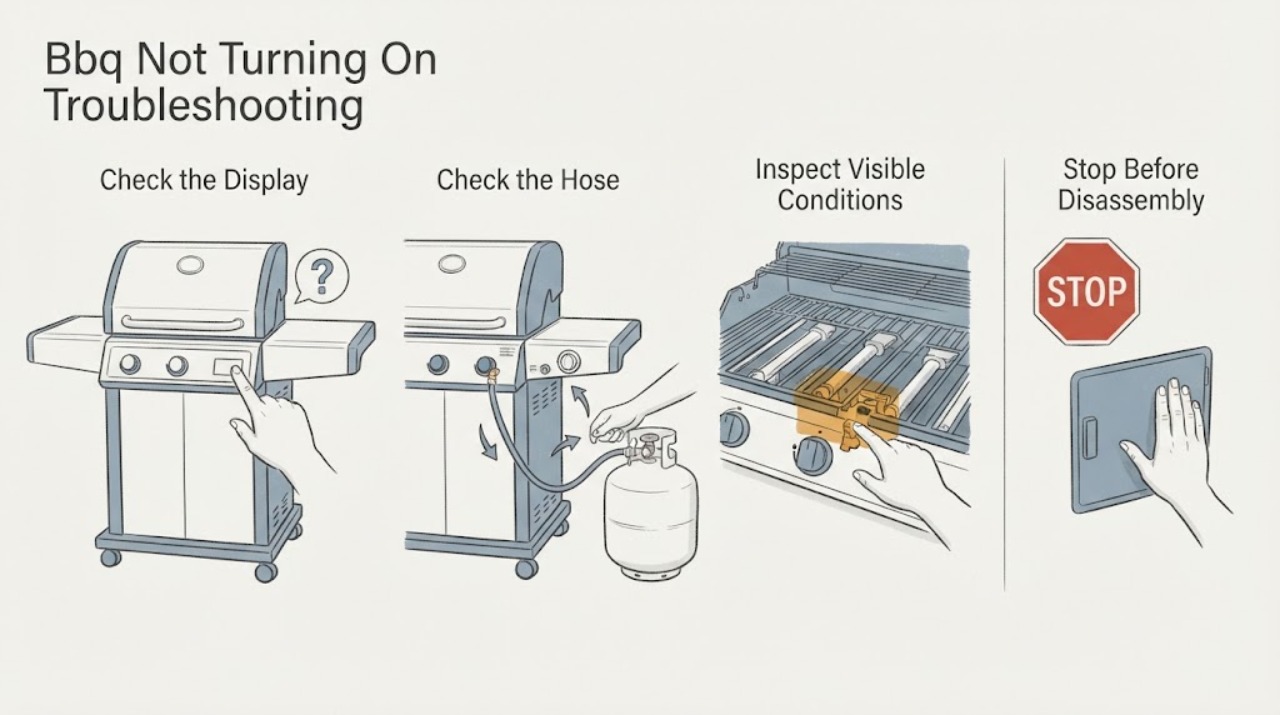
Work through in order
Diagnostic checks
Use only checks that match the exact appliance or system and its official guide.
-
Check 1
Check fuel and controls: With the grill cold, confirm the fuel source is present and the control is in the intended position. Do not attempt to ignite a grill that smells of gas.
Expected result: The fuel control is off, empty, or a gas odor is present; otherwise the control is set but the reported symptom remains.
Next step: Close the fuel supply and keep flames and cigarettes away if gas is suspected; follow the model manual for normal startup.
Why this matters
Why: A missing supply or gas odor changes this into a safety stop; a correct control state shifts attention to the external burner and airflow path.
-
Check 2
Inspect the outside surfaces and hose: Look over the grill body, gas hose, connector, and visible burner openings for cracking, holes, brittleness, grease, or debris without removing the burner assembly.
Expected result: Damage, a leak sign, or blockage is visible; or the external parts appear intact.
Next step: Do not use the grill until a leak or damaged part is repaired by a qualified person.
Why this matters
Why: CPSC treats damaged hoses and leak signs as reasons to replace or service before use; a clear outside path makes a control or internal burner fault more likely.
-
Check 3
Observe ignition and flame behavior: Use only the manufacturer startup sequence while outdoors, with the lid position and ignition controls specified by the manual; observe whether ignition is absent, uneven, or followed by flame loss.
Expected result: There is no ignition, an uneven flame, a flare-up, or a stable flame.
Next step: Turn off the fuel if the flame goes out and follow the manual before any restart.
Why this matters
Why: No ignition or flame loss can reflect the fuel, igniter, or burner path; flare-up or unstable flame requires stopping and cleaning or service.
-
Check 4
Check ventilation and heat conditions: Confirm the grill is outdoors in open ventilation, away from combustible overhead surfaces, and not surrounded by grease or clutter; observe whether heat is weak or excessive.
Expected result: Ventilation is restricted, the grill is unusually hot, or the location is suitable.
Next step: Move or clean only when the grill is cold and arrange service for persistent heat problems.
Why this matters
Why: Poor ventilation or grease accumulation increases fire or carbon monoxide risk; a suitable location leaves the grill fault for model-specific diagnosis.
-
Check 5
Run one controlled retest: After an accessible condition is corrected and the grill is cold and outdoors, follow the complete model startup sequence once and watch the flame without leaving it unattended.
Expected result: The BBQ operates normally, or the same symptom returns.
Next step: Stop using it for recurring failures, smoke, flames outside the normal burner area, or any gas odor.
Why this matters
Why: A normal cycle supports an external setup cause; recurrence indicates a fuel, ignition, burner, or control fault requiring service.
Use your observations
Decision map
Find the observation that best matches what you see, then follow the next safe action.
-
PATH 01Next step
What you see
The control is inactive, paused, delayed, or showing an error or lockout.
Do this next
Record the display and follow the exact owner or equipment manual reset or cycle procedure.
Why this path and its safety boundary
Why it matters: The appliance may be waiting for a documented control action or reporting a model-specific fault rather than a generic component failure.
-
PATH 02Next step
What you see
An accessible supply, seal, filter, hose, container, load, or airflow path is visibly restricted or damaged.
Do this next
Correct only the accessible condition described by the source or model manual, then perform one controlled retest.
Why this path and its safety boundary
Why it matters: An external operating or maintenance condition is more likely than an internal component failure.
-
PATH 03Next step
What you see
Power and accessible paths are normal but the same symptom returns during a controlled retest.
Do this next
Stop using the appliance when damage or overheating is possible and contact the manufacturer or a qualified technician with the recorded observations.
Why this path and its safety boundary
Why it matters: The remaining possibilities include an internal pump, heater, motor, sensor, valve, burner, drive, or control fault that requires model-specific service tools.
Helpful context
Understand the symptom
This guide keeps the bbq diagnosis at external checks supported by an authoritative safety or manufacturer source. Work in order and use each observation to choose the next branch.
When checks do not resolve it
Need a professional?
Stop and contact the manufacturer, site supervisor, or a qualified technician if the symptom persists, a safety control or interlock is involved, there is smoke, fire, gas odor, sparks, burning smell, water near electrical parts, abnormal heat, or any internal sealed, electrical, gas, heating, motor, or control work is needed.
Common questions
FAQ
What should make me stop immediately?
Stop for gas odor, uncontrolled flame, smoke, sparks, burning smell, damaged wiring, water near electrical parts, repeated breaker trips, or excessive heat. Isolate the appliance safely and use qualified service.
Why is the exact model or equipment manual important?
Control sequences, filters, safety interlocks, reservoirs, vents, and service procedures vary by model. Record the identification label and any displayed code before ordering a part or attempting a repair.
When is a replacement part justified?
Only after the model manual or a qualified technician connects the observed result to that part. A similar symptom alone does not establish fit or compatibility.
Read the exact guide
Official sources
- Summer Grilling SafetyU.S. Consumer Product Safety Commission · gas and charcoal grills
Community feedback
Share a repair observation
Share a plain-text repair observation. Accepted observations are published automatically; this page may take a moment to update.