
On this page
Start here
Quick answer
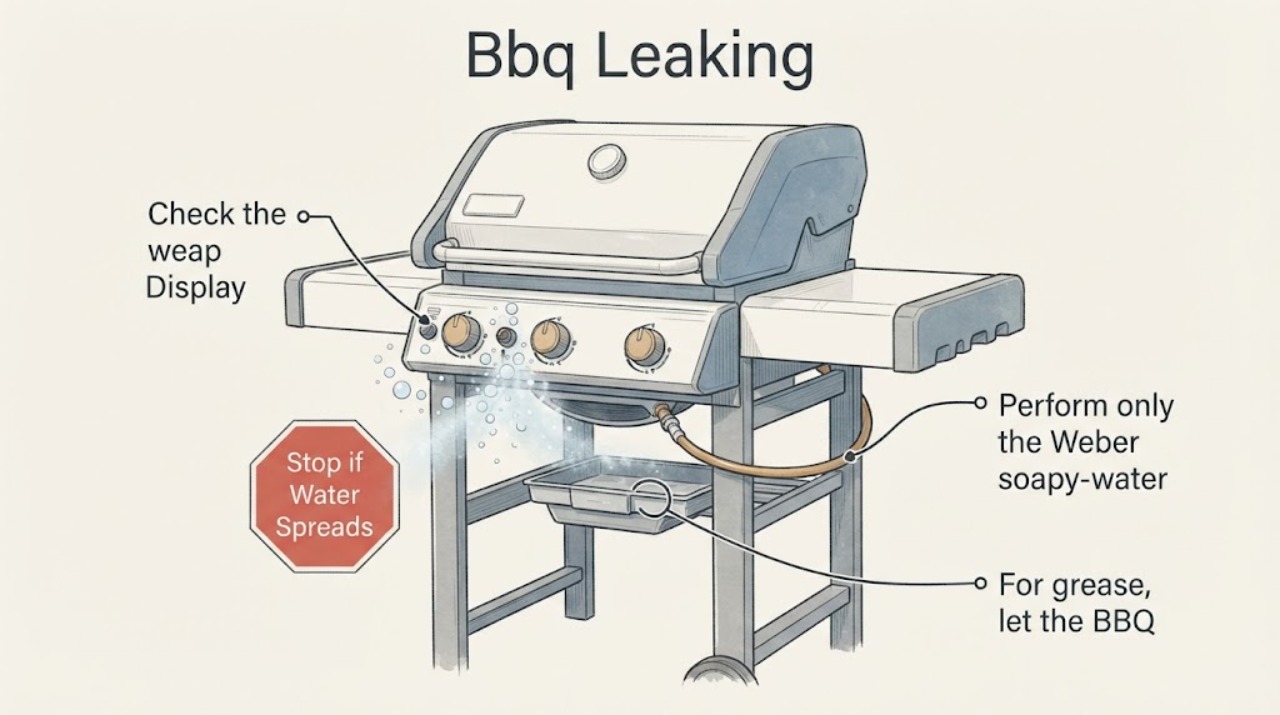
A leaking BBQ can release gas at a tank or hose connection, or liquid grease from an overflowing or misaligned collection system. Weber’s official instructions require a soapy-water gas leak test with burners off and say never to use the grill when bubbles persist; grease leaks require a cold, clean collection system.
Work through in order
Diagnostic checks
Use only checks that match the exact appliance or system and its official guide.
-
Check 1
If gas may be leaking, turn every control knob OFF.
Expected result: Keep flames, cigarettes, switches, and sparks away; close the cylinder valve if it is safely accessible and move people away.
Next step: Do not use an open flame or continue testing after a leak is found.
Why this matters
Why: A gas smell, hissing, or bubbles at a fitting means the grill must not be operated.
-
Check 2
Perform only the Weber soapy-water test.
Expected result: With knobs off and the gas source opened only as the instructions require, apply soapy water to the cylinder-regulator and hose connections and watch for growing bubbles.
Next step: Close the gas source, rinse connections, and contact service for persistent bubbles.
Why this matters
Why: Growing bubbles identify a gas leak at that connection; no bubbles there does not prove the entire appliance is safe if odor persists.
-
Check 3
For grease, let the BBQ become completely cold.
Expected result: Inspect the drip pan, catch pan, grease tray, channels, and foil or liners for overflow, cracks, misalignment, or blockage.
Next step: Empty and clean the approved collection parts when cold, and do not line them with unapproved foil.
Why this matters
Why: A full or obstructed collection path can allow liquid grease to escape; hot grease can burn and ignite.
-
Check 4
Check for recurrence and damage.
Expected result: After cleaning, observe whether gas odor, oil, bubbles, hose abrasion, a cracked tray, or flare-ups return.
Next step: Do not operate until the responsible component is replaced or inspected by qualified service.
Why this matters
Why: Recurrence points to a damaged hose/regulator, fitting, collection component, or burner-area problem.
Use your observations
Decision map
Find the observation that best matches what you see, then follow the next safe action.
-
PATH 01Next step
What you see
No gas odor is present, and cold inspection finds an overflowing or blocked grease tray.
Do this next
Clean and reseat the collection system cold, then monitor for recurrence.
Why this path and its safety boundary
Why it matters: The leak is likely grease-management related rather than fuel gas.
-
PATH 02Next step
What you see
Gas odor, hissing, or growing bubbles appear at a tank, regulator, or hose connection.
Do this next
Close the gas source if safe, keep ignition sources away, and contact Weber or qualified gas service.
Why this path and its safety boundary
Why it matters: The BBQ has an active fuel leak and is unsafe to use.
-
PATH 03Next step
What you see
The source is unclear, a hose/regulator is cracked, or liquid reaches electrical/ignition components.
Do this next
Keep the BBQ out of service and obtain qualified inspection.
Why this path and its safety boundary
Why it matters: The leak cannot be safely classified or contains a damaged component.
Helpful context
Understand the symptom
Identify gas versus grease
Do not ignite the BBQ to locate a leak. Determine whether the smell is propane/gas, the wet material is oily grease, or water is coming from a weather-exposed area.
When checks do not resolve it
Need a professional?
Use Weber or qualified gas-grill service for persistent gas bubbles, damaged hose/regulator/tank fittings, recurring grease leaks, cracked trays, or ignition-area contamination.
Common questions
FAQ
Can I find a BBQ gas leak with a flame?
No. Weber requires a soap-and-water solution and warns that flame or sparks can cause fire or explosion.
Can I cover the grease tray with foil?
Weber warns that foil can interfere with grease flow. Use the collection parts and instructions for the exact model.
Read the exact guide
Official sources
- How to Safely Connect a Propane Tank to Your Grill - WeberWeber · This is official manufacturer support; exact model-specific behavior and parts remain limited to the named product or manual.
- Understanding the Grease Management System - WeberWeber · This is official manufacturer support; exact model-specific behavior and parts remain limited to the named product or manual.
Community feedback
Share a repair observation
Share a plain-text repair observation. Accepted observations are published automatically; this page may take a moment to update.