
On this page
Start here
Quick answer
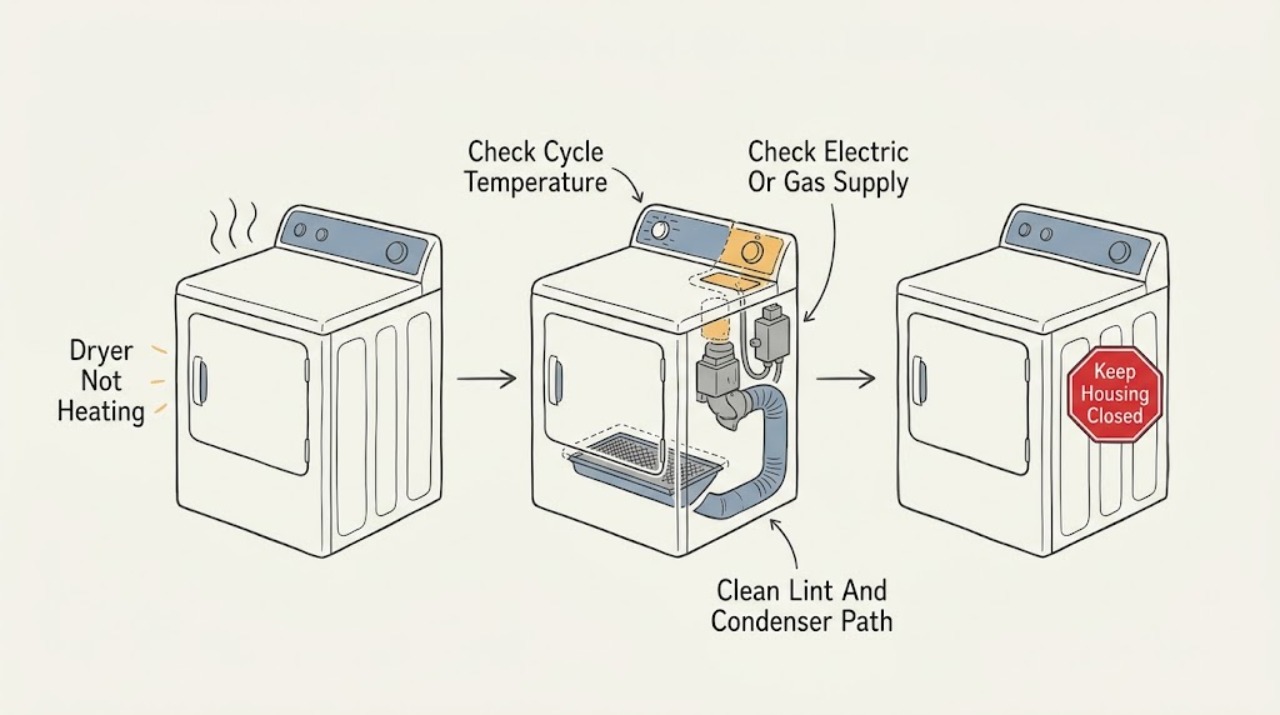
If an Electrolux dryer tumbles but does not heat, first check that the cycle is not Air Fluff or another no-heat setting. An electric dryer can still turn while one of its two house circuits or fuses is open; a gas model also needs an open gas supply and adequate ventilation. Clean the lint screen and, as the model manual allows, the condenser or heat exchanger and exhaust path. If the drum remains cold after these safe checks, if airflow is restricted, a gas supply is interrupted, a circuit trips again, or a burning smell or electrical symptom appears, stop using the dryer and arrange qualified service. Do not open the cabinet or test live heater, gas, or control components.
Before you begin
Safety first
- This article covers model-documented controls and ordinary-access maintenance only. Leave heater, burner, gas, thermal-protection, electrical, control, and concealed exhaust work to qualified service; isolate the appliance when a dangerous symptom appears.
Work through in order
Diagnostic checks
Use only checks that match the exact appliance or system and its official guide.
-
Check 1
Select a documented heated or timed drying cycle and a permitted heat level for the fabric; make sure Air Fluff, cool air, or another no-heat option is not selected. Close the door fully and start the cycle normally.
Expected result: Observe whether the drum tumbles, whether the selected cycle indicates heat, and whether the dryer displays an error or stops immediately.
Next step: Correct only the documented cycle or temperature setting and run one supervised test. If the control will not select a heated cycle or shows a persistent error, stop and arrange service.
Stop if: Do not bypass a door switch, force the selector, or repeatedly restart after an error, burning smell, smoke, or abnormal heat.
Why this matters
Why: Tumbling on Air Fluff or a no-heat setting is expected and does not prove a failed heater. If a heated cycle is selected but the drum remains cold, continue to the supply and airflow checks.
-
Check 2
From a dry, safe position, check the power connection and household protective devices. For an electric dryer, confirm that the appliance has its intended supply without opening the outlet or terminal area; for a gas model, confirm the gas shutoff is open and the fuel supply is available according to the installation instructions.
Expected result: Record whether the drum runs but one supply device is tripped, the outlet or connection is loose, the gas valve is closed, an LP tank is empty, or the supply appears normal. Note whether a breaker or fuse trips again.
Next step: Reset a protective device only once when safe and permitted, and do not increase fuse capacity. Have a qualified electrician or gas professional correct an abnormal supply; do not test voltage, gas pressure, or wiring yourself.
Stop if: Stop for a gas smell, damaged cord, hot outlet, sparking, a repeated trip, suspected carbon monoxide, or any need to open electrical or gas components.
Why this matters
Why: Electrolux explains that one open circuit or fuse can leave an electric dryer tumbling without heat. A gas dryer cannot heat when its gas supply is interrupted, but a repeated electrical trip or uncertain supply is a service boundary.
-
Check 3
Switch the dryer off and let hot parts cool. Clean the lint screen after each use; for a condenser or heat-pump model, clean the condenser or heat exchanger only by the model manual's procedure, and replace the screen before operation.
Expected result: Record whether the lint screen, condenser, or heat exchanger is coated with lint or residue, whether the screen is damaged, and whether the manual requires a different maintenance interval or access method.
Next step: Clean and dry the accessible parts as instructed, then run one supervised heated cycle. If the drum remains cold or the airflow remains restricted, stop and arrange service.
Stop if: Do not operate without the lint screen, use water on live or warm electrical parts, bend fins, use compressed air into concealed electronics, or dismantle the condenser housing beyond the manual.
Why this matters
Why: Electrolux says restricted filters, condensers, or heat exchangers can cause poor drying and that a dryer should not be operated without its lint screen. A heavily restricted path can reduce drying performance and warrants correction before judging the heater.
-
Check 4
With the dryer off, inspect the visible exhaust duct, vent hood, room clearance, and exterior outlet for a crushed or kinked duct, lint blockage, a blocked hood, or laundry and rugs restricting air around the appliance. For a gas model, confirm that the exhaust vents outdoors and that the room has the ventilation required by the installation instructions.
Expected result: Record whether the duct is restricted, the hood damper cannot open, the dryer is enclosed without the required clearance, or the ventilation path appears clear. Do not reach into a concealed duct or remove building ductwork by force.
Next step: Clear only accessible lint and restore the model-specified clearance; have a qualified service provider clean or inspect concealed ductwork. Do not continue using a gas dryer with an indoor or blocked exhaust.
Stop if: Stop for exhaust leakage indoors, a gas smell, suspected carbon monoxide, a hot wall or duct, severe lint accumulation, or any need to alter the vent installation.
Why this matters
Why: Electrolux identifies blocked exhaust paths and insufficient ventilation as causes of poor drying; it warns that a gas dryer without outdoor exhaust creates a carbon-monoxide risk. A clear visible path does not prove the concealed duct or heating system is sound.
-
Check 5
After the cycle, supply, lint, and visible ventilation checks, run one model-approved heated or timed cycle with a normal load or no load as the manual permits, remain nearby, and observe warmth without touching the heater or opening service panels.
Expected result: Record whether the drum becomes warm, remains cold, heats briefly and stops, shows an error, trips the supply, or produces a burning smell, smoke, unusual noise, or excessive heat.
Next step: Stop testing and give the technician the model, cycle, supply type, temperature setting, cleaning and vent findings, error code, and exact heat behavior.
Stop if: Stop immediately for smoke, burning smell, gas smell, carbon-monoxide concern, shock, sparking, repeated electrical trips, or any uncontrolled temperature.
Why this matters
Why: Warm air after a corrected setting or airflow issue supports that branch. A persistently cold drum after a heated cycle indicates a heating source, sensor, control, or supply fault; intermittent heat or a returning error also needs professional diagnosis.
Use your observations
Decision map
Find the observation that best matches what you see, then follow the next safe action.
-
PATH 01Safety boundary
What you see
The dryer tumbles on Air Fluff, cool air, or another documented no-heat cycle.
Do this next
Select the model-approved heated cycle and temperature for the load, then perform one supervised test.
Why this path and its safety boundary
Why it matters: The lack of heat is a selected operating behavior rather than proof of a failed heating component.
Safety stop: Stop if a heated cycle cannot be selected, an error persists, or the dryer behaves abnormally.
-
PATH 02Safety boundary
What you see
An electric dryer tumbles but one house circuit or fuse is open, the outlet is abnormal, or a protective device trips again.
Do this next
Have a qualified electrician verify the supply and correct the circuit; do not open the terminal or outlet.
Why this path and its safety boundary
Why it matters: A partial electrical supply can allow the drum motor to run while the heater does not.
Safety stop: Do not increase fuse capacity, repeatedly reset the breaker, or test live voltage.
-
PATH 03Safety boundary
What you see
A gas model has a closed or interrupted fuel supply, insufficient surrounding air, or an exhaust path that does not vent outdoors.
Do this next
Stop using the dryer and have the gas supply and installation checked by a qualified professional; do not relight or adjust gas components.
Why this path and its safety boundary
Why it matters: The burner cannot operate safely without its intended gas supply and ventilation.
Safety stop: Leave the area and follow local gas-emergency guidance for a gas smell or suspected carbon monoxide; do not operate without outdoor exhaust.
-
PATH 04Safety boundary
What you see
The lint screen, condenser, heat exchanger, exhaust duct, or hood is blocked or heavily coated, with no immediate electrical or gas danger.
Do this next
Clean accessible components under the model manual and have concealed ductwork serviced, then perform one supervised test.
Why this path and its safety boundary
Why it matters: Restricted airflow can cause poor drying and may interfere with normal heat transfer.
Safety stop: Do not operate without the lint screen, cover a vent, or continue with severe lint, hot ducting, or an exhaust leak.
-
PATH 05Safety boundary
What you see
A heated cycle is selected, the supply and airflow are acceptable, but the drum remains cold or heat stops abnormally.
Do this next
Stop using the dryer and arrange authorised or qualified service with the exact model and observations.
Why this path and its safety boundary
Why it matters: A heater, thermal protection, sensor, control, burner, or another internal fault remains possible and cannot be identified safely by external checks.
Safety stop: Do not remove panels, bypass thermal protection, probe wiring, test gas pressure, or replace a heater from the symptom alone.
Helpful context
Understand the symptom
Separate a no-heat setting from a heating fault
A dryer that tumbles is not necessarily receiving the heating part of its cycle. Electrolux specifically lists Air Fluff or a no-heat temperature as a reason the drum can turn without heat. For an electric model, the drum motor and heater can also depend on separate house circuits, so a partial supply fault can leave the drum moving while heat is absent.
Airflow is part of heating safety
Lint screens, condensers, heat exchangers, exhaust ducts, and vent hoods must be maintained according to the exact model instructions. Restricted airflow can lengthen drying and affect heating performance. Never operate a gas dryer without an exhaust duct vented outdoors, and do not cover ventilation openings or place laundry and rugs against the dryer.
Heat-pump dryers may feel different
Electrolux notes that heat-pump systems use lower drying temperatures and can take longer than conventional dryers. That does not make a consistently cold drum, a new sharp performance change, an error, or a burning smell normal. Use a model-appropriate cycle and stop for symptoms that indicate a fault.
Safety boundary
Stop conditions
- Stop immediately for gas smell, suspected carbon monoxide, smoke, burning smell, sparking, shock, damaged cord, or a repeated electrical trip.
- Do not operate a gas dryer without an exhaust duct that vents outdoors or with blocked ventilation around the appliance.
- Do not open the cabinet, heater housing, burner, gas valve, terminal area, or control panel, and do not test live voltage or gas pressure.
- Do not bypass a thermal limiter, door switch, sensor, control, or any safety device, and do not increase a fuse capacity.
- Do not operate without the lint screen or continue after severe lint accumulation, a hot duct, an exhaust leak, or a persistent no-heat symptom.
Only after diagnosis
Potential parts
- dryer lint filter
Consider this category only if the exact model's filter is damaged, missing, or cannot be cleaned to the documented condition and airflow is affected.
Confirm the exact Electrolux model and filter design before ordering; do not operate the dryer without the correct filter installed. - dryer heating assembly
Consider this internal part only after qualified testing confirms a heating-source failure with the cycle, supply, airflow, and safety controls verified.
Confirm the exact model, electric or gas configuration, electrical rating, and authorised fitment; do not replace or test the heating system while energized.
When checks do not resolve it
Need a professional?
Arrange qualified Electrolux service when a heated cycle remains cold after the cycle, supply, lint, and ventilation checks; when an electric circuit trips, a gas supply or exhaust problem is suspected, an error returns, or the diagnosis requires access to the heater, thermal protection, burner, sensor, wiring, or control.
Safety scope: This article covers model-documented controls and ordinary-access maintenance only. Leave heater, burner, gas, thermal-protection, electrical, control, and concealed exhaust work to qualified service; isolate the appliance when a dangerous symptom appears.
Common questions
FAQ
Why does my Electrolux dryer tumble but not heat?
Check for Air Fluff or another no-heat setting, then check the electric supply or gas supply as applicable. A partial electric supply can run the drum while the heater remains off. Clean the accessible lint and airflow path under the model manual before arranging service.
Can a tripped breaker cause an Electrolux dryer to have no heat?
Yes. Electrolux says an electric dryer can tumble while its heater does not operate if one of the two house circuits or fuses is tripped or blown. Reset only once when safe; do not increase fuse capacity or investigate live wiring.
Can a clogged vent stop an Electrolux dryer from heating?
Restricted lint filters, condensers, heat exchangers, exhaust ducts, or vent hoods can cause poor drying and airflow problems. Clean accessible parts as the manual directs and have concealed ductwork serviced; do not operate a gas dryer without outdoor exhaust.
How can I tell whether a heat-pump Electrolux dryer is heating?
Heat-pump dryers use lower temperatures and may feel less hot or take longer than conventional dryers. Use the model-approved cycle and observe drying results and the drum after a controlled test. A consistently cold drum, error, or sudden performance change needs service.
What should I do if my dryer smells like burning while not heating?
Stop the cycle immediately and isolate the dryer only when safe. Do not restart it or open the cabinet. A burning smell, smoke, sparking, hot cord, gas smell, or repeated electrical trip requires qualified service and may require local emergency guidance.
Read the exact guide
Official sources
- My dryer is running, but does not seem to be heating. What should I do?Electrolux · Electrolux owner support guidance for dryers that run without apparent heat; exact model installation instructions control.
- Dryer - Not Drying and Extended Drying TimeElectrolux · Electrolux owner support guidance for dryers with poor or extended drying; use the exact model manual for cleaning access and cycle settings.
Community feedback
Share a repair observation
Share a plain-text repair observation. Accepted observations are published automatically; this page may take a moment to update.