
On this page
Start here
Quick answer
First confirm that the cycle is a heated dry cycle rather than Air Fluff or Cool Down, and that the dryer is actually running. Check the accessible outlet and breaker or fuse state; an electric dryer can tumble with incomplete power, while a gas dryer also needs a working gas supply. Keep the front air intake and exhaust path clear, clean the lint filter, and inspect the vent hose and outside wall cap for a kink or obstruction. Never operate a gas dryer without its vent. Stop for gas odor, smoke, burning or melting odor, a damaged cord, sparking, unusual heat, or a repeated breaker trip. If the cycle, power, gas, and vent checks do not restore heat, leave the dryer off and arrange qualified GE service. [Source: ge-gas-no-heat; ge-electric-no-heat; ge-venting; ge-dryer-start; ge-dryer-manual]
Work through in order
Diagnostic checks
Use only checks that match the exact appliance or system and its official guide.
-
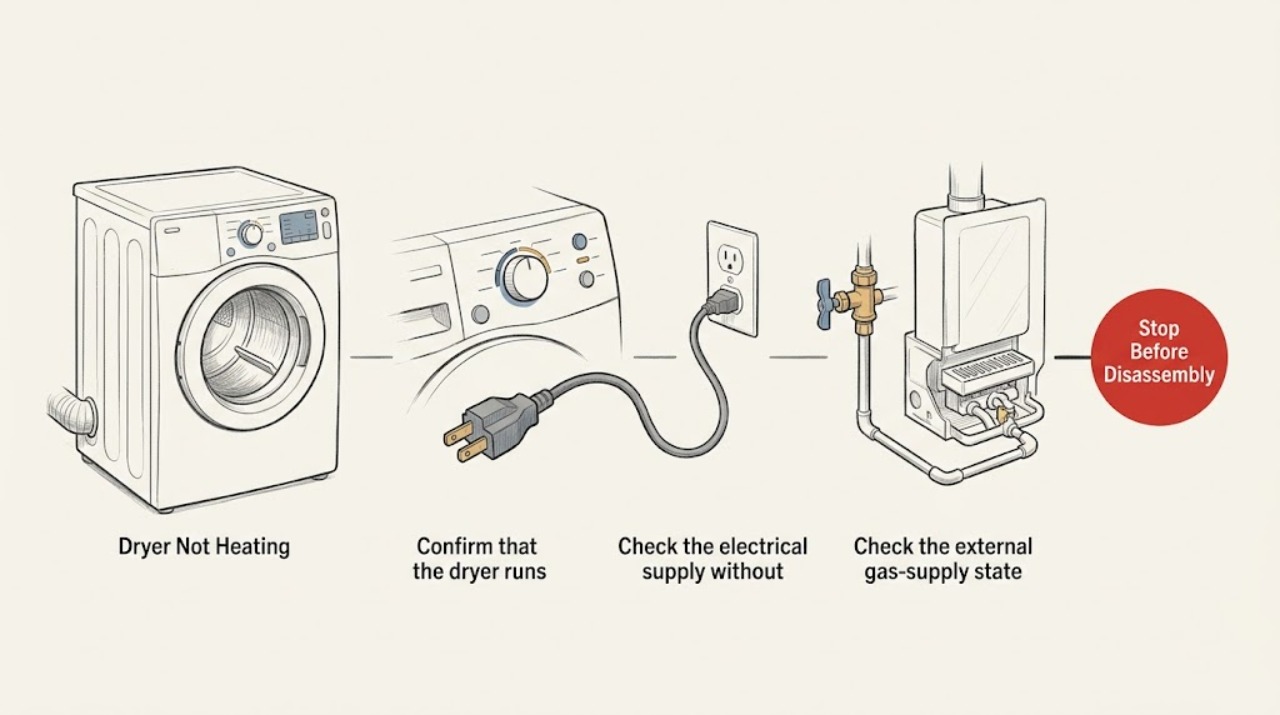
Confirm that the dryer runs but does not heat
Select the normal dry cycle shown by the exact model guide, confirm the fabric and temperature setting, close the door, and observe whether the drum tumbles and the cycle advances. Do not keep testing if there is smoke, gas odor, sparking, or unusual heat.
Expected result: The dryer does not start, tumbles with no heat, runs only in Air Fluff or Cool Down, or stops when the door or control is touched.
Next step: For a true run-without-heat symptom, continue to the power, gas, and airflow checks. For no start, correct only the model-approved control or door condition and arrange service if it remains.
Why this matters
Why: GE separates start and no-heat paths. A no-heat symptom can be a cycle or temperature setting, partial electrical supply, gas service, airflow, or heating fault; a no-start symptom needs its own power, door, and control checks.
-
Check the electrical supply without opening the dryer
Observe the accessible outlet, plug, and household breaker or fuse state from a dry, safe position. If the circuit is tripped, reset it only once when there is no smoke, heat, odor, moisture, or visible damage; do not open a cover or inspect the rear terminal block yourself.
Expected result: The dryer has no power, the breaker or fuse is tripped, the dryer tumbles but heat is absent, the breaker trips again, or the plug and circuit appear normal.
Next step: Leave the dryer off and contact a qualified electrician or GE service for a repeat trip, damaged cord, or persistent no heat. Do not change the circuit protection or test live voltage.
Why this matters
Why: GE notes that an electric dryer may run with incomplete power but not heat, and that a tripped breaker or fuse can cause no heat. A repeated trip or damaged connection is an electrical fault, not a reset problem.
-
Check the external gas-supply state on gas models
For a gas dryer, confirm only from a safe external observation whether the home's gas service is available and whether the dryer was recently installed or moved. Do not open fittings, adjust the gas shutoff, change conversion parts, or relight a burner; if gas odor is present, follow the emergency branch immediately.
Expected result: The gas service is off or uncertain, the dryer is a new installation, the dryer runs but the burner never produces heat, or the external gas supply appears normal.
Next step: If the supply is uncertain, use a qualified gas professional or utility channel. If supply is normal but there is no heat, keep the dryer off and request GE-authorized service.
Why this matters
Why: GE identifies gas service being off as a cause of a gas dryer that runs without heat and recommends service when gas is available but heat remains absent. Gas supply and burner diagnosis cannot be safely confirmed from the outside.
-
Check lint and airflow without running a gas dryer ventless
With the dryer cool and off, clean the lint filter and inspect the accessible exhaust hose for a kink, collapse, disconnection, or lint obstruction. Check the outside wall cap for an obstruction and keep the front air intake clear; do not disconnect the vent and run a gas dryer.
Expected result: The lint filter is blocked, the hose is kinked or collapsed, the wall cap is obstructed, airflow is weak, the front is blocked, or the accessible vent path is clear.
Next step: Correct accessible lint or routing problems and arrange professional duct cleaning for an obstructed full-length path. Keep a gas dryer connected to its vent; if heat or odor returns, stop and request service.
Why this matters
Why: GE states that restricted airflow traps heat and humidity, increases drying time, and can impair heating performance. Lint buildup is also a fire risk, while a clear accessible path shifts the problem toward supply or internal service.
-
Match the load to a heated cycle
Remove any Air Fluff or Cool Down selection and choose the heat and fabric setting appropriate for the load. Do not overload the drum or dry items contaminated with gasoline, solvents, oils, or other flammable substances; follow garment care labels.
Expected result: The dryer heats on the corrected cycle, the load is too large or mixed heavily, the load contains a prohibited or contaminated item, or clothes remain cold and wet on a correct cycle.
Next step: Use a properly sorted load only after all safety conditions are clear. If a correct heated cycle still produces no heat, stop repeated tests and arrange qualified service.
Why this matters
Why: GE identifies cycle, fabric, temperature, and load conditions as factors in drying performance. Flammable vapors or contaminated fabrics can ignite, and a correct cycle with no heat points back to power, gas, airflow, or service.
-
Arrange service for an internal heating fault
Record the exact GE model and serial details, gas or electric type, cycle and temperature setting, tumbles/no-heat behavior, breaker or gas-supply observations, vent condition, and any error or safety symptom. Keep the dryer off and do not remove panels, test the heating circuit, replace an igniter, or adjust a gas valve from the symptom alone.
Expected result: The dryer heats after a safe setting, power, gas, or vent correction, remains cold with all external checks normal, or shows smoke, burning odor, unusual heat, sparking, or a damaged connection.
Next step: Request GE-authorized appliance service or qualified electrical/gas service as appropriate. Do not run the dryer without the vent or continue cycles to reproduce the fault.
Why this matters
Why: A corrected external issue can be monitored. Persistent no heat with a correct cycle and clear accessible vent needs diagnosis of the heating system, gas burner, electrical supply, or controls; safety symptoms require immediate stop.
Use your observations
Decision map
Find the observation that best matches what you see, then follow the next safe action.
-
PATH 01Safety boundary
What you see
The dryer does not start or does not tumble.
Do this next
Check the door, cycle, START control, accessible plug, and breaker or fuse once. Persistent no-start needs GE service.
Why this path and its safety boundary
Safety stop: Continue with no-heat power, gas, airflow, and load checks.
-
PATH 02Safety boundary
What you see
The dryer tumbles but remains cold on a heated cycle.
Do this next
Check the external power state, gas availability if applicable, and accessible vent path. If these are normal, arrange service.
Why this path and its safety boundary
Safety stop: Correct the cycle or setting before evaluating heat.
-
PATH 03Safety boundary
What you see
The dryer is electric and the breaker or fuse may be partially tripped.
Do this next
Reset the correct accessible breaker once only when safe; a repeat trip or persistent no heat requires electrical or appliance service.
Why this path and its safety boundary
Safety stop: Continue with cycle, airflow, and service checks.
-
PATH 04Safety boundary
What you see
The dryer is gas and gas service is off, uncertain, or accompanied by gas odor.
Do this next
Keep the dryer off. For gas odor, leave the area and use the appropriate gas or emergency channel; for uncertain supply without odor, use qualified gas service.
Why this path and its safety boundary
Safety stop: Continue with vent and heating-system diagnosis.
-
PATH 05Safety boundary
What you see
Lint or venting is obstructed, or smoke, burning odor, unusual heat, sparking, or a damaged cord appears.
Do this next
Stop immediately. Keep a gas dryer connected to its vent, isolate power only from a safe location, and use qualified or emergency service as appropriate.
Why this path and its safety boundary
Safety stop: Perform at most one supervised heated cycle after the safe correction; request service if heat does not return.
Helpful context
Understand the symptom
A dryer that tumbles but does not heat is different from a dryer that will not start. The useful split is cycle selection, power, gas supply on gas models, airflow, and a heating-system fault. Model controls and installation requirements vary, so use the exact GE manual for the appliance.
These checks stay at the controls, accessible outlet or breaker, lint filter, front clearance, and visible vent path. Do not open the cabinet, remove a terminal-block cover, test live wiring, adjust a gas valve, or bypass a thermal or door safety.
A gas dryer must remain connected to a safe exhaust path. GE warns that operating a gas dryer without its vent can allow combustion fumes into the room, so a vent-disconnection test applies only to electric models and only when the model guidance allows it.
Safety boundary
Stop conditions
- Stop immediately for gas odor, smoke, burning or melting odor, sparking, unusual heat, a damaged cord or plug, a repeated breaker trip, or lint igniting.
- Do not open the cabinet or terminal block, test live wiring, alter the circuit protection, adjust gas valves or burners, bypass thermal or door safety, or install improvised venting.
- Never operate a gas dryer without its exhaust vent, and never dry items contaminated with gasoline, solvents, oils, or other flammable substances.
- Do not keep running cycles to reproduce no heat. Arrange qualified GE, electrical, gas, or vent service when external checks do not restore heating.
When checks do not resolve it
Need a professional?
Request GE-authorized appliance service when a correct heated cycle remains cold after safe power, gas, lint, and vent checks, when the breaker trips again, when the gas supply is normal but the burner produces no heat, or when the dryer has a persistent error. Use qualified electrical or gas service for supply and installation concerns, and emergency service for gas odor, smoke, sparking, fire, or damaged wiring.
Have this ready
- Exact GE model and serial details
- Whether the dryer is gas or electric and whether the drum tumbles
- Cycle, fabric, and temperature setting used
- Breaker or fuse behavior and whether the dryer is the only affected appliance
- Gas-supply observations for gas models and whether any gas odor was present
- Lint-filter, vent-hose, wall-cap, airflow, load, smoke, heat, odor, sparking, or cord-damage observations
Common questions
FAQ
Why does my GE dryer tumble but not heat?
Confirm a heated cycle and correct temperature, then check the accessible power state, gas supply if it is a gas model, lint filter, and vent path. If the dryer remains cold, stop repeated tests and arrange qualified GE service.
Can a tripped breaker cause a GE dryer to run without heat?
Yes. GE notes that an electric dryer may tumble with incomplete power but not heat. Check the accessible breaker or fuse once when safe; if it trips again or heat remains absent, request electrical or appliance service.
Can a blocked vent stop a GE dryer from heating?
Restricted airflow can trap heat and humidity and impair drying. Clean the lint filter and inspect accessible vent conditions after the dryer is cool, but never operate a gas dryer without its vent. Persistent no heat needs service.
Read the exact guide
Official sources
- GE Gas Dryer Use and Care BookGE Appliances · GE gas dryer user manual; gas, fire, electrical, lint, venting, flammable-load, and authorized-service safety guidance
- Dryer - Will Not Run or StartGE Appliances · GE gas and electric dryers; manufacturer guidance for plug, door, cycle, START, breaker, cord, and service
- Electric Dryer - Runs But Does Not HeatGE Appliances · GE electric dryers; manufacturer guidance for incomplete power, circuit protection, settings, airflow, cord condition, and service
- Dryer - Things To Check For A Venting IssueGE Appliances · GE dryers, including gas dryers; manufacturer guidance for lint, airflow, vent restrictions, heat buildup, and prohibition on operating a gas dryer without its vent
- Gas Dryer - Runs But Does Not HeatGE Appliances · GE gas dryers; manufacturer guidance for cycle and heat settings, airflow, gas supply, power, and service
Community feedback
Share a repair observation
Share a plain-text repair observation. Accepted observations are published automatically; this page may take a moment to update.