
On this page
Start here
Quick answer
First confirm that the dryer is on a heated cycle rather than Air Only, Fluff, cool-down, or another no-heat setting, then run a brief empty test and observe the airflow at the outside exhaust without touching hot parts. If the drum runs but the exhaust stays cold, check the correct power or gas supply, lint screen, vent hose, and outside hood. A blocked vent can restrict airflow and create a fire risk, while a failed heating element, burner, igniter, thermostat, or thermal fuse requires model-specific service. Do not open the cabinet, test live wiring, bypass a safety device, or keep operating a dryer with smoke, a burning smell, a damaged cord, or little or no exhaust airflow.
Before you begin
Safety first
- Keep the dryer off for smoke, burning odor, sparking, damaged wiring, repeated breaker trips, gas odor or hissing, uncontrolled heat, or blocked exhaust with no airflow. Do not open panels, test live wiring, bypass safety parts, or ignite a burner.
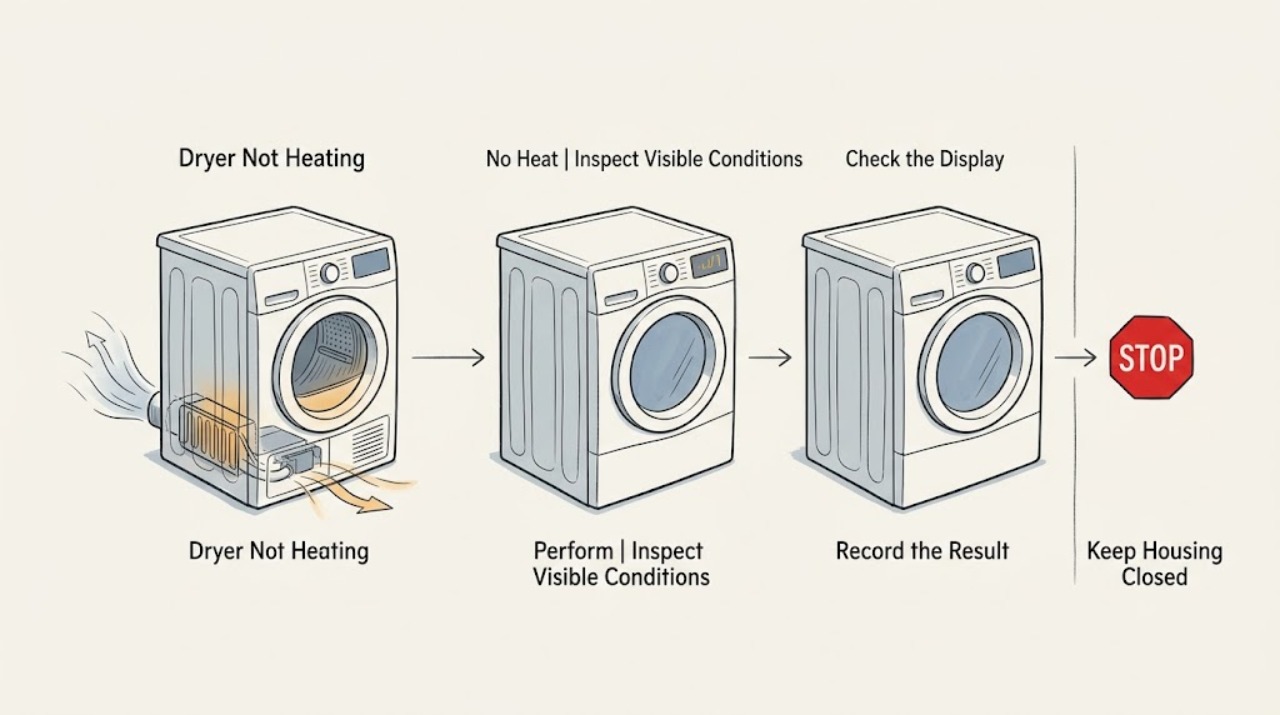
Work through in order
Diagnostic checks
Use only checks that match the exact appliance or system and its official guide.
-
Check 1
Empty the dryer, select a heated timed or normal dry cycle specified for the model, and run a brief supervised test. Observe the drum and the outside exhaust hood from a safe position; do not reach into the drum or touch the heater, duct, or hot metal.
Expected result: The exhaust becomes warm at some point, remains cool while the drum runs, or there is no normal air movement at the outside hood.
Next step: Record the result and continue with the cycle, dryer-type, lint, vent, and supply checks. Stop immediately for smoke, burning odor, sparking, unusual heat, or a cord or duct that looks damaged.
Why this matters
Why: Warmth confirms that the heating system is producing at least some heat; a continuously cool exhaust suggests a setting, supply, heating, or control problem, while absent airflow makes an exhaust restriction or disconnected duct more likely.
-
Check 2
Check the selected cycle, temperature option, Eco or energy-saving option, and any Air Only, Fluff, Cool Down, or no-heat indicator against the exact owner manual. Confirm the door is fully closed and the cycle has actually started.
Expected result: A no-heat cycle or low-heat option was selected, or a heated cycle is selected correctly but the exhaust remains cool.
Next step: Run one supervised test on the model's heated cycle. If the correct cycle still produces no heat, do not keep changing settings at random; continue to the supply and airflow checks.
Why this matters
Why: A no-heat setting can fully explain a cool exhaust; correct settings with no heat shift the investigation toward power or gas supply, airflow, or the heating system.
-
Check 3
Identify whether the dryer is conventional vented electric, vented gas, or ventless heat pump, using the model label and manual. Look for an actual outside exhaust termination before treating no heat at an exhaust as a vent problem.
Expected result: A vented model has a duct and outside hood, a gas model has a gas supply, or the unit is ventless or heat pump with no outside exhaust.
Next step: For a ventless model, use its manual's air path, filter, heat exchanger, and condensate checks instead of testing an outside hood. For a vented model, continue with the lint, hood, duct, and supply checks below.
Why this matters
Why: Heat pump dryers use a closed-loop air path and do not release drying air through a home's exterior vent. Vented electric and gas dryers use different heat sources and supply checks.
-
Check 4
Turn the dryer off and clean the lint screen or filter as the manual directs. Inspect the filter slot, the visible rear duct connection, and the outside hood for lint, crushed sections, a closed flap, nesting, or another obvious obstruction; do not reach deep into a duct or cabinet.
Expected result: The screen is coated or blocked, the rear hose is kinked or crushed, lint is visible at the hood, the hood flap cannot open, or these areas are clear.
Next step: Correct only a visible routing or lint issue that can be handled without moving a connected gas appliance or opening the cabinet. Arrange professional vent cleaning for a long or inaccessible duct, then retest once.
Why this matters
Why: Restricted lint or exhaust paths reduce airflow and can extend drying or contribute to heat buildup. Clear external evidence makes an internal heater or supply issue more likely, but does not prove it.
-
Check 5
With the dryer off, observe the outside hood during one supervised heated-cycle test and compare the airflow with the dryer running empty. Use the model's built-in vent test if it has one; do not disconnect the duct unless the exact manual permits it and the appliance is safely isolated.
Expected result: Airflow is strong and the heater remains cold, airflow is weak or absent, or heat and airflow improve only when the model's approved vent test reports a clear path.
Next step: Stop using the dryer until a weak or absent exhaust path is cleared or professionally inspected. If airflow is normal but heat is absent, continue with the correct power or gas supply check and then service.
Why this matters
Why: Strong airflow with no heat points away from a simple exhaust blockage and toward cycle, supply, heating, or control causes. Weak airflow points toward the duct or outside hood and can be a fire concern.
-
Check 6
For an electric dryer, with the dryer switched off, check the dedicated dryer circuit at the household panel for a partially tripped breaker and reset it only once according to the panel instructions. Do not remove the power-cord cover or inspect the terminal block yourself.
Expected result: The breaker was visibly or partially tripped and heat returns, or the breaker was normal and the dryer still tumbles without heat.
Next step: If the breaker trips again, leave it off and call a qualified electrician or appliance technician. If it stays on but no heat returns, do not test voltage or open the dryer; arrange appliance service.
Why this matters
Why: Electric dryers can run the motor while lacking the portion of the supply used by the heater. A normal or repeatedly tripping breaker points to a supply or appliance fault rather than a setting issue.
-
Check 7
For a gas dryer, check only that the external supply valve is open as shown in the model instructions, and do so only when there is no gas odor, hissing, or visible damage. Do not light a burner or remove a burner panel.
Expected result: The supply valve was closed, the valve is open but exhaust remains cold, or there is a gas odor, hissing, or damaged connector.
Next step: If the valve was closed, open it only as the manual permits and run one supervised test. For persistent no heat, gas odor, hissing, or damage, stop using the dryer, leave the valve off if safe, leave the area if odor is strong, and obtain qualified help.
Why this matters
Why: A closed gas valve can allow the drum to turn without heat. An open valve with no heat requires diagnosis of ignition, burner, controls, or airflow; gas odor or a damaged connector is an immediate stop.
-
Check 8
Inspect the accessible plug, outlet face, power cord, gas connector, and rear duct without removing covers or moving a heavy or gas-connected dryer. Look for scorching, melted plastic, fraying, looseness, a crushed hose, or a connector under strain.
Expected result: A cord, outlet, connector, or duct is damaged or hot, or all visible connections look intact while heat remains absent.
Next step: Stop and isolate the appliance only from a safe location for any damage, odor, heat, or gas concern. If connections look sound but no heat returns, arrange qualified appliance service rather than opening panels.
Why this matters
Why: Visible electrical or gas damage can create a fire, shock, or leak hazard and is not a heating adjustment. Intact external connections leave an internal heater, igniter, thermal fuse, thermostat, sensor, or control fault possible.
-
Check 9
If the correct cycle, airflow path, lint screen, supply, and visible connections are normal, stop testing and give the technician the model, dryer type, cycle used, exhaust airflow result, whether the drum turns, and any display code or safety symptom.
Expected result: The dryer still tumbles but exhaust heat is absent after the safe checks, or it stops, trips, overheats, or shows a fault message.
Next step: Leave the dryer off and arrange qualified appliance service. Do not bypass a fuse or thermostat, test live voltage, keep resetting a breaker, or continue running loads to see whether heat returns.
Why this matters
Why: An internal heating element, burner or igniter, thermal fuse, thermostat, sensor, wiring, or control problem is possible and cannot be confirmed safely from the outside.
Use your observations
Decision map
Find the observation that best matches what you see, then follow the next safe action.
-
PATH 01Next step
What you see
The dryer was on Air Only, Fluff, Cool Down, or another no-heat cycle, and a heated cycle produces normal warmth and airflow.
Do this next
Use the model's heated cycle and load guidance. Stop if the no-heat symptom returns on the correct setting or any safety symptom appears.
Why this path and its safety boundary
Why it matters: The original cold exhaust was caused by cycle selection rather than a failed heater.
-
PATH 02Next step
What you see
A vented dryer has weak or absent airflow at the outside hood, damp clothes, lint buildup, or a crushed or blocked duct.
Do this next
Stop using the dryer until the visible lint or routing issue is corrected or the full duct is professionally cleaned and inspected. Reconnect all approved ducting before use.
Why this path and its safety boundary
Why it matters: The exhaust path is restricted or disconnected, which can impair drying and increase fire risk even if the heater itself works.
-
PATH 03Next step
What you see
The dryer has strong normal airflow but remains cold on the correct heated cycle, while the electric breaker or gas valve appears normal.
Do this next
Leave it off and arrange qualified appliance service. Do not open the cabinet or bypass a safety component to force heat.
Why this path and its safety boundary
Why it matters: An internal heating element, burner, igniter, thermal fuse, thermostat, sensor, wiring, or control issue is more likely than a simple vent blockage.
-
PATH 04Next step
What you see
An electric dryer tumbles but a breaker is partially tripped, trips again, or the cord or outlet shows heat or damage.
Do this next
Leave the breaker off after a repeat trip, keep the dryer unplugged only if it is safe to reach, and call a qualified electrician or appliance technician. Do not remove the terminal cover.
Why this path and its safety boundary
Why it matters: The heating supply or connection may be incomplete or unsafe; repeated reset attempts can worsen an electrical fault.
-
PATH 05Next step
What you see
A gas dryer has no heat with the valve open, or there is gas odor, hissing, or a damaged connector.
Do this next
Do not ignite, test, or disassemble the burner. Stop using the dryer, leave the area if odor is strong, avoid switches or flames, and contact the gas utility or qualified emergency service as appropriate.
Why this path and its safety boundary
Why it matters: The burner or ignition system may need service, and odor or connector damage can indicate a gas-safety emergency.
-
PATH 06Next step
What you see
The appliance is a ventless heat pump dryer with no outside exhaust, or its display reports a model-specific airflow, filter, or heat-pump condition.
Do this next
Use only the exact manual's filter, heat exchanger, condensate, and error guidance. If the unit remains cold or reports a persistent fault, arrange manufacturer-qualified service.
Why this path and its safety boundary
Why it matters: An outside exhaust temperature check does not apply to this design; the internal air path and service instructions are different.
-
PATH 07Next step
What you see
Smoke, burning odor, sparking, melted wiring, a hot plug or outlet, fire, a gas odor, or a blocked exhaust with no air movement occurs.
Do this next
Stop immediately, keep clear, disconnect power only from a safe location if there is no water or gas hazard, close the gas valve only if safe, and obtain emergency or qualified help. Do not restart to test.
Why this path and its safety boundary
Why it matters: Continued operation could cause fire, shock, gas ignition, or worsening lint accumulation.
Helpful context
Understand the symptom
Confirm what no heat at the exhaust means
An outside vent that feels cool once does not identify the failed part. Some cycles deliberately use no heat, a dryer can cycle its heater on and off, and a heat pump dryer may not have an outside exhaust at all. Use the exact model instructions, choose a heated cycle, and observe the dryer and outside hood from a safe position. The useful result is whether heat and normal airflow ever appear, not whether one short puff feels hot.
Airflow and heat are related but different faults
A blocked lint screen or exhaust route can reduce drying performance and raise fire risk, but a clear vent does not prove that the heating system works. Conversely, a dryer that heats but has weak outside airflow may have a vent restriction rather than a failed heater. Check both observations separately: temperature on the correct cycle and the strength of air leaving the outside hood.
Stop before opening the appliance
Dryers combine substantial electrical power, moving parts, hot surfaces, and, on gas models, a fuel supply. External checks are appropriate; removing a panel, testing an energized terminal, bypassing a thermal fuse, or probing a gas burner is not. If the accessible checks do not restore heat, give a technician the dryer type, model, cycle, airflow result, and any code or safety symptom.
Safety boundary
Stop conditions
- Stop using the dryer for smoke, a burning smell, sparking, a hot plug or outlet, melted or frayed wiring, a repeated breaker trip, or a damaged gas connector.
- Stop for gas odor or hissing. Do not operate switches or flames; leave the area if odor is strong and contact the gas utility or emergency service as appropriate.
- Do not bypass a thermal fuse, thermostat, door switch, or other safety device; do not test live terminals or open the cabinet as an ordinary user check.
- Stop a vented dryer with weak or absent outside airflow until its exhaust path is cleared or professionally inspected. Reconnect approved ducting before any further use.
Only after diagnosis
Potential parts
- electric dryer heating element
Consider this only after a qualified diagnosis confirms that the correct heated cycle, airflow path, and electrical supply are present but the electric heating circuit does not produce heat.
Heating elements are model-specific and require safe access. Confirm the exact model and technician diagnosis before selecting a part. - gas dryer burner or igniter assembly
Consider this only when a qualified technician confirms an open gas supply but an ignition or burner fault after ruling out airflow and control causes.
Gas components and installation requirements vary by model. Do not order or install a burner component by appearance alone. - thermal fuse, thermostat, sensor, or control component
Consider this only after qualified testing identifies a failed thermal-protection, temperature-sensing, or control component and the airflow cause has been addressed.
These safety and control parts are model-specific; never bypass one or choose a replacement without the exact model and diagnosis. - dryer exhaust duct or vent component
Consider this only when inspection confirms a crushed, damaged, disconnected, or unsuitable exhaust route is causing weak airflow or a returning vent restriction.
Follow the appliance installation instructions and local requirements; confirm the duct material and routing before replacement.
When checks do not resolve it
Need a professional?
Arrange qualified appliance service when the dryer still tumbles without heat after the correct-cycle, dryer-type, lint, airflow, and supply checks; when the breaker or gas valve appears normal but exhaust heat is absent; or when an internal heating, ignition, thermal protection, sensor, wiring, or control fault is possible. Use a qualified electrician for a supply, outlet, or breaker problem and urgent gas or emergency help for odor, hissing, smoke, sparking, fire, or uncontrolled heat.
Safety scope: Keep the dryer off for smoke, burning odor, sparking, damaged wiring, repeated breaker trips, gas odor or hissing, uncontrolled heat, or blocked exhaust with no airflow. Do not open panels, test live wiring, bypass safety parts, or ignite a burner.
Common questions
FAQ
Can a dryer run while the heater has no power?
Yes. An electric dryer can tumble while a partial or interrupted supply prevents the heater from operating. Check the dedicated household breaker once with the dryer off, but do not open the terminal cover or test live voltage.
Could Air Only or Fluff explain no heat at the exhaust?
Yes. Air Only and Fluff cycles are designed not to add heat. Select the exact model's heated cycle and perform one supervised test before assuming a component failed.
Does a blocked vent always cause the dryer to have no heat?
No. A restriction can reduce airflow and lengthen drying, and some models reduce heat when airflow is poor, but a clear vent does not prove that the heater works. Check airflow and heat as separate observations.
Why is there no heat at an exhaust that does not exist?
A ventless heat pump dryer may recycle air internally and have no exterior exhaust hood. Use the model manual's filter, heat exchanger, condensate, and fault guidance instead of an outside-vent temperature check.
When should I stop troubleshooting and call for dryer service?
Call when the correct heated cycle, lint and airflow checks, and safe power or gas checks do not restore heat. Stop immediately for smoke, burning odor, sparking, damaged wiring, repeated breaker trips, gas odor or hissing, or blocked exhaust with no airflow.
Read the exact guide
Official sources
- Dryer not heating: troubleshooting guideWhirlpool · Whirlpool troubleshooting guide; heating component access and service boundaries are model-specific.
- Run a Vent Blockage test on your Samsung dryerSamsung Support · Samsung models with the described vent test or manual-approved comparison; controls and test availability vary by model.
- Clothes DryersENERGY STAR · ENERGY STAR consumer guidance; product designs and controls vary by model.
- Dryer is Not HeatingWhirlpool Product Help · Whirlpool dryer support article; cycle, supply, and vent details can vary by model.
- Samsung Dryer FAQ | Product, Shipping & SupportSamsung · Samsung FAQ; exact model controls, temperatures, and service procedures vary.
- CPSC Publication 5022 - Overheated Clothes Dryers Safety AlertU.S. Consumer Product Safety Commission · Government safety alert for household clothes dryers; it is safety guidance, not model-specific repair instructions.
- Electric Dryer - Runs But Does Not HeatGE Appliances · GE electric dryer support article; use the exact model installation instructions for electrical requirements and access.
Community feedback
Share a repair observation
Share a plain-text repair observation. Accepted observations are published automatically; this page may take a moment to update.