
On this page
Start here
Quick answer
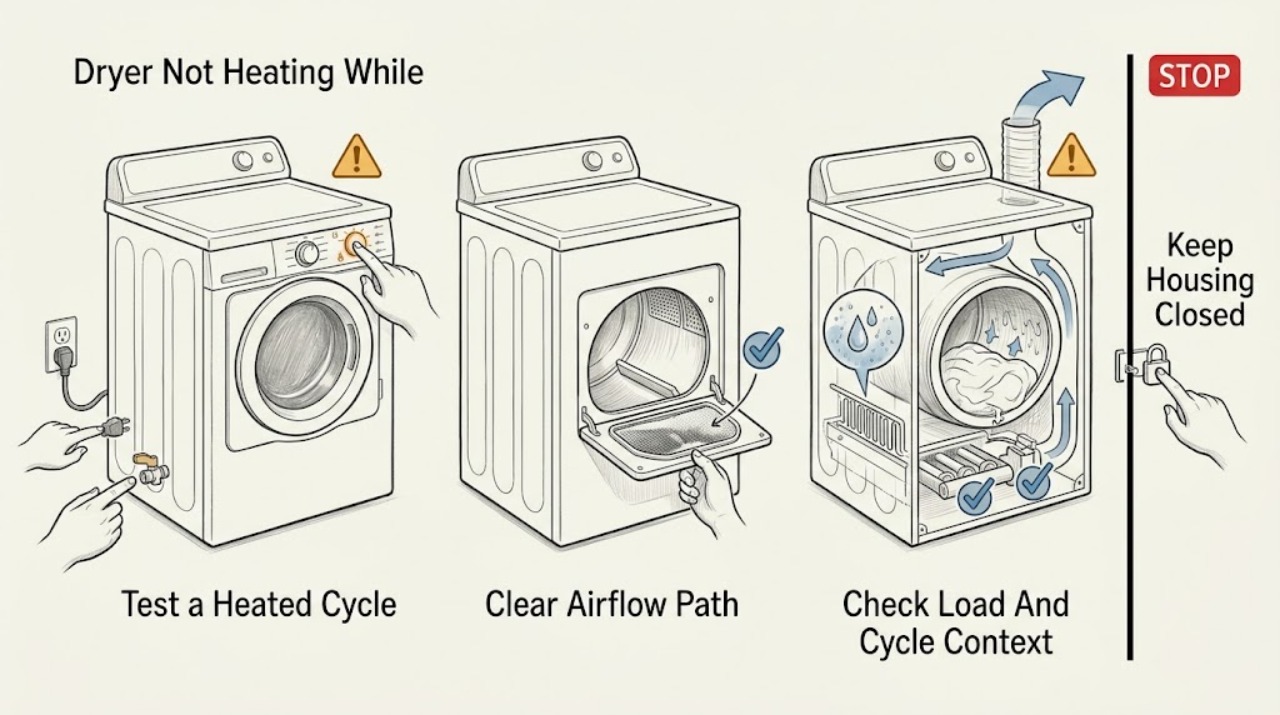
A dryer can tumble and finish a cycle while producing no heat because the drum motor and heating system are separate. First verify that a heated timed cycle is selected and that the air coming from the exhaust is actually cold, not merely slow to dry. Clean the lint screen, check the accessible exhaust path for kinks or blockage, and reduce an overloaded or soaking-wet load. An electric dryer may run with an incomplete power supply, while a gas dryer can tumble with its gas supply unavailable; check only the accessible supply condition without opening wiring or adjusting gas components. If a clean airflow path and correct cycle do not restore heat, the heating element, burner, thermal fuse, thermostat, flame sensor, or control needs qualified diagnosis. Stop immediately for gas odor, smoke, sparking, a hot or damaged cord, or repeated breaker trips.
Work through in order
Diagnostic checks
Use only checks that match the exact appliance or system and its official guide.
-
Check 1
Remove the load and check the control panel for an Air Only, Air Fluff, or other no-heat setting. If there is no gas odor, smoke, sparking, or damaged power connection, select a manual-approved heated timed cycle and observe from outside for a short period; do not open the cabinet or feel near a hot exhaust opening.
Expected result: The selected cycle is air-only, the heated cycle produces warm exhaust, the drum tumbles but exhaust remains cold, or the dryer stops with an error or unusual odor.
Next step: Choose the model-approved heated cycle only when safe and continue with filter, vent, load, and supply checks if the exhaust stays cold. Stop and arrange qualified appliance service for an error, unusual odor, smoke, sparking, or any unsafe power condition.
Stop if: Do not keep running a heated cycle to force warmth, open the access panel, bypass a safety device, or place hands near hot air or energized components.
Why this matters
Why: An air-only selection explains no heat without a component failure, and warm exhaust means the heating system may be working while the load or airflow causes slow drying. Cold exhaust during a proper heated cycle confirms a heating or supply problem. A stop, error, odor, smoke, or spark raises the safety urgency.
-
Check 2
Turn the dryer off and clean the lint screen according to the owner's manual. Inspect the accessible exhaust hose and outside hood for a visible kink, crushing, or lint obstruction; do not disconnect a difficult or hot vent connection. Check whether airflow at the outlet is weak compared with normal operation.
Expected result: The screen is coated, the hose is kinked or crushed, the outside hood is blocked, airflow is weak, or the accessible exhaust path is clean and strong.
Next step: Clean only the user-accessible screen and vent opening, restore a smooth vent route when it can be done without moving the appliance, and retest one normal load. Use qualified vent or appliance service for a hidden blockage, damaged vent, persistent weak airflow, or cold exhaust after cleaning.
Stop if: Do not run the dryer with a missing lint screen, insert tools into the vent, remove the rear panel, or continue using it when lint buildup or overheating is suspected.
Why this matters
Why: Lint or restricted exhaust reduces airflow and can lengthen drying or cause heating protection to intervene. Normal accessible airflow makes a cycle, load, power or gas supply, heating element, burner, fuse, sensor, or control issue more likely.
-
Check 3
Compare the symptom with the load and cycle: remove some items from a tightly packed drum, untangle bulky fabrics, and note whether clothes entered the dryer soaking wet. Confirm that the selected cycle is intended to heat and that the load has room to tumble; do not exceed the model's load guidance.
Expected result: A smaller or drier load warms, only a large or tightly packed load stays cold or damp, or every load remains cold even with a proper heated cycle and normal airflow.
Next step: Run one appropriately sized load only if the dryer produces heat and has no safety warning. If normal loads remain cold, keep the dryer off and continue to the supply check or arrange qualified service rather than repeatedly cycling wet laundry.
Stop if: Do not use a dryer to compensate for soaking-wet loads, pack the drum tightly, or continue operation when the heating system appears completely inactive.
Why this matters
Why: A load that improves when reduced or spun drier can create a misleading slow-dry symptom by restricting circulation or adding excess moisture. Cold exhaust across normal loads points away from load size and toward power, gas, heating, safety, or control components.
-
Check 4
Identify whether the dryer is electric or gas. From a dry, safe position, check that the plug and outlet show no burn marks or looseness and that the relevant breaker is not visibly tripped; for a gas dryer, verify only the accessible supply condition described in the owner's manual and do not adjust a gas fitting. Do not open the terminal box or remove a gas connection.
Expected result: The electric dryer has a tripped or uncertain supply, the cord or outlet is hot or damaged, the gas supply appears unavailable, the breaker trips again, or the visible supply conditions are normal.
Next step: Leave the dryer off and use a qualified electrician or appliance technician for a damaged cord, outlet, uncertain supply, repeated trip, or any internal electrical or gas diagnosis. If the visible supply is normal, the heating element, burner, fuse, sensor, or control needs qualified service.
Stop if: Do not test voltage, reset a repeatedly tripping breaker, move wiring, open the terminal area, loosen gas fittings, or attempt this check if gas odor is present.
Why this matters
Why: An incomplete electric supply can leave the dryer running while the heater cannot operate, and a gas dryer can tumble without producing heat when its fuel supply is unavailable. Damage, repeated trips, or uncertainty indicate an electrical or gas-service boundary rather than a user adjustment.
Use your observations
Decision map
Find the observation that best matches what you see, then follow the next safe action.
-
PATH 01Next step
What you see
The dryer was on Air Only or Air Fluff, the exhaust warms on a heated cycle, or a smaller and properly spun load dries normally.
Do this next
Use the model-approved heated cycle and load size, clean the lint screen, and monitor drying. If a heated cycle later produces only cold air, return to the power, gas, airflow, and service branches.
Why this path and its safety boundary
Why it matters: A no-heat setting or load and moisture condition is more likely than a failed heating component.
-
PATH 02Next step
What you see
The lint screen or accessible vent is blocked, the outside hood does not open freely, or exhaust airflow is clearly weaker than normal.
Do this next
Clean the accessible lint and vent path and use qualified vent service for a hidden, damaged, or persistent restriction. Stop using the dryer if overheating or heavy lint accumulation is present.
Why this path and its safety boundary
Why it matters: Restricted airflow is more likely than an isolated heater failure and can cause long drying or heating protection to intervene.
-
PATH 03Next step
What you see
The dryer tumbles but has cold exhaust on every proper heated cycle, and the electric supply is incomplete or the gas supply is unavailable while no vent restriction explains it.
Do this next
Keep the appliance off and obtain qualified electrical, gas, or appliance service. Do not open wiring, change the gas connection, or keep resetting a breaker.
Why this path and its safety boundary
Why it matters: A supply-side issue is more likely than a drum or cycle problem; the motor can operate while the heater cannot.
-
PATH 04Next step
What you see
A proper heated cycle runs, airflow is normal, the load is appropriate, visible supply conditions are normal, and the exhaust remains cold or an error returns.
Do this next
Leave the dryer off and arrange qualified appliance service. Provide the cycle, exhaust-temperature observation, airflow result, dryer type, error indication, and supply checks; do not open the cabinet to test parts.
Why this path and its safety boundary
Why it matters: A heating element, burner or ignition system, thermal fuse, thermostat, flame sensor, or control fault is more likely and requires internal diagnosis.
Helpful context
Understand the symptom
Confirm that it is a heat problem, not only a long-dry problem
An air-only or fluff cycle is designed not to add heat, and a large or soaking-wet load can feel as if the dryer is cold even when the heating system works. Check the selected cycle and the load before assuming a failed part. If a proper heated cycle runs and the exhaust stays cold, the heating path—not the tumbling motor—is the branch to investigate.
Airflow is both a performance check and a safety boundary
Lint on the screen or a restricted exhaust path can lengthen drying and stress the heating system. Clean the user-accessible screen and look for a crushed or visibly blocked vent only where it can be reached safely. Heating elements, burners, thermal fuses, flame sensors, wiring, and terminal areas are not routine user checks.
Only after diagnosis
Potential parts
- dryer lint screen or exhaust vent component
Only consider this category when the screen or visible vent component is damaged or service confirms it is restricting airflow.
Confirm the exact dryer model and manufacturer's airflow and venting requirements before replacement or modification. - dryer heating element or gas burner assembly
Only consider this category when a proper heated cycle, load, airflow, and supply checks are normal and qualified service confirms the heating source has failed.
Electric elements and gas burner assemblies are model-specific and require qualified diagnosis and installation. - dryer thermal fuse, thermostat, or flame sensor
Only consider this category after cold exhaust persists and a technician identifies a failed temperature or safety component.
Do not bypass a safety component; verify the exact model and have qualified service install the correct component.
When checks do not resolve it
Need a professional?
Stop using the dryer and obtain qualified appliance service when a proper heated cycle produces cold exhaust after the filter, airflow, load, and visible supply checks; an error returns; the heating element, burner, thermal fuse, thermostat, flame sensor, wiring, or controls are suspected; or diagnosis would require removing panels or testing energized parts. Use a qualified electrician for a hot or damaged cord or outlet, uncertain electric supply, or repeated breaker trips. For gas odor, smoke, sparks, or suspected combustion trouble, do not operate switches or attempt relighting; leave the area and contact the gas utility or emergency service from a safe location.
Common questions
FAQ
Why does my dryer run but not heat?
The drum motor and heating system are separate. Check that the cycle is not Air Only, clean the lint screen and accessible exhaust path, reduce an overloaded or soaking-wet load, and check the visible electric or gas supply condition. Persistent cold exhaust after those checks needs service.
Can a gas dryer tumble if the gas supply is off?
Yes. Manufacturer guidance notes that a gas dryer can turn while failing to heat if its gas supply is unavailable. Do not adjust gas fittings or attempt relighting if you smell gas; leave the area and contact the gas utility or qualified service.
What should I check before replacing a dryer heating element?
Verify a heated cycle, clean the lint screen, inspect accessible vent airflow, assess load size and wetness, and check visible power or gas supply conditions. A heating element, burner, thermal fuse, thermostat, or flame sensor should be diagnosed and replaced by qualified service rather than guessed from cold air alone.
Read the exact guide
Official sources
- Dryer is Not HeatingMaytag Product Help · Manufacturer dryer heat test, air-only cycle, venting, electric supply, gas supply, and model-manual service guidance
- Why Is My Dryer Not Heating?Maytag · Manufacturer dryer-running-but-not-heating causes, cycle, airflow, load, power, gas, heating element, thermal fuse, and professional-service guidance
- Clothes are not dry after using Samsung dryerSamsung · Manufacturer dryer no-heat or poor-drying troubleshooting for power, lint screen, venting, cycle tests, and service escalation
Community feedback
Share a repair observation
Share a plain-text repair observation. Accepted observations are published automatically; this page may take a moment to update.