
Brand-independent appliance guidance
General Dryer Repair Guides
Brand-independent troubleshooting and repair guidance for common dryer problems and maintenance questions.
General dryer guides
Use these guides when the problem is not limited to a specific manufacturer.
-
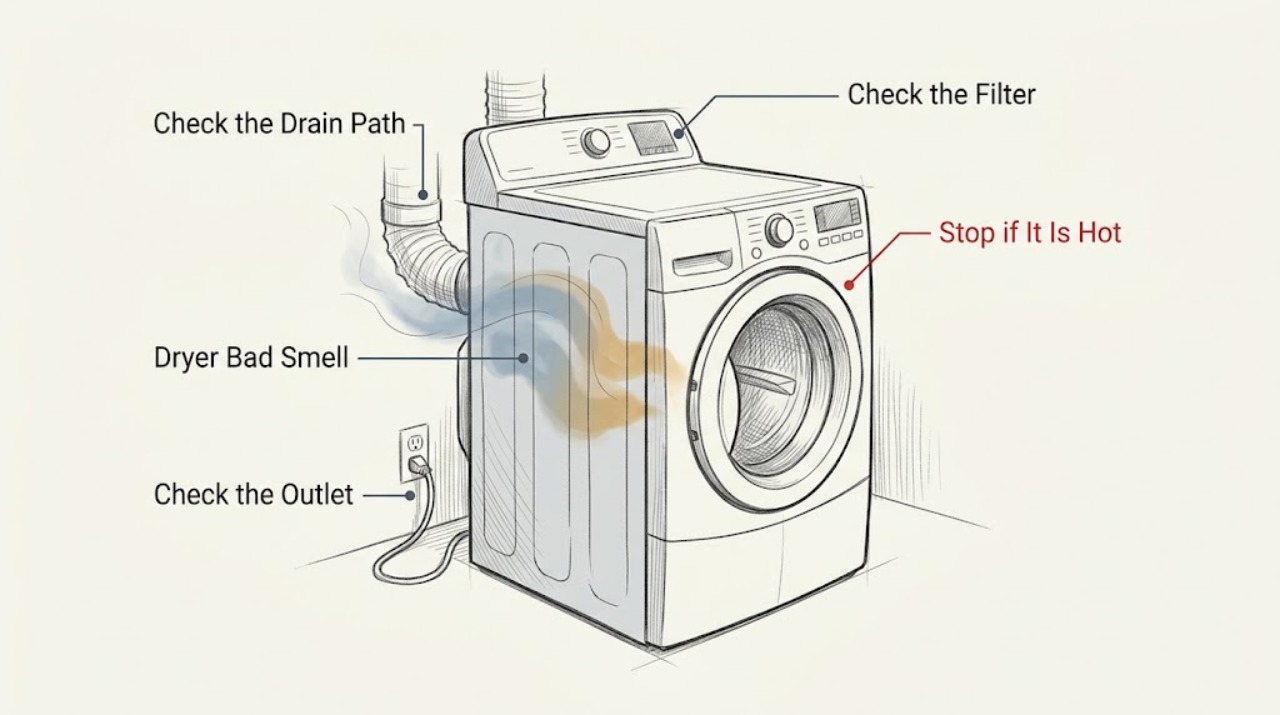
Dryer Bad Smell: Separate Mildew, Vent, Electrical, and Gas Causes
A dryer bad smell is not one diagnosis. A damp or musty odor can come from wet laundry, residue, or a dirty drum; a hot lint or burning smell can indicate restricted airflow or an overheating part; a sharp electrical odor points to a cord, plug, outlet, motor, or control fault; and a rotten-egg odor on a gas dryer may signal a gas emergency.
-
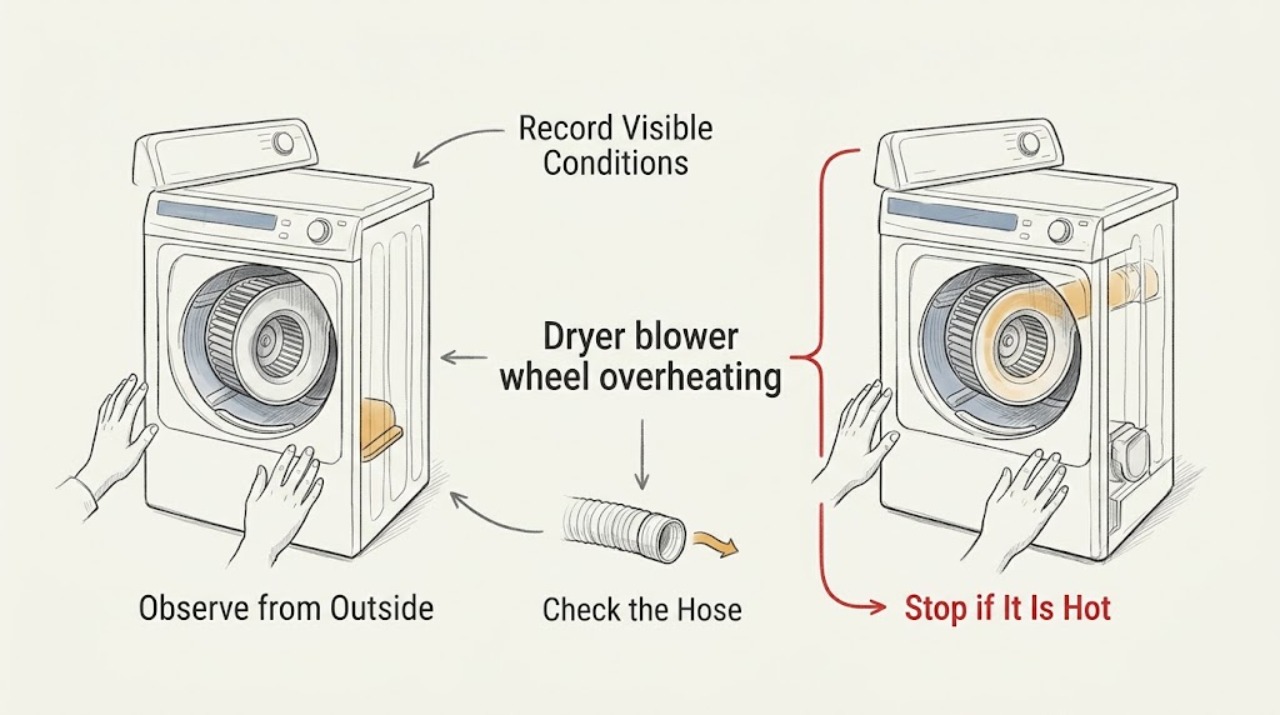
Dryer blower wheel overheating: What to Check and What to Do Next
A dryer blower wheel can contribute to overheating when it is loose, off-balance, obstructed, or unable to move air, but the same symptom can come from a blocked exhaust path, heating-control fault, motor problem, or lint near a heat source. Stop the dryer and leave it off if the cabinet or clothes become intensely hot, a burning smell appears, smoke is visible, drying time suddenly increases, or a thermal safety device opens.
-
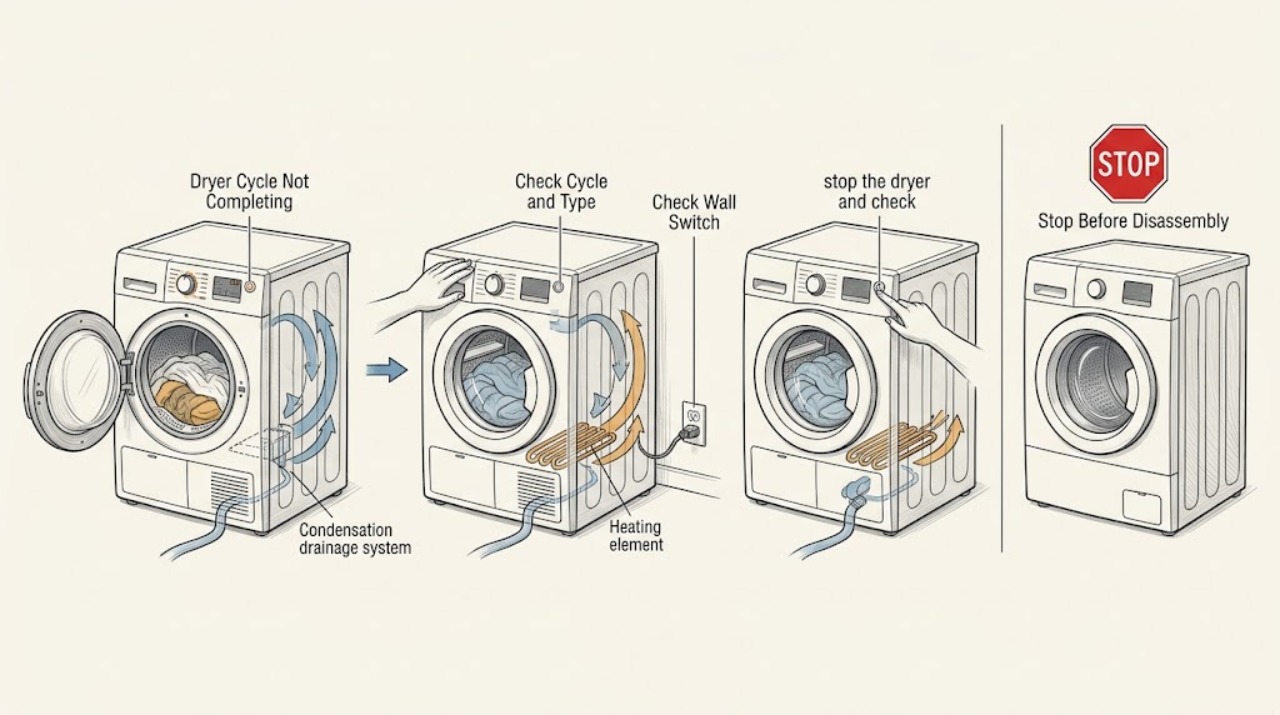
Dryer Cycle Not Completing: Find the Stage That Stops
First record whether the dryer stops during sensing, heating, tumbling, cooling, wrinkle care, or after an end indicator, and note whether the clothes are dry, damp, hot, or still wet. A timer that appears still can be normal on some automatic cycles, and Wrinkle Prevent can tumble without heat after drying is complete.
-
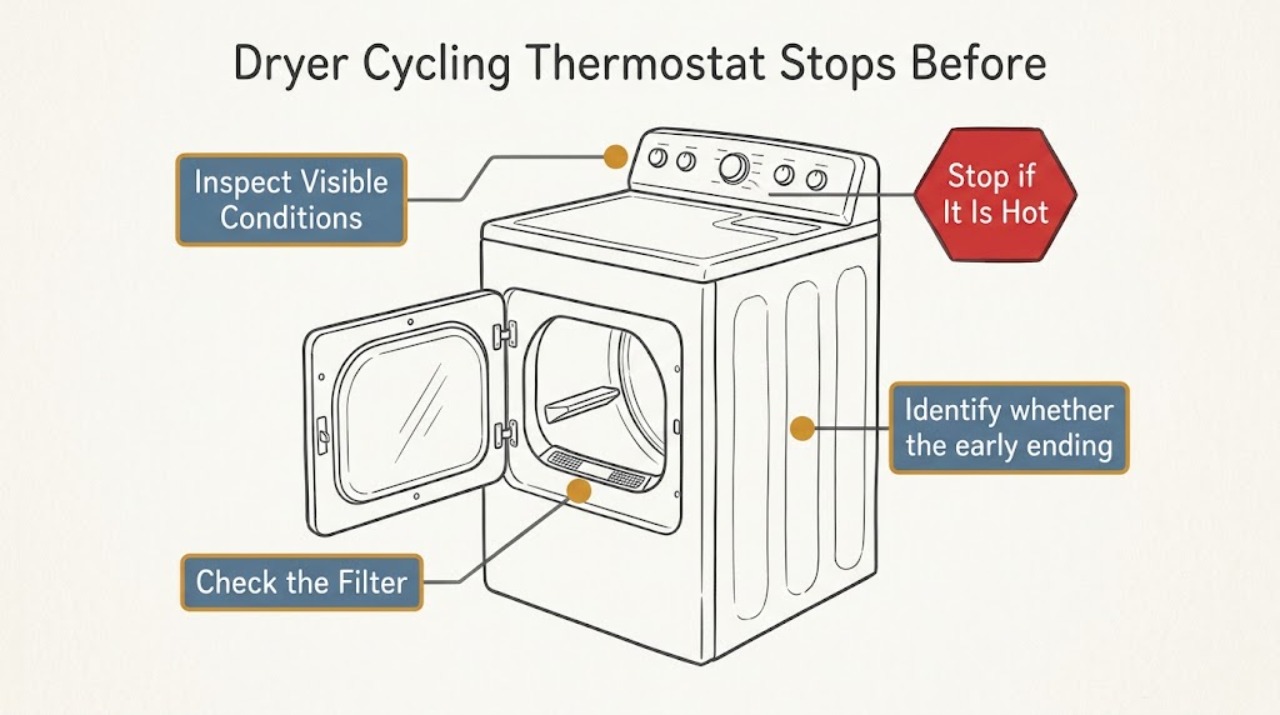
Dryer Cycling Thermostat Stops Before Cycle Ends: What to Check and What to Do Next
A dryer cycling thermostat normally switches the heater off and on to control drum-air temperature; that heat cycling is not the same as ending the entire cycle. A sensor or automatic cycle can end early when the dryer decides the load is dry, while a timed cycle should run for its selected time.
-
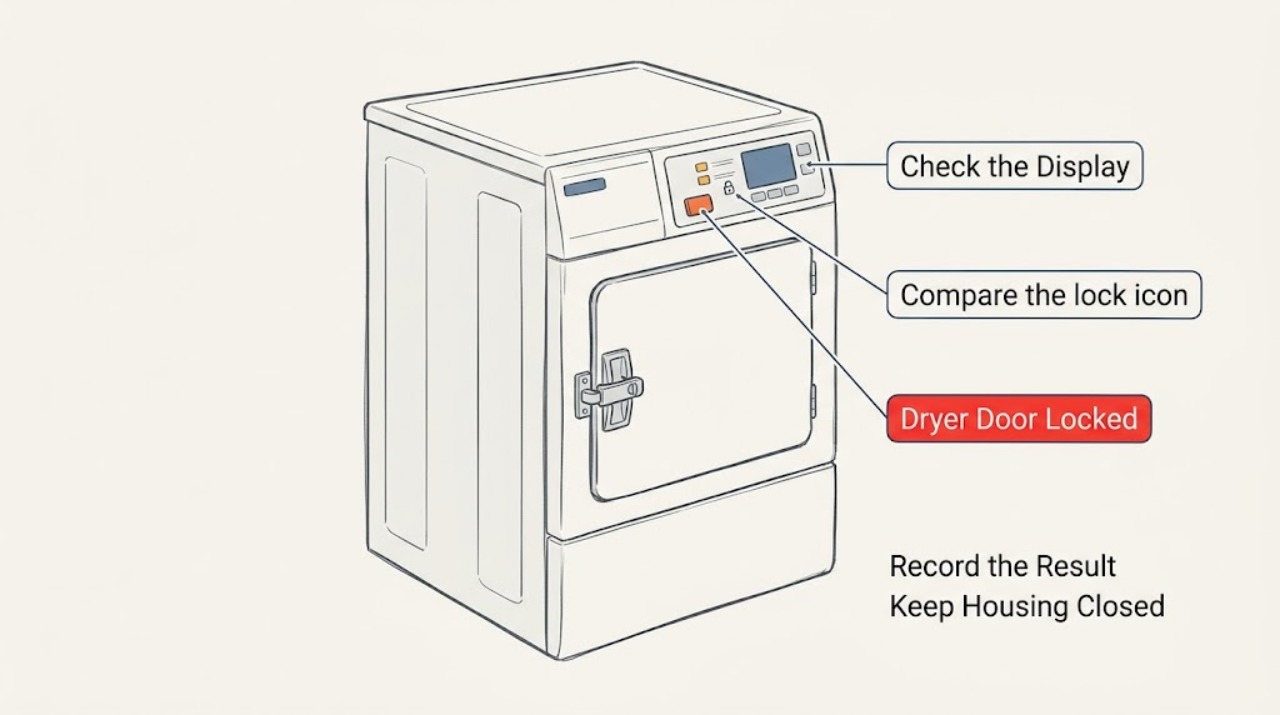
Dryer Door Locked: Identify the Lock Before Forcing Anything
First stop the cycle with the dryer's normal control and wait until the drum is completely stationary and the hot load and door have cooled. Then separate a control or child lock from a physically stuck door: if a lock icon is on but the handle opens, use the exact model manual to turn off the control lock; if the handle will not release after the cycle has ended, do not pry or bypass the latch.
-
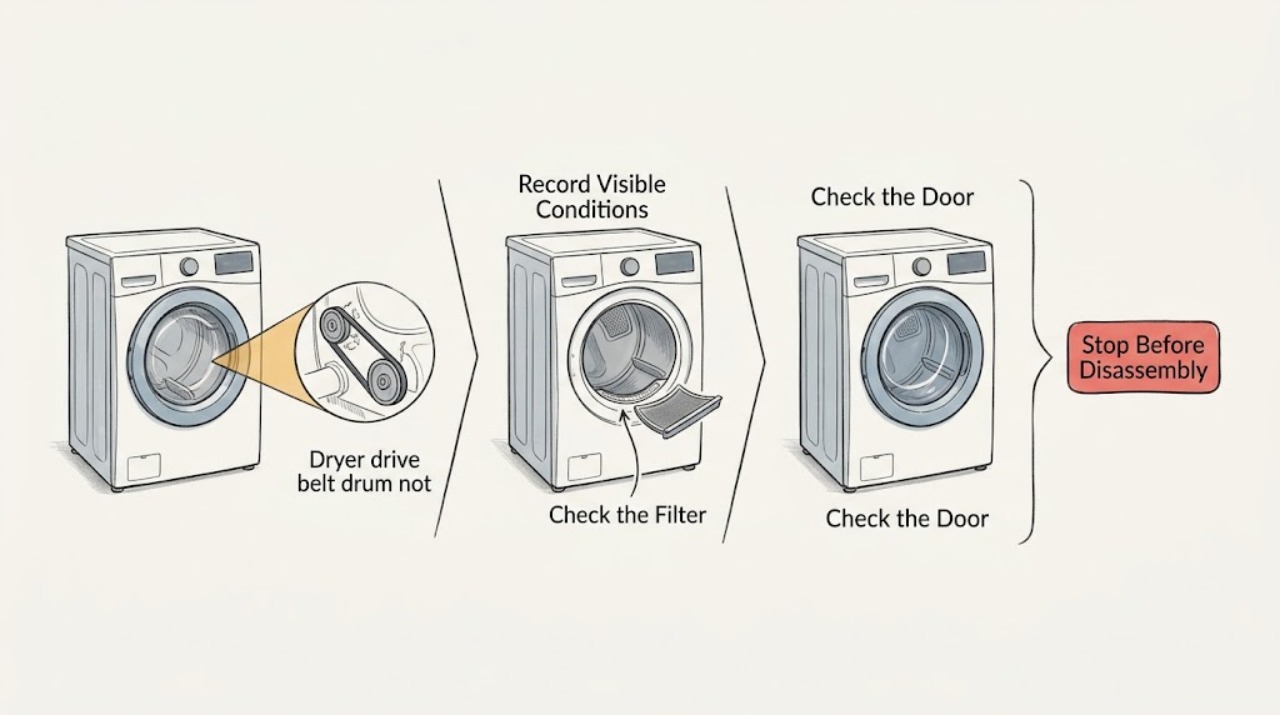
Dryer drive belt drum not tumbling: What to Check and What to Do Next
If a dryer powers on but the drum is not tumbling, stop the cycle after one safe observation and record whether the door is closed, the controls respond, the drum appears to start, and what sound is present. A door or child-lock state, an unsuitable or overloaded load, a motor or drive-belt fault, seized rollers or idler, or incomplete power can look similar.
-
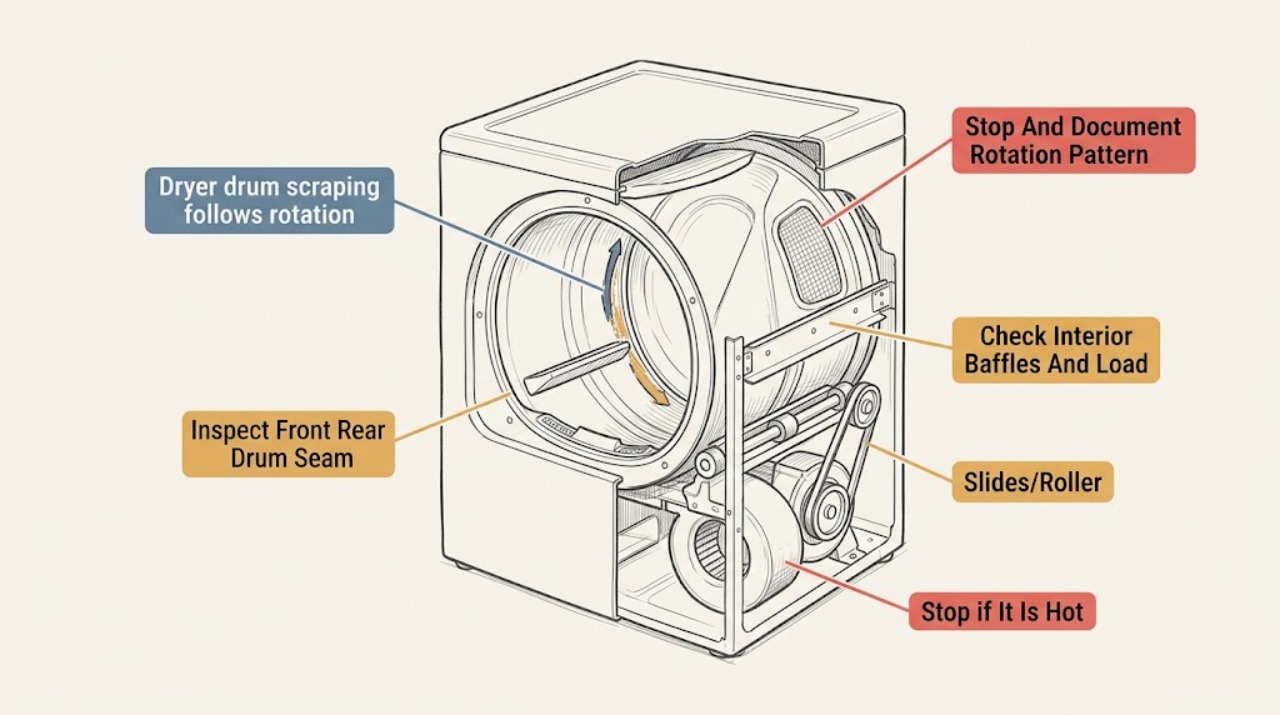
Dryer drum scraping follows rotation: What to Check and What to Do Next
A scraping sound that repeats with dryer-drum rotation usually comes from an object caught where the drum meets the front or rear, a loose or worn drum slide, a support or roller problem, or a loose baffle or seal. Stop the dryer, disconnect power using the normal plug or approved disconnect, and inspect only the empty drum and accessible edges for coins, screws, clips, or other objects.
-
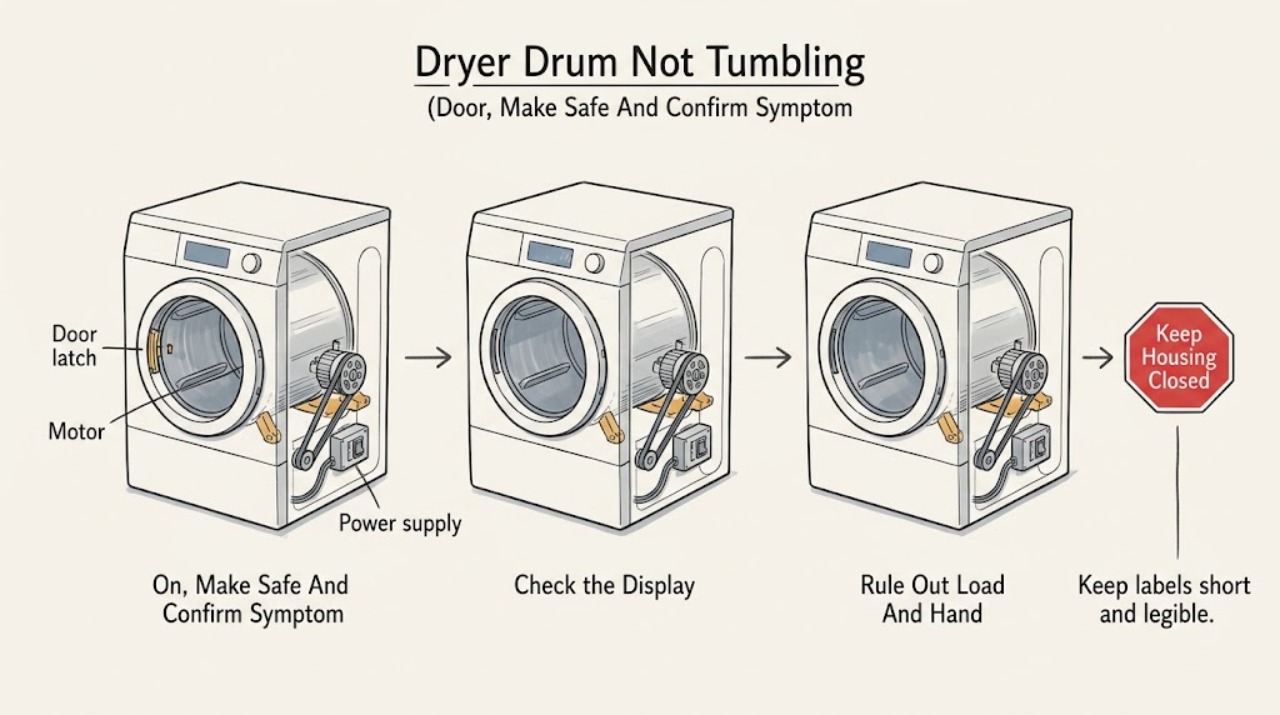
Dryer Drum Not Tumbling (Door Closes): What to Check and What to Do Next
If the dryer door closes but the drum does not tumble, first verify that the cycle is actually starting, the controls are not locked, and the dryer has power. With the dryer unplugged or otherwise disconnected from power, remove a heavy or tightly packed load and turn the drum gently by hand only as the model instructions allow.
-
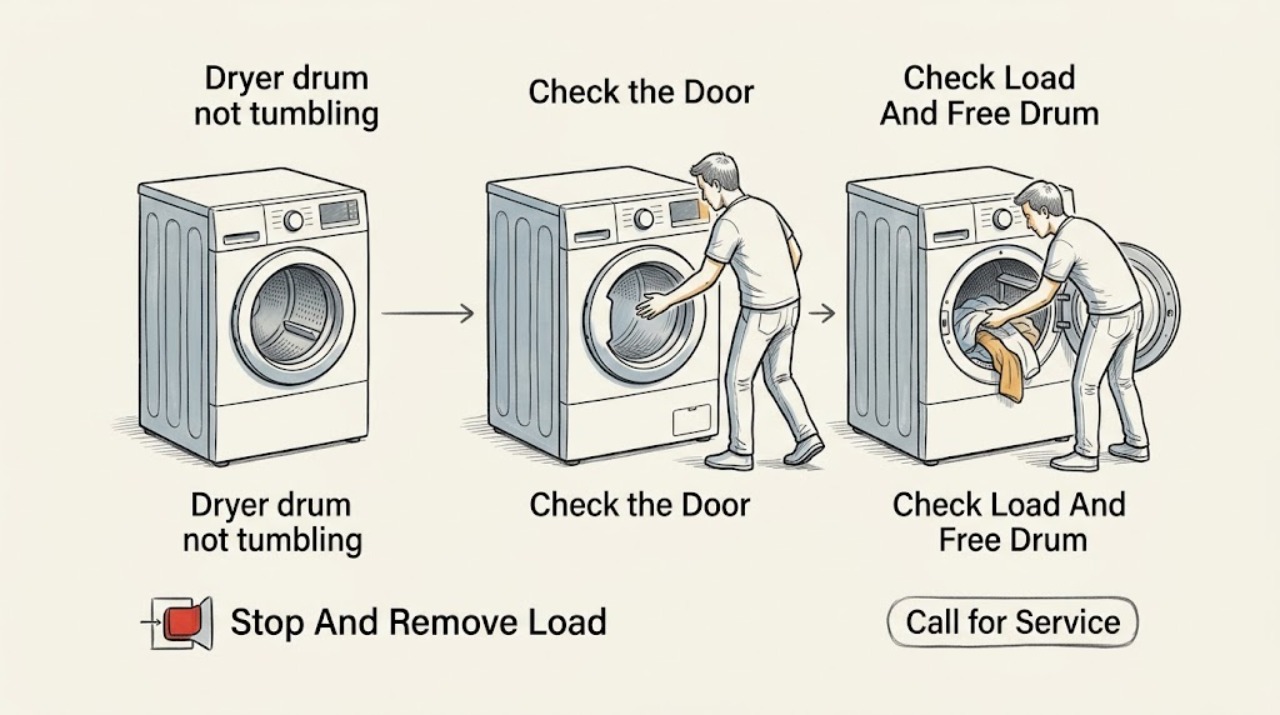
Dryer drum not tumbling and remains still: What to Check and What to Do Next
If the dryer drum remains still, stop using the dryer until you know whether it is a simple start or door-latch issue or a mechanical fault. With the dryer empty and unplugged, check that the door latches, the controls are not locked, and the Start control is used as the model requires.
-
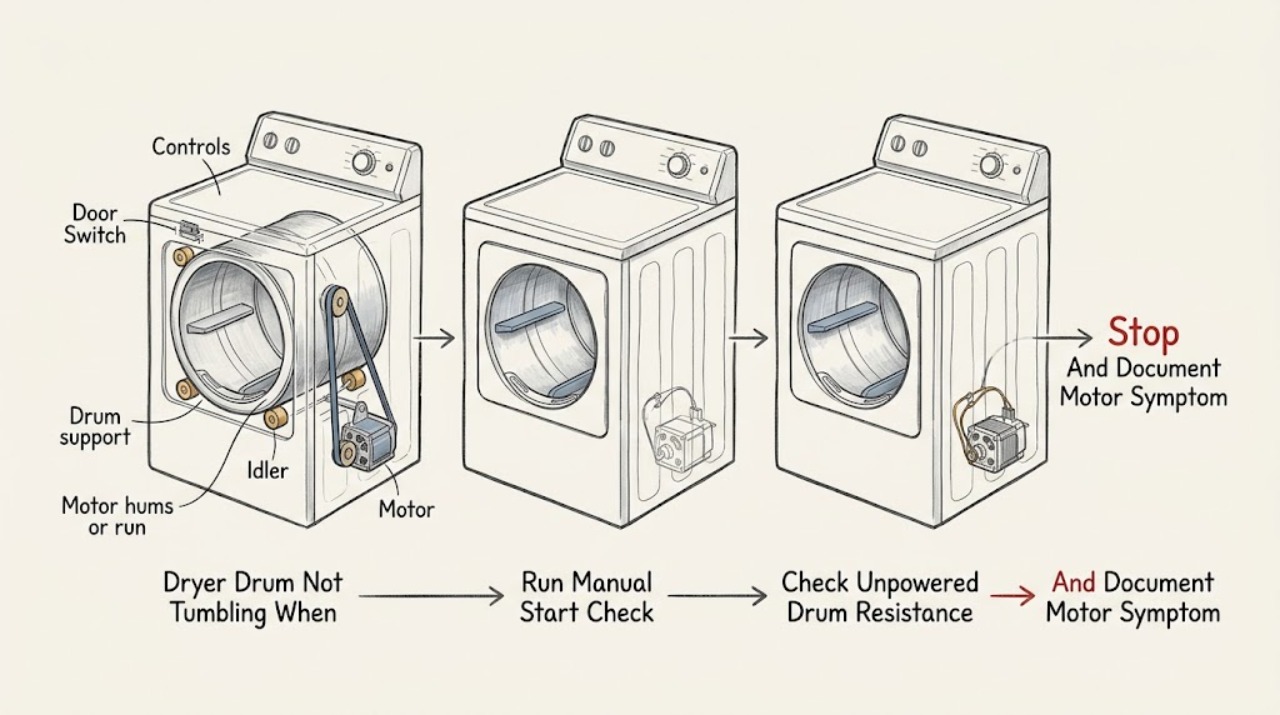
Dryer Drum Not Tumbling When the Motor Hums or Runs: What to Check and What to Do Next
If a dryer motor hums or continues running while the drum does not tumble, stop using the dryer and first confirm that a cycle really started, the door is latched, and the drum is not overloaded or seized. With the dryer powered off, a drum that turns unusually hard points toward a support or seized-drum problem; a drum that turns normally while the motor runs makes a broken or disengaged drive belt, idler, or another drive-path fault more likely.
-
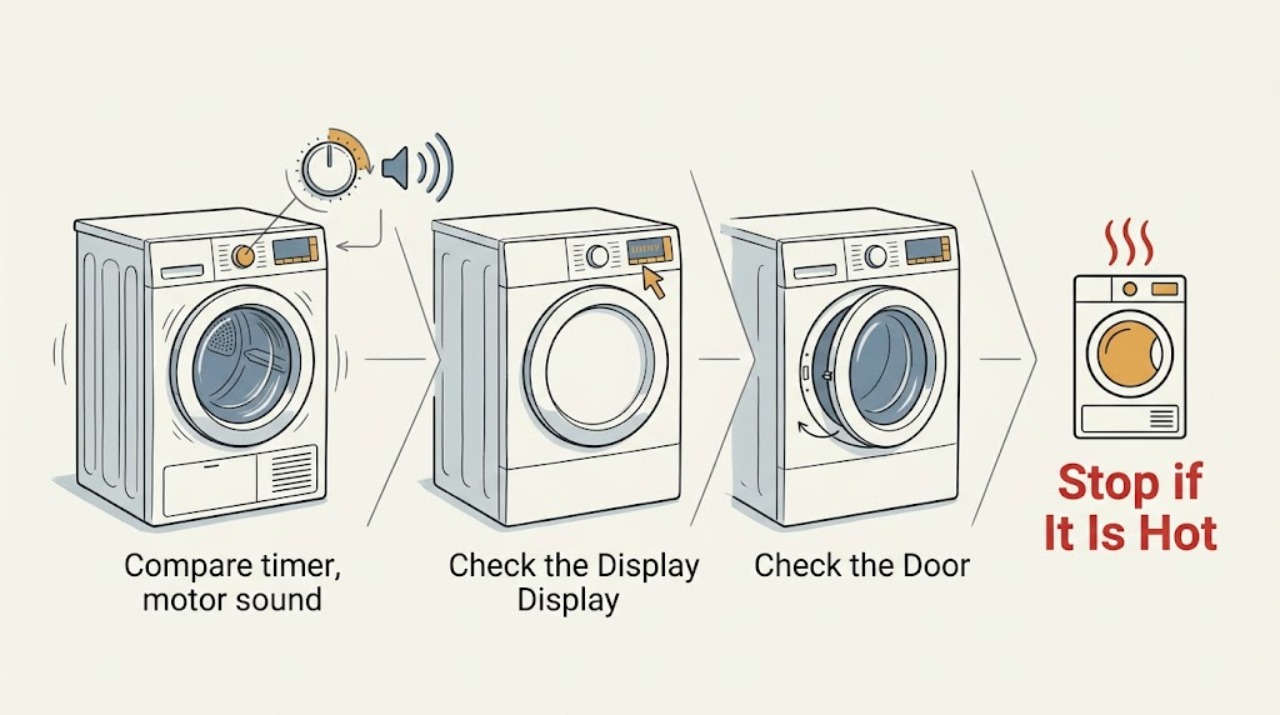
Dryer drum not tumbling: What to Check and What to Do Next
If a dryer turns on but its drum does not tumble, first confirm that the controls have actually started a cycle and that the door is latched. Check the display, timer response, sound, and any odor from a safe position. If the timer advances or the motor hums while the drum stays still, the drive system needs service; do not open the cabinet, force the drum, or keep running the dryer. A burning smell, smoke, sparks, unusual heat, or a gas-like odor is a stop-use condition.
-
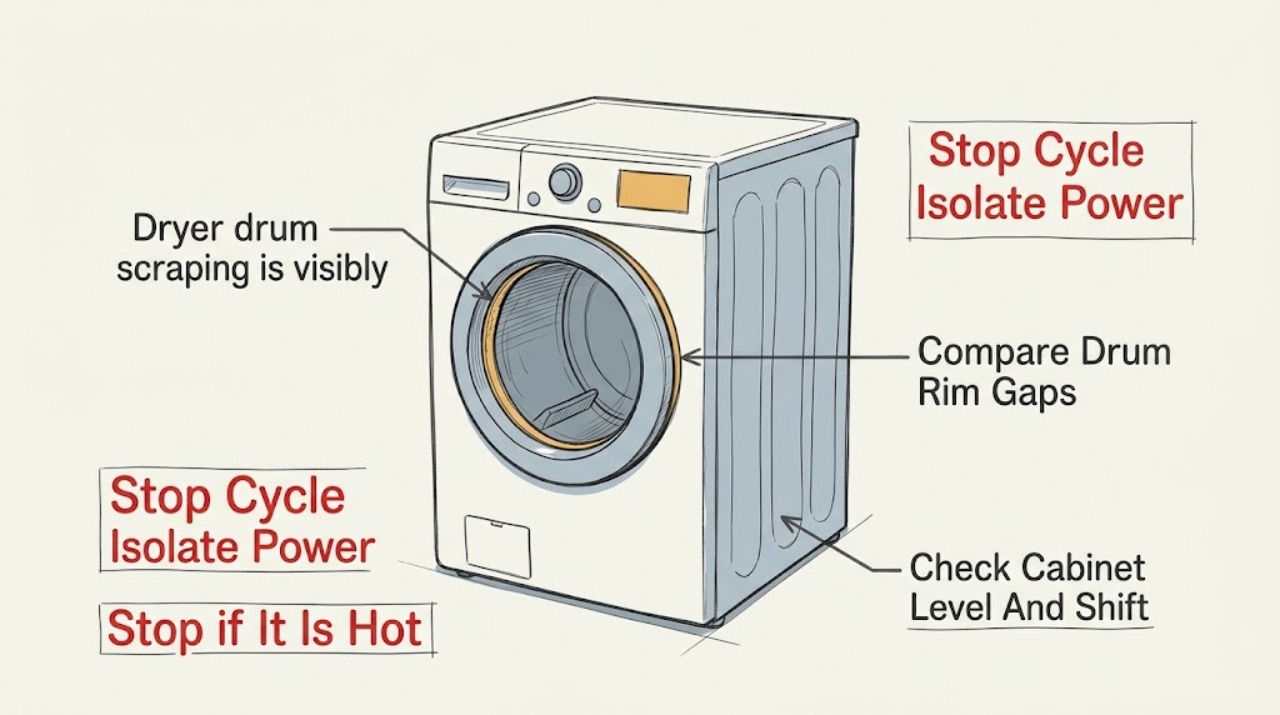
Dryer drum scraping is visibly misaligned: What to Check and What to Do Next
Stop the dryer, remove the load, and disconnect power before inspecting a drum that is visibly off-center or scraping. Do not run another cycle to see whether it settles.
-
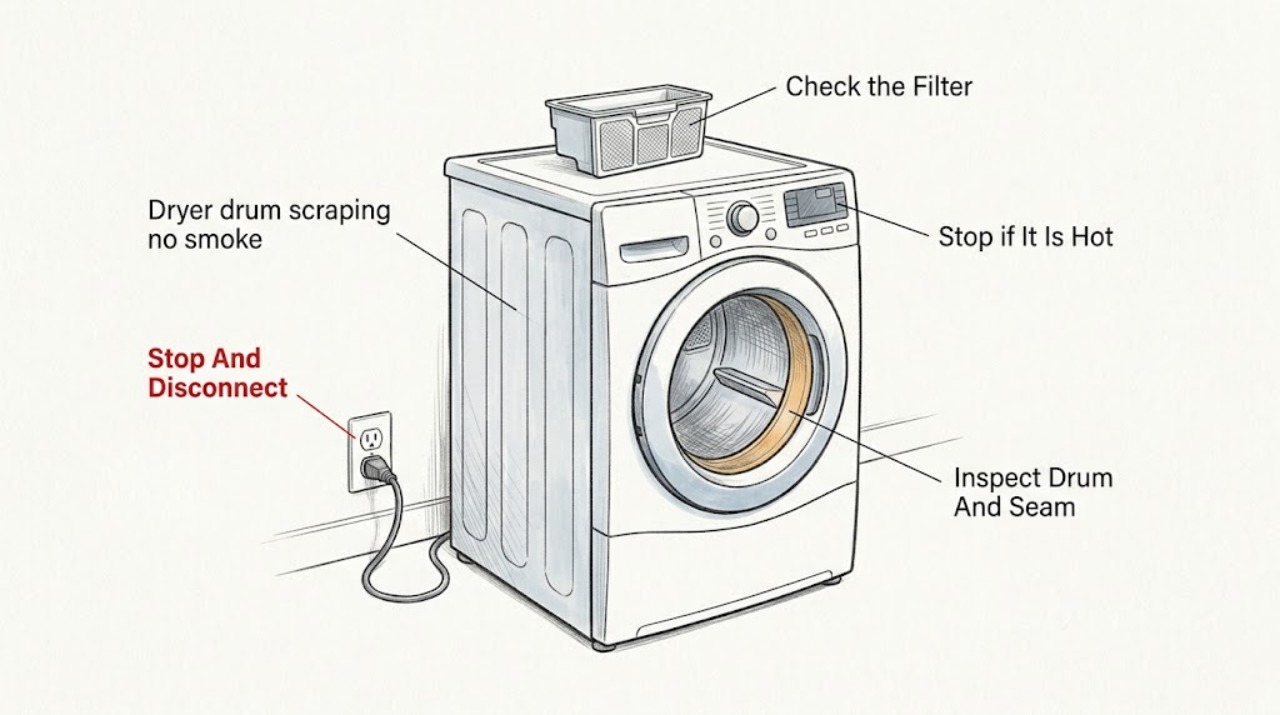
Dryer drum scraping no smoke: What to Check and What to Do Next
No smoke is a useful observation, but it does not make a scraping dryer safe to keep running. Stop the cycle, disconnect power as the owner's instructions allow, and inspect only the drum opening, front and rear drum edges, lint-filter area, and surrounding floor for a coin, fastener, zipper, or other loose object.
-
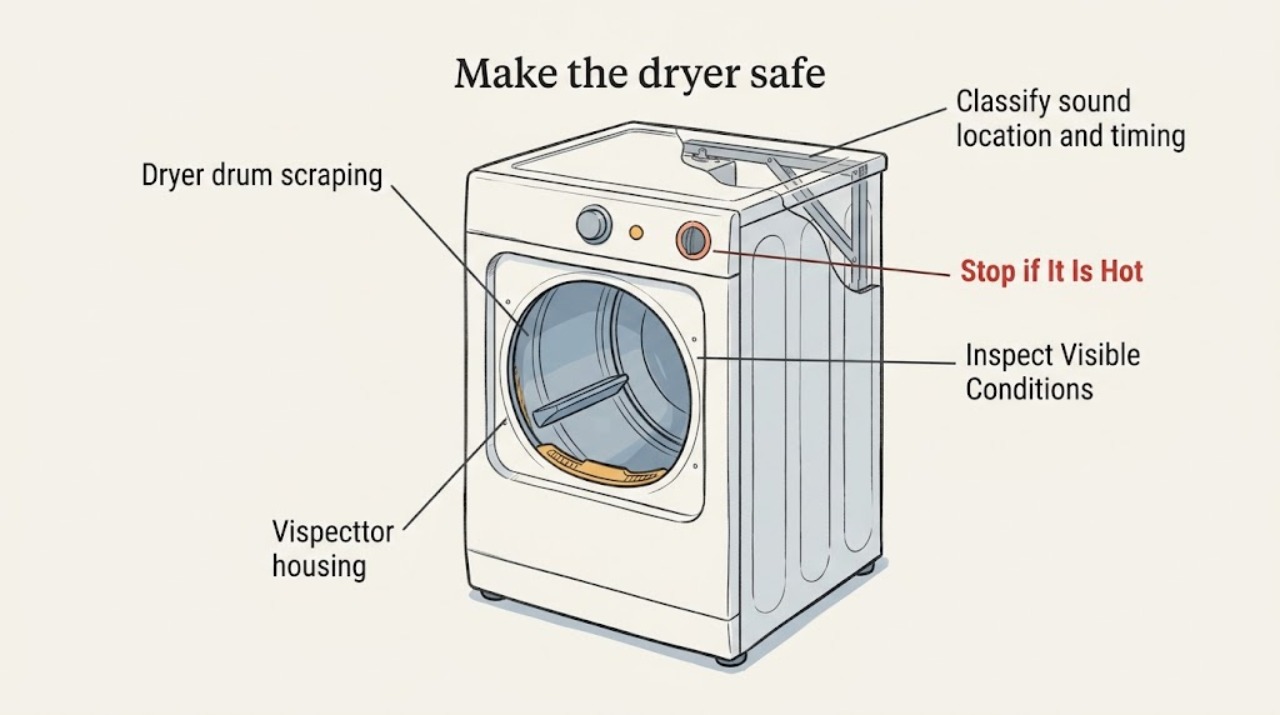
Dryer drum scraping: What to Check and What to Do Next
A dryer drum that scrapes or makes metal-on-metal noise should not be kept running. First turn it off, unload it when safe, and look from the door at the front and rear drum edges for a plainly visible object; do not reach into a seam or dismantle the dryer.
-
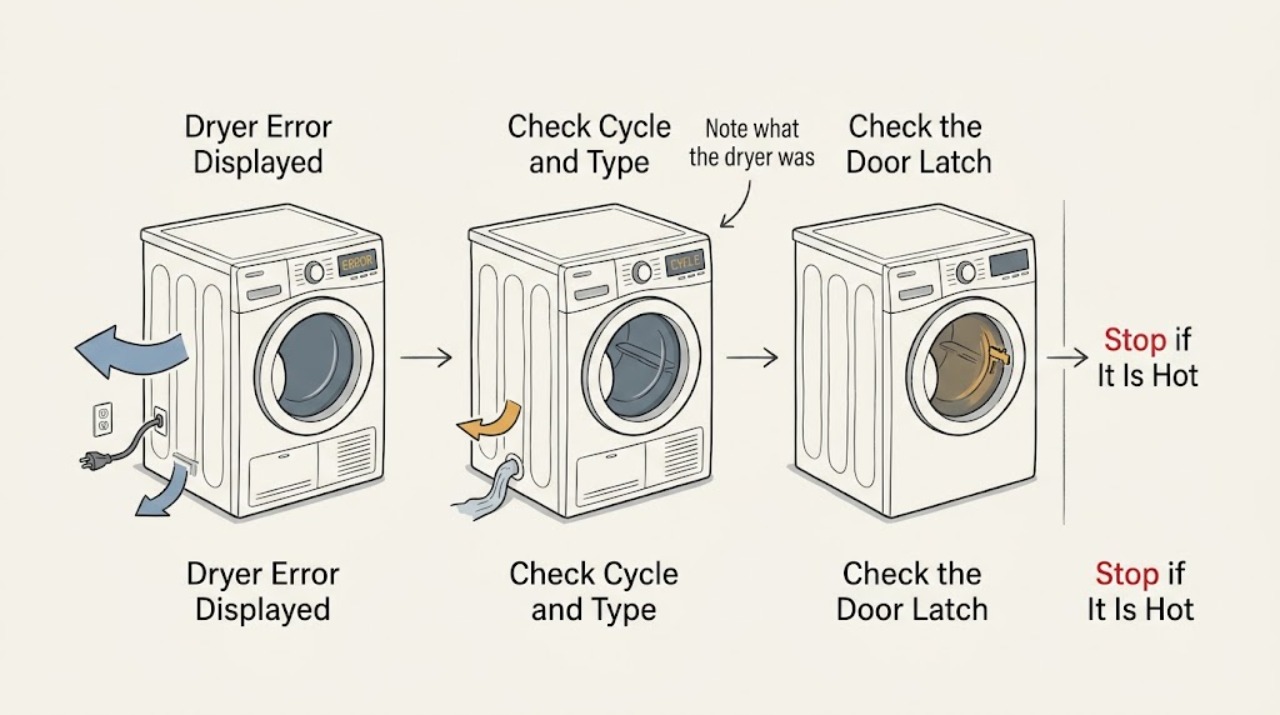
Dryer Error Displayed: Capture the Code and Follow the Safe Model-Specific Path
A dryer error displayed on the panel is a symptom, not a universal diagnosis. Write down the complete code or icon, the brand and model, whether the dryer is electric, gas, vented, condenser, or heat-pump, and the cycle stage when it appeared.
-
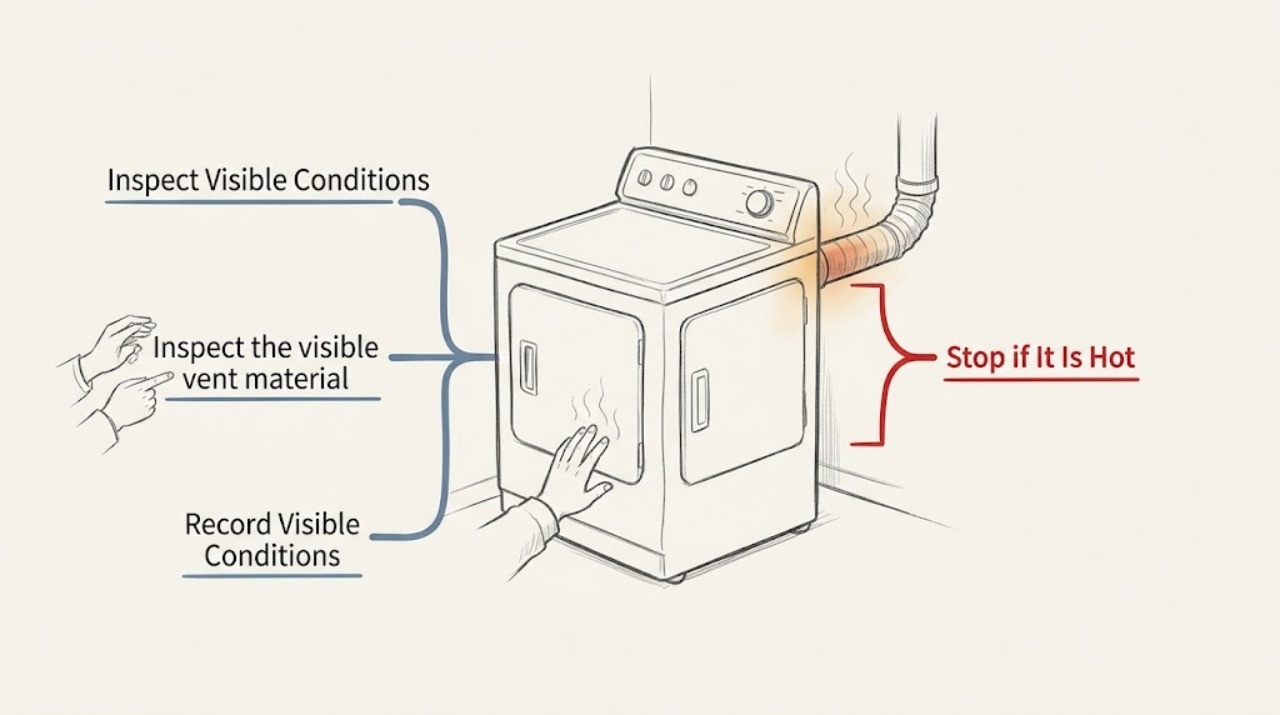
Dryer exhaust vent overheating: What to Check and What to Do Next
If a dryer is overheating and the exhaust vent is the suspected component, first stop use for any burning odor, smoke, scorching, unusually hot cabinet, or gas or electrical warning. When there is no active hazard, use prior safe-cycle information or a brief normal observation from outside to record hood opening and airflow, then photograph the visible vent material and path without moving the dryer or deep-cleaning the duct.
-
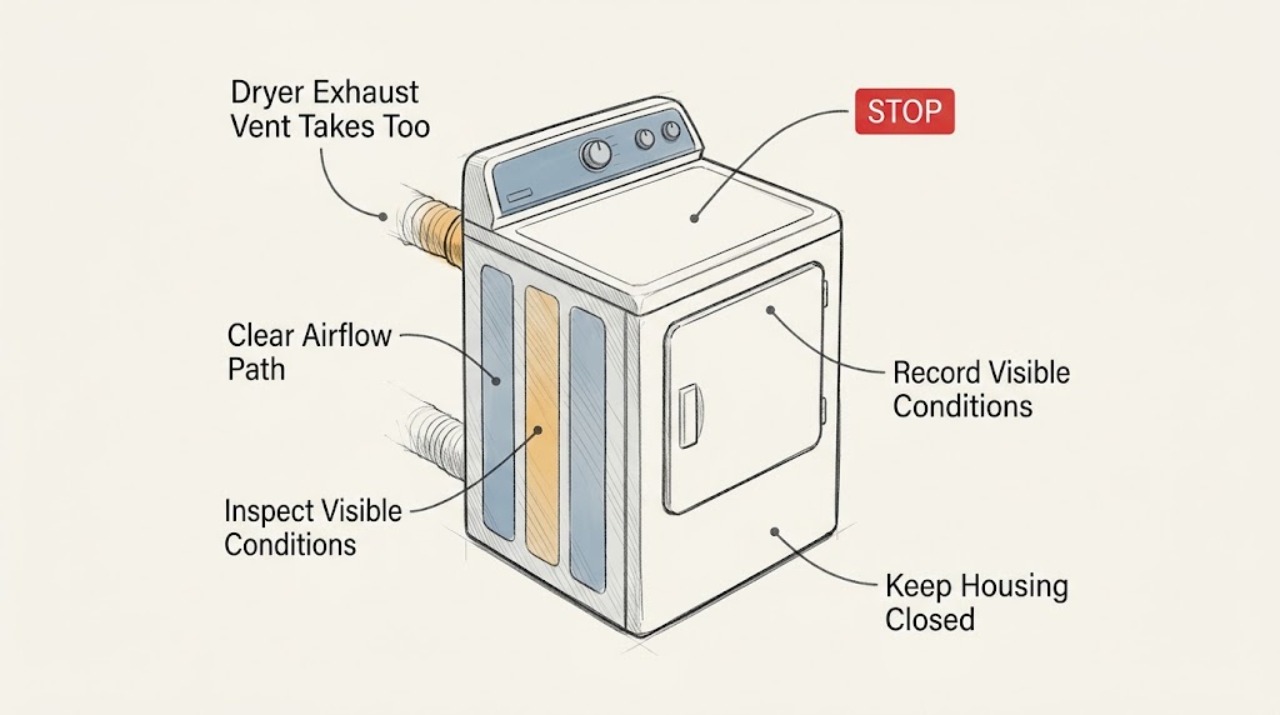
Dryer Exhaust Vent Takes Too Long to Dry: What to Check and What to Do Next
When a vented dryer heats but takes too long to dry, restricted exhaust airflow is a leading suspect. Start with the lint screen, any restricted-airflow or check-vent message, the visible hose behind the dryer, and the outside hood: lint, a crushed or kinked hose, too many bends, excessive length, or a blocked hood can keep moist air from leaving.
-
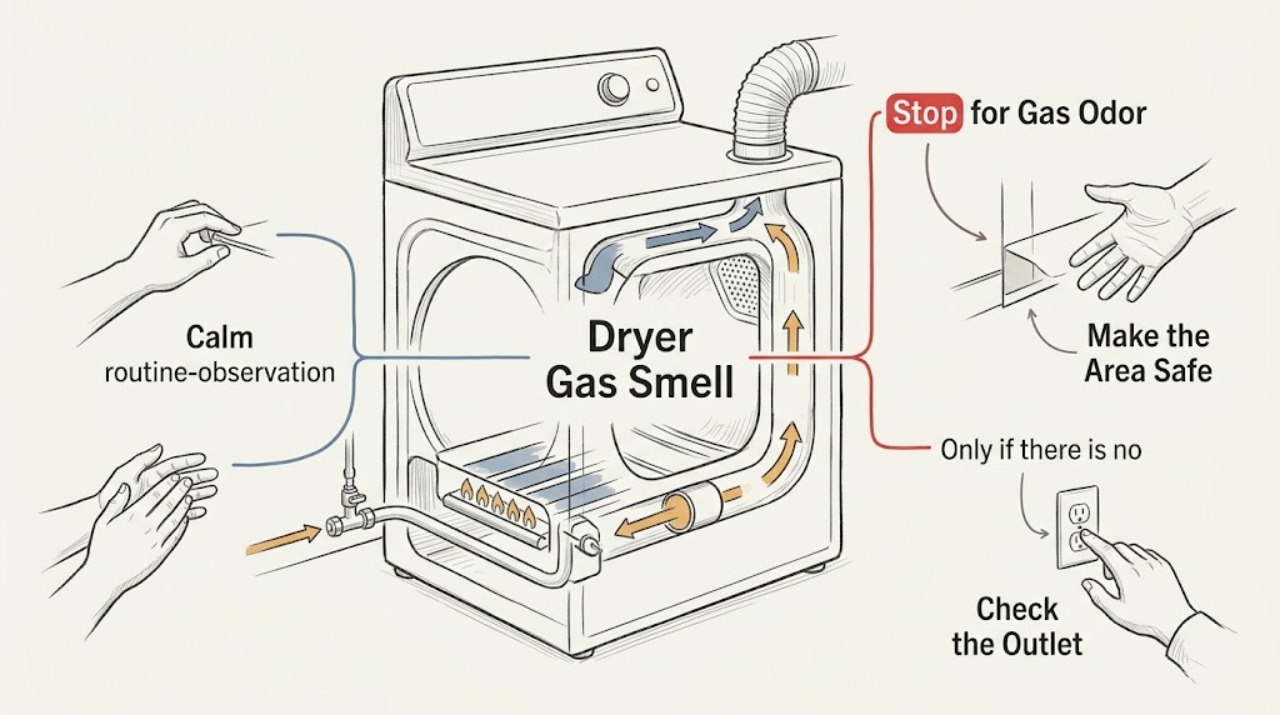
Dryer Gas Smell: Safe Shutdown, Gas-Leak Triage, and Service Checks
Treat a strong, persistent, or uncertain gas smell as a possible gas leak: stop using the dryer, do not light anything or operate electrical switches, leave the area, and contact your local gas emergency service from a safe location. If it is safe to do so without returning to a hazardous area, the gas supply may be isolated at the meter; do not search for a leak, remove panels, or restart the dryer to test it.
-
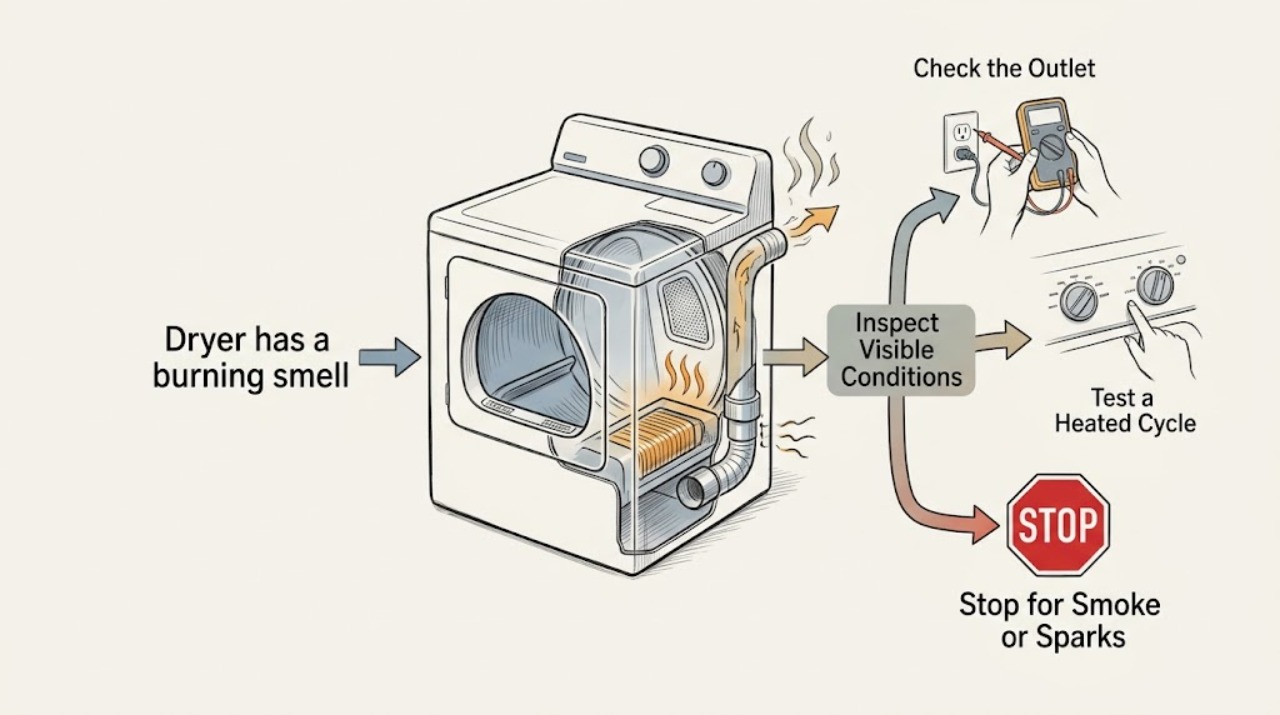
Dryer has a burning smell odor appears during heat: What to Check and What to Do Next
A burning smell that appears when a dryer heats can come from normal oils or dust during initial use of a new appliance, lint in the screen, cabinet, or exhaust path, a blocked vent that makes the dryer run hotter, an overheated belt, drum support, motor, heating element, wiring, or a gas-combustion problem.
-
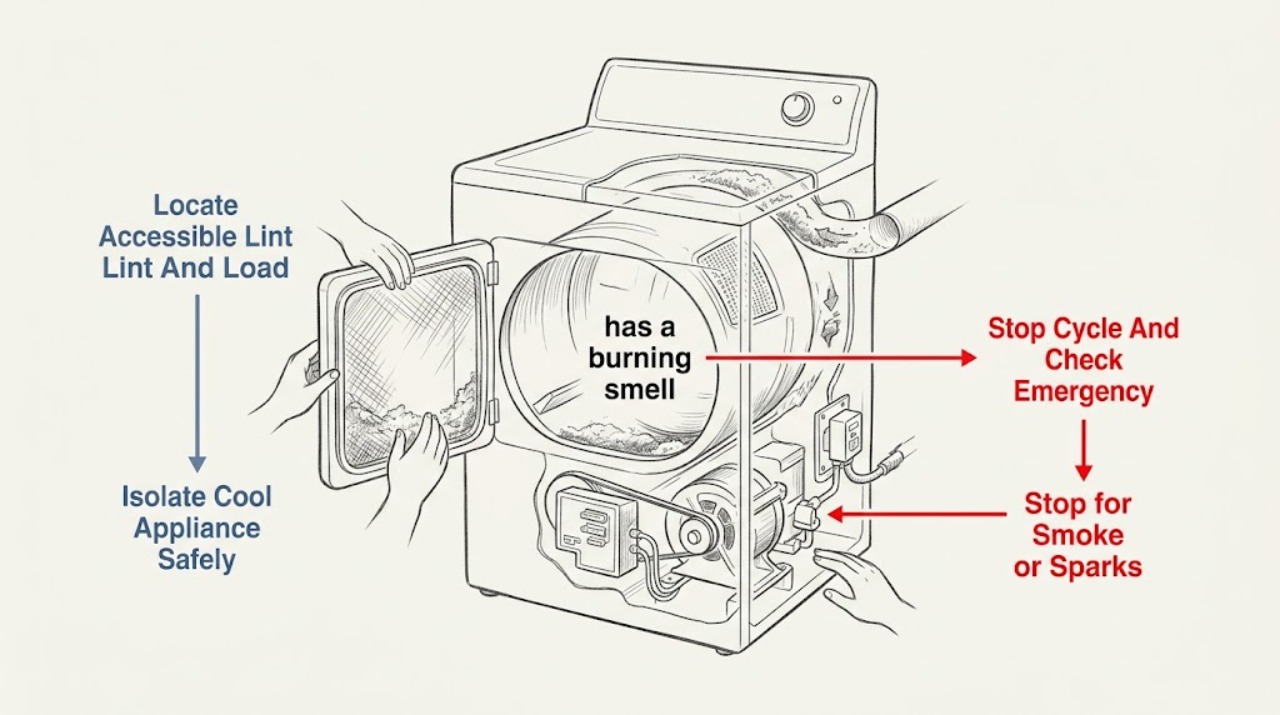
Dryer Has a Burning Smell and Lint Is Visible: What to Check and What to Do Next
A burning smell plus visible lint is a stop-using symptom, not a normal lint-cleaning reminder. End the cycle, keep the dryer off, and do not restart it to see whether the smell clears.
-
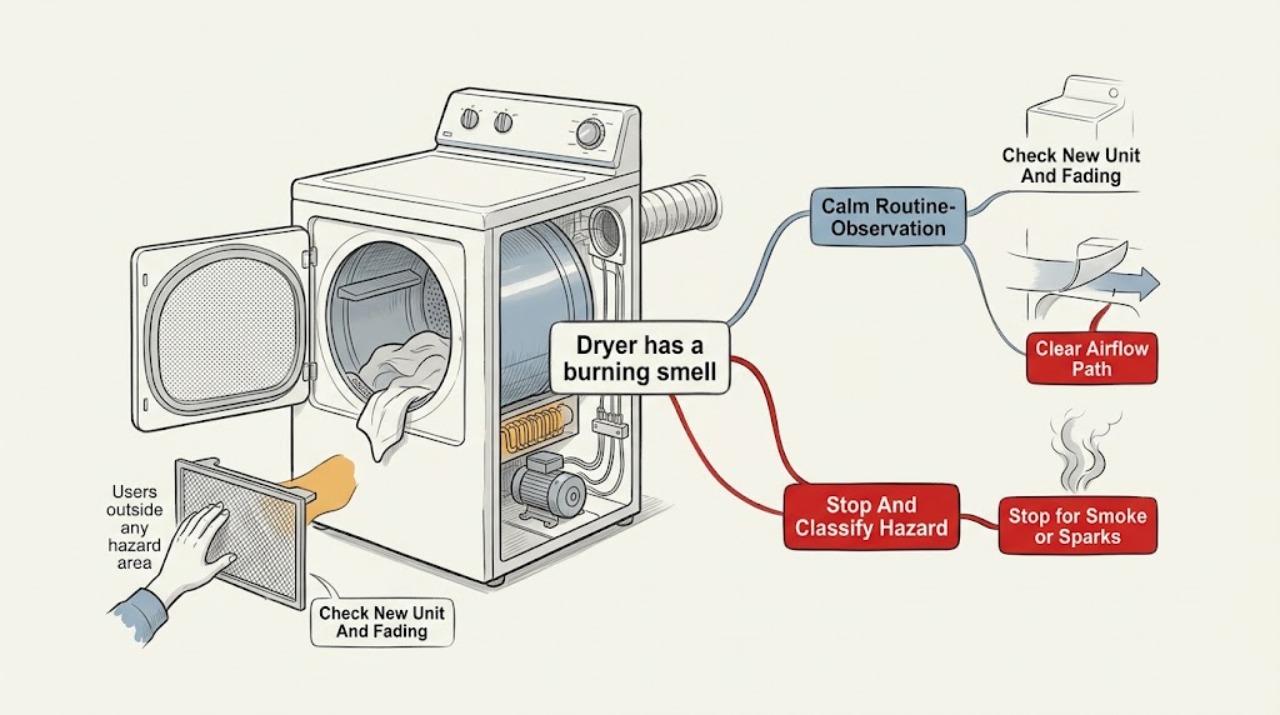
Dryer has a burning smell, with or without smoke: What to Check and What to Do Next
Treat a dryer burning smell as a stop-and-check symptom, not as a normal operating noise. If you see smoke, smell gas, see sparks, or the cabinet, cord, or outlet is hot, leave the area as appropriate, do not operate switches or the dryer, and use qualified or emergency help; a gas smell or smoking gas dryer requires clearing the building and contacting emergency services.
-
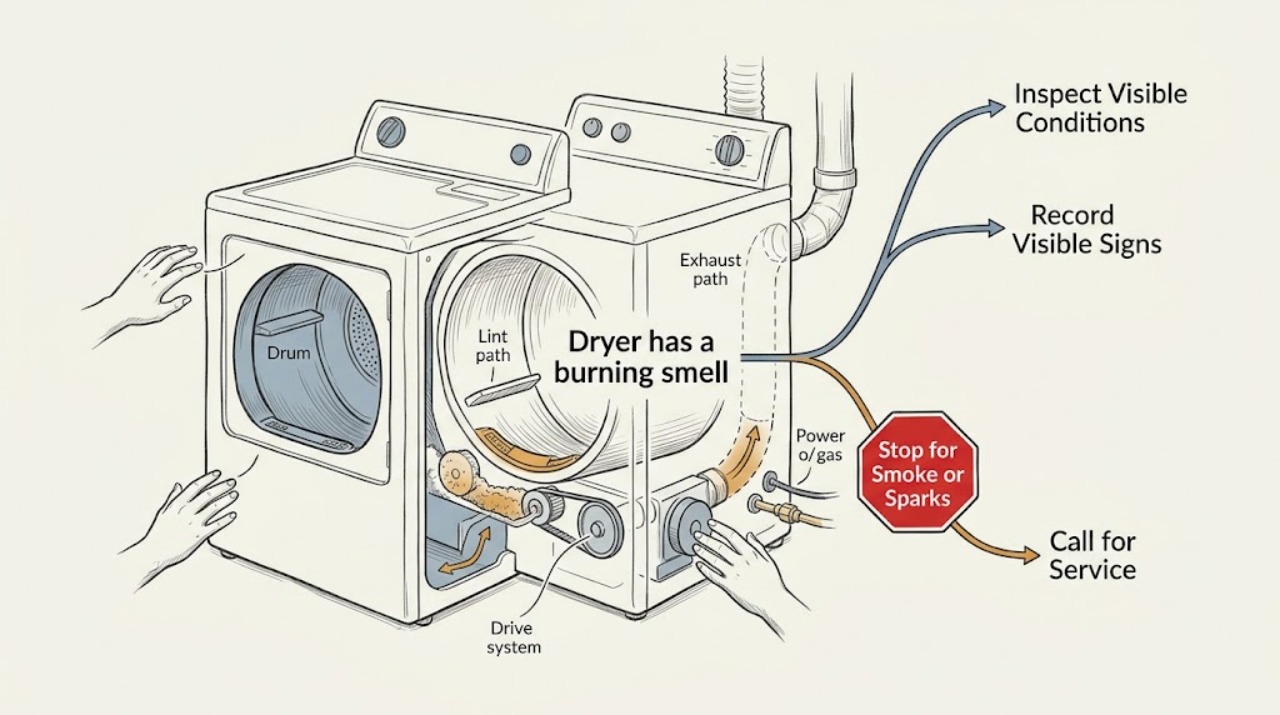
Dryer has a burning smell: What to Check and What to Do Next
Stop using the dryer as soon as a burning smell appears. If the dryer is cool enough and the plug is clearly reachable without touching hot equipment, unplug it; do not reach behind it, open the cabinet, disturb the vent, or operate it again to test the odor.
-
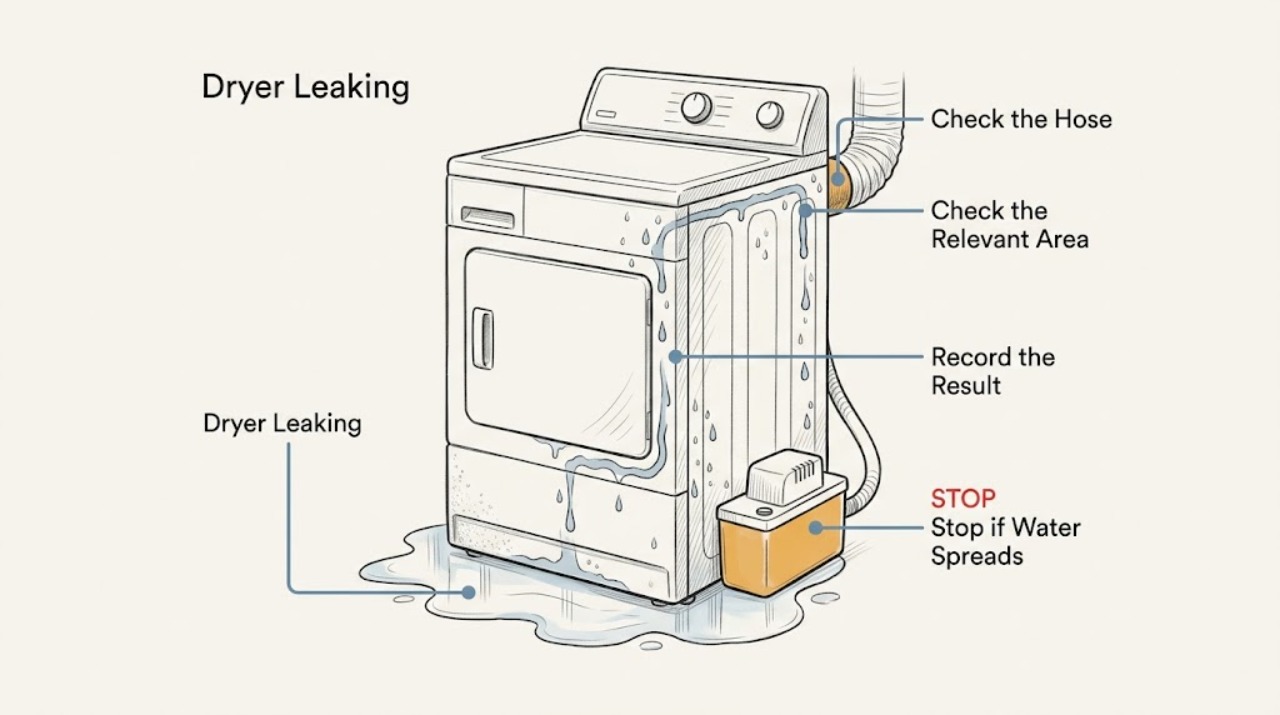
Dryer Leaking: Identify the Water Path Before Repair
Stop the dryer and find the first place water appears before choosing a repair path. A vented dryer sends hot, moist air through an exhaust duct; a kinked or restricted duct can collect water or cause condensation around the door.
-
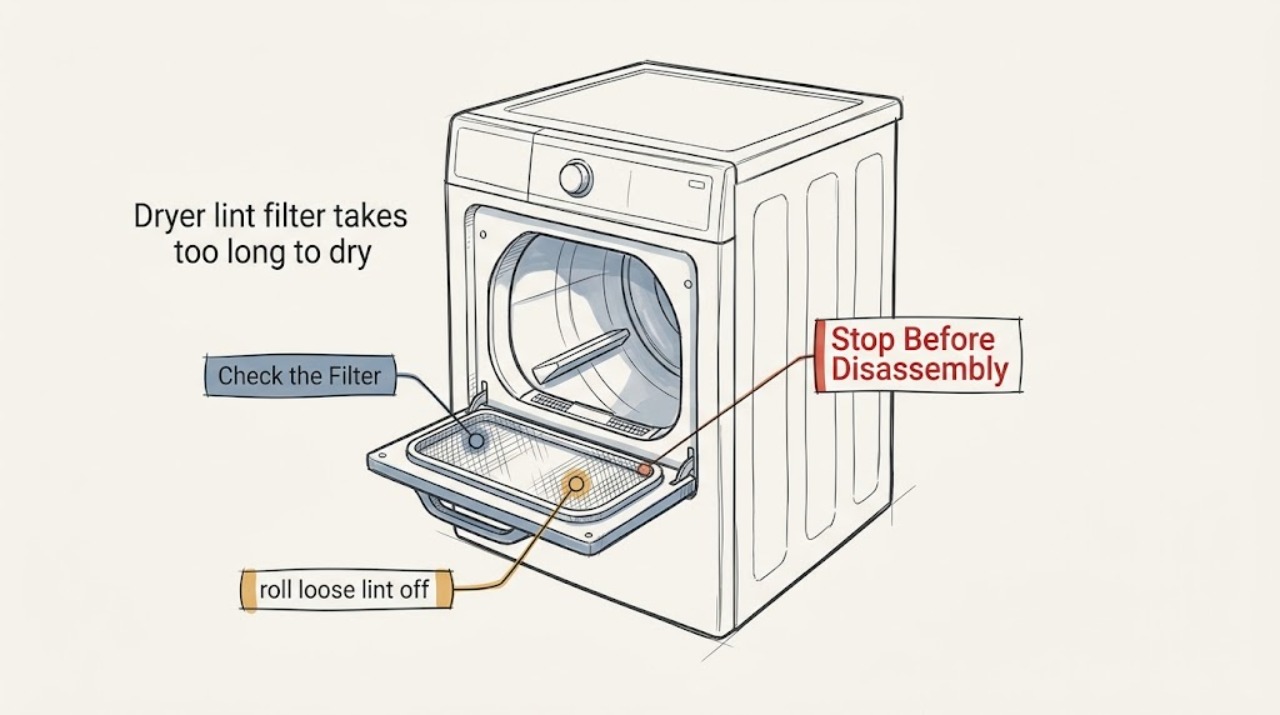
Dryer lint filter takes too long to dry: What to Check and What to Do Next
First separate a lint filter that remains wet after washing from clothes that take too long to dry. A washed filter should be rinsed, towel-dried thoroughly, and reinstalled only when fully dry.
-
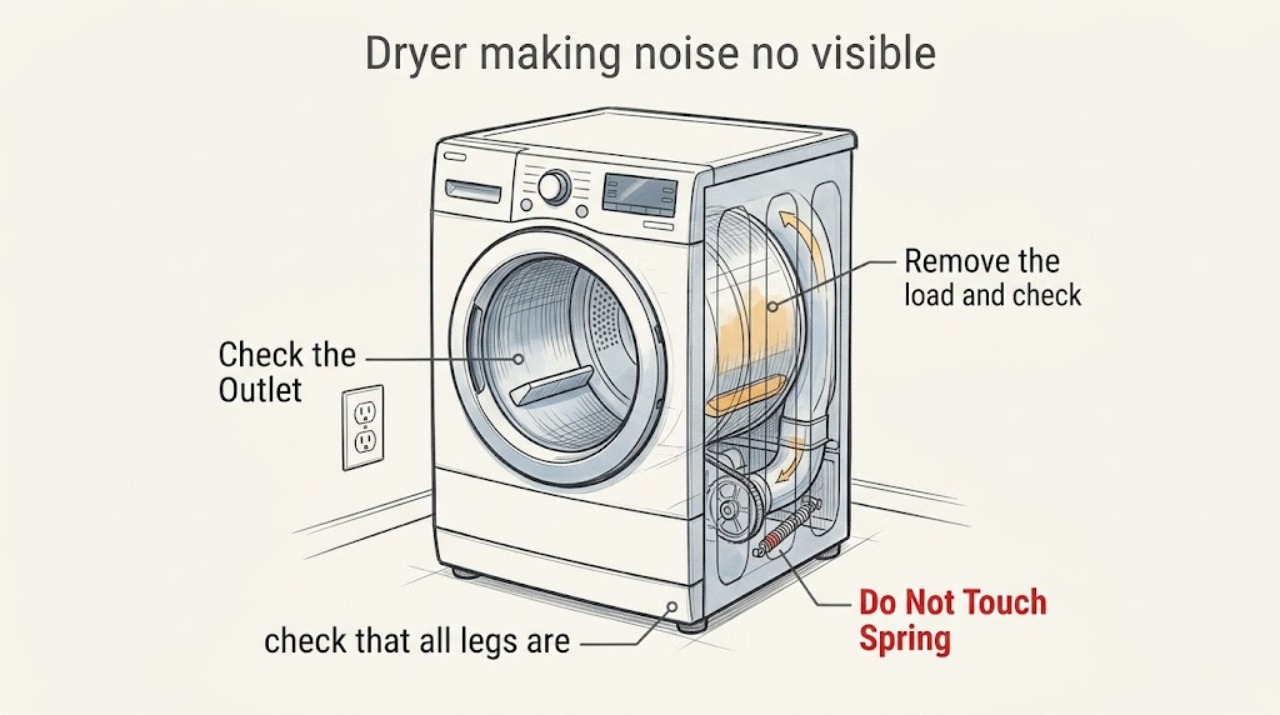
Dryer making noise no visible damage: What to Check and What to Do Next
A dryer can make noise even when no damage is visible from the outside. Common explanations include a twisted load, coins or fasteners in the drum seam, a missing or unlevel leg, an exhaust tube or pedestal vibrating, rollers that temporarily flatten after storage, or internal wear in the drum rollers, glides, idler pulley, belt, motor, blower wheel, or bearings.
-
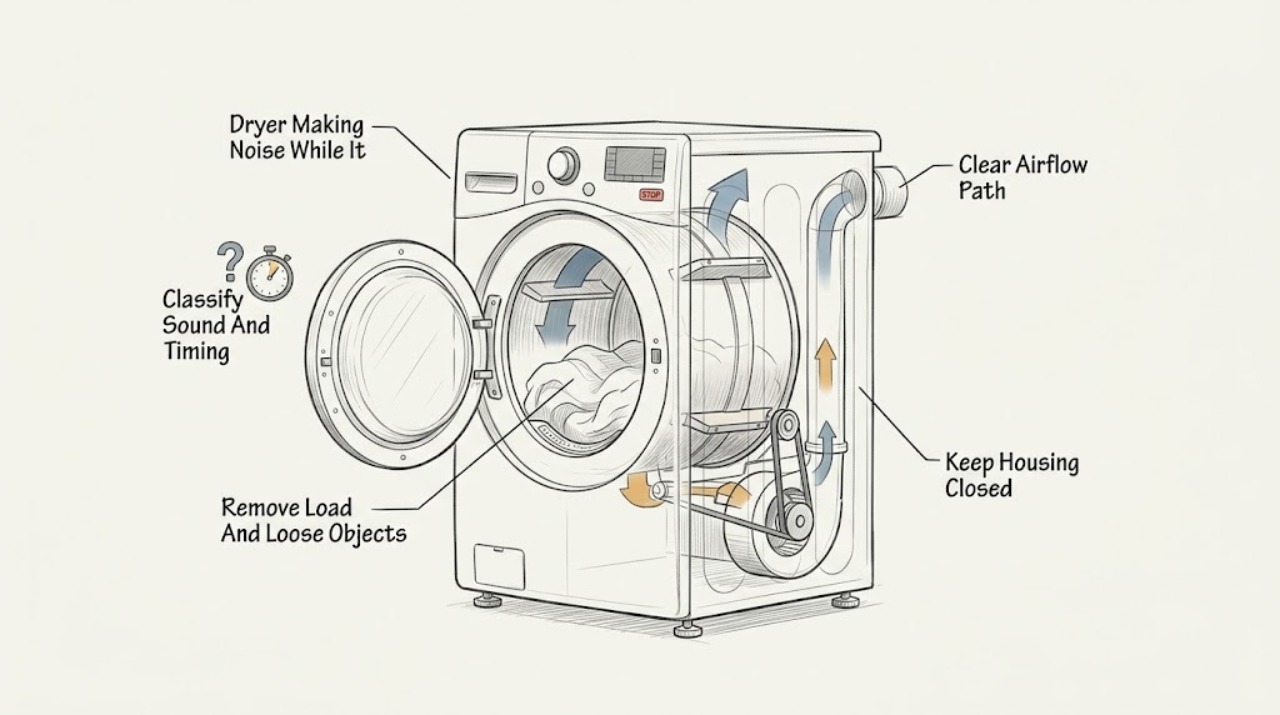
Dryer Making Noise While It Still Tumbles: What to Check and What to Do Next
A dryer that still tumbles can make harmless load or cabinet noises, but a new or worsening sound can also be an early sign of worn drum supports, an idler, belt, blower wheel, or motor. First identify whether the sound is clicking, thumping, rattling, scraping, squealing, grinding, rumbling, or humming and when it occurs.
-
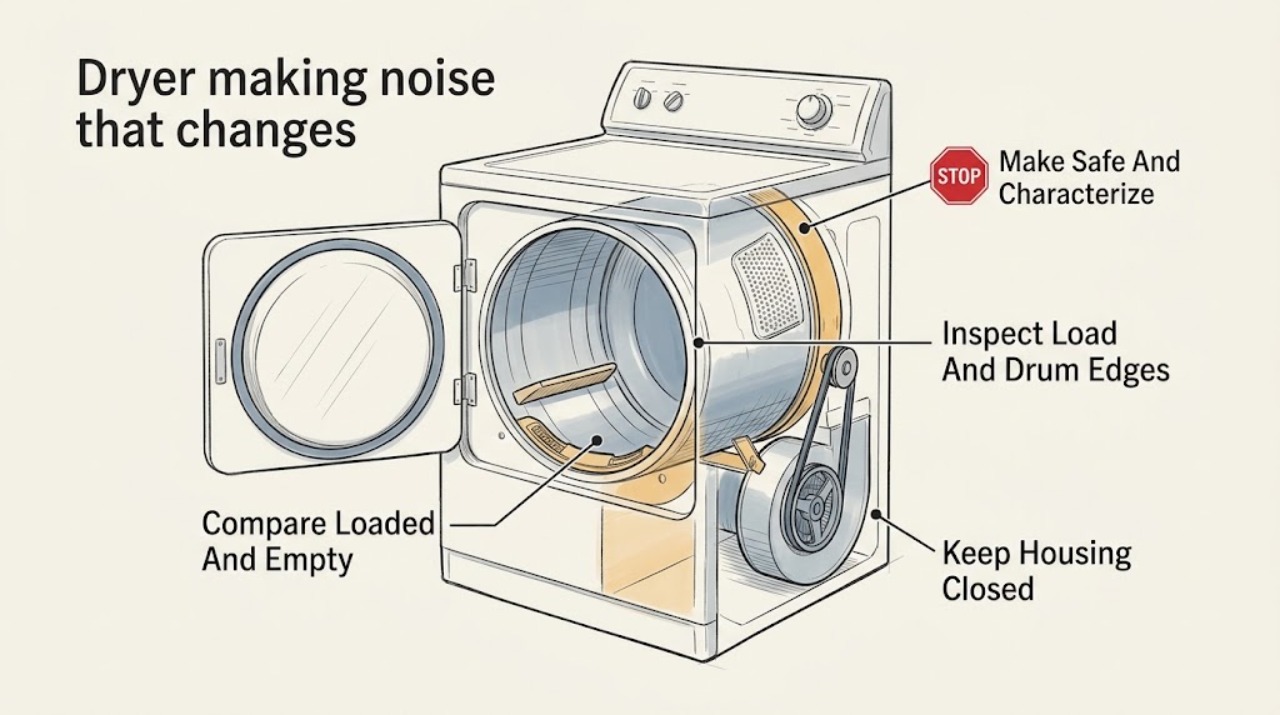
Dryer making noise that changes with drum speed: What to check next
When a dryer noise speeds up, slows down, or repeats with the rotating drum, first treat it as a rotation-related symptom rather than guessing at a single part. Stop the cycle, remove the load, and check for loose objects at the drum edges, a tangled or heavy load, contact with the cabinet or vent, and an unlevel dryer.
-
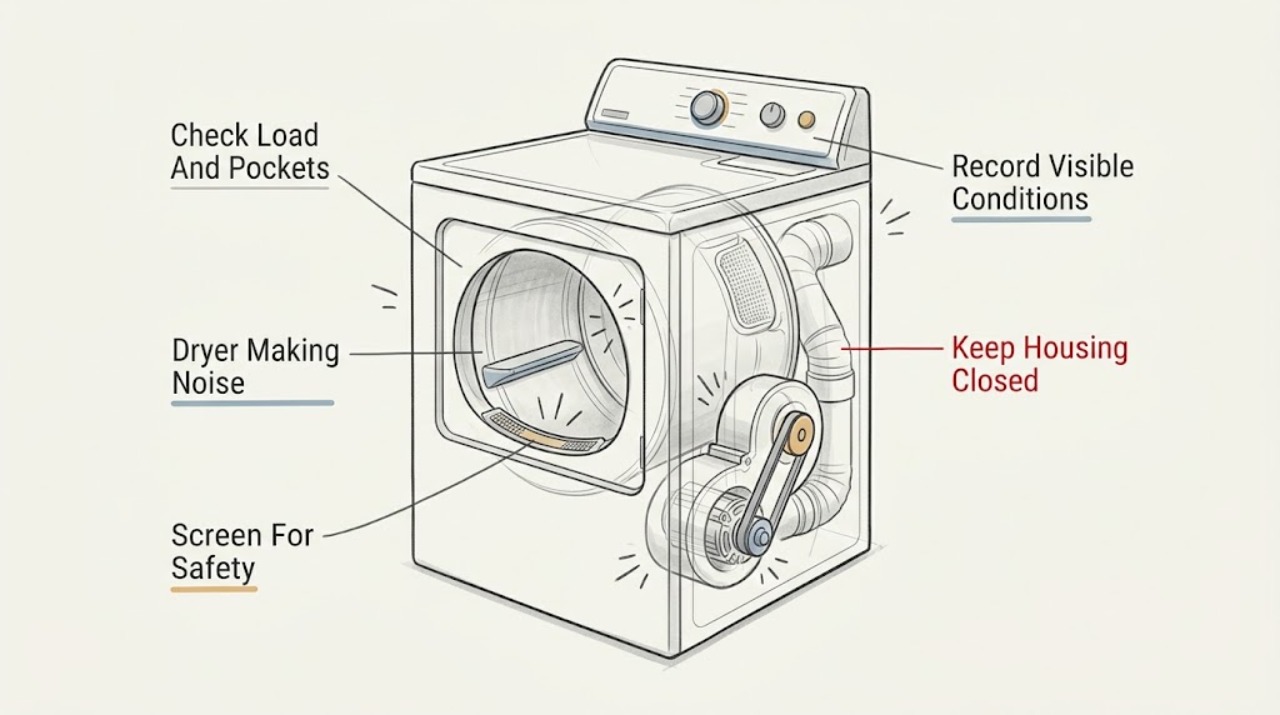
Dryer Making Noise: Identify the Sound Before Replacing Parts
A dryer making noise should be diagnosed by sound type, timing, location, and whether the drum is empty or loaded. Rattling often points to pockets, zippers, the exhaust duct, a loose object, or the cabinet touching something; thumping can come from a balled-up load, an unlevel floor, or rollers after storage; humming may be a normal blower or, on models equipped with one, a condensation pump.
-
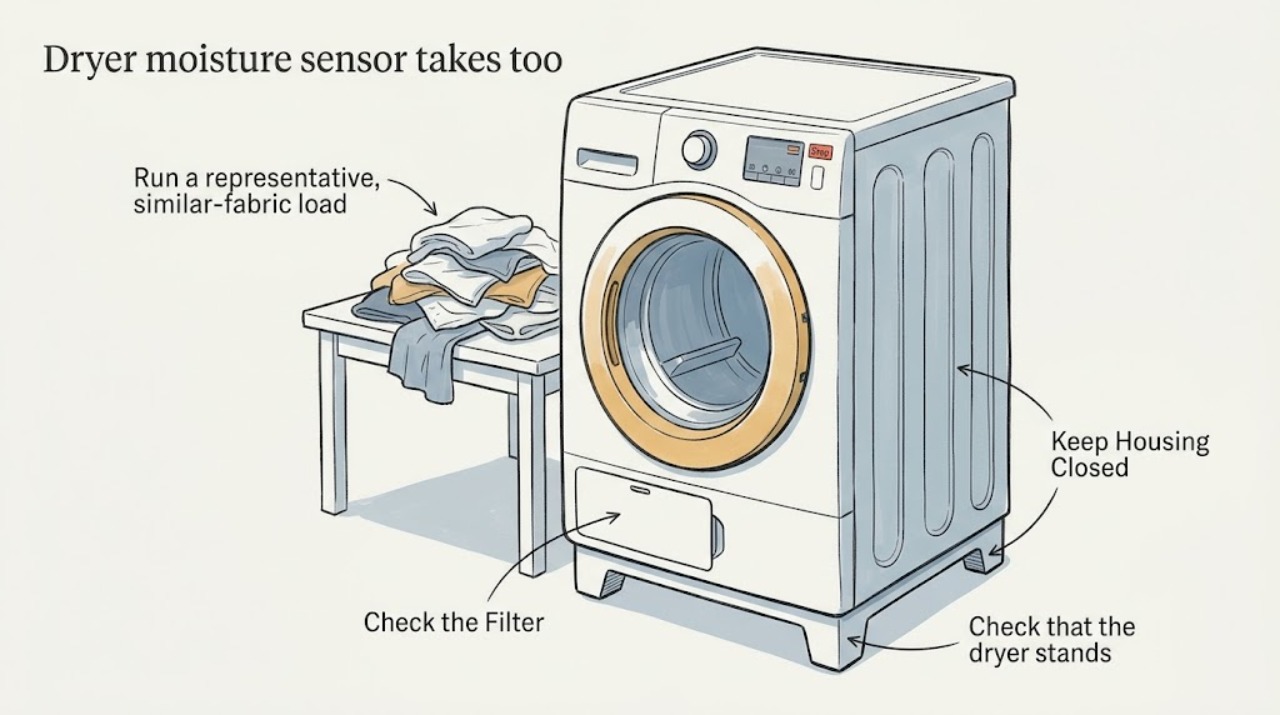
Dryer moisture sensor takes too long to dry: What to Check and What to Do Next
If a dryer takes too long on a moisture-sensing cycle, first check whether the load is actually contacting clean sensor strips and whether the dryer is level. Then check the lint filter, vent hose, outside hood, load size, and the heat result.
-
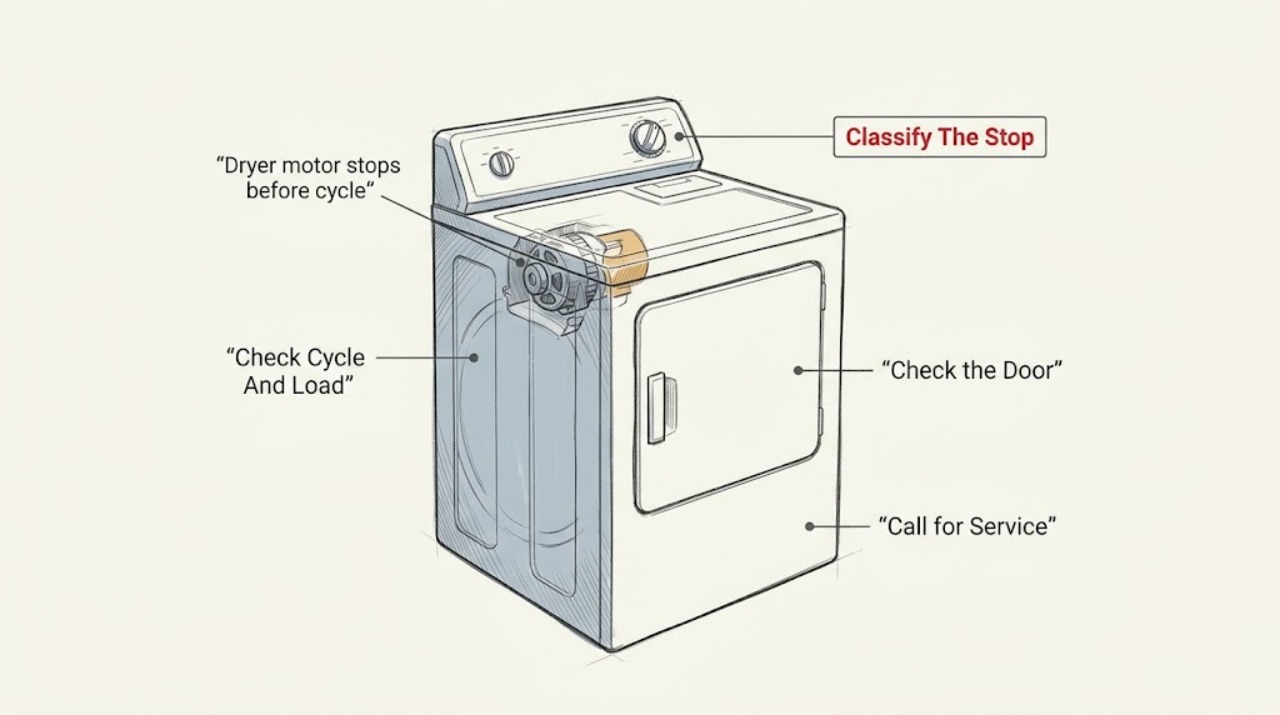
Dryer motor stops before cycle ends: What to Check and What to Do Next
A dryer that stops before the selected cycle ends may be ending normally because of an automatic moisture cycle, a door or load condition, or a timer/display behavior rather than a failed motor. First note whether the drum actually stops, whether the controls remain on, and whether the dryer restarts only after cooling.
-
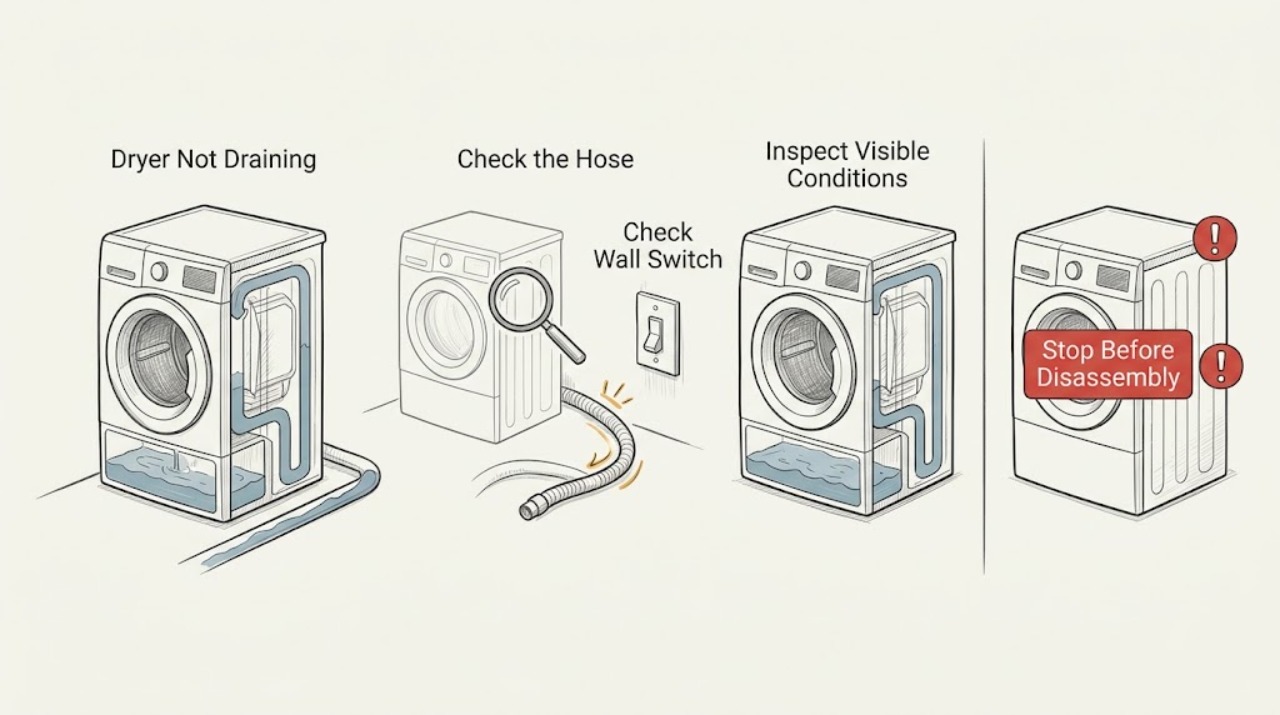
Dryer Not Draining: Identify the Dryer Type Before Checking Water Paths
First determine whether this dryer has a water path. A standard vented dryer sends moist air through an exhaust duct and normally has no condensate tank to empty; if it has no tank, drain hose, or water alert, “not draining” may actually mean clothes remain damp and the venting guide is the safer match.
-
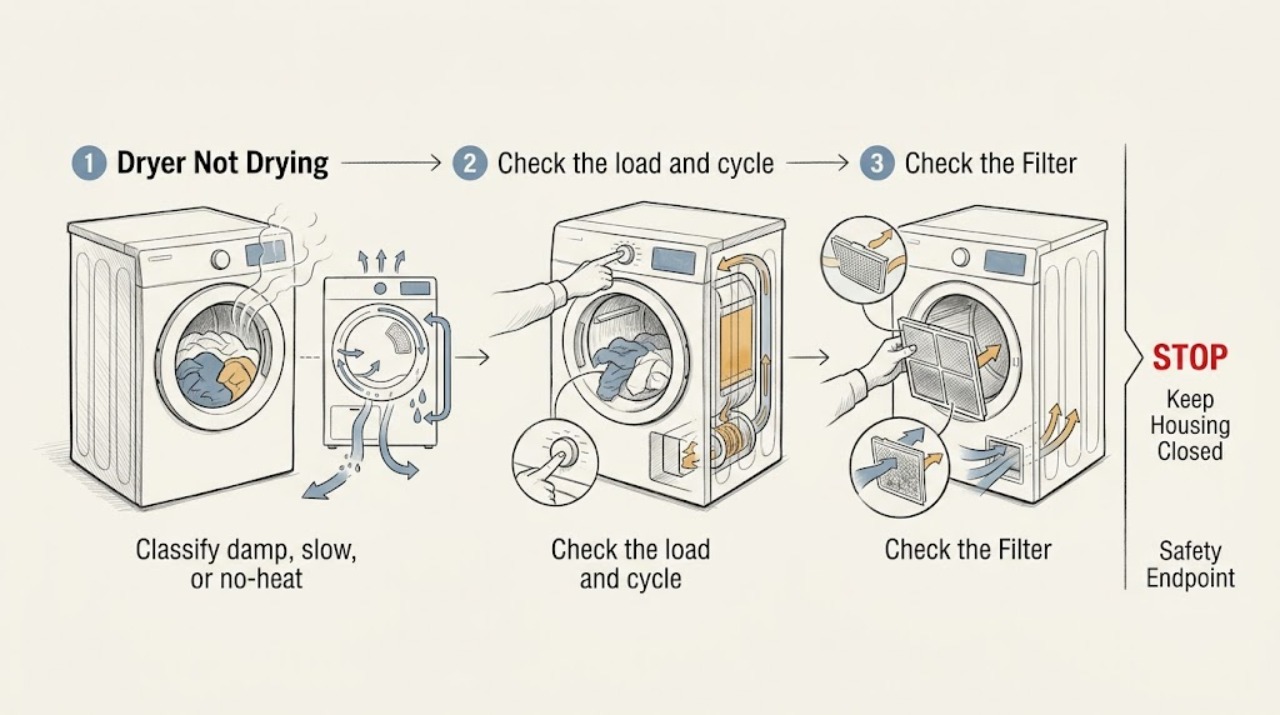
Dryer Not Drying: Separate Damp Loads, Long Cycles, and No Heat
If a dryer is not drying, first separate clothing that is still damp from a cycle that runs too long and from a dryer that produces no heat. Stop using it for smoke, a burning or gas smell, sparking, an unusually hot cabinet or connection, repeated breaker trips, or clothes that show scorching.
-
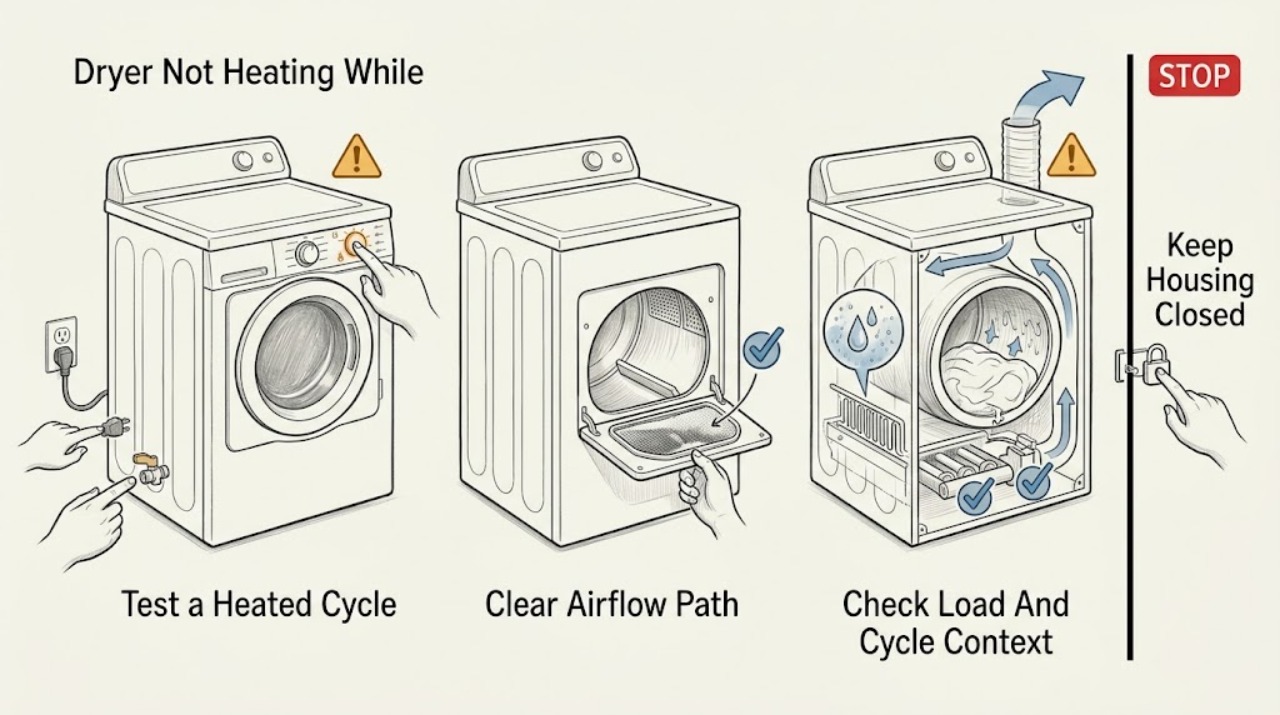
Dryer Not Heating While the Cycle Runs: What to Check and What to Do Next
A dryer can tumble and finish a cycle while producing no heat because the drum motor and heating system are separate. First verify that a heated timed cycle is selected and that the air coming from the exhaust is actually cold, not merely slow to dry.
-
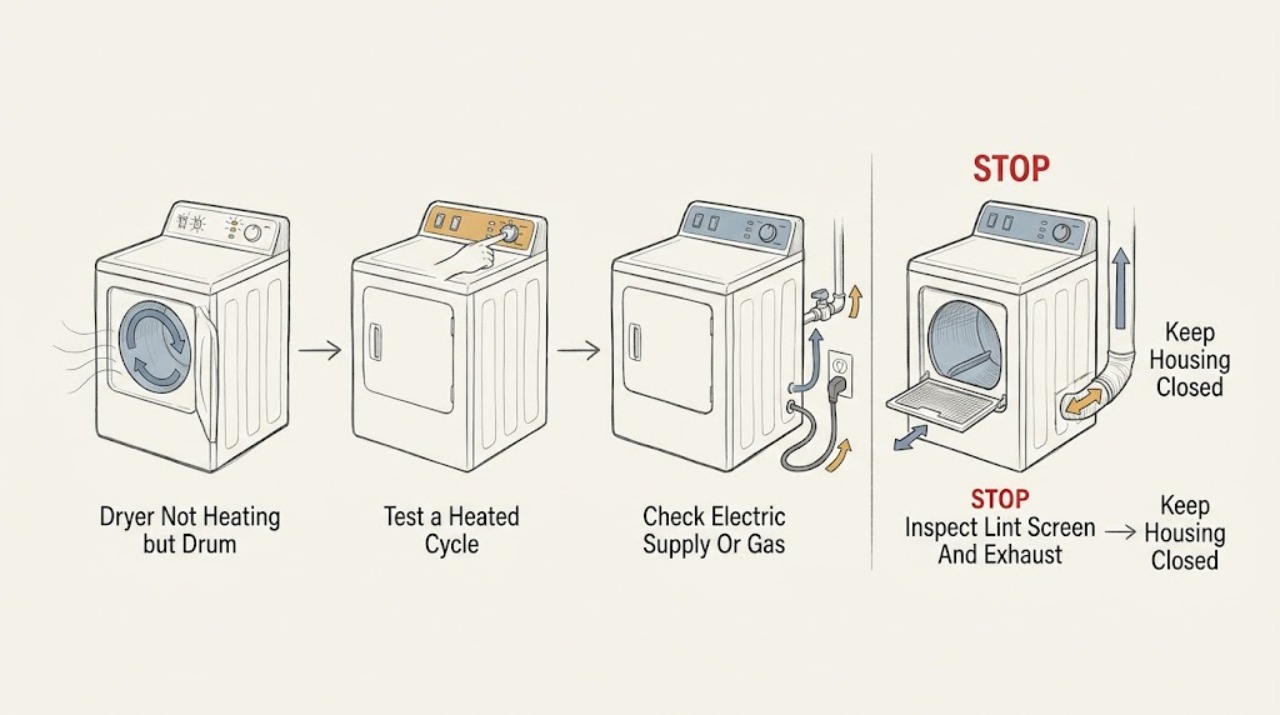
Dryer Not Heating but Drum Tumbles: What to Check and What to Do Next
When a dryer tumbles but does not heat, first confirm that a heated cycle is selected and that the symptom is not an Air Only or Fluff setting. Electric dryers can tumble when one side of the household supply is unavailable, so check for a tripped breaker only from the panel and stop if it trips again.
-
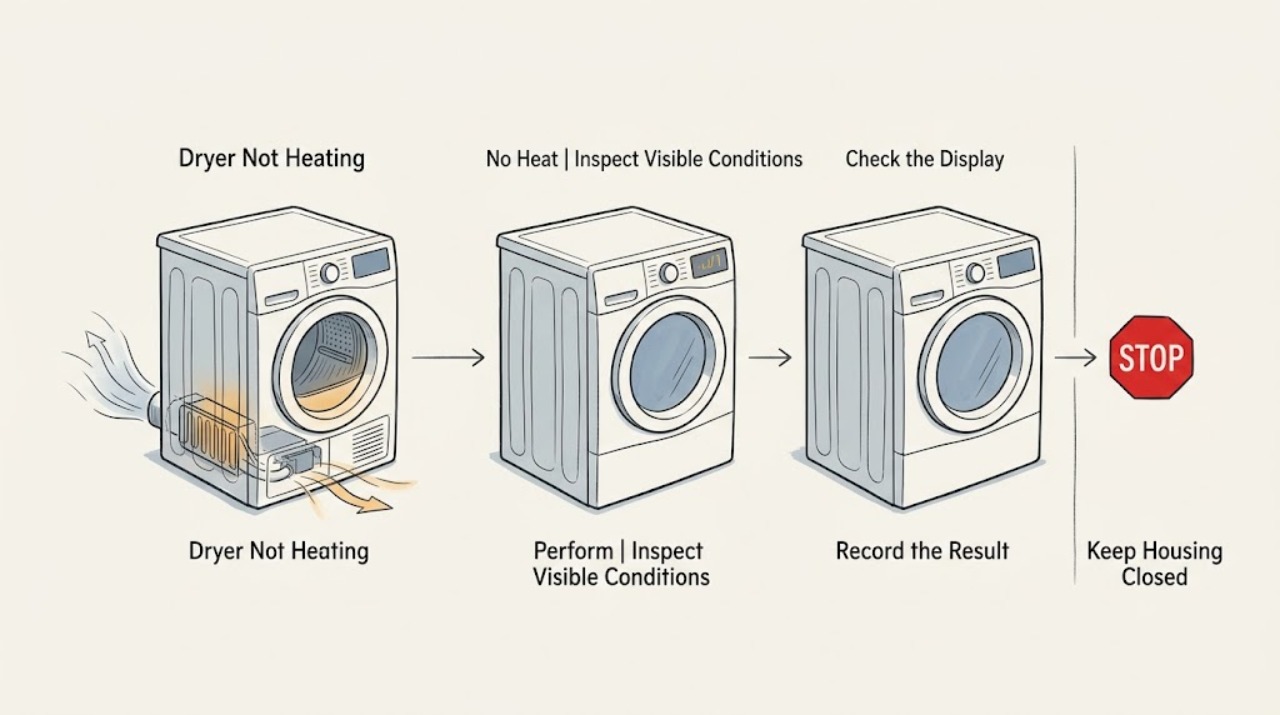
Dryer Not Heating, No Heat at Exhaust: What to Check and What to Do Next
First confirm that the dryer is on a heated cycle rather than Air Only, Fluff, cool-down, or another no-heat setting, then run a brief empty test and observe the airflow at the outside exhaust without touching hot parts. If the drum runs but the exhaust stays cold, check the correct power or gas supply, lint screen, vent hose, and outside hood.
-
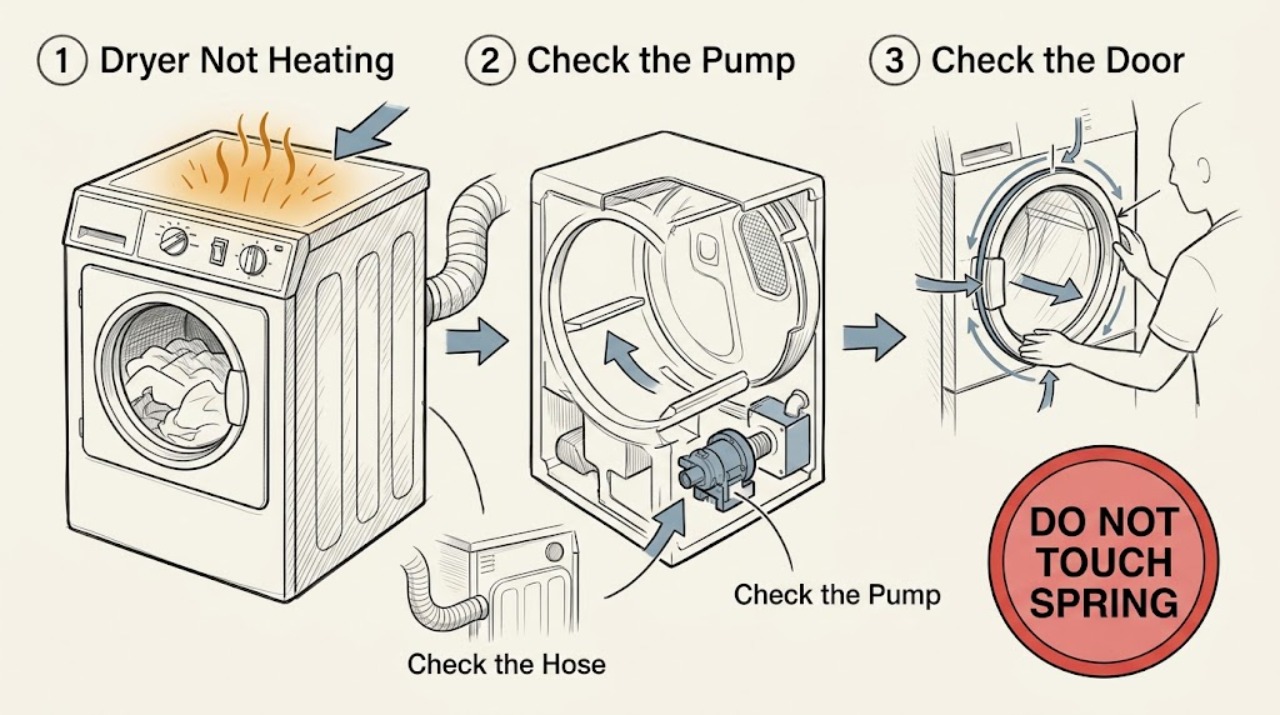
Dryer Not Heating: Check the Cycle, Airflow, Power, and Fuel Safely
If a dryer is not heating, first confirm whether it is actually running a heated cycle or an Air, Air Fluff, No Heat, or cool-down cycle. Then check the load, lint screen, visible exhaust, and accessible power connection with the dryer off and cool.
-
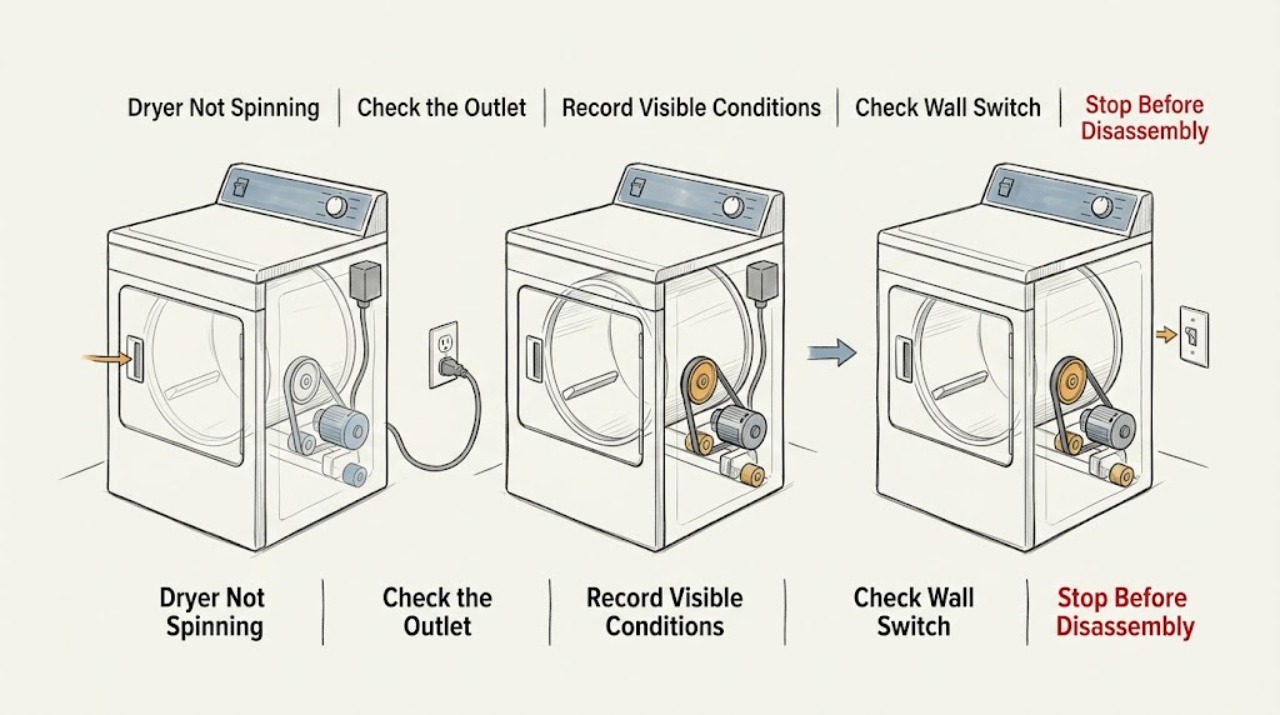
Dryer Not Spinning: Separate a Start Problem from a Drum Problem
First decide whether the dryer never starts or whether it starts and you can hear a motor or blower while the drum remains still. With the dryer empty, cool, and disconnected from power, check only the outside door, load, and accessible controls; a drum that turns unusually freely can point to a loose or broken belt, while a drum that is hard to turn can point to a drive or support problem.
-
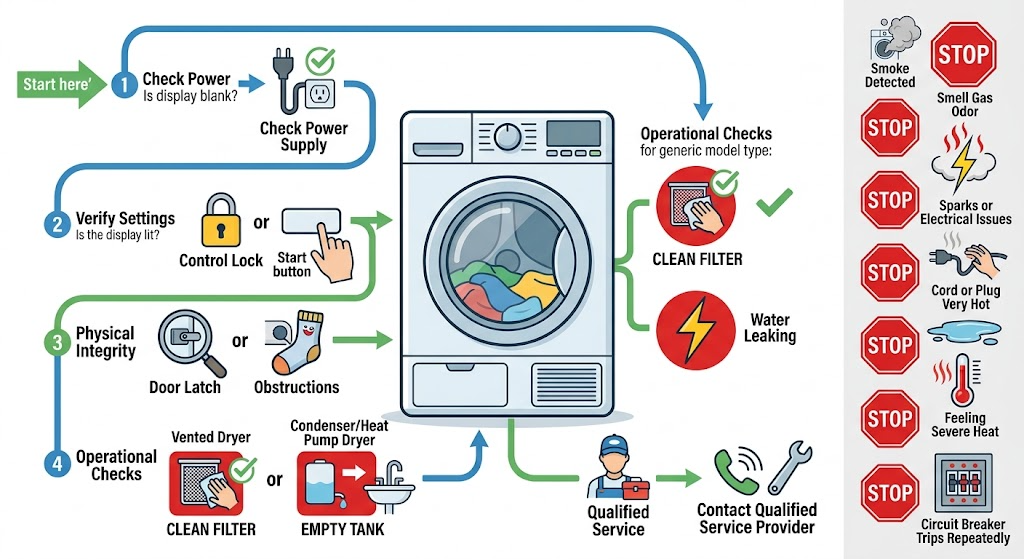
Dryer Not Starting: Separate Power, Controls, Door, and Safety Faults
First decide whether the dryer has no power at all or has a display and lights but will not start. If there is no smoke, burning smell, gas odor, sparking, water, or abnormal heat, check the plug, dedicated breaker or fuse, dry control panel, Control Lock, cycle selector, Start or Hold-to-Start input, and fully latched door.
-
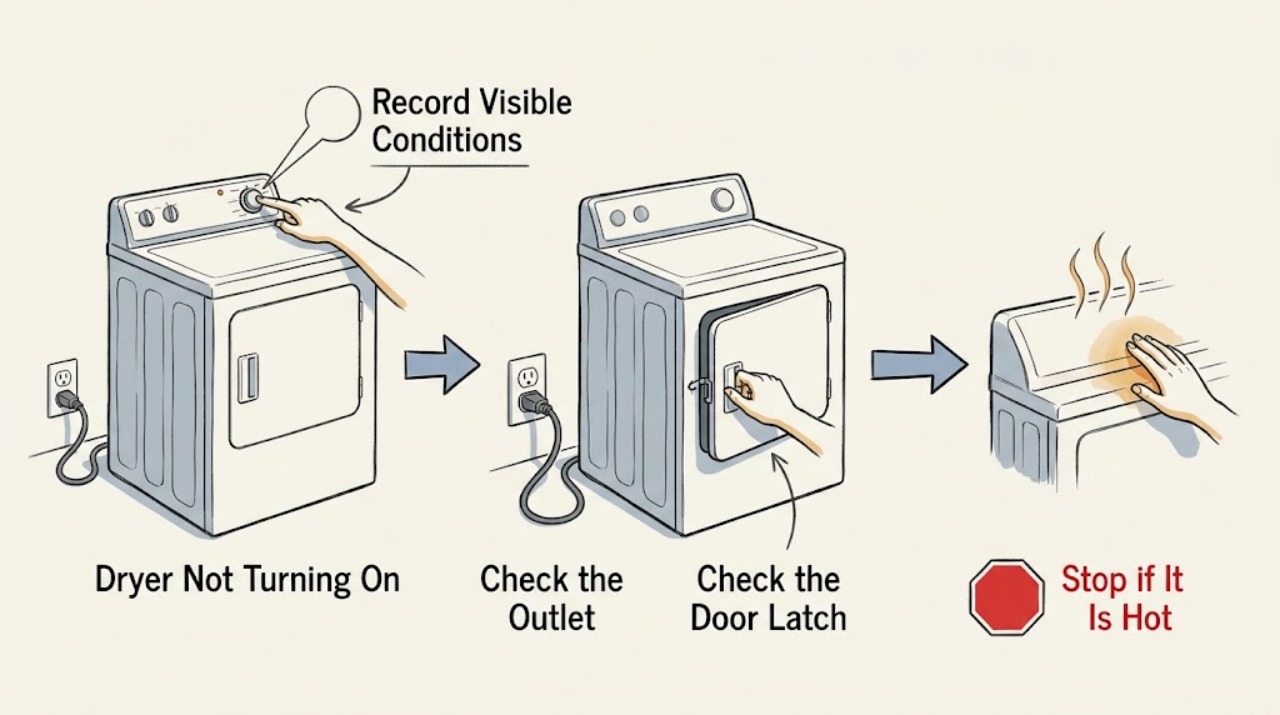
Dryer Not Turning On: Separate No Power from a No-Start Control Problem
When a dryer is not turning on, first separate a completely blank appliance from a dryer whose display or drum light works but will not start. For no power, inspect only the accessible plug, cord, outlet, and breaker or fuse status; major appliances should use a direct wall connection.
-
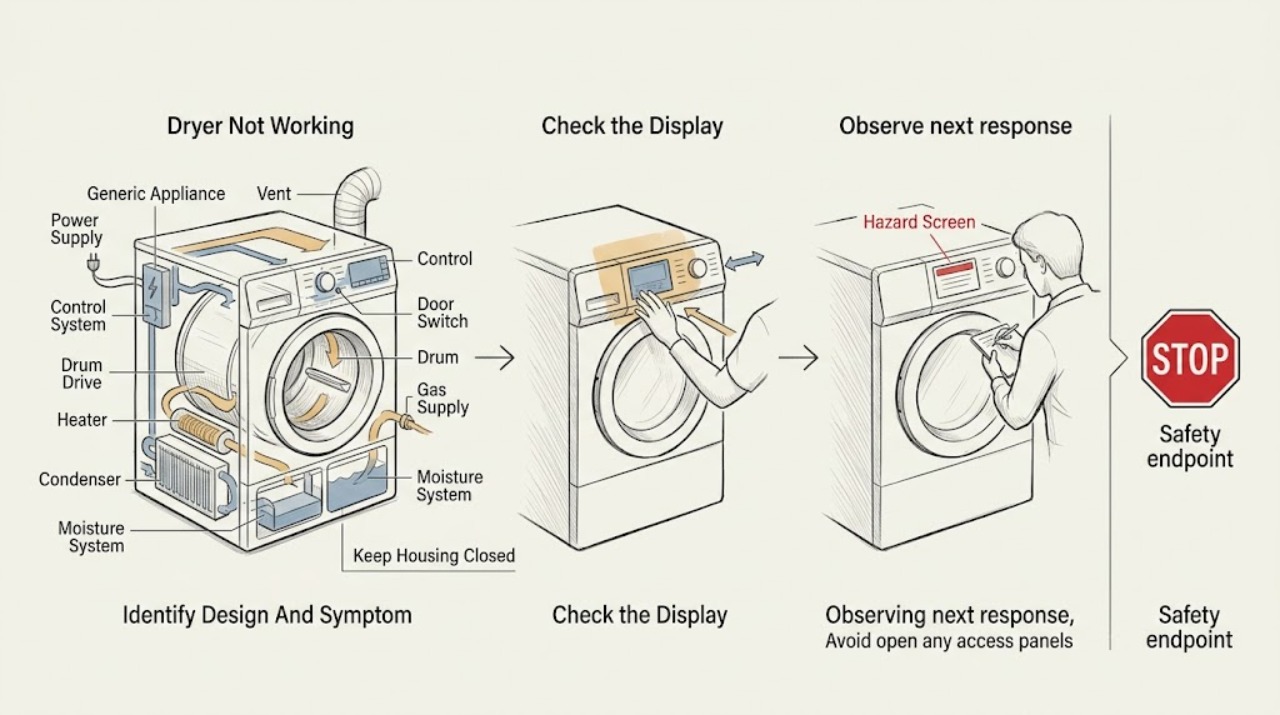
Dryer Not Working: Separate Power, Start, Heat, Airflow, and Cycle Faults
Dryer not working is a symptom, not one diagnosis. First record whether the display or drum light is dead, the dryer has power but will not start, the drum does not turn, it turns without heat, clothes stay damp, or a cycle stops or never finishes.
-
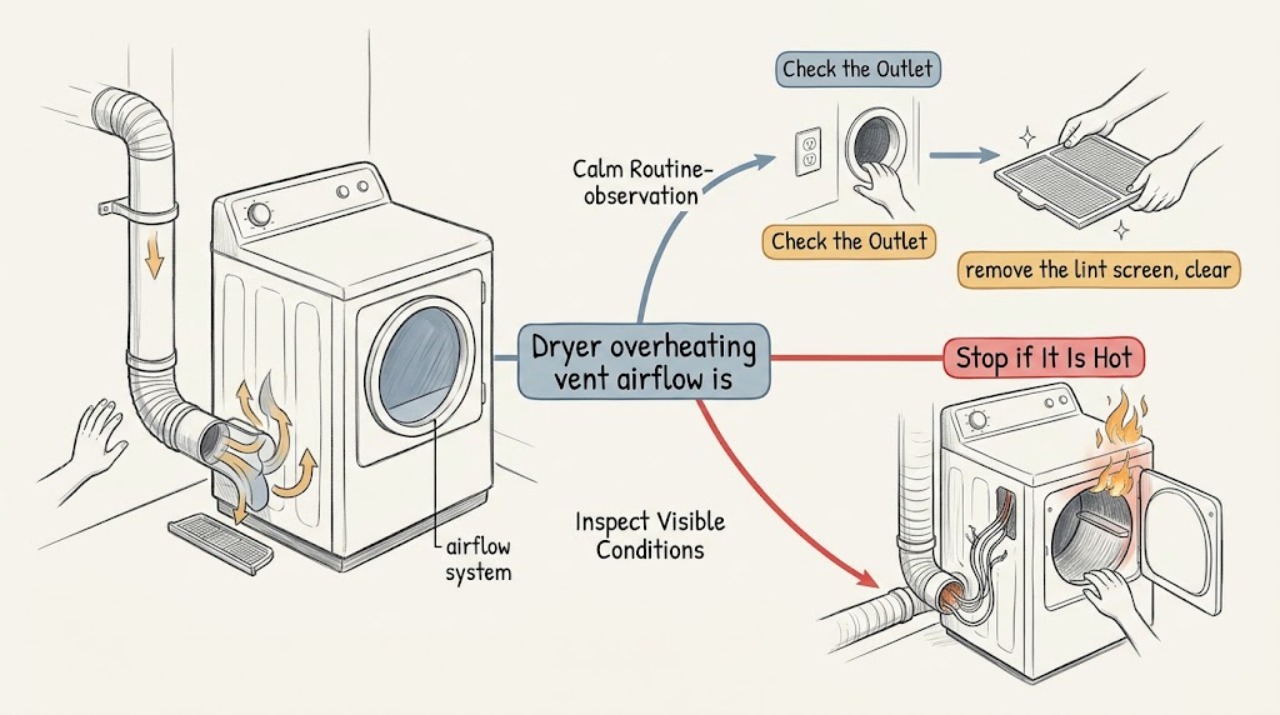
Dryer overheating vent airflow is restricted: What to Check and What to Do Next
Stop using a dryer that is overheating until its airflow is checked. Unplug it before inspecting the lint screen, the reachable vent hose, and the outside hood; look for a crushed or kinked duct, lint or debris, a stuck hood flap, weak exhaust flow, or a vent run with excessive length and bends.
-
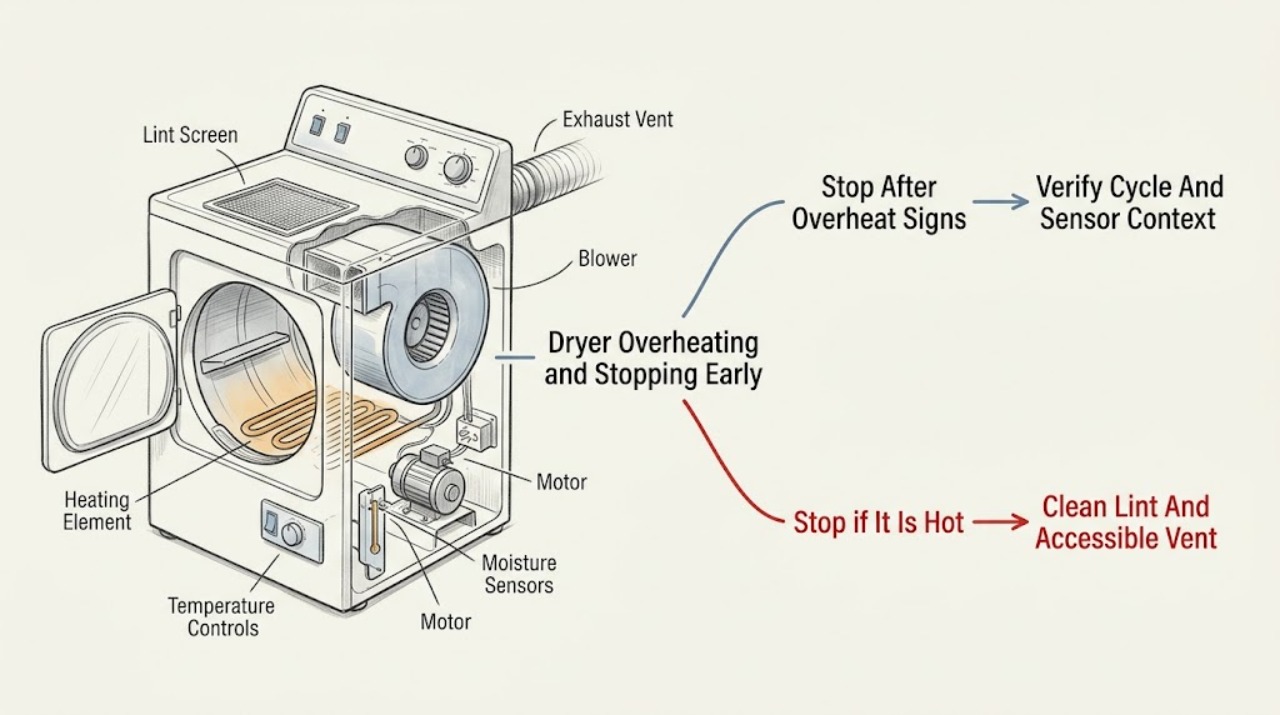
Dryer Overheating and Stopping Early: What to Check and What to Do Next
A dryer that becomes unusually hot and stops before the cycle ends may be protecting itself from restricted airflow, but an early stop can also be normal moisture-sensor behavior if the load is already dry. Stop the dryer if the cabinet or clothes are intensely hot, there is a burning smell, smoke, sparking, or a damaged cord.
-
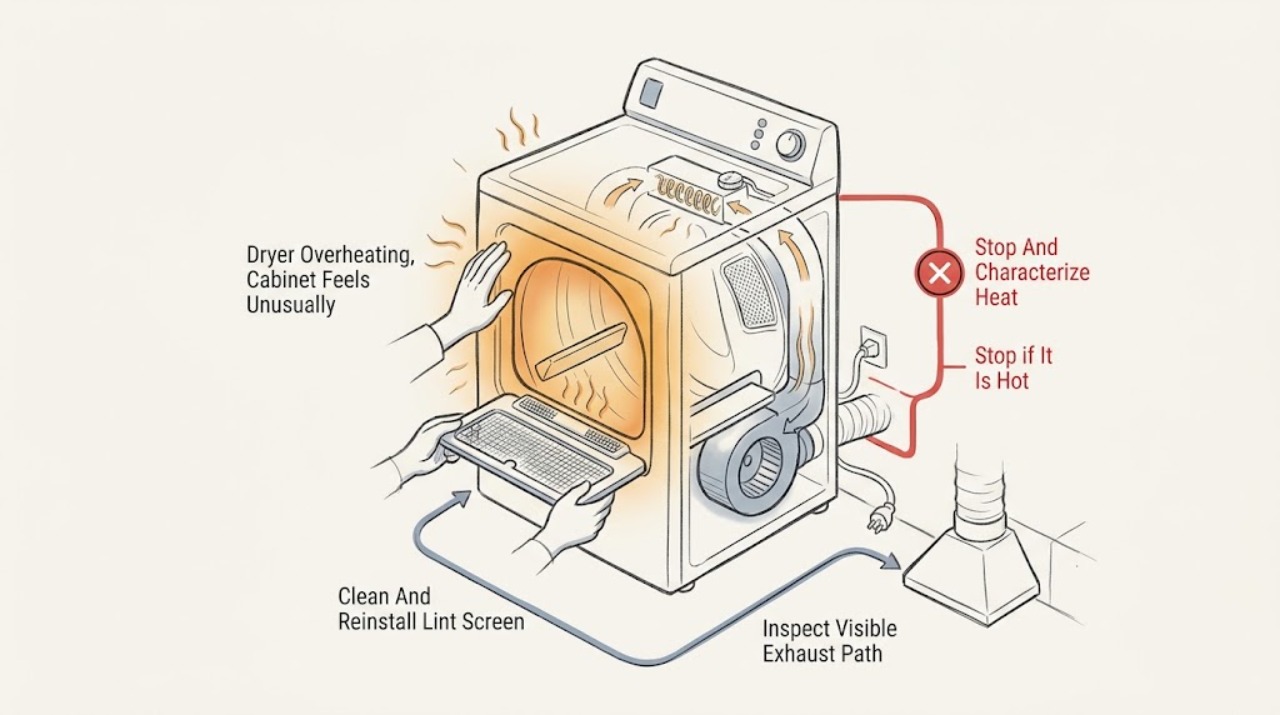
Dryer Overheating, Cabinet Feels Unusually Hot: What to Check and What to Do Next
A dryer should feel warm while operating, but an unusually hot cabinet, very hot clothes, steam, long dry times, weak outside airflow, a burning odor, or repeated shutdown is a warning to stop using it until the airflow and appliance are evaluated. Manufacturer guidance links heat staying inside the dryer to a clogged or kinked exhaust path, lint buildup, a blocked outside hood, or a failed blower; a loose, damaged, blocked, or missing lint screen can also cause overheating.
-
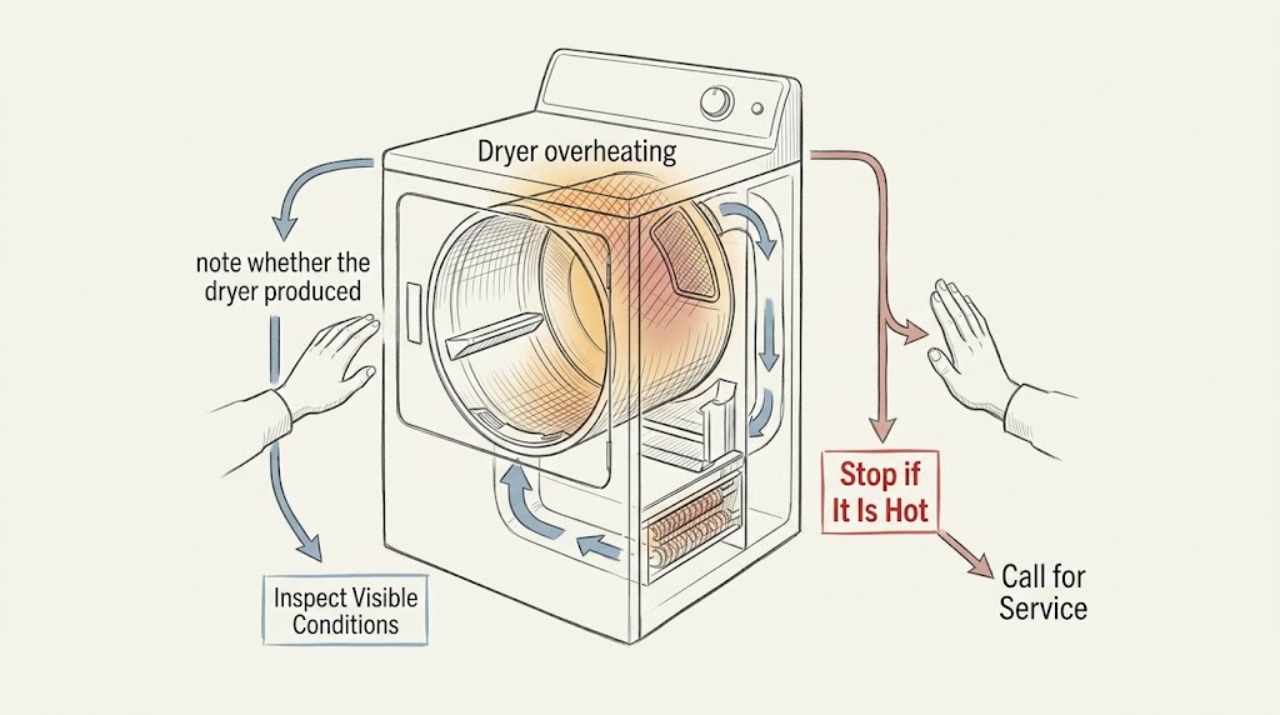
Dryer overheating: What to Check and What to Do Next
Stop using a dryer that is overheating, smells like burning, produces smoke, shows scorching, or shuts down abnormally. Do not run another test cycle or open the cabinet.
-
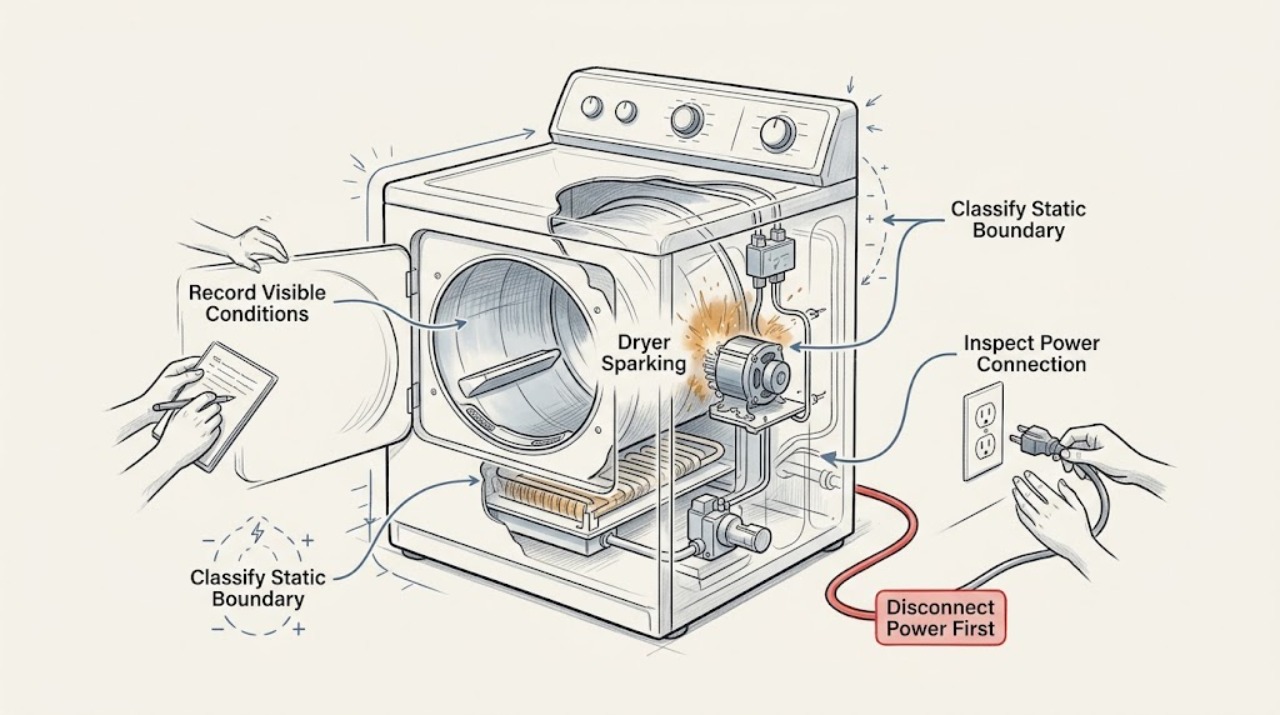
Dryer Sparking: Stop Use and Identify the Safe Next Step
A visible spark or arc from a dryer, its plug, outlet, cord, controls, cabinet, drum, or internal area is abnormal: stop the cycle, keep people away, and do not run the dryer again to see whether it repeats. If the machine is still operating and it is safe to do so from a dry position, turn its control off; isolate power only without touching a hot, wet, scorched, loose, or actively arcing connection.
-
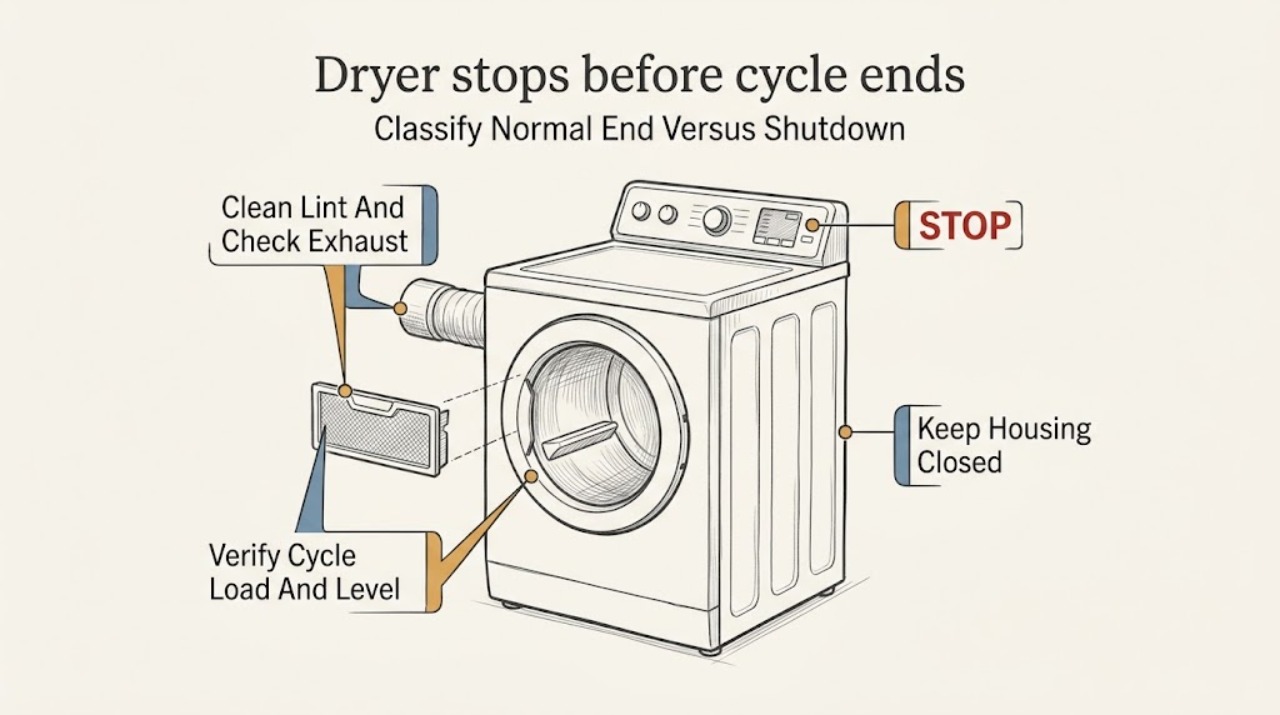
Dryer stops before cycle ends restart works after cooling: What to Check and What to Do Next
A dryer that stops before the cycle ends and works again only after cooling is not necessarily fixed: heat buildup can trigger a protective shutdown, and repeated restarting can worsen a restricted-vent, motor, drive, or control problem. First determine whether the cycle actually ended normally because a sensor cycle detected dry clothes, or whether the dryer became hot and lost power or stopped with damp clothes.
-
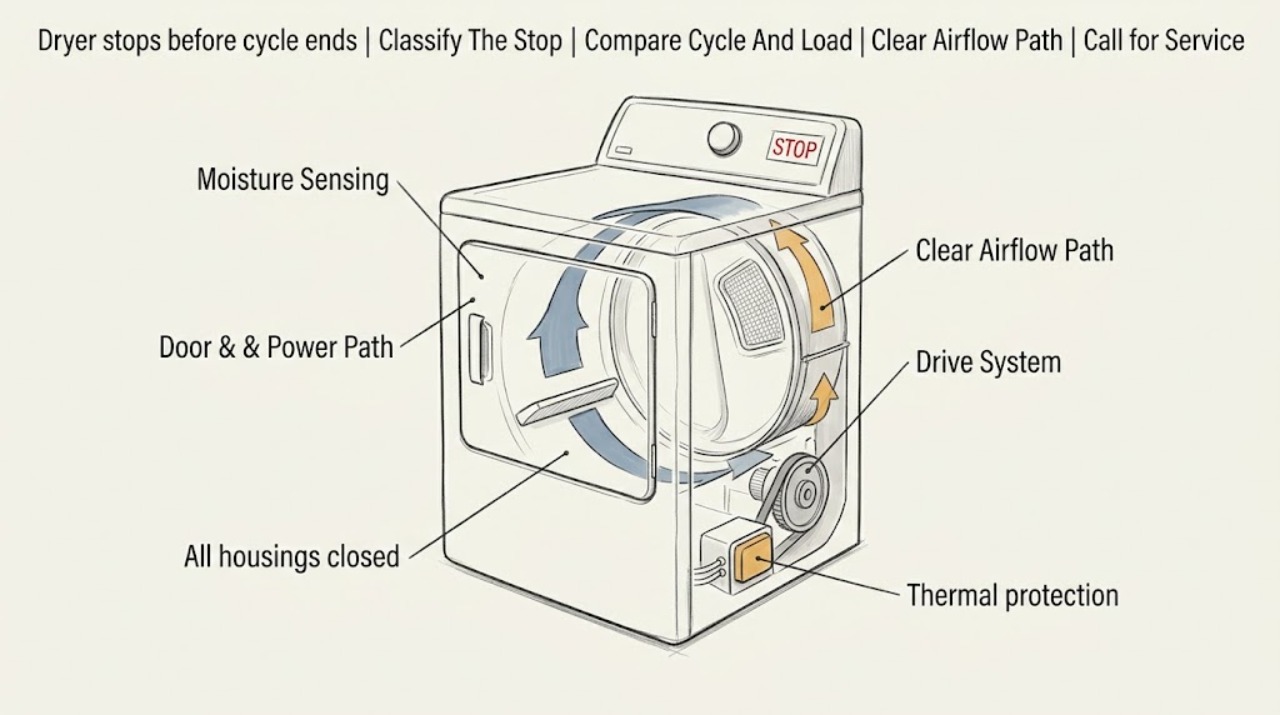
Dryer stops before cycle ends after warming: What to Check and What to Do Next
A dryer that warms and then stops before the selected cycle ends is not automatically a failed motor or thermal fuse. First separate a normal sensor-cycle decision from a true mid-cycle stop: note whether the display ends normally, whether the drum stops while controls remain active, whether clothes are damp, and whether the dryer runs again only after cooling.
-
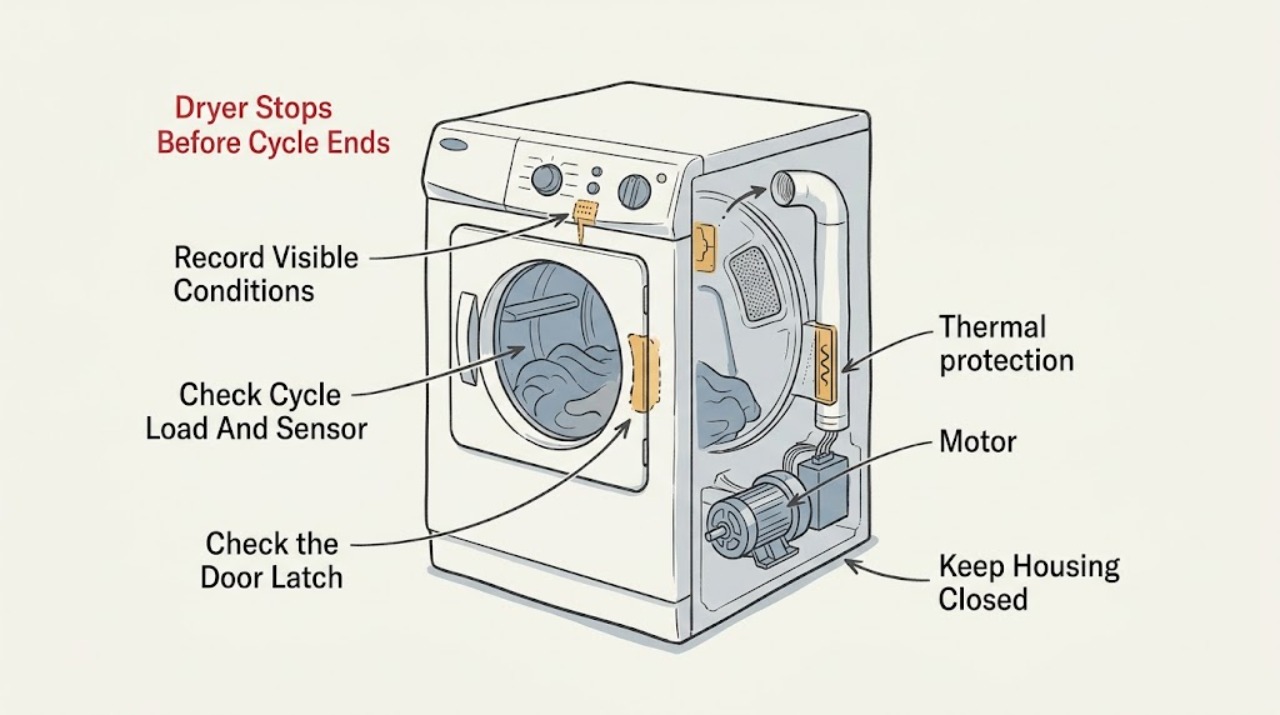
Dryer Stops Before Cycle Ends and Starts Normally: What to Check and What to Do Next
A dryer that starts normally and stops before the displayed cycle ends may be completing an automatic cycle early, losing contact with the load sensors, detecting an open door, overheating from restricted airflow, losing part of its power supply, or developing an internal motor, thermal, or control fault.