
On this page
Start here
Quick answer
If the dryer drum remains still, stop using the dryer until you know whether it is a simple start or door-latch issue or a mechanical fault. With the dryer empty and unplugged, check that the door latches, the controls are not locked, and the Start control is used as the model requires. An overloaded load of heavy wet clothes can let a drive belt slip; a drum that turns unusually freely can indicate a loose or broken belt, while a drum that is hard to turn or makes grinding or rumbling sounds can indicate seized supports or rollers. Do not run a dryer that heats without tumbling, because the drum is needed to circulate air through the load. Do not remove panels, test live wiring, bypass the door switch, or replace a belt, motor, roller, fuse, or control board based only on the symptom. Unplug the appliance and arrange qualified appliance service for a drum that still will not turn, a motor hum, burning smell, loud noise, a damaged cord, or any electrical concern.
Before you begin
Safety first
- A homeowner may remove the load, check ordinary controls and latch, and gently assess an empty drum with power disconnected. A qualified technician should handle cabinet removal, belt, motor, rollers, bearings, fuses, control boards, wiring, terminal connections, and any gas or electrical diagnosis.
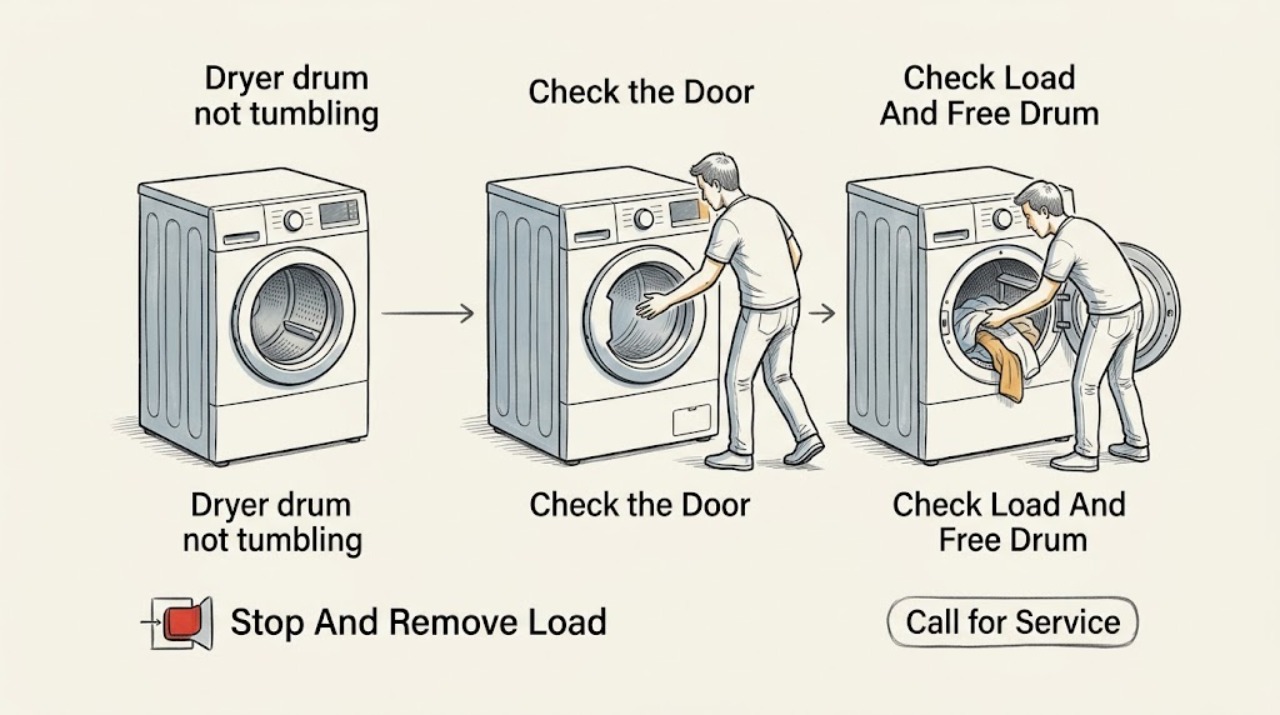
Work through in order
Diagnostic checks
Use only checks that match the exact appliance or system and its official guide.
-
Check 1
Stop the cycle, remove the clothes, and unplug the dryer before any inspection; do not start a test cycle if the drum is still, the dryer is heating, or an abnormal sound or odor is present.
Expected result: Record whether the controls were lit, whether the drum was warm, whether the motor was humming, and whether there was a burning smell, smoke, scraping, or a damaged cord or outlet.
Next step: Keep the dryer unplugged and continue only with the unloaded, external checks below. Arrange service immediately for heat without tumbling, burning odor, smoke, arcing, or cord or outlet damage.
Stop if: Do not run the dryer with a stationary drum, leave it connected while inspecting, or continue after smoke, burning odor, electrical damage, or severe noise.
Why this matters
Why: A heated but stationary drum is an immediate use boundary because the load is not being tumbled and air is not being circulated normally. A silent dark control panel is a power or control path symptom; a motor hum with no motion points toward the drive path or a restricted drum.
-
Check 2
With hands dry and the dryer still unplugged, verify that the door closes and latches fully, the Start or Push to Start control is used for the model's required press, and any Control Lock setting is off according to the owner's manual.
Expected result: Record whether the panel responds, whether the drum light or controls are on, whether the door latch feels normal, and whether a lock indicator or error remains after the ordinary control check.
Next step: Correct one obvious setting or close the door once, then perform at most one brief observation from a safe position. If the drum remains still or an error persists, unplug it and arrange service.
Stop if: Do not tape or hold the door switch closed, remove the control panel, bypass a lock, or touch terminals or wiring.
Why this matters
Why: A door that does not latch, a locked control, or an unregistered Start command can prevent a motor start without proving a broken belt. Correct controls with a still motionless drum shift attention toward power delivery or the mechanical drive.
-
Check 3
Check that the previous load was not a tightly packed mass of heavy wet items; with the drum empty and power disconnected, gently rotate it by hand without forcing it or reaching past the drum opening.
Expected result: Classify the empty drum as moving with normal resistance, turning unusually freely, difficult to turn, or making scraping, rumbling, or grinding sounds; note whether removing part of an overloaded load would change the symptom.
Next step: Do not reload or operate the dryer if the drum is free-spinning, difficult to turn, or noisy. Record the result and arrange qualified appliance service for the belt, motor, rollers, bearings, or drive path.
Stop if: Do not spin the drum aggressively, reach into hidden gaps, remove the drum, open cabinet panels, or use a tool to free a seized drum.
Why this matters
Why: A heavy wet load can make a belt slip. A drum that turns unusually freely is consistent with a loose or broken belt, while a hard-to-turn or noisy drum makes a seized drum, roller, bearing, or other support problem more likely. Hand movement cannot prove which part failed.
-
Check 4
From outside the appliance, check that the plug is fully seated and the nearby outlet and cord show no scorching, looseness, moisture, or damage; check the dryer breaker once only if the panel and area are dry and safe, without opening the dryer or touching terminals.
Expected result: Record whether the dryer has control power, whether a breaker is tripped, whether it trips again, and whether the plug, cord, or outlet is hot, discolored, loose, or damaged.
Next step: If there is no visible hazard and the breaker is clearly tripped, reset it once and observe only from a safe position. If it trips again, the cord or outlet is damaged, or the drum remains still, leave power off and contact a qualified appliance technician or electrician as appropriate.
Stop if: Do not reset repeatedly, remove the outlet or dryer terminal cover, test voltage, repair a cord, or continue with a hot, wet, scorched, or damaged power connection.
Why this matters
Why: No control power can be a supply or installation issue, while a repeat breaker trip or damaged cord indicates an electrical fault. Power to the controls with no drum motion makes the door, motor, belt, drive, support, or control path more likely.
-
Check 5
Document whether the motor hums, the drum stopped mid-cycle, the drum turns freely or binds, the dryer heats, and which controls and power checks passed; do not open the cabinet to inspect a belt or motor as a routine user test.
Expected result: Note a free drum, hard or noisy drum, motor hum without movement, no motor sound, intermittent tumbling, a control error, or heat with no tumbling.
Next step: Keep the dryer unplugged and arrange qualified appliance repair. Provide the model information, load type, timing of failure, sounds, drum movement, heat observation, power result, and photographs of any external cord or outlet damage.
Stop if: Do not operate the dryer again until the drum turns normally and the cause is resolved; do not bypass a safety device or replace a belt, motor, fuse, roller, or control board without model-specific diagnosis.
Why this matters
Why: These patterns can help a technician distinguish a belt or drive issue from motor, roller, bearing, door, power, or control causes, but they do not safely identify a part or justify a cabinet repair.
Use your observations
Decision map
Find the observation that best matches what you see, then follow the next safe action.
-
PATH 01Safety boundary
What you see
The drum turns normally when empty, but it stopped with a tightly packed load of heavy wet clothes and there are no electrical or noise red flags.
Do this next
Do not keep retrying the same load. Use a smaller balanced load only after the model guidance allows a test; stop and arrange service if tumbling does not return or the symptom repeats.
Why this path and its safety boundary
Why it matters: The load may have exceeded what the drive can move or allowed the belt to slip; this does not prove the belt is healthy.
Safety stop: Do not run a load if the dryer heats without tumbling, smells burnt, or makes a new noise.
-
PATH 02Safety boundary
What you see
With power disconnected and the drum empty, it rotates unusually freely, while the motor or controls had appeared to operate.
Do this next
Keep the dryer unplugged and arrange appliance service for the belt and drive path rather than opening the cabinet or fitting a guessed part.
Why this path and its safety boundary
Why it matters: A loose or broken drive belt is plausible, but another drive connection or drum-support issue remains possible.
Safety stop: Do not operate the dryer with a free-spinning drum or attempt to reinstall a belt without model-specific service procedure.
-
PATH 03Safety boundary
What you see
The empty drum is difficult to turn or makes scraping, rumbling, or grinding sounds.
Do this next
Leave the dryer unplugged and arrange qualified appliance diagnosis; include the sound and hand-movement observation.
Why this path and its safety boundary
Why it matters: A seized drum, failed roller, bearing, glide, or another support problem is more likely than a simple control setting.
Safety stop: Do not force the drum, lubricate an unknown part, open panels, or use the dryer to see whether noise worsens.
-
PATH 04Safety boundary
What you see
The panel is powered but Start is not registering, a Control Lock is active, or the door does not latch securely; no mechanical test has yet been made.
Do this next
Correct the setting or close the door according to the owner's manual once. If the latch, control, or error remains abnormal, unplug the dryer and arrange service.
Why this path and its safety boundary
Why it matters: A normal safety interlock or control condition can prevent tumbling without a failed belt or motor.
Safety stop: Do not defeat the door switch, pry the latch, remove the control panel, or touch wiring.
-
PATH 05Safety boundary
What you see
The controls are dark, a breaker trips again, or the plug, cord, or outlet is hot, scorched, loose, wet, or damaged.
Do this next
Leave the dryer disconnected and arrange qualified electrical or appliance service as appropriate; report the exact breaker, cord, and outlet observations.
Why this path and its safety boundary
Why it matters: A supply, installation, or electrical fault is possible and is a higher priority than a belt or drum diagnosis.
Safety stop: Do not reset repeatedly, test voltage, open terminal covers, or continue operation with an electrical warning sign.
-
PATH 06Safety boundary
What you see
The load is removed, the door and controls appear normal, power is not visibly hazardous, but the drum remains still or the motor hums without rotation.
Do this next
Keep the dryer unplugged and arrange qualified appliance repair. Provide the model, gas or electric type, timing of failure, drum movement, sound, heat, and power observations.
Why this path and its safety boundary
Why it matters: A belt, motor, idler, roller, bearing, thermal device, wiring, or control problem is possible; the external symptom cannot distinguish them safely.
Safety stop: Do not open the cabinet, bypass the door switch, test live circuits, or continue operating a dryer that does not tumble.
Helpful context
Understand the symptom
First separate a no-start from a no-tumble symptom
A control panel that stays dark, a door that is not latched, a control lock, or an unregistered Start press can prevent the motor from starting. If the dryer sounds as though the motor is running but the drum stays still, the belt or drum-drive path becomes more likely. If the drum spins freely by hand when empty, a belt may be loose or broken; if it is difficult to move or sounds rough, a support, roller, bearing, or seized-drum problem is possible. These observations narrow the path but do not identify a replacement part.
Do not test a stationary heated load
A dryer that produces heat without tumbling cannot circulate that heat normally through the clothes. Remove the load and leave the appliance off rather than walking away from a test cycle. A heavy, wet load can make a belt slip, but repeatedly retrying an overloaded or noisy machine can worsen a belt, motor, or support problem.
Keep electrical and cabinet work out of a general check
Electric dryers use a high-power supply, and gas models add fuel and combustion considerations. A homeowner can verify ordinary controls and look for obvious load or latch conditions, but power-cord terminals, thermal devices, motors, belts, pulleys, rollers, bearings, and control boards are behind model-specific service procedures. Unplug the dryer and arrange qualified appliance repair when safe external checks do not restore tumbling.
Safety boundary
Stop conditions
- Do not operate a dryer that heats while the drum remains still; leave it off until tumbling and the cause are resolved.
- Unplug the dryer before maintenance or cleaning, and stop for smoke, burning odor, arcing, a hot or damaged cord, or a tripped breaker that returns.
- Do not open cabinet panels, test live wiring, bypass the door switch or control lock, or handle a motor, belt, fuse, pulley, roller, or bearing as a general check.
- Do not force a seized or noisy drum, keep retrying an overloaded load, or run the appliance to see whether a mechanical noise worsens.
- Arrange qualified appliance service when the drum remains still after safe load, door, control, and power checks, or when the drum spins freely, binds, or hums.
When checks do not resolve it
Need a professional?
Arrange qualified appliance repair when the drum remains still after the load, door, controls, and safe power checks; when it spins freely, binds, or makes grinding or rumbling sounds; when the motor hums without movement; or when the dryer heats without tumbling. Use a qualified electrician for a damaged outlet, cord, or recurring breaker problem.
Safety scope: A homeowner may remove the load, check ordinary controls and latch, and gently assess an empty drum with power disconnected. A qualified technician should handle cabinet removal, belt, motor, rollers, bearings, fuses, control boards, wiring, terminal connections, and any gas or electrical diagnosis.
Common questions
FAQ
Why is my dryer heating but the drum is not tumbling?
Stop using it and unplug it. A heated stationary load is not being tumbled or circulated normally; a belt, motor, support, or control fault is possible and needs service rather than repeated testing.
What does it mean if the empty dryer drum spins freely?
A drum that turns unusually freely with power disconnected can be consistent with a loose or broken belt, although another drive fault is possible. Keep the dryer unplugged and arrange model-specific service.
Can an overloaded dryer stop the drum from turning?
Yes. GE notes that a heavy wet load can cause a drive belt to slip. Do not keep retrying the same load; if tumbling does not return or the dryer is noisy or heated without tumbling, arrange service.
Could the door latch or Control Lock keep the dryer from tumbling?
Yes. A door that is not fully latched, an unregistered Start press, or an active Control Lock can prevent a start. Correct only the ordinary setting or latch condition according to the manual, and do not bypass the switch.
What should I tell the dryer repair technician?
Provide the model and gas or electric type, whether the failure began at startup or mid-cycle, whether heat or a motor hum was present, how the empty drum moved, any noise, and the results of the safe door and power checks.
Read the exact guide
Official sources
- 10 Reasons Your Dryer Won’t Spin & How to Fix ItWhirlpool · Dryer no-spin causes including door, controls, breaker, belt, motor, seized drum, rollers, and control board
- Dryer - Drum Does Not TurnGE Appliances · Dryer drum not turning, overloaded heavy load, free drum and belt clue, and service boundary
- How to Fix a Dryer That Won’t SpinMaytag · Dryer no-spin belt, motor, seized drum, rollers, door latch, controls, breaker, and do-not-use service guidance
- How To Fix a Dryer That Won't Start: Troubleshooting GuideMaytag · Dryer Start control, power, door latch, cycle options, control lock, and service boundary
- Not Tumbling or Spinning - DryerWhirlpool Product Help · Dryer no-tumble power, Start control, moisture on controls, power-cord installation, and professional electrical boundary
Community feedback
Share a repair observation
Share a plain-text repair observation. Accepted observations are published automatically; this page may take a moment to update.