
On this page
Start here
Quick answer
If the dryer door closes but the drum does not tumble, first verify that the cycle is actually starting, the controls are not locked, and the dryer has power. With the dryer unplugged or otherwise disconnected from power, remove a heavy or tightly packed load and turn the drum gently by hand only as the model instructions allow. A drum that turns unusually freely can indicate a loose or broken drive belt; a drum that is difficult to move can indicate a seized drum or support problem. If you hear the motor but the drum stays still, a belt or drive path is more likely; if the dryer is silent, power, controls, door-switch, motor, or control issues remain possible. Do not open the cabinet, reach into the motor area, or continue running a dryer that heats without tumbling. Arrange qualified appliance service for a persistent no-tumble condition, unusual noise, burning smell, smoke, or repeated breaker operation.
Before you begin
Safety first
- This article covers external controls, power status, latch observation, a power-disconnected hand-movement check, and one brief outside listening observation only. Do not open the cabinet, handle live wiring, or operate a stationary heated drum.
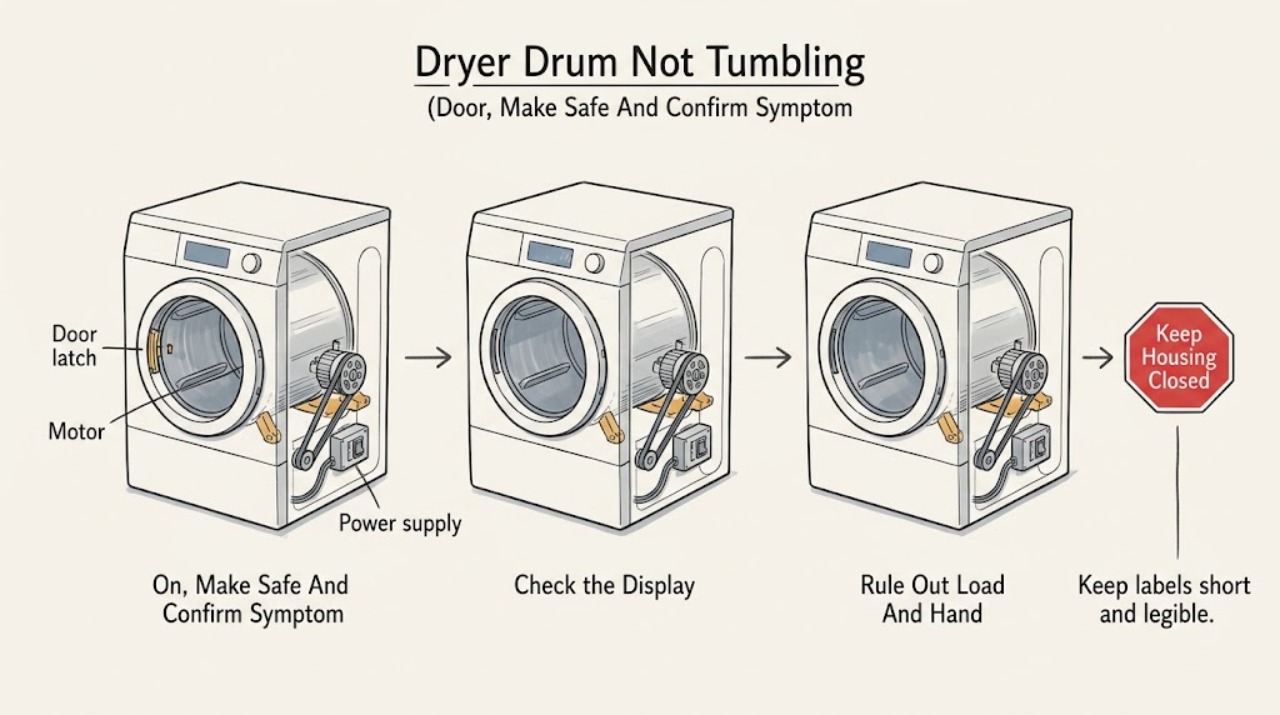
Work through in order
Diagnostic checks
Use only checks that match the exact appliance or system and its official guide.
-
Check 1
Stop the dryer, remove the load only when safe to handle, and disconnect power before any inspection or cleaning. Confirm that the door closes and latches without force, then note whether the drum failed from the start or stopped during a cycle.
Expected result: The door closes and latches normally, the drum stopped mid-cycle, the drum never started, or the dryer has heat, odor, smoke, or an abnormal sound.
Next step: Keep the dryer disconnected while proceeding to external power and control checks. For smoke, burning odor, sparking, or severe noise, leave the dryer out of service and arrange prompt help.
Stop if: Do not reach into a moving drum, operate a dryer that heats without tumbling, or continue after smoke, burning odor, sparking, or an electrical trip.
Why this matters
Why: A closed door makes a simple open-door condition less likely but does not prove that the door switch or control registered the latch. A mid-cycle stop raises motor, belt, roller, thermal, or power-protection possibilities; heat without tumbling is unsafe to continue.
-
Check 2
From outside the appliance, verify that the display or drum light has power, the control lock is not active, the selected cycle is one that turns the drum, and the start command is entered exactly as the model manual describes. Check the plug and household breaker or fuse only from the normal user-accessible locations.
Expected result: The display is blank, the control lock is active, the start command is not registering, the cycle is correct but the drum stays still, or a breaker or fuse has operated.
Next step: Correct only an accessible lock, cycle, start, plug, or breaker condition allowed by the manual. If the breaker operates again or the dryer remains dead, stop and arrange qualified appliance or electrical service.
Stop if: Do not remove the terminal cover, test live voltage, replace a fuse with an unverified type, or repeatedly reset a breaker that trips.
Why this matters
Why: A blank display or operated supply can prevent the motor from starting even when the door closes. A lock, incorrect cycle, or unregistered start command can mimic a mechanical failure. A correct powered start with no tumble shifts attention toward the drive system or motor.
-
Check 3
With power disconnected and the drum empty, remove any heavy or tightly packed load and rotate the drum gently by hand only from the normal opening, without tools or cabinet access.
Expected result: The drum turns with ordinary resistance, turns unusually freely, is difficult or impossible to move, or makes scraping, rumbling, or grinding sounds.
Next step: Do not reconnect power to test a drum that binds, scrapes, or turns abnormally freely. Record the result and arrange qualified service; if the drum moves normally, continue only with the external start observation.
Stop if: Do not force the drum, reach behind it, remove the baffle, insert tools, or open the cabinet to inspect the belt or rollers.
Why this matters
Why: An overloaded wet load can make a belt slip. A drum that turns unusually freely can indicate a loose or broken belt, while binding or grinding can indicate seized supports, rollers, glides, or a drum obstruction. Hand movement alone cannot distinguish every internal failure.
-
Check 4
After all prior checks are complete and the area is safe, make one brief start attempt from outside the closed dryer while listening and watching only through the normal window or opening. Stop immediately if the dryer heats without tumbling, makes a severe sound, or smells hot.
Expected result: The motor is silent, the motor hums or runs while the drum remains still, the drum starts then stops, or the drum turns but makes rumbling or scraping noise.
Next step: Stop the dryer and disconnect power for any abnormal pattern. Provide the sound and movement result to a technician rather than opening the cabinet or ordering a belt from sound alone.
Stop if: Do not run a no-tumble dryer with heat, keep repeating start attempts, reach through the door, or remove panels while powered.
Why this matters
Why: Silence can involve power, controls, door-switch feedback, motor, or board. Motor sound with no drum movement makes the belt or drive path more likely. Start-then-stop or rumbling points toward motor protection, support, obstruction, or control faults.
-
Check 5
With the dryer disconnected, inspect only the lint screen area and the visible exhaust outlet for obvious lint accumulation or an external obstruction, and remove loose lint from the normal user-accessible screen. Do not treat vent cleaning as a substitute for a no-tumble repair.
Expected result: The lint screen or visible outlet is obstructed, airflow was normal, or the dryer heated while the drum did not move.
Next step: Restore the lint screen only as the manual directs and leave the dryer unused until the tumbling fault is diagnosed. Arrange qualified service for internal belt, motor, roller, control, or electrical work.
Stop if: Do not operate without the required lint screen, insert tools into the exhaust, open the rear cabinet, or continue a heat cycle with a stationary drum.
Why this matters
Why: Restricted airflow can add heat stress, but it does not explain every no-tumble pattern. Heat without tumbling is a stop-use condition regardless of vent appearance because clothes are not being circulated through the drum.
-
Check 6
Record the dryer model number, gas or electric type, door-latch result, display and power status, cycle and control-lock state, load size, hand-movement result, motor sound, noise, heat, odor, and breaker behavior before requesting service.
Expected result: The record shows a powered but silent dryer, a running motor with a still drum, abnormal hand resistance, a mid-cycle stop, or a safety symptom.
Next step: Keep the dryer disconnected when the drum does not tumble and arrange qualified appliance service; call an electrician when the external supply or breaker behavior is abnormal.
Stop if: Do not select or install an internal part from the symptom record alone, and do not resume use until the no-tumble cause is repaired and tested safely.
Why this matters
Why: These patterns help a technician separate control and power checks from belt, motor, roller, drum-support, or seized-drum diagnosis without requiring the user to expose internal parts.
Use your observations
Decision map
Find the observation that best matches what you see, then follow the next safe action.
-
PATH 01Next step
What you see
The door closes, but the display is blank, the control lock or cycle selection prevents a start, the start command does not register, or the breaker or fuse has operated.
Do this next
Correct only the accessible documented setting or supply condition once. If the dryer remains dead or the breaker operates again, leave it out of service and arrange qualified appliance or electrical service.
Why this path and its safety boundary
Why it matters: Power, control, door-switch feedback, or cycle selection is more likely than a broken belt, although the closed door alone does not prove the switch is working.
-
PATH 02Next step
What you see
The dryer has power and accepts the cycle, the motor can be heard, but the drum does not move; with power disconnected, the drum also turns unusually freely.
Do this next
Do not operate the dryer or open the cabinet. Arrange qualified service to inspect the belt, idler, pulley, drum supports, and motor drive and confirm the exact part.
Why this path and its safety boundary
Why it matters: A loose or broken drive belt or another drive-path failure is more likely than a door-latch problem.
-
PATH 03Next step
What you see
With power disconnected, the empty drum is difficult to move or makes scraping, rumbling, or grinding sounds, or the drum starts and stops with severe noise.
Do this next
Leave the dryer disconnected and arrange qualified diagnosis. Do not force the drum or continue a cycle that can heat a stationary load.
Why this path and its safety boundary
Why it matters: A seized drum, worn roller, glide, bearing, obstruction, or motor overload is more likely than a simple control setting.
-
PATH 04Next step
What you see
The drum fails with a heavy or tightly packed wet load but turns and tumbles normally when empty or lightly loaded after the load is reduced.
Do this next
Use the load limits and cycle guidance in the exact manual. Stop using the dryer if it slips, overheats, smells hot, or fails to tumble with a normal load.
Why this path and its safety boundary
Why it matters: Load weight or packing may have caused belt slip or motor overload, but recurrence with ordinary loads still needs service.
-
PATH 05Next step
What you see
The dryer heats while the drum remains still, produces smoke or burning odor, makes a severe abnormal sound, or repeatedly trips the breaker.
Do this next
Stop the cycle, disconnect power when safe, keep the area clear, and arrange prompt qualified appliance or electrical service. For smoke or fire, leave the area and contact emergency help from a safe location.
Why this path and its safety boundary
Why it matters: This is an immediate stop-use condition involving potential heat concentration, mechanical damage, or electrical fault; a closed door does not make continued operation safe.
Helpful context
Understand the symptom
A closed door confirms only one part of the start sequence
A dryer can appear closed while the latch, cycle selection, control lock, or start command still prevents the motor from running. Confirm the door is latched without forcing it, then check the display and cycle controls. If the control responds but the drum remains still, use the power and drum-movement observations to separate a supply or control problem from a mechanical drive problem.
The drum movement and motor sound provide different clues
With power disconnected, a drum that turns too freely is a different pattern from a drum that binds or will not move. During a brief start attempt from outside the closed cabinet, a humming or running motor with no drum movement points toward the belt or drive path, while silence can leave power, controls, door-switch, motor, or board causes open. These observations do not identify a replacement part by themselves.
Do not use a no-tumble dryer as a heat-only appliance
The drum circulates clothes through the heated airflow. Continuing to run a dryer that heats while the drum remains still can leave a concentrated hot load and further stress components. Stop the cycle and disconnect power before any maintenance or inspection; cabinet, belt, motor, roller, and electrical work belong to qualified service.
Safety boundary
Stop conditions
- Do not run a dryer that heats while the drum remains stationary, and do not keep repeating start attempts.
- Disconnect power before maintenance or inspection; do not open the cabinet, reach into the motor area, or test live wiring.
- Do not force a drum that binds, scrape or pry internal supports, or order a belt, motor, roller, or board from the symptom alone.
- Stop for smoke, burning odor, sparking, severe grinding or rumbling, a hot electrical smell, water near electrical parts, or a repeated breaker trip.
- Leave a persistent no-tumble condition out of service until qualified diagnosis confirms a safe repair and test.
Only after diagnosis
Potential parts
- dryer drive belt
Consider this category only when qualified diagnosis confirms a loose, broken, or slipping belt or drive-path problem after the drum and motor observations.
Confirm the exact dryer model, belt length, routing, idler arrangement, and manufacturer fit information before ordering. - dryer drum roller or glide
Consider this category only when binding, rumbling, scraping, or support wear is confirmed as the cause of the no-tumble condition.
Confirm the exact model, support position, roller or glide design, shaft, and any required matched set before ordering. - dryer drive motor or idler pulley
Consider this category only when the motor or belt-tension path is isolated by qualified diagnosis after power, load, and drum movement checks.
Confirm exact model, motor rotation and connector, pulley arrangement, electrical rating, and technician diagnosis before ordering. - dryer door switch or electronic control
Consider this category only when the door closes but qualified testing shows that latch feedback or the control is not sending the motor command.
Confirm the exact model, switch or board configuration, wiring, and required safety checks; do not bridge the switch.
When checks do not resolve it
Need a professional?
Arrange qualified appliance service when the dryer has power and accepts a cycle but the drum remains still, turns unusually freely, binds, makes abnormal noise, stops mid-cycle, or heats without tumbling. Call an electrician when the external outlet, cord, breaker, or fuse behavior is abnormal. Stop immediately for smoke, burning odor, sparking, severe noise, or repeated breaker operation.
Safety scope: This article covers external controls, power status, latch observation, a power-disconnected hand-movement check, and one brief outside listening observation only. Do not open the cabinet, handle live wiring, or operate a stationary heated drum.
Common questions
FAQ
Why does my dryer door close but the drum not tumble?
A closed door rules out only an obviously open door. The dryer may still have a control-lock, cycle, start, power, door-switch, belt, motor, roller, seized-drum, or control-board problem. Check external controls and power, then use a power-disconnected hand-movement observation.
What does it mean if the dryer motor runs but the drum does not move?
A running or humming motor with a stationary drum makes a loose or broken belt or another drive-path problem more likely. Stop the dryer, disconnect power, and arrange qualified service rather than opening the cabinet or ordering a belt from sound alone.
Should the dryer drum turn freely by hand?
With power disconnected and the drum empty, it should not be forced or inspected with tools. An unusually free drum can indicate a belt problem, while binding or grinding can indicate a support, obstruction, or seized-drum problem. Either abnormal pattern needs service.
Can an overloaded dryer stop the drum from tumbling?
A heavy, wet, or tightly packed load can overload the drive or cause belt slip. Remove some items and use the model's load guidance, but stop using the dryer if it still fails with an ordinary load, smells hot, or heats without tumbling.
Can I use a dryer if it heats but the drum is not spinning?
No. The drum must circulate the load through the heated airflow. Continuing to run a stationary heated drum can concentrate heat and damage components. Stop the cycle, disconnect power when safe, and arrange qualified service.
When is a no-tumble dryer an electrical emergency?
Stop immediately for smoke, burning odor, sparking, severe grinding or rumbling, a hot electrical smell, water near electrical parts, or a breaker that trips again. Disconnect power when safe, keep people away, and seek qualified appliance or electrical help; contact emergency services for fire or immediate danger.
Read the exact guide
Official sources
- TROUBLESHOOTINGWhirlpool · Owner-manual reference for a specific Whirlpool dryer family; it is used to reinforce model-specific instructions and the distinction between drum movement and heat.
- Why is my dryer not spinning?Whirlpool · Manufacturer consumer guidance for Whirlpool dryers used to separate no-tumble patterns; exact model instructions and qualified service control repair.
- Not Starting or Not Operating - DryerWhirlpool Product Help · Manufacturer troubleshooting guidance for Whirlpool dryer start conditions; controls and cycle names vary by model.
- Dryer - Drum Does Not TurnGE Appliances · Manufacturer guidance for GE dryers used for general diagnostic patterns; the exact dryer model controls access and repair procedure.
Community feedback
Share a repair observation
Share a plain-text repair observation. Accepted observations are published automatically; this page may take a moment to update.