
On this page
Start here
Quick answer
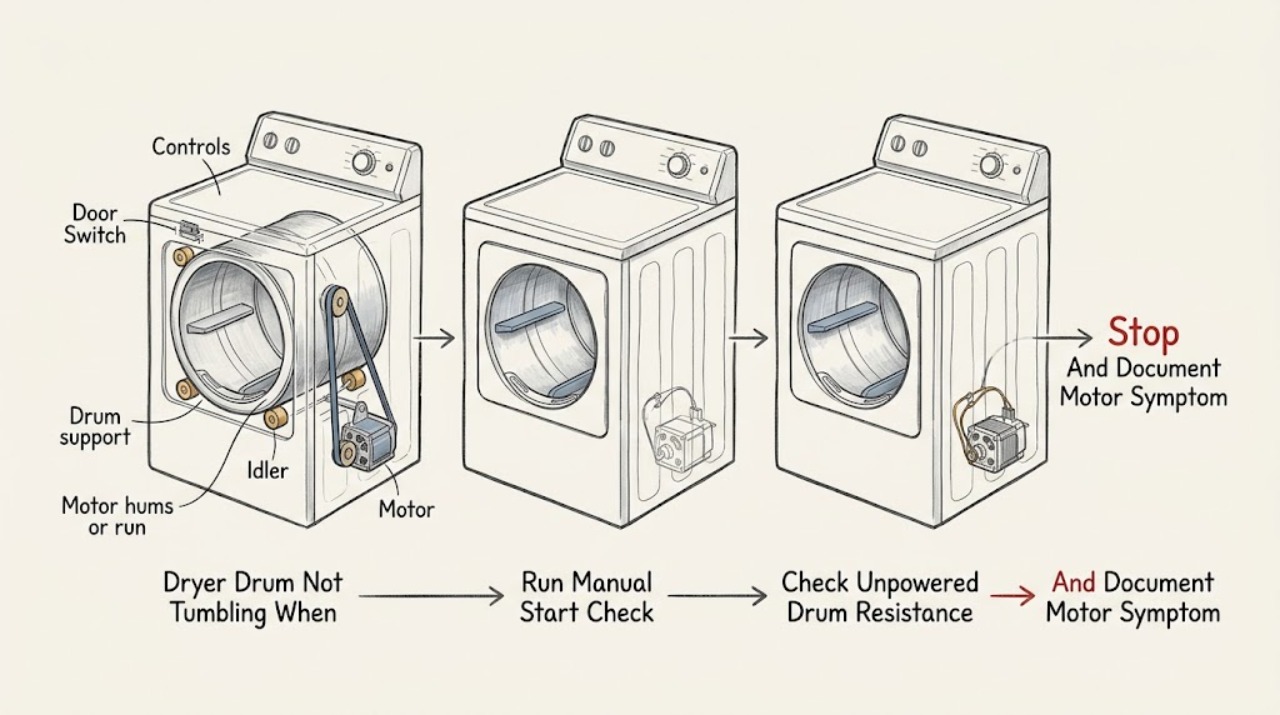
If a dryer motor hums or continues running while the drum does not tumble, stop using the dryer and first confirm that a cycle really started, the door is latched, and the drum is not overloaded or seized. With the dryer powered off, a drum that turns unusually hard points toward a support or seized-drum problem; a drum that turns normally while the motor runs makes a broken or disengaged drive belt, idler, or another drive-path fault more likely. Do not run the dryer with the drum stationary, remove panels, reach near a moving belt or motor, or test live wiring. Record whether the drum stopped mid-cycle, whether the motor runs with the door open or closed, and any grinding or burning smell, then arrange qualified appliance service for internal drive, motor, electrical, or control diagnosis.
Work through in order
Diagnostic checks
Use only checks that match the exact appliance or system and its official guide.
-
Check 1
Stop the dryer, remove the load, and note whether the drum stopped during a cycle or never started. Check from outside that the door closes and latches, the control lock is not active, and the selected cycle is intended to run the drum. Do not open the cabinet or continue a heated cycle while the drum is stationary.
Expected result: The timer does not advance, the door or lock prevents the cycle from starting, the timer advances while the motor hums or runs, or the drum stopped after initially tumbling.
Next step: Correct only a clearly displayed control-lock or door-closure condition using the owner's manual. If the cycle is active and the drum still does not move, keep the dryer off and continue only with the unpowered drum check; arrange service if the motor keeps running without tumbling.
Stop if: Do not defeat the door switch, operate the dryer with the door open, or restart a heated cycle to see whether the drum eventually moves.
Why this matters
Why: A timer that does not advance or a door/lock condition can prevent a cycle from starting even though a sound is heard. A timer that advances while the drum remains still confirms a mechanical or drive-path symptom. A mid-cycle stop makes a belt, motor, overload, or support problem more likely than a simple start-setting issue.
-
Check 2
After the dryer is off and disconnected from power from a dry, safe position, remove any clothing and gently rotate the drum by hand through part of a turn. Use only light hand force and stop if it binds, scrapes, or will not move; do not reach behind the drum or try to free a jam by force.
Expected result: The empty drum turns with ordinary resistance, turns very hard or will not turn, scrapes or rumbles, or has noticeable side-to-side looseness.
Next step: Leave the dryer off in all cases. Document the feel and sound for service; do not remove panels or attempt to replace an internal support or drive component based on this check alone.
Stop if: Do not rotate the drum while power is connected, use tools to force it, or put hands near a belt, pulley, blower, or motor.
Why this matters
Why: A drum that is hard to turn or binds makes a seized drum, support, roller, bearing, or obstruction more likely. Rubbing or rumbling points toward a support component. A drum that turns normally makes a disconnected or broken belt, idler, motor, or control-path problem more likely when the motor runs.
-
Check 3
Only if the drum turns normally by hand, there is no burning smell, sparking, damaged cord, or breaker issue, and the owner's manual permits a brief test, select a simple timed cycle, close the door, and hold Start for the model-specified interval while watching from outside. Stop immediately if the motor hums without drum movement or the sound becomes abnormal.
Expected result: The timer advances and the drum tumbles, the timer advances but the drum stays still while the motor runs, the timer does not advance, or the dryer makes grinding, squealing, or burning sounds.
Next step: Stop the test and keep the dryer off when the motor runs without tumbling or any abnormal sound or odor appears. Give service the timer behavior, motor sound, load status, and unpowered-drum result rather than repeating the test.
Stop if: Do not run repeated tests, operate with panels removed, bypass a switch, or continue if the motor stalls, overheats, sparks, or smells burned.
Why this matters
Why: A normal tumble during this controlled check can indicate an intermittent drive or load issue, but it does not prove the dryer is safe for routine use. Timer movement with motor sound and no drum movement strongly favors a drive-path fault; no timer movement favors controls, door sensing, or start-input issues. Abnormal noise or odor raises the urgency of service.
-
Check 4
From outside the appliance, record the dryer type, whether the drum was empty or heavily loaded, whether the issue began after moving or installation, and whether the power cord or outlet shows visible heat or damage. For an electric dryer, do not open the terminal area; use a qualified electrician for suspected supply or cord problems.
Expected result: The issue occurs only with a heavy load, began after installation or relocation, the cord or outlet is damaged or hot, a breaker trips, or the motor hums with an empty drum and normal power signs.
Next step: Do not use the dryer until a qualified appliance technician or electrician evaluates a damaged cord, hot outlet, breaker trip, incorrect installation, or persistent no-tumble condition. Provide the model, gas or electric type, and symptom history.
Stop if: Do not reset a repeatedly tripping breaker, change wiring, open the terminal box, or use an extension cord to continue testing.
Why this matters
Why: A load-dependent symptom can expose a weak drive path, while a post-installation or damaged-power symptom requires installation or electrical evaluation. A motor that hums with an empty drum and normal visible power is more consistent with an internal drive or motor fault than an overloaded load.
Use your observations
Decision map
Find the observation that best matches what you see, then follow the next safe action.
-
PATH 01Next step
What you see
The timer does not advance, the door does not latch, or a control-lock or error indication prevents the timed cycle from starting.
Do this next
Use the owner's manual for the displayed control or door condition. If the timer still will not advance with a properly latched door, stop and arrange appliance service.
Why this path and its safety boundary
Why it matters: The motor sound may not be the drum drive running; a start command, door-sensing, lock, or control issue is more likely than a broken belt.
-
PATH 02Next step
What you see
The empty drum rotates with ordinary resistance when unpowered, the timer advances, and the motor hums or runs without the drum tumbling.
Do this next
Keep the dryer off and have qualified appliance service inspect the drive path and motor; do not run it without the drum turning because airflow and heat distribution are abnormal.
Why this path and its safety boundary
Why it matters: The belt, idler, motor-to-drum drive, or another internal drive component is more likely than a seized drum. The motor sound alone cannot identify which component failed.
-
PATH 03Next step
What you see
The unpowered drum binds, is difficult to rotate, scrapes, rumbles, or has unusual looseness, whether or not the motor can be heard.
Do this next
Leave the dryer disconnected and arrange appliance service for mechanical inspection. Report the resistance and sound; do not force the drum or open the cabinet to search for the obstruction.
Why this path and its safety boundary
Why it matters: A seized drum, worn rollers, bearing or support, blower obstruction, or another mechanical restriction is more likely. Continuing to energize the motor can add damage or heat.
-
PATH 04Next step
What you see
The cord or outlet is hot or damaged, a breaker trips, the problem began after installation or relocation, or the dryer shows an electrical error.
Do this next
Stop using the appliance and obtain qualified electrical or appliance service. Do not keep resetting the breaker or attempt terminal or control-board work.
Why this path and its safety boundary
Why it matters: Power-supply, wiring, installation, or control problems can overlap with a no-tumble symptom and are not safe to diagnose by opening the dryer.
Helpful context
Understand the symptom
The motor sound does not prove that the drum drive is working
The motor can run while the drum is disconnected from it, or it can hum against a mechanical load it cannot overcome. That is why the useful split is whether the drum turns freely when the appliance is off, whether the cycle timer advances, and whether the motor sound continues. A normal drum feel with a running motor points toward the belt or another drive-path component; a stiff drum points toward support, roller, bearing, or obstruction concerns.
Limit the check to controls and the unpowered drum
Dryer models differ in how the belt, rollers, idler, motor, and door switch are arranged. A user can document the symptom and perform the manual-approved start and unpowered-drum checks, but internal access requires the model's service procedure and electrical safety controls. If the dryer smells hot, sparks, trips a breaker, or the motor runs without drum movement, leave it off.
Only after diagnosis
Potential parts
- dryer drive belt
Only consider this category when the motor runs, the empty drum turns normally by hand, and service confirms a broken, loose, or disengaged belt.
Confirm the exact dryer model and belt routing in the manufacturer's service information; do not infer fit from belt length or appearance. - dryer drum rollers, glides, or bearing support
Only consider this category when the unpowered drum binds, scrapes, rumbles, or has abnormal looseness and a technician identifies a worn support component.
Support components vary by model and may be installed as matched sets; have service confirm the failed part and fit. - dryer drive motor or motor control component
Only consider this category after the drum, belt, supports, door sensing, and power supply are checked and a technician confirms a motor or control fault.
Motor and control work involves internal electrical and mechanical access; verify the exact model and professional diagnosis before replacement.
When checks do not resolve it
Need a professional?
Stop using the dryer and obtain qualified appliance service when the motor hums or runs while the drum remains still, the drum binds or makes grinding or rumbling sounds, the issue returns after a brief model-approved start check, or diagnosis would require removing panels, reaching the belt or motor, bypassing a door switch, or testing energized wiring. Use a qualified electrician for a hot or damaged outlet, damaged power cord, incorrect installation, or a repeatedly tripping breaker. Do not continue operating a dryer that cannot tumble; it cannot circulate air normally and may suffer further damage or overheating.
Common questions
FAQ
Why does my dryer motor run but the drum does not tumble?
A running motor with an empty drum that turns normally by hand makes a broken, loose, or disengaged drive belt or another internal drive fault more likely. A drum that is hard to turn points instead toward a seized drum or worn support. Keep the dryer off and have service confirm the part.
Can I keep using a dryer if the motor hums but the drum is still?
No. Stop using it. The drum is needed to circulate air through the load, and continued operation with no tumble can add heat or mechanical damage. Record the sound and drum resistance for a qualified technician.
What can I safely check before calling for dryer service?
Check that the door latches, the control lock is off, the selected timed cycle actually starts, and the empty drum turns with ordinary resistance only after power is disconnected safely. Do not remove panels, bypass a switch, open the terminal area, or test energized wiring.
Read the exact guide
Official sources
- Samsung dryer turns on but will not start or spinSamsung · Samsung dryer no-spin checks for error codes, door and control lock, timer progression, timed-cycle start, and service escalation
- How to Fix a Dryer That Won’t SpinMaytag · Maytag manufacturer guidance on dryer no-spin causes, belt and motor symptoms, drum resistance, rollers, door latch, controls, service, and safe use
- Not Tumbling or Spinning - DryerMaytag Product Help · Maytag dryer no-tumble control, power, start-button, door, and power-cord troubleshooting
- Samsung dryer loses power or won't turn onSamsung · Samsung dryer power-cord, outlet, breaker, electrical-safety, and electrician escalation guidance
Community feedback
Share a repair observation
Share a plain-text repair observation. Accepted observations are published automatically; this page may take a moment to update.