
On this page
Start here
Quick answer
If a dryer powers on but the drum is not tumbling, stop the cycle after one safe observation and record whether the door is closed, the controls respond, the drum appears to start, and what sound is present. A door or child-lock state, an unsuitable or overloaded load, a motor or drive-belt fault, seized rollers or idler, or incomplete power can look similar. An LG service guide specifically links a drive-belt error to halted drum rotation, but that code and procedure are model-specific; a belt cannot be confirmed without the correct service diagnosis. Do not open the cabinet, reach into moving parts, bypass a door or thermal safety, probe live wiring, or keep running a non-tumbling dryer that heats. Arrange qualified appliance service for a persistent no-tumble symptom, scraping or burning odor, repeated shutdown, gas odor, or any electrical or heat hazard.
Before you begin
Safety first
- Observation from normal controls and accessible exterior only. No cabinet or terminal access, live measurements, belt/roller replacement, thermal bypass, door-interlock bypass, gas work, or repeated operation with a stationary drum.
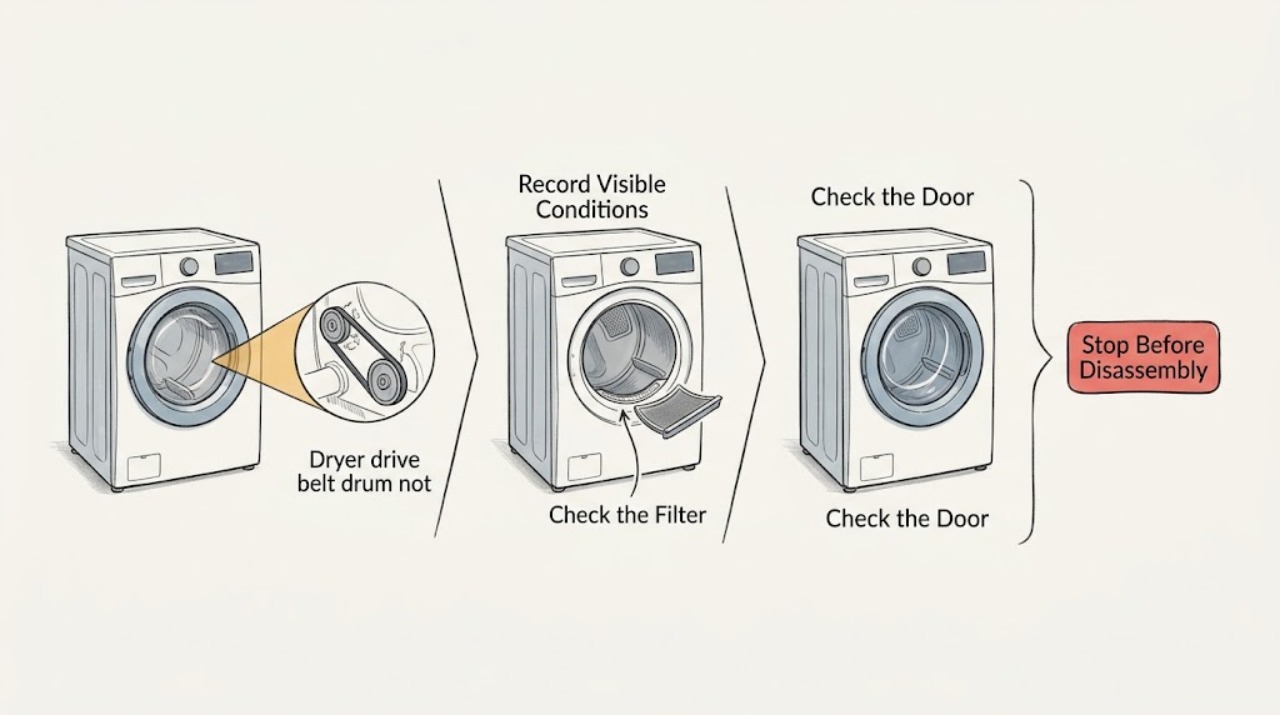
Work through in order
Diagnostic checks
Use only checks that match the exact appliance or system and its official guide.
-
Check 1
Identify the exact model and whether the dryer is gas, electric, or heat-pump, then record the cycle, load size, door status, display, and whether the drum never starts, stops mid-cycle, or restarts after a pause. If there is no hazard, make one brief observation from outside with the door closed; do not keep running a stationary drum.
Expected result: The display is normal, a door or control-lock indication is present, the cycle starts but the drum remains still, the drum stops after starting, or an exact error code appears.
Next step: Save the complete message and timing, then follow only the matching model manual. Stop using the dryer if it heats without tumbling or if the code returns.
Stop if: Stop immediately for smoke, burning odor, sparks, gas odor, unusual heat, metal-on-metal scraping, or a damaged cord or outlet.
Why this matters
Why: A control or door state can prevent the motor command, while a valid cycle with a stationary drum points toward the drive, motor, support, or supply path. An exact code is more useful than assuming the belt is the cause.
-
Check 2
With the dryer stopped, verify that no clothing is trapped in the door, the door closes fully, the lint filter is seated as the manual requires, and no child-lock or control-lock indicator is active. Clear only a documented control lock from the normal panel; do not bypass or defeat the door interlock.
Expected result: The door was not fully closed, clothing or the filter was interfering, a control lock was active, or all visible control and door conditions are normal but the drum remains still.
Next step: Correct only the obvious user-level condition documented for the model and make one supervised start attempt. If the drum still does not turn, stop and request service rather than opening the cabinet.
Stop if: Stop for a bent door, damaged latch, cracked control, repeated door code, smoke, heat damage, or a lock that would need to be held closed manually.
Why this matters
Why: A door, filter, or lock state can prevent operation without a belt failure. A normal door and control state with no tumble makes a mechanical drive, motor, or power fault more likely.
-
Check 3
Remove the laundry and inspect only the accessible drum opening and floor area for an unusually heavy load, a tangled bulky item, loose belt-like debris, or an object caught at the door edge. Do not reach behind the drum, remove panels, or hand-force the drum unless the exact manual explicitly provides a safe, de-energized check.
Expected result: The no-tumble symptom occurs only with a very heavy or bulky load, persists with the drum empty, or visible debris or a dropped-looking drum is present.
Next step: If the manual allows and the dryer is otherwise safe, try one normal, modest load only; otherwise leave it off. Give the technician the empty-versus-loaded result and any visible debris or drum-position change.
Stop if: Stop for a loose belt fragment near heat, a drum that sags or rubs, sharp edges, trapped objects that require tools, or any need to enter the cabinet.
Why this matters
Why: A heavy load can overload the drive on some models, while no rotation with an empty drum makes a belt, motor, idler, roller, drum support, or control fault more plausible. Visible belt debris or a changed drum position is a service clue, not a confirmation of the correct replacement.
-
Check 4
From outside the closed dryer, record one brief sound pattern only if the appliance is otherwise safe: no sound, a hum without rotation, a squeal at start, rhythmic thumping, or metallic scraping. Do not repeat the cycle to chase a noise or open the cabinet while power is connected.
Expected result: There is a hum with no drum motion, a brief belt-like squeal, repeated thumping, sharp scraping, or silence with an otherwise active display.
Next step: Save an audio or video record from a safe distance and request model-specific drive diagnosis. Do not lubricate, pull the drum, or replace a belt based only on the sound.
Stop if: Stop for metallic scraping, belt smell, burning odor, smoke, a hot cabinet, or an abnormal sound that worsens during the brief observation.
Why this matters
Why: A hum without rotation can indicate that the motor is being commanded but the drive or drum is not moving; squeal or scraping can implicate belt, rollers, idler, shaft, or another internal part. Sound alone cannot identify which component failed.
-
Check 5
Read the rating label and check only the normal household power indication and accessible plug or outlet condition without removing the terminal cover or touching conductors. Note a dead display, drum light behavior, tripped breaker, power interruption, or whether controls work but the drum does not; arrange service for any uncertain supply or gas condition.
Expected result: The dryer is completely dead, controls work but the drum does not, a breaker or outlet issue is visible, or power appears normal while no tumble persists.
Next step: Use only the model's documented external reset or supply check, and do not repeatedly reset a tripping breaker. If the drum remains still, provide the model, symptom, sound, load result, and power observations to a qualified appliance technician.
Stop if: Stop for a hot or damaged outlet, repeated breaker trips, exposed wiring, gas odor, scorched cord, or any request to measure live voltage or open the terminal area.
Why this matters
Why: A supply problem can prevent the motor from operating, while a powered control panel with a stationary drum shifts attention toward the drive, motor, interlock, or internal control path. Gas and electric configurations may use different supply arrangements.
Use your observations
Decision map
Find the observation that best matches what you see, then follow the next safe action.
-
PATH 01Next step
What you see
The door was not fully closed, a control lock was active, a filter or garment interfered with closure, or the symptom appears only with an unusually heavy or bulky load.
Do this next
Correct only the documented condition and make one supervised start attempt. If an empty or normal load still will not tumble, stop and follow the service branch.
Why this path and its safety boundary
Why it matters: A user-level operating condition is more likely than a confirmed drive-belt failure.
-
PATH 02Next step
What you see
The dryer starts normally but the empty drum remains still, a hum occurs without rotation, the drum sags or rubs, loose belt-like debris is visible, or a belt/motor-related code appears.
Do this next
Leave the dryer off and request qualified service. Provide the empty-drum result, sound, code, model, and visible clues; do not order a belt solely from the symptom.
Why this path and its safety boundary
Why it matters: The drive path is implicated, but belt, motor, idler, rollers, shaft, interlock, and control faults cannot be separated without model-specific access and diagnosis.
-
PATH 03Next step
What you see
The display or drum light is dead, the breaker trips, the outlet or cord is damaged, or the controls work inconsistently while the drum does not start.
Do this next
Stop repeated resets and obtain qualified appliance or electrical service. Do not open the terminal block, test live wiring, or continue a cycle that can heat without tumbling.
Why this path and its safety boundary
Why it matters: Supply, interlock, or control trouble may be preventing the motor command; this is not evidence that the drive belt is the failed part.
-
PATH 04Next step
What you see
Metallic scraping, burning odor, smoke, sparks, unusual heat, gas odor, or a damaged cord, outlet, cabinet, or exhaust condition accompanies the no-tumble symptom.
Do this next
Stop the dryer, keep people away, and obtain qualified appliance service or emergency help as appropriate. Do not restart it to verify the belt or open the cabinet.
Why this path and its safety boundary
Why it matters: The dryer has crossed from ordinary symptom classification into fire, gas, electrical, or mechanical safety risk.
Helpful context
Understand the symptom
A no-tumble symptom is not proof of a broken belt
The drum is mechanically driven, but a dryer can refuse to tumble because the door interlock or control lock is active, the load is too heavy, the motor is not being commanded, the motor cannot turn the drive, or a support component is binding. A belt may be broken, stretched, displaced, or intact while another part has failed. Keep the visible symptom and the diagnosis separate until the model-specific service procedure confirms the drive path.
Do not run heat with a stationary drum
A dryer that heats without tumbling can concentrate heat on one area of the load and may worsen a mechanical or airflow problem. If the drum stops, produces a burning or metallic sound, or the cabinet becomes unusually hot, stop using it. Lint, heating, gas, and electrical components belong in the model manual or qualified-service path, not a cabinet-open inspection by the homeowner.
Gas and electric dryers share the drive symptom but not every safety path
The drive belt and drum symptom can appear on both gas and electric dryers, but supply, ignition, heater, and circuit checks differ. Use the rating label and owner's manual to identify the type. Never open a gas path, test live terminals, defeat the door switch, or bypass a thermal fuse to make the drum run.
Safety boundary
Stop conditions
- Do not open the dryer cabinet, terminal block, heater, burner, gas line, or motor area; do not test live wiring or bypass the door interlock, thermal fuse, or other safety device.
- Do not keep running a dryer whose drum is stationary, repeatedly reset a tripping breaker, hand-force the drive, lubricate internal parts, or replace a belt based only on the symptom.
- Stop immediately for smoke, gas odor, sparks, burning smell, unusual heat, metallic scraping, damaged cord/outlet, or a compromised exhaust or gas connection; keep clear and obtain qualified or emergency help as appropriate.
Only after diagnosis
Potential parts
- dryer drive belt
Consider only after qualified diagnosis finds a broken, stretched, displaced, or otherwise failed belt and rules out motor, idler, roller, drum, interlock, and control causes.
Belt length, rib pattern, tension, drum design, and model fit are specific to the dryer; confirm the exact model and approved part through service documentation. - idler pulley or belt tensioner
Consider only when the belt path is intact but qualified inspection finds a seized, noisy, misaligned, or worn tension component.
The pulley, bracket, spring, and belt path must match the exact dryer chassis; do not substitute by appearance. - drum roller, shaft, or drum support
Consider only when scraping, thumping, rubbing, sag, or excessive mechanical resistance is traced to the drum support rather than the belt or motor.
Support geometry and wear parts differ by model, and repair may require cabinet disassembly; use qualified service for selection and installation. - dryer drive motor or motor control
Consider only when the motor or its control path is diagnosed as unable to drive a mechanically free drum with correct supply and interlock status.
Motor, wiring, thermal protection, and control compatibility are model-specific and require electrical diagnosis; no live testing is included here.
When checks do not resolve it
Need a professional?
Call a qualified appliance technician when the drum remains still with an empty drum, a belt or motor error appears, the symptom returns after a documented user-level check, internal access is required, or the dryer has any gas, heat, smoke, scraping, or electrical warning.
Safety scope: Observation from normal controls and accessible exterior only. No cabinet or terminal access, live measurements, belt/roller replacement, thermal bypass, door-interlock bypass, gas work, or repeated operation with a stationary drum.
Common questions
FAQ
How can I tell whether the dryer belt is broken?
A drum that stays still can be consistent with a broken belt, but the same symptom can come from the motor, idler, rollers, drum support, interlock, control, or supply. An empty-drum result, a hum, a belt-related code, or visible belt debris helps the technician; none confirms the correct belt without model-specific diagnosis.
Why does the dryer run but the drum does not tumble?
The controls may be active while the drive path is not moving. Possible paths include a load or door state, motor command or supply problem, belt, idler, rollers, drum support, or internal control fault. Stop the cycle if it heats without tumbling and arrange service rather than opening the cabinet.
Can I keep using the dryer if the drum is not turning but it still heats?
No. A stationary drum can concentrate heat and indicates that the dryer is not operating normally. Stop using it, especially for burning odor, unusual heat, smoke, sparks, or scraping, and request qualified service.
Should I open the dryer to replace the drive belt?
Do not open the cabinet as a generic homeowner step. Belt access can expose moving, electrical, thermal, and—on gas dryers—combustion components, and model disassembly varies. Give the technician the model, empty-drum result, sounds, codes, and visible clues instead.
When is a no-tumbling dryer an emergency?
Smoke, gas odor, sparks, burning smell, a hot or scorched cord/outlet, metallic scraping, unusual cabinet heat, or a damaged exhaust or gas connection requires stopping the appliance and obtaining qualified or emergency help as appropriate. Do not restart it to test the belt.
Read the exact guide
Official sources
- Power Issues - Laundry DryerLG USA Support · Directly applies to LG dryer models covered by the guide; used for accessible power/control distinctions and the warning that gas and electric dryers may have different supply arrangements.
- [LG Dryer] Noise From the DryerLG USA Support · Directly applies to LG dryer models covered by the guide; used for distinguishing ordinary load sounds from persistent scraping, belt, roller, shaft, or internal-part clues.
- [LG Dryer] Dryer Drum Not TurningLG USA Support · Directly applies to LG dryer models covered by the guide; used for model-dependent examples involving door state, load size, and service when an empty drum still will not rotate.
- LG Dryer - Error Code List(New)LG USA Support · Directly applies to LG dryer models and codes covered by the guide; used for the belt/motor, door, power, and service-escalation examples, not as universal code meanings for other brands.
Community feedback
Share a repair observation
Share a plain-text repair observation. Accepted observations are published automatically; this page may take a moment to update.