
On this page
Start here
Quick answer
If a Bosch dryer powers on but the drum does not tumble, first stop the cycle and check the simple operating conditions Bosch lists: the power connection, a fully closed door, and a selected drying program. With power isolated, remove only an accessible load obstruction and turn the drum gently only if the model manual permits; abnormal resistance, scraping, a loose feel, or a drum that will not move points toward a mechanical drive problem rather than a setting. If the dryer is completely inactive, the door does not latch, a breaker trips, an error recurs, or the drum remains still after the basic checks, leave it off and arrange Bosch-qualified service. Do not open panels, reach around a moving drum, bypass the door switch, test live wiring, or keep running a dryer with a burning smell, smoke, heat damage, or a damaged belt or drum support.
Before you begin
Safety first
- This article covers normal controls, external inspection, accessible lint care, and a model-authorized cool hand observation only. Drive belt, idler, drum support, motor, heater, wiring, control, door switch, and internal protection work belongs to a qualified professional.
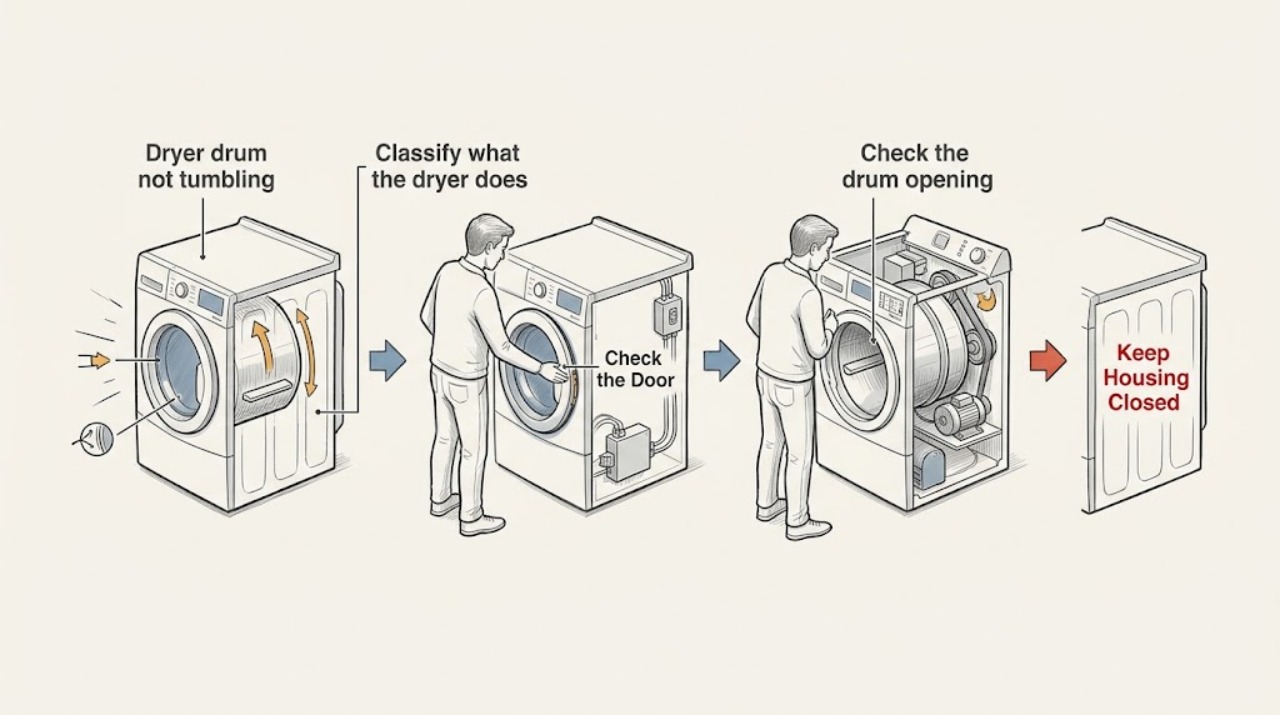
Work through in order
Diagnostic checks
Use only checks that match the exact appliance or system and its official guide.
-
Classify what the dryer does when started
Stop the cycle, remove the load only if the drum and clothes are safe to touch, and note whether the display lights, the program starts, the motor hums, heat begins, the drum moves intermittently, or nothing happens. Do not reach into a moving drum or repeat a hot cycle.
Expected result: The dryer is blank or inactive, the display starts but the drum is still, the motor hums or clicks, heat is present without tumbling, or an error or breaker trip appears.
Next step: Use the matching branch and continue only with the external checks below when there is no heat, smoke, odor, leak, or electrical hazard. Keep the dryer off for a stationary heated load or recurring error.
Stop if: Stop immediately for smoke, burning odor, abnormal heat, exposed wiring, a damaged drum, a repeated breaker trip, or a cycle that cannot be stopped normally.
Why this matters
Why: An inactive unit shifts attention to power, door, program, or protection checks. A running or heating unit with no tumble makes a drive, motor, support, or control fault more likely. Heat without movement is a stop condition, not a reason to run longer.
-
Verify power, door closure, and a selected program
From the normal user controls, confirm the plug is seated, the dryer door closes fully, a valid drying program is selected, and the control responds when the cycle is started. Check a tripped breaker only from the panel and only if there is no odor, moisture, damage, or repeated trip; do not remove an outlet cover or open the dryer.
Expected result: The plug is loose, the breaker is tripped once, the door does not latch, no program is selected, the controls start normally, or protection trips again.
Next step: Correct only a clearly loose plug, select the proper program, or close an unobstructed door. If the door will not latch, power is abnormal, or the breaker trips again, leave the dryer off and arrange appliance or electrical service.
Stop if: Do not bypass the door switch, reset a breaker repeatedly, use a damaged cord or outlet, or touch electrical parts with wet hands or while moisture is present.
Why this matters
Why: Power, door, and program conditions can prevent a Bosch dryer from beginning the drive command. A repeat trip, damaged cord or outlet, or normal controls with a still drum points beyond a routine setting check and needs qualified diagnosis.
-
Check the drum opening for an obvious obstruction
With the dryer off, cool, and disconnected from power as the manual directs, inspect the drum opening, seal, and accessible baffles for a garment edge, foreign object, or debris that could interfere with rotation. Remove only an object that releases without force; do not remove the rear drum or reach behind seals.
Expected result: The opening is clear, an object is trapped at the door or baffle, the drum is visibly damaged, or the obstruction cannot be removed safely.
Next step: Remove only a loose, visible obstruction, then perform no more than one cool, supervised start check if the manual permits. Keep the dryer off if the drum remains still or the obstruction needs tools or panel removal.
Stop if: Do not use a knife or tool to pry an object, reach around the drum, remove a seal or baffle, or run the dryer with a cracked drum or sharp edge.
Why this matters
Why: An accessible obstruction can stop or load the drum, while a damaged drum or trapped object that requires disassembly is a mechanical service issue. A clear opening does not prove the belt, motor, idler, or bearing system is healthy.
-
Observe drum resistance only under the model's safe manual procedure
If the Bosch manual permits a user-level hand check, rotate the empty drum gently from the opening with power isolated and the dryer cool. Stop at the first sign of scraping, binding, wobble, a loose drum, unusual resistance, or a foreign object; do not remove panels or continue a motor test.
Expected result: The empty drum turns smoothly, turns with scraping or binding, has excessive play or wobble, will not turn, or the manual does not authorize this check.
Next step: If movement is normal, use the service branch if the powered cycle still does not tumble. If movement is abnormal or access is unclear, leave the dryer off and provide the observation to a qualified Bosch technician.
Stop if: Do not energize the dryer with panels removed, bypass the door interlock, touch a belt or motor, or force a seized drum free.
Why this matters
Why: Smooth manual movement makes a complete mechanical seizure less likely but does not rule out a belt, idler, motor, control, or interlock fault. Binding, wobble, or no movement points toward drum-support or drive damage and requires service. An unauthorized check should be skipped.
-
Record any error, heat, lint, or electrical warning
Read the exact display or blinking indication and inspect only the accessible lint filter and external air inlet for obvious restriction, following the model manual. Note burning odor, smoke, unusual heat, a damaged cord, moisture, or a breaker that trips again; do not open the rear or heater area.
Expected result: A documented error appears, the lint filter or air inlet is restricted, there is no warning, or a safety symptom is present.
Next step: Clean only the accessible lint filter as the manual directs and record the exact code. If the code returns, the drum remains still, or any safety symptom is present, stop and arrange qualified service.
Stop if: Do not remove the heater cover, defeat a thermal or door safety, probe wiring, or continue running with smoke, odor, heat damage, or a repeated fault code.
Why this matters
Why: Some Bosch codes identify blocked lint or heating or electronics faults, while an unrestricted filter does not explain a drum that will not tumble by itself. A safety symptom overrides cleaning checks and requires isolation and service.
-
Prepare a model-specific service handoff
Record the Bosch model marking, whether the display and program start, door-latch result, drum movement when safely isolated, motor sound, heat state, error wording, lint-filter observation, breaker behavior, and when the no-tumble condition began. Do not disassemble the dryer to improve the record.
Expected result: The drum remains still with normal power and door conditions, the drum movement is abnormal, a drive sound occurs without rotation, or an error or safety symptom persists.
Next step: Leave the dryer off and arrange qualified Bosch appliance service. Request electrical help for an outlet or breaker problem and urgent help for smoke, fire, shock, or immediate danger.
Stop if: Stop all homeowner troubleshooting when diagnosis requires panel removal, live measurement, belt or motor access, heater access, moving the appliance, or bypassing an interlock.
Why this matters
Why: These patterns help a technician separate a door or supply interlock from a belt, idler, drum support, motor, wiring, control, or protection fault. They do not identify a replacement component without model-specific testing.
Use your observations
Decision map
Find the observation that best matches what you see, then follow the next safe action.
-
PATH 01Next step
What you see
The dryer does not start a program, the display is inactive, the door does not latch, the plug or breaker condition is abnormal, or the start command is not accepted.
Do this next
Use only the normal external checks in the Bosch guide. If power is abnormal, the door remains unlatched, or a breaker trips again, leave the appliance off and arrange qualified service.
-
PATH 02Next step
What you see
A program starts and the display or motor responds, but the drum does not turn and there is no accessible obstruction.
Do this next
Stop using the dryer and arrange Bosch appliance service. Do not run it with heat on, remove panels, or try to reconnect a belt or motor.
-
PATH 03Next step
What you see
With power isolated and the dryer cool, the manual-authorized hand check finds binding, scraping, wobble, excessive play, a loose feel, or no movement.
Do this next
Keep the dryer off and arrange qualified service; provide the exact movement symptom. Do not force the drum or remove seals, baffles, or panels.
-
PATH 04Next step
What you see
A Bosch error or blinking indication appears, the lint filter or air inlet is restricted, or the dryer stops with an overheating or heating-related symptom.
Do this next
Record the exact code and clean only the accessible filter or inlet as the manual directs. If the code returns or the drum remains still, stop and arrange service.
-
PATH 05Next step
What you see
The dryer heats while stationary, smells burned, smokes, shows exposed wiring or heat damage, shocks, leaks, or trips the breaker repeatedly.
Do this next
Stop the dryer, isolate power at the breaker if safe, keep clear of smoke or exposed electrical areas, and arrange qualified appliance or electrical help. Use appropriate emergency help for fire, shock, or immediate danger.
Helpful context
Understand the symptom
Separate a no-start condition from a no-tumble condition
A blank or inactive dryer needs a power, door, program, fuse, or breaker check before the drum drive can be judged. A dryer that runs a program, heats, or makes a motor sound while the drum stays still is a different pattern: the control may be calling for tumbling but the drive is not transferring motion. Bosch's public drum guide keeps the first user checks deliberately narrow, so do not infer a belt, motor, or control-board failure from one symptom alone.
The door latch is an operating interlock
Bosch requires the dryer door to be properly closed before the cycle can operate. Check the visible door edge, latch area, and drum opening for a garment or object preventing closure, but do not defeat the switch or hold it closed by hand. If the door closes normally yet the drum remains still, a latch, wiring, control, or drive fault needs model-specific diagnosis.
A stopped drum is a fire and mechanical boundary
Do not keep applying heat to a stationary load. A drum that cannot turn can leave heat concentrated in one area, while lint, a seized support, or a damaged drive can create additional risk. Bosch manuals include fire, electric-shock, and injury warnings and direct model-specific troubleshooting to the owner's manual and qualified service. Isolate the dryer for smoke, burning odor, visible damage, abnormal heat, or a repeated breaker trip.
Use the exact Bosch model before any repair decision
Bosch dryer designs and manuals vary. Record the E-Nr. or model marking, whether the display and motor sound are present, whether the drum moves freely when the appliance is safely isolated, and any error or odor. A technician can then distinguish an interlock or supply issue from a belt, idler, drum support, motor, control, or other model-specific fault without guessing at a part.
Safety boundary
Stop conditions
- Stop using the dryer for smoke, burning odor, abnormal heat, heat damage, exposed wiring, shock, a damaged drum, a stationary heated load, or repeated breaker trips.
- Do not bypass the door switch, energize the dryer with panels removed, test live wiring, access the belt, motor, heater, or control board, or force a binding drum as an ordinary user check.
- Do not keep restarting a no-tumble dryer, use tools to pry an obstruction, or treat a clear lint filter as proof that the drive system is safe.
Only after diagnosis
Potential parts
- Bosch dryer drive belt
Consider this category only when qualified diagnosis finds a broken, stretched, or displaced belt after power, door, obstruction, and drum-support causes are evaluated.
Confirm the exact Bosch model, belt routing, tensioning hardware, and manufacturer-approved fit before ordering. - Bosch dryer idler or drum-support assembly
Consider this category only when service localizes scraping, binding, wobble, or excessive drum resistance to a support or tensioning assembly.
Confirm the exact model and assembly configuration; a hand symptom alone does not prove which support component failed. - Bosch dryer drive motor
Consider this category only when qualified testing confirms the motor or its circuit is not driving a freely moving drum after interlock, belt, support, and control causes are excluded.
Confirm exact model, motor configuration, wiring, mounting, and manufacturer-approved compatibility before replacement. - Bosch dryer door switch or electronic control
Consider this category only when service confirms that a properly closed door is not proving the interlock or that the control is not issuing the tumble command.
Confirm the exact Bosch model and diagnostic evidence; do not bypass or replace an interlock based only on a still drum.
When checks do not resolve it
Need a professional?
Arrange qualified Bosch appliance service when the dryer has normal power, a selected program, and a properly latched door but the drum remains still; when the drum binds, scrapes, wobbles, or will not turn under the model's safe manual check; when an error returns; or when diagnosis requires panels, live electrical testing, belt/motor/heater access, or interlock bypass. Arrange electrical service for an outlet or breaker fault. Stop immediately and seek urgent qualified help for smoke, fire, shock, exposed wiring, uncontrolled heat, or repeated breaker trips.
Safety scope: This article covers normal controls, external inspection, accessible lint care, and a model-authorized cool hand observation only. Drive belt, idler, drum support, motor, heater, wiring, control, door switch, and internal protection work belongs to a qualified professional.
Have this ready
- Provide the exact Bosch model marking, display and selected program behavior, door-latch result, drum movement when safely isolated, motor sound, heat or odor symptom, exact error or blinking indication, lint-filter observation, breaker behavior, and when the condition began.
Common questions
FAQ
Why is my Bosch dryer drum not tumbling?
Start with Bosch's basic checks: verify power, a properly closed door, and a selected program. If the dryer starts or heats but the drum stays still, an obstruction, belt, idler, drum support, motor, wiring, or control fault may be involved and needs model-specific diagnosis.
My Bosch dryer turns on but the drum does not move. What should I do?
Stop the cycle and do not keep applying heat to a stationary load. Check the visible door opening for an obstruction only with power isolated and the dryer cool. If the drum remains still with normal power and door closure, arrange qualified Bosch appliance service.
Can a Bosch dryer door prevent the drum from tumbling?
Yes. Bosch lists a properly closed door as a basic operating condition. Check for clothing or an object preventing the latch from closing, but do not bypass or hold the door switch. A door that closes normally with a still drum needs further service-level diagnosis.
Should I turn the Bosch dryer drum by hand?
Only if the exact owner's manual permits a cool, power-isolated hand observation. Turn it gently from the opening and stop for scraping, binding, wobble, or unusual resistance. Do not force the drum or remove panels, seals, belts, or supports.
Could a Bosch dryer error code cause the drum not to tumble?
An error can stop or limit operation, but the code must be interpreted for the exact Bosch model. Record the complete display or blinking pattern and follow the matching official guide. Do not assume a lint or electronics code identifies a drum-drive part.
Is it safe to run a Bosch dryer if the drum is not turning but it is heating?
No. Stop the dryer and isolate power when safe. Heat without drum movement can leave a stationary load exposed to concentrated heat, and smoke, burning odor, abnormal heat, or a repeated breaker trip requires urgent qualified help.
When should I call for Bosch dryer service?
Arrange service when power, program, door closure, and any model-authorized cool inspection are normal but the drum remains still; when it binds or wobbles; when an error returns; or when diagnosis requires panels, live electrical tests, belt or motor access, or interlock work.
Read the exact guide
Official sources
- Bosch Dryer Error CodesBosch Home Appliances · Bosch dryer error indications; exact model manual governs code interpretation where applicable.
- Dryer Troubleshooting: Dryer drum is not spinningBosch Home Appliances · Bosch dryer no-tumble troubleshooting; exact model manual controls all further access and tests.
- Dryer Troubleshooting: Dryer is not turning onBosch Home Appliances · Bosch dryer start-condition guidance used to distinguish inactive power/door problems from a running no-tumble fault.
- en-us Use and Care Manual, Installation InstructionsBosch Home Appliances · Official Bosch dryer manual opened for model WTG865H2UC2; used for safety and model-variation boundaries, not as a universal fitment claim.
- Bosch Dryer Troubleshooting & Repair GuideBosch Home Appliances · Bosch dryer troubleshooting overview; individual issue pages and exact manuals control the detailed procedure.
Community feedback
Share a repair observation
Share a plain-text repair observation. Accepted observations are published automatically; this page may take a moment to update.