
On this page
Start here
Quick answer
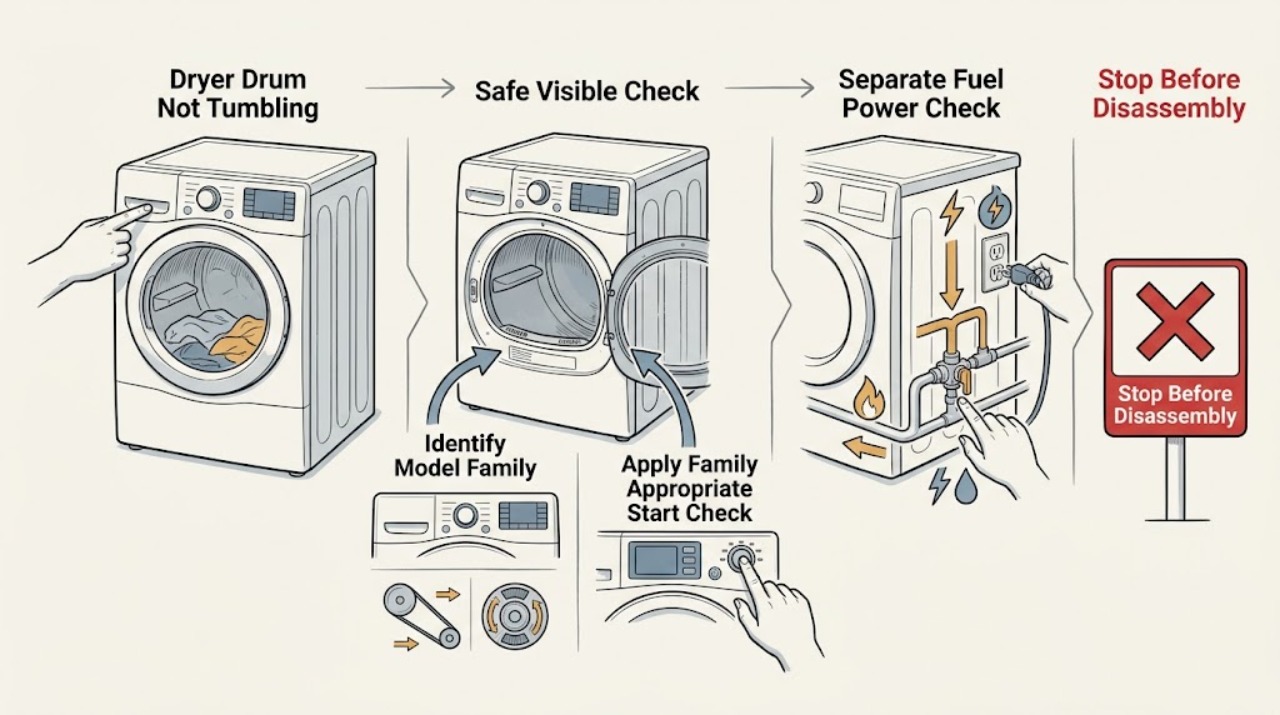
Start by reading the complete Amana model number and identifying the family shown in Amana's dryer comparison: 6.5 cu. ft. electric or gas top-load-matching models use dial controls, while 7.4 cu. ft. electric or gas front-load-matching models use electronic touch controls and Sensor Drying. Do not apply the electronic Start sequence to a dial model. For an electronic model, Amana says the Start, Push to Start, or Hold to Start control may need a firm two-to-five-second press and that a wet panel or wet hands can prevent registration; for an electric model, have a qualified electrician handle the 240-volt supply, while a gas shutoff is a heating check and does not by itself explain a drum that will not turn. With power safely available, check the model-appropriate start control, door/latch area, load freedom, and level installation. If the command registers but the drum remains still, hums, scrapes, or repeatedly stops, leave the dryer off and arrange qualified service—Amana's public guidance does not support selecting a belt, idler, roller, or motor from the symptom alone.
Before you begin
Safety first
- This article supports dry, ordinary-access observation and model-documented control use only. It does not authorize console or cabinet access, terminal inspection, live electrical testing, door-safety bypass, drive-part removal, motor testing, or gas-line work.
Work through in order
Diagnostic checks
Use only checks that match the exact appliance or system and its official guide.
-
Check 1
With the dryer stopped and safe to approach, record the complete Amana model number and note whether its controls match a dial-control top-load-matching family or an electronic-touch front-load-matching family. Also record whether the label identifies an electric or gas dryer.
Expected result: The model matches a listed 6.5 cu. ft. dial family, a listed 7.4 cu. ft. electronic-touch family, another Amana family, or cannot be identified safely.
Next step: Use the exact model manual for the normal start control, cycle names, door arrangement, and power requirements before continuing.
Stop if: Do not move an unstable dryer, remove a panel, or handle a wet or damaged cord to read the label.
Why this matters
Why: Amana's comparison page documents different control styles and both fuel types. The family determines whether a touch Start instruction, a gas/electric supply check, or a model-specific cycle guide is relevant; the examples cannot be generalized to an unidentified model.
-
Check 2
For an electronic-touch Amana family, dry your hands and panel and hold the documented Start, Push to Start, or Hold to Start control for the manual's interval; for a dial family, set the documented cycle and use its physical start control. Observe the display or drum light from outside.
Expected result: The control registers and the dryer starts, the touch panel stays unresponsive, the dryer has a dial with no response, the controls are dark, or the display responds but the drum remains still.
Next step: Follow the exact manual once for the control family. If the command remains unregistered, leave the dryer off for service; if it registers, continue to the door and load checks.
Stop if: Do not use a fingernail or pointed tool, bypass a control lock or safety, or open the console.
Why this matters
Why: Amana specifically attributes missed starts on applicable touch models to a short/incorrect press or moisture. Dark controls point toward power; a registered command with a stationary drum points away from a simple touch-control issue.
-
Check 3
From a dry, safe position, check that the plug appears seated and the household breaker has not tripped. If the model is electric, record whether the supply concern involves the dryer motor circuit and have a qualified electrician assess uncertain 240-volt or cord wiring; if it is gas, do not manipulate the gas line as a no-tumble test.
Expected result: The display is dark, a breaker is tripped, power status is uncertain, the electric dryer has a suspected supply issue, or the gas dryer has normal controls but the drum still does not turn.
Next step: Have an electrician assess uncertain electric supply or cord wiring. For a gas dryer with normal controls, continue only with the visible door/load checks and then service if the drum remains still.
Stop if: Do not reset a breaker repeatedly, remove a terminal cover, touch wiring, open a gas connection, or run with smoke, sparks, burning odor, or a hot cord.
Why this matters
Why: Amana states that electric dryers use a 240-volt supply with separate circuit legs including the motor circuit. It also states that a gas dryer drum can turn with the gas shutoff closed, so gas availability is primarily a heat issue rather than a safe explanation for no rotation.
-
Check 4
Open and close the door normally. Inspect the visible latch area for clothing, packing or shipping material, and debris; redistribute an overly tight load without forcing the door; and observe whether all four feet appear firmly supported.
Expected result: The latch closes evenly, the latch is blocked or damaged, the load is tightly packed, the dryer rocks, or the door/load/floor appear normal.
Next step: Remove only a loose visible obstruction, reduce or redistribute the load, or use the model's documented installation guidance. If the door is damaged or the drum still does not move with a normal load, stop and request service.
Stop if: Do not bend or force the door, hold a safety switch closed, tip a connected dryer, or insert tools near the drum.
Why this matters
Why: Amana links blocked latches, tightly packed loads, and an unlevel dryer with poor operation or tumbling on applicable cycles. These visible conditions should be corrected only as described by the model's installation and use guidance.
-
Check 5
Only when the model-appropriate control has registered, the door latches, the load is loose, the dryer is stable, and no hazard is present, make one brief model-approved start while remaining nearby. Listen from outside and observe whether the drum rotates, turns intermittently, or stays still.
Expected result: The drum rotates normally, the drum stays still with no sound, the motor hums or clicks without rotation, the drum starts and stops, or scraping, grinding, heat, smoke, or an electrical warning appears.
Next step: Stop at the first recurrence and arrange qualified service with the model, fuel type, control family, sound, and drum behavior. Do not repeat starts to force movement.
Stop if: Do not make this observation after sparks, smoke, burning odor, grinding, a hot cord, repeated breaker trips, or a damaged door/cabinet.
Why this matters
Why: Normal rotation after a corrected control, latch, load, or installation condition supports that visible cause. A stationary or abnormal drum after those checks needs cabinet-level diagnosis; the Amana public sources do not identify a failed drive part from sound alone.
-
Check 6
If the drum turns but clothes or the drum area show lint, residue, or a musty smell, disconnect power and clean only the accessible drum, lint-screen, door-seal, and vent areas using Amana's mild-cleaning guidance. Do not treat cleaning as permission to open the drive cabinet.
Expected result: The accessible residue or lint is removed and the drum then rotates normally, or the drum remains stationary/abnormal after the accessible cleaning.
Next step: Resume use only if the model completes a normal cycle without abnormal sound or heat. Otherwise leave it off and arrange qualified service.
Stop if: Do not spray liquid into controls, remove the drum, reach behind panels, or operate while the interior or cord is wet.
Why this matters
Why: Amana says residue can create odors and lint/debris can hinder movement and airflow, but cleaning does not establish that the motor, drive, or control is healthy. A stationary drum after cleaning is a service condition.
Use your observations
Decision map
Find the observation that best matches what you see, then follow the next safe action.
-
PATH 01Next step
What you see
The model number identifies an Amana 6.5 cu. ft. dial-control top-load-matching family or a 7.4 cu. ft. electronic-touch front-load-matching family, and the dryer does not begin tumbling.
Do this next
Use the exact model manual once for the documented start behavior. If it registers without movement, continue to the door/load and fuel-power branches, then service if unresolved.
Why this path and its safety boundary
Why it matters: The first pattern favors a family-specific control/start path; the last pattern means the start request was accepted and a door, load, power, or internal drum problem is more relevant. Amana's comparison page supports the control-family distinction, not a universal control sequence.
-
PATH 02Safety boundary
What you see
The dryer is electric with a dark display or breaker/supply concern, or it is gas with a normal start command but a question about the gas shutoff.
Do this next
Leave uncertain electric supply for a qualified electrician. For gas, do not touch the gas connection; if the drum remains still after the visible checks, arrange appliance service.
Why this path and its safety boundary
Why it matters: Amana's official guidance separates the electric motor supply from the heating circuit and says a gas drum will turn with the gas shutoff closed. A gas valve is therefore not a safe no-tumble fix, while an uncertain electric supply needs an electrician.
Safety stop: Do not remove terminals, repeatedly reset breakers, open gas fittings, or work on energized equipment.
-
PATH 03Next step
What you see
The model accepts the start command but the door is obstructed, the load is tightly packed, or the dryer is unstable.
Do this next
Correct only the visible load, latch, or installation issue described by the manual and observe one normal cycle. If the drum itself remains still, stop and request service.
Why this path and its safety boundary
Why it matters: Amana ties load size, latch clearance, and firm foot contact to operation and tumbling. Correcting a visible door, load, or installation condition is distinct from diagnosing an internal drive fault.
-
PATH 04Safety boundary
What you see
The correct model-family start procedure registers, the door and load are normal, the dryer is stable, and the drum still does not rotate or produces a hum/click/scrape.
Do this next
Leave the dryer off and arrange qualified appliance service. Provide the model family, fuel type, control response, sound, and whether the drum ever turned.
Why this path and its safety boundary
Why it matters: The remaining fault is inside the appliance or its model-specific drive/control path. Amana's official sources direct unresolved no-tumbling cases to service but do not support naming a belt, idler, roller, or motor from this observation alone.
Safety stop: Do not open the cabinet, remove the drum, release a drive part, defeat a door switch, or perform live electrical testing.
-
PATH 05Safety boundary
What you see
Smoke, sparks, burning odor, grinding, a hot or damaged cord, repeated breaker trips, a damaged cabinet/door, or a gas concern appears while the drum will not tumble.
Do this next
Stop using the dryer, keep clear, and isolate power only from a dry safe position if that can be done without touching damaged equipment; arrange qualified appliance or electrical/gas service as appropriate.
Why this path and its safety boundary
Why it matters: This is a safety shutdown, not a drive-part troubleshooting branch. Further starts or cabinet access can increase the hazard.
Safety stop: Do not restart the dryer, open panels, touch hot or damaged parts, bypass a safety, or manipulate a gas connection.
Helpful context
Understand the symptom
Use the Amana family map before pressing Start
Amana's official comparison page identifies two useful families for this symptom: NED4655EW and NGD4655EW are listed as 6.5 cu. ft. electric and gas top-load-matching dryers with dial controls, while NED5800HW and NGD5800HW are listed as 7.4 cu. ft. electric and gas front-load-matching dryers with electronic touch controls and Sensor Drying. These model numbers are examples from the comparison page, not a claim about every Amana dryer. Read the rating label and use the exact manual before assuming the appliance has a touch panel, a particular cycle, or a particular power arrangement.
The start test changes with the control family
On an Amana model with electronic touch controls, the manufacturer's not-tumbling guidance says to use a fingertip, hold the Start, Push to Start, or Hold to Start control for two to five seconds, and keep the hands and panel dry. A dial-control model does not justify a guessed touch-panel sequence. For either family, a dark display or drum light is a power/start-path clue; a responsive control with a stationary drum moves the investigation toward the door, load, installation, or internal service boundary.
Do not confuse a gas heat check with drum power
Amana's dryer guidance treats electric and gas models differently. It states that electric dryers require a 240-volt supply and that separate circuit legs serve the motor and heating element; a qualified electrician should assess supply or cord wiring. It also states that a gas dryer drum will turn even if its gas shutoff is closed, although the dryer will not heat. Therefore, do not open a gas line or treat a closed gas valve as the explanation for a drum that never rotates. Keep electrical and gas work outside the owner check.
Check the visible door, load, and floor conditions
Amana says a tightly packed load can prevent free movement or keep the door from latching, that packing material or clothing can block the latch, and that all four feet should contact the floor. Use the model's normal door and cycle controls, remove only a loose visible obstruction, and redistribute a load only while the door closes normally. Do not infer a drive failure from a door or installation condition that has not been checked.
Treat lint or an odor as a maintenance clue, not a drive diagnosis
Amana's drum-cleaning guidance says lint, fabric-softener residue, or detergent can accumulate and that a musty smell or buildup is a reason to clean the drum, lint screen, door-seal area, and accessible vent area. Unplug before cleaning and use only the mild-cleaning method described for the drum. Cleaning may remove an obstruction or residue, but it does not prove that a motor, belt, roller, or control is sound. If the drum remains stationary after a clean, correctly loaded, model-appropriate start, stop at service.
Stop at the cabinet and safety boundary
Amana's not-tumbling guidance sends unresolved cases to service after the power and Start checks. Do not remove the console or cabinet, inspect terminals while energized, bypass a door switch, release a belt, hand-test a motor, or work on a gas connection. Smoke, sparks, burning odor, grinding, a hot cord, repeated breaker trips, or a damaged door or cabinet are immediate stop conditions. Give the technician the model family, electric or gas type, control response, door result, load condition, level condition, sound, and whether the drum ever moved.
When checks do not resolve it
Need a professional?
Arrange qualified appliance service when an Amana dryer accepts the model-appropriate start command but the drum remains stationary, starts and stops, or makes an abnormal sound after the visible door, load, level, and safe supply checks. Use a qualified electrician for uncertain electric supply or cord wiring, and obtain prompt help for smoke, sparks, burning odor, grinding, a hot cord, repeated breaker trips, a damaged cabinet or door, or any gas concern.
Safety scope: This article supports dry, ordinary-access observation and model-documented control use only. It does not authorize console or cabinet access, terminal inspection, live electrical testing, door-safety bypass, drive-part removal, motor testing, or gas-line work.
Common questions
FAQ
Which Amana dryer controls should I use when the drum will not tumble?
Identify the exact model first. Amana's comparison page lists 6.5 cu. ft. top-load-matching families with dial controls and 7.4 cu. ft. front-load-matching families with electronic touch controls. The not-tumbling guide's two-to-five-second Start instruction applies to the applicable touch-control behavior, not automatically to dial models.
Can a closed gas valve make an Amana dryer drum stop tumbling?
Amana says the drum of a gas dryer will turn even when the gas shutoff is closed; the closed valve explains no heat, not normally a drum that never rotates. Do not manipulate the gas connection as a no-tumble test.
Why does my Amana electronic dryer ignore the Start button?
Amana says the applicable Start, Push to Start, or Hold to Start control should be held for two to five seconds, touched with a fingertip, and used with dry hands and a dry panel. If the command still does not register, leave the dryer off and arrange service rather than opening the console.
Can an overloaded or unlevel Amana dryer stop the drum from tumbling?
Amana says tightly packed clothing can limit free movement or keep the door from latching, and that all four feet should contact the floor for sensor-cycle operation and tumbling. Redistribute a load only when the door closes normally; do not tip a connected dryer.
Should I replace an Amana belt or motor when the drum will not move?
Not from the symptom alone. Amana's public no-tumbling guidance supports power, Start, door, load, and model checks, then directs unresolved problems to service; it does not identify a belt, idler, roller, or motor for an unspecified model. A qualified technician should diagnose the internal cause and confirm compatibility.
Read the exact guide
Official sources
- How does a Dryer Dry Clothing?Amana Product Help · General Amana dryer operation explanation; it does not identify a specific failed drive component.
- Dryer is Not Heating - Product Help | AmanaAmana Product Help · Amana dryer electric/gas guidance; it supports fuel and supply distinctions, not a specific no-tumble part diagnosis.
- Cleaning the Dryer Drum - Product Help | AmanaAmana Product Help · Amana dryer drum maintenance guidance; cleaning does not identify or authorize internal drive repair.
- Door Not Closing - Dryer - Product Help | AmanaAmana Product Help · Amana dryer door and installation guidance; exact model door and cycle behavior controls.
- Not Tumbling or Spinning - Dryer - Product Help | AmanaAmana Product Help · Amana dryer not-tumbling guidance; electronic control behavior, power arrangement, and exact start procedure remain model-specific.
- Dryer Comparison ChartAmana · Amana's current comparison chart; listed model examples and features must not be generalized to unlisted models.
Community feedback
Share a repair observation
Share a plain-text repair observation. Accepted observations are published automatically; this page may take a moment to update.