
On this page
Start here
Quick answer
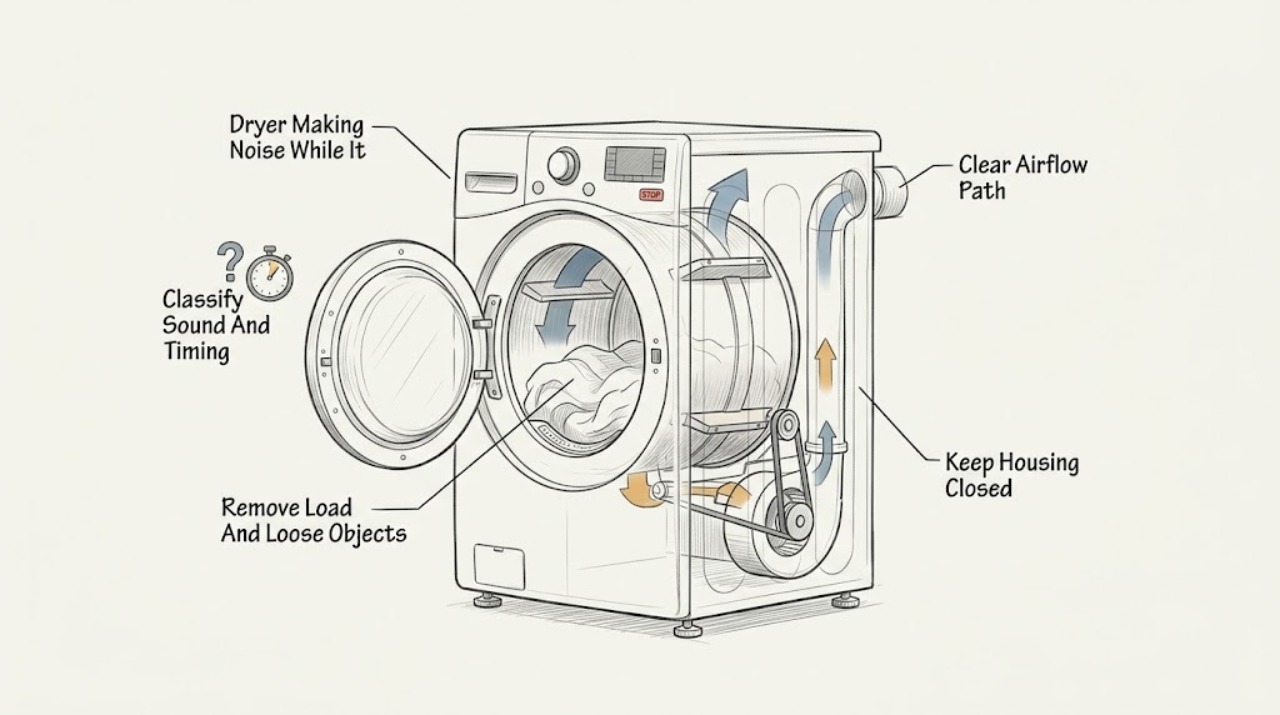
A dryer that still tumbles can make harmless load or cabinet noises, but a new or worsening sound can also be an early sign of worn drum supports, an idler, belt, blower wheel, or motor. First identify whether the sound is clicking, thumping, rattling, scraping, squealing, grinding, rumbling, or humming and when it occurs. Remove loose objects, untangle or reduce an unbalanced load, check the lint screen and accessible vent or cabinet contact, and confirm the dryer is stable. A brief periodic click on some gas dryers can be normal, but grinding, screeching, persistent rumbling, a noise when empty, burning odor, smoke, sparking, or a sound that worsens calls for qualified appliance service. Do not remove panels, lubricate unknown parts, reach into the blower or belt path, or keep operating through a severe noise.
Work through in order
Diagnostic checks
Use only checks that match the exact appliance or system and its official guide.
-
Check 1
Stop the cycle if the noise is severe, and record the sound from a safe position during a normal load only if there is no burning odor, smoke, sparking, or hot electrical smell. Note whether it starts with drum movement, follows airflow, occurs at ignition on a gas dryer, appears only at shutdown, or continues throughout the cycle.
Expected result: The sound is a brief click, load-related thump, rattling, scraping, squeal, grinding, rumble, or hum, and it occurs at startup, during rotation, with airflow, at ignition, or at shutdown.
Next step: Keep the dryer off for grinding, screeching, loud ignition, burning or gas odor, smoke, or sparks. Otherwise continue with the load and exterior checks, and save a short sound recording and timing notes for service if the noise remains.
Stop if: Do not open the cabinet, relight a pilot, bypass a door or safety switch, or continue a test when gas, combustion, smoke, or electrical warning signs are present.
Why this matters
Why: A brief gas-valve click or a thump tied to a tangled load can be normal for the situation. Rattling or scraping may come from loose objects or nearby contact, while squealing, grinding, or rumbling that follows rotation is more consistent with a worn support, idler, belt, blower, or motor. Ignition-timed bangs or any safety odor are not routine noise.
-
Check 2
Turn the dryer off, remove the load, and check pockets, zippers, buttons, coins, pens, clips, and other loose objects in the drum. Untangle large items and reload them loosely rather than as a tight ball; do not place hard items such as shoes in the drum if the manufacturer's instructions provide another drying method.
Expected result: The noise disappears when the drum is empty, follows one bulky or hard item, remains with an ordinary balanced load, or comes from a loose object at the drum edge or lint opening.
Next step: Remove the loose object and run only a normal, balanced load if no other warning exists. If the noise remains empty or with a balanced load, stop using the dryer and arrange qualified appliance service rather than repeating full cycles.
Stop if: Do not reach into a narrow drum seam or lint chute for an object you cannot remove easily, and do not use tools to pry an object from the drum or blower path.
Why this matters
Why: A noise that disappears empty or tracks a bulky, hard, or tangled load is more likely load-related than a failed internal part. A sound that remains with an empty or ordinary load makes drum supports, idler, belt, blower wheel, motor, or another internal component more likely.
-
Check 3
With the dryer off, clean the lint screen as the manual directs and inspect only the accessible lint opening for a loose object. Look around the outside for a vent, power cord, pedestal drawer, shelf, wall, or item resting against the cabinet; confirm that the dryer is stable and all visible feet contact the floor. Do not pull the dryer out or remove panels.
Expected result: The noise comes from the vent or cabinet contact, the dryer rocks or a foot is missing or loose, a lint-screen opening contains an accessible object, or all visible exterior and airflow conditions are normal.
Next step: Clear only the outside contact or accessible loose object and confirm stable placement using the model instructions. If the sound persists, or leveling would require moving a stacked or hard-connected unit, arrange service instead of forcing an adjustment.
Stop if: Do not reach into the blower opening, insert tools into the lint chute, disconnect venting, move a stacked dryer alone, or work around a hot or damaged power connection.
Why this matters
Why: A vent or nearby object can vibrate against the cabinet, and an unstable dryer can pound or rattle as the drum rotates. An object at the lint opening can strike the blower area. Normal exterior checks shift suspicion toward internal drum supports, idler, belt, blower wheel, or motor.
-
Check 4
After the load and exterior checks, and only when there is no safety warning, use the manufacturer's brief empty-drum observation if the owner's manual permits it. Listen from outside for the first movement, steady tumble, airflow, and shutdown; do not remove any panel or place hands near a moving part.
Expected result: The noise is absent when empty, appears only with the load, occurs immediately as the drum starts, continues steadily while the drum turns, or is present with an empty drum.
Next step: Stop using the dryer and give the technician the empty-versus-loaded result, sound location, cycle stage, and whether the drum remains smooth. Do not attempt internal lubrication or part replacement based on sound alone.
Stop if: Do not run repeated empty cycles, operate with the cabinet open, or continue if the noise becomes grinding, screeching, hot, smoky, or electrically abnormal.
Why this matters
Why: Load-only noise points toward items or balance. A start-up squeal or repeated rotation noise can indicate belt, idler, roller, glide, bearing, or motor wear. A rumble that persists empty can involve the blower wheel or internal support, and an empty-drum noise is a stronger reason for service than a load-specific thump.
Use your observations
Decision map
Find the observation that best matches what you see, then follow the next safe action.
-
PATH 01Next step
What you see
The thump or rattle disappears with an empty drum, follows a bulky or hard item, or is traced to a pocket item, drum edge, lint opening, or object leaning against the dryer.
Do this next
Remove the object, clear pockets, untangle and rebalance the load, and keep hard items out unless the model instructions allow them. Escalate if the noise returns with an ordinary balanced load or when empty.
Why this path and its safety boundary
Why it matters: The load or a removable object is more likely than a worn drive component.
-
PATH 02Next step
What you see
The noise follows airflow or vibration, and a vent, cord, nearby object, pedestal, loose foot, or unlevel cabinet is visibly contacting or moving against the dryer.
Do this next
Clear the contact and follow the owner's manual for a safe stability check. Use service for a stacked or hard-connected installation, missing feet, or noise that persists after the accessible correction.
Why this path and its safety boundary
Why it matters: External contact, vent alignment, or dryer stability is more likely than an internal bearing or drive fault.
-
PATH 03Next step
What you see
Squealing, grinding, screeching, or rumbling persists with an empty or ordinary load and is tied to drum rotation or the blower area.
Do this next
Leave the dryer off and arrange qualified appliance service for internal inspection. Provide the sound recording, where it is loudest, empty-versus-loaded result, and whether the drum still turns smoothly.
Why this path and its safety boundary
Why it matters: A drum bearing, roller, glide, idler, drive belt, blower wheel, or motor issue is more likely than a loose load; sound alone cannot identify the failed part.
-
PATH 04Next step
What you see
The sound is brief, familiar, and tied to a normal cycle event, disappears after a load is corrected, and is not accompanied by odor, smoke, sparks, worsening vibration, or abnormal drying.
Do this next
Use the dryer only according to the owner's manual, keep the lint screen clear, and stop and arrange service if the sound becomes louder, persists empty, or gains an odor, heat, vibration, or performance symptom.
Why this path and its safety boundary
Why it matters: A normal gas-valve click, load movement, or short-lived roller thump may be more likely than a repairable fault, but a new sound should still be monitored.
Helpful context
Understand the symptom
Because the drum still tumbles, start with the sound pattern
Tumbling confirms that the cycle is moving the drum, not that every drive and support part is healthy. A thump that follows a balled-up load is a different branch from a squeal at the front, a rumble at the blower area, or grinding that remains when the drum is empty. The location and timing of the sound are more useful than simply calling it loud.
Separate a removable load problem from an internal repair
Loose coins, fasteners, zippers, and objects in or around the dryer can rattle or scrape while the drum turns. A stable dryer, clear lint screen and chute, and a normal empty-drum check reduce those possibilities. Internal rollers, glides, bearings, idler, belt, motor, and blower work vary by model and should be left to qualified service when the noise persists.
Only after diagnosis
Potential parts
- dryer lint screen or lint-chute component
Only consider this category when the accessible screen or chute is damaged or a technician confirms it is the source of rattling or airflow noise.
Confirm the exact dryer model and the manufacturer's maintenance instructions before replacing or accessing this component. - dryer drum rollers, glides, or bearings
Only consider this category when rotation-timed squealing, grinding, rumbling, or scraping persists with an empty or balanced drum and service confirms support wear.
Support components vary by model and may require matched replacement or cabinet access; have qualified service confirm fit. - dryer drive belt or idler pulley
Only consider this category when a technician links a start-up or rotation-timed squeal, slapping, or rubbing sound to the drive path.
Verify exact model routing and component fitment; do not infer a belt or idler replacement from sound alone. - dryer blower wheel or drive motor
Only consider this category when rumbling, humming, or grinding is confirmed at the blower or motor after load, exterior, and support causes are ruled out.
Blower and motor work requires internal access and electrical or mechanical diagnosis by qualified appliance service.
When checks do not resolve it
Need a professional?
Stop using the dryer and obtain qualified appliance service when grinding, screeching, persistent rumbling, or severe vibration continues with an empty or balanced drum; the sound is worsening; the drum becomes difficult to turn; the dryer overheats, smells burned, smokes, sparks, or trips a breaker; or diagnosis would require removing panels, reaching the belt, idler, blower, motor, rollers, bearings, or wiring. For gas odor or suspected combustion trouble, leave the area without operating switches and contact the gas utility or emergency service from a safe location. Do not keep operating through an unresolved severe noise simply because the drum still tumbles.
Common questions
FAQ
Why is my dryer making noise if it still tumbles?
Tumbling does not rule out a worn roller, glide, bearing, idler, belt, blower wheel, or motor. First remove loose objects and correct a bulky or unbalanced load, then check accessible cabinet contact, stability, and airflow. A noise that remains empty or with a normal load needs service.
Is a clicking sound from a gas dryer normal?
A brief periodic click can be a normal gas-valve operating sound on some gas dryers. Stop and obtain service if the click changes into a bang, the dryer smells of gas or sulfur, smoke or soot appears, or other performance and safety symptoms occur.
Can I lubricate my noisy dryer myself?
Do not lubricate an unknown part or open the cabinet just to locate the noise. Rollers, glides, bearings, idler, belt, blower, and motor arrangements vary by model, and a technician should confirm the source before internal work.
Read the exact guide
Official sources
- Possible Fixes for a Dryer That’s Making Loud NoisesMaytag · Manufacturer dryer noise troubleshooting by sound, location, load, drum objects, drum supports, blower wheel, and service boundary
- Samsung dryer is too noisySamsung · Manufacturer dryer noise troubleshooting for rattling, thumping, squealing, grinding, humming, leveling, vent alignment, and service escalation
- Sounds or Noises in a DryerMaytag Product Help · Manufacturer dryer sound guidance for gas-valve clicking, load thumping, support-roller thumping, leveling, scraping objects, and rattling contacts
Community feedback
Share a repair observation
Share a plain-text repair observation. Accepted observations are published automatically; this page may take a moment to update.