
On this page
Start here
Quick answer
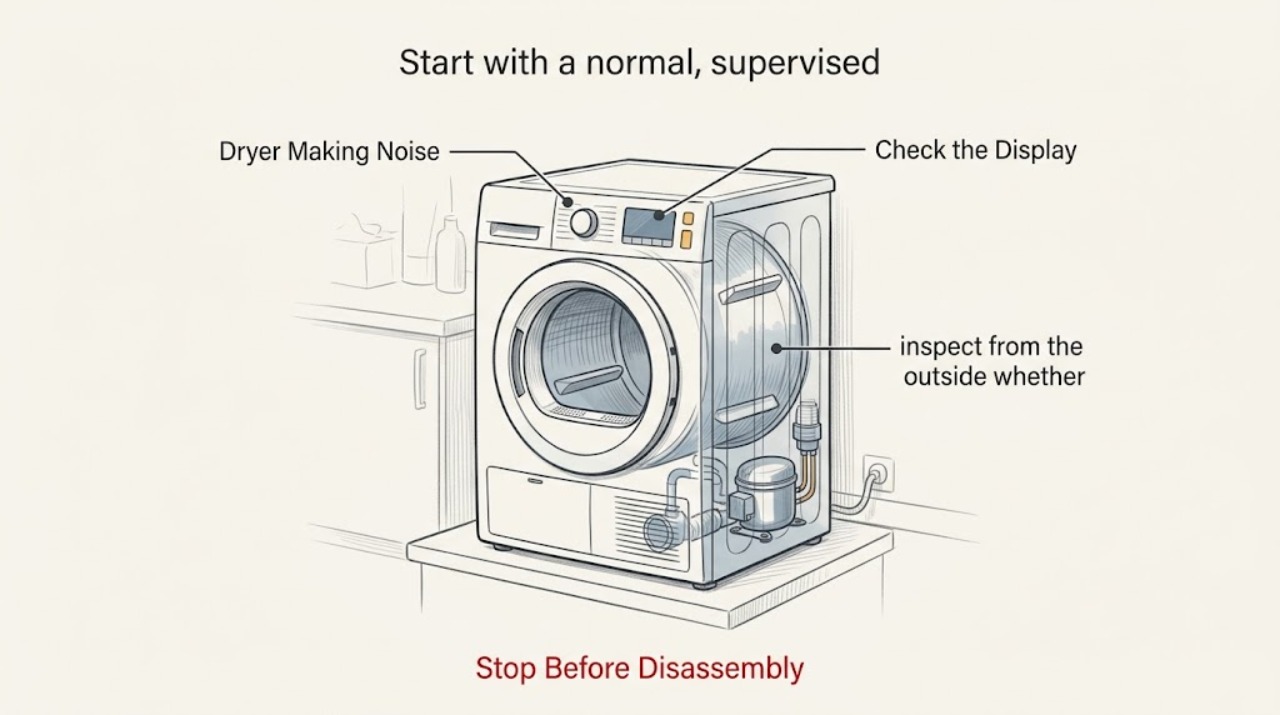
An Asko dryer can make normal operating sounds: its manual describes compressor humming or flowing-liquid noise, compressor ventilation buzzing, condensate-pump or liquid-flow sounds, heat-exchanger cleaning clicks, and rattling from hard items such as buttons or zippers in the laundry. First note when the sound begins and whether it follows the load, programme stage, or cooling period. Then check the load for hard objects, confirm the dryer is stable and not touching nearby surfaces, and clean the user-accessible lint filters while keeping vents clear. Stop using the dryer for grinding, scraping, repeated knocking, smoke, burning odor, a stalled drum, damaged cord, or a noise that remains abnormal after these external checks; internal repair belongs to qualified service.
Work through in order
Diagnostic checks
Use only checks that match the exact appliance or system and its official guide.
-
Check 1
Start with a normal, supervised cycle and listen from a safe position without touching the moving drum; note whether the sound occurs at startup, while the drum turns, during a later drying stage, during a brief pause, or while the appliance is cooling.
Expected result: The sound is a hum or flowing-liquid sound at startup, a buzz during compressor ventilation, a click during a cleaning phase, a pumping sound, or a harsh noise that does not track any programme stage.
Next step: For an operation-linked hum, buzz, click, or pump sound, continue with the load and installation checks. For grinding, scraping, repeated hard knocks, smoke, odor, or a stalled drum, stop the cycle and arrange service.
Why this matters
Why: The first patterns match the operating sounds described in the ASKO manual for the compressor, pump, or heat-exchanger cleaning. A harsh, stage-independent sound is not identified as normal by that description and needs the abnormal-noise boundary.
-
Check 2
Stop the programme with the normal control, wait for the drum and laundry to cool, then remove the load and check pockets, buttons, zippers, and other hard items; do not reach into a moving or hot drum.
Expected result: The rattle occurs only with one load or item, disappears with the hard object removed, or continues with an empty-looking load and no visible item source.
Next step: Remove loose objects and run the next load only when the drum is cool and the door and filters are secure. If the same rattle continues across loads, stop repeated testing and provide the sound recording and load details to service.
Why this matters
Why: The manual says hard parts such as buttons and zippers can rattle during drying, so a load-dependent rattle points to the contents rather than proving a dryer-part failure. A continuing rattle without a visible load explanation remains unresolved.
-
Check 3
With the dryer off and cool, inspect from the outside whether it rocks, slides, touches a wall or cabinet, or has a blocked clearance; check only visible conditions and do not move a stacked or built-in unit by yourself.
Expected result: The cabinet is unstable, the feet appear uneven, the dryer touches nearby furniture, or the installation looks stable with no contact but the noise continues.
Next step: If the appliance is freestanding and the exact manual provides a safe levelling procedure, arrange the appliance only as directed; otherwise have installation or service check it. Do not drag a stacked, built-in, or unstable dryer. If the installation is sound, continue to filter and abnormal-noise checks.
Why this matters
Why: A loose or incorrectly levelled installation can transmit vibration and make operation loud. A stable, clear installation makes installation amplification less likely but does not identify an internal cause.
-
Check 4
After the dryer is off and cool, clean the user-accessible lint filter(s) as directed by the exact model manual and confirm that visible air-intake or exhaust openings are not covered by lint, carpet, or stored items; do not remove covers.
Expected result: The filter is clogged, an air opening is obstructed, the cabinet is unusually hot, or the filters and visible air path are clear while the noise remains.
Next step: Correct only the visible filter or obstruction and retry one supervised cycle after the dryer has cooled. If overheating, a fault indication, or abnormal noise returns, stop using the dryer and arrange service.
Why this matters
Why: The ASKO manual requires frequent filter cleaning and says blocked ventilation can cause overheating or a fault. Clearing an external obstruction may restore normal airflow, but it does not prove that a continuing noise comes from the filter system.
-
Check 5
After the safe external checks, make one final supervised observation from outside the appliance and record the sound, programme, load, location, and whether the drum turns; do not remove panels, probe wiring, or attempt to access the motor, compressor, pump, or belt.
Expected result: The noise is very loud, grinding, scraping, or repeatedly knocking; the drum stalls; a cord is damaged; smoke or burning odor appears; or the appliance operates normally with only the documented stage-linked sound.
Next step: For an abnormal or unsafe symptom, stop the dryer and disconnect it only from a safe user-accessible control when practical, then arrange qualified service. If operation is normal and the sound matches the manual, monitor it and retain the model and programme notes.
Why this matters
Why: A stage-linked sound with normal drying can fit the manual's operating descriptions. A worsening mechanical or electrical symptom, loss of drum movement, or safety sign cannot be safely isolated from the outside and requires professional assessment.
Use your observations
Decision map
Find the observation that best matches what you see, then follow the next safe action.
-
PATH 01Safety boundary
What you see
Does the noise sound like humming, flowing liquid, buzzing, or pumping during a drying stage?
Do this next
The manual associates these sounds with compressor operation, compressor ventilation, and condensate pumping; note whether drying remains normal and whether the sound follows the programme stage.
Why this path and its safety boundary
Safety stop: Continue to the load-rattle and installation-vibration branches rather than assuming the compressor or pump is at fault.
-
PATH 02Safety boundary
What you see
Does the rattle occur only with laundry containing buttons, zippers, or another hard object?
Do this next
Remove or secure the item when the drum is cool; the manual identifies hard laundry parts as a source of rattling during drying.
Why this path and its safety boundary
Safety stop: If the rattle continues without a load explanation, stop repeated cycles and request service assessment.
-
PATH 03Safety boundary
What you see
Does the dryer rock, slide, touch nearby furniture, or show visible signs of incorrect levelling?
Do this next
Treat installation or levelling as the leading external cause; do not move a stacked or built-in unit without suitable help and the exact instructions.
Why this path and its safety boundary
Safety stop: A stable, clear installation makes vibration less likely; continue with airflow and abnormal-noise checks.
-
PATH 04Safety boundary
What you see
Are lint filters or visible ventilation openings obstructed, or is the cabinet unusually hot?
Do this next
Stop and let the dryer cool, clean the user-accessible filters, and clear only visible obstructions as the exact manual directs; arrange service if heat or noise returns.
Why this path and its safety boundary
Safety stop: Normal visible airflow does not rule out an internal fault if the noise is harsh or persistent.
-
PATH 05Safety boundary
What you see
Is there grinding, scraping, repeated hard knocking, stalled drum movement, smoke, burning odor, damaged cord, or a fault indication?
Do this next
Stop using the dryer and arrange qualified service; do not open the appliance or continue cycling it to reproduce the sound.
Why this path and its safety boundary
Safety stop: If drying is normal and the sound matches a documented stage-linked hum, buzz, click, pump, or load rattle, monitor it and record the conditions if it changes.
Helpful context
Understand the symptom
Start with when the noise happens
A sound at the start of a heat-pump cycle is different from a rattle that follows a particular load. ASKO's manual describes compressor, pump, heat-exchanger-cleaning, and hard-item sounds that may occur during normal drying. Record the programme stage, whether the drum is turning, and whether the sound changes as the cycle progresses before deciding that a part has failed.
Installation can amplify vibration
The dryer should stand on a stable, level base and not touch a wall or adjacent furniture. The manual says incorrect levelling can cause vibration, sliding, and loud operation, and that unusual or louder noise may result from improper installation. A visible contact point or rocking cabinet is a useful clue, but moving a stacked or built-in appliance is not a casual user check.
Keep the repair boundary clear
Cleaning the user-accessible lint filters and keeping the air path clear are maintenance checks, not permission to open the dryer. The back can become hot, and the manual reserves repairs and similar work for an adequately trained person. If a sound is harsh, worsening, or paired with heat, odor, smoke, or loss of drum movement, stop and arrange service.
Safety boundary
Stop conditions
- Stop the cycle for smoke, burning odor, a damaged cord or plug, a repeated electrical trip, visible sparking, or a cabinet that is abnormally hot; leave internal diagnosis to qualified service.
- Do not reach into a moving or hot drum, remove cabinet panels, probe wiring, or attempt to repair the motor, compressor, pump, belt, or controls.
- Do not move a stacked, built-in, or unstable dryer alone; installation and levelling work that requires moving the appliance should be handled safely by an appropriately trained person.
- Stop repeated test cycles for grinding, scraping, repeated hard knocking, a stalled drum, a fault indication, or a noise that is getting louder rather than following a documented operating stage.
- If the safe load, visible installation, and filter checks do not resolve an abnormal noise, stop using the dryer and contact service rather than guessing a replacement part.
When checks do not resolve it
Need a professional?
Arrange qualified service for grinding, scraping, repeated hard knocking, a stalled drum, persistent abnormal noise, a fault indication, smoke, burning odor, damaged cord, repeated electrical trip, abnormal heat, or a noise that remains after the load, stability, clearance, and user-accessible filter checks. Service is also appropriate when the dryer is stacked or built in and its stability or installation needs inspection.
Common questions
FAQ
Is humming from an Asko dryer normal?
ASKO's manual describes compressor humming or flowing-liquid noise and says the level can depend on the programme and drying stage. If the sound is harsh, worsening, or paired with poor drying, heat, odor, or a fault indication, stop and arrange service.
Why is my Asko dryer rattling?
Check a cool load for hard items such as buttons or zippers; the manual identifies these as a source of rattling during drying. If the rattle continues across loads without a visible item cause, stop repeated tests and request service.
Can an uneven Asko dryer make more noise?
Yes. The manual says incorrect levelling can cause vibration, sliding, and loud operation. Check only visible stability and contact, and do not move a stacked or built-in dryer alone.
What should I do if the dryer makes a clicking or pumping sound?
ASKO describes heat-exchanger-cleaning clicks and condensate-pump or liquid-flow sounds as operating noises. Note the programme stage and whether drying remains normal; a continuous harsh noise or a fault indication needs service.
When should an Asko dryer noise be serviced?
Arrange qualified service for grinding, scraping, repeated hard knocking, stalled drum movement, persistent abnormal noise, smoke, burning odor, damaged cord, repeated electrical trip, abnormal heat, or a fault indication. Do not open the dryer to diagnose it.
Read the exact guide
Official sources
- User Manual: Tumble dryer TD76 / T108HBW / T1084HBWASKO · ASKO tumble-dryer operation, sounds, installation, safety, and service guidance
- Search for ManualsASKO · ASKO model-specific manual lookup and support documentation
Community feedback
Share a repair observation
Share a plain-text repair observation. Accepted observations are published automatically; this page may take a moment to update.